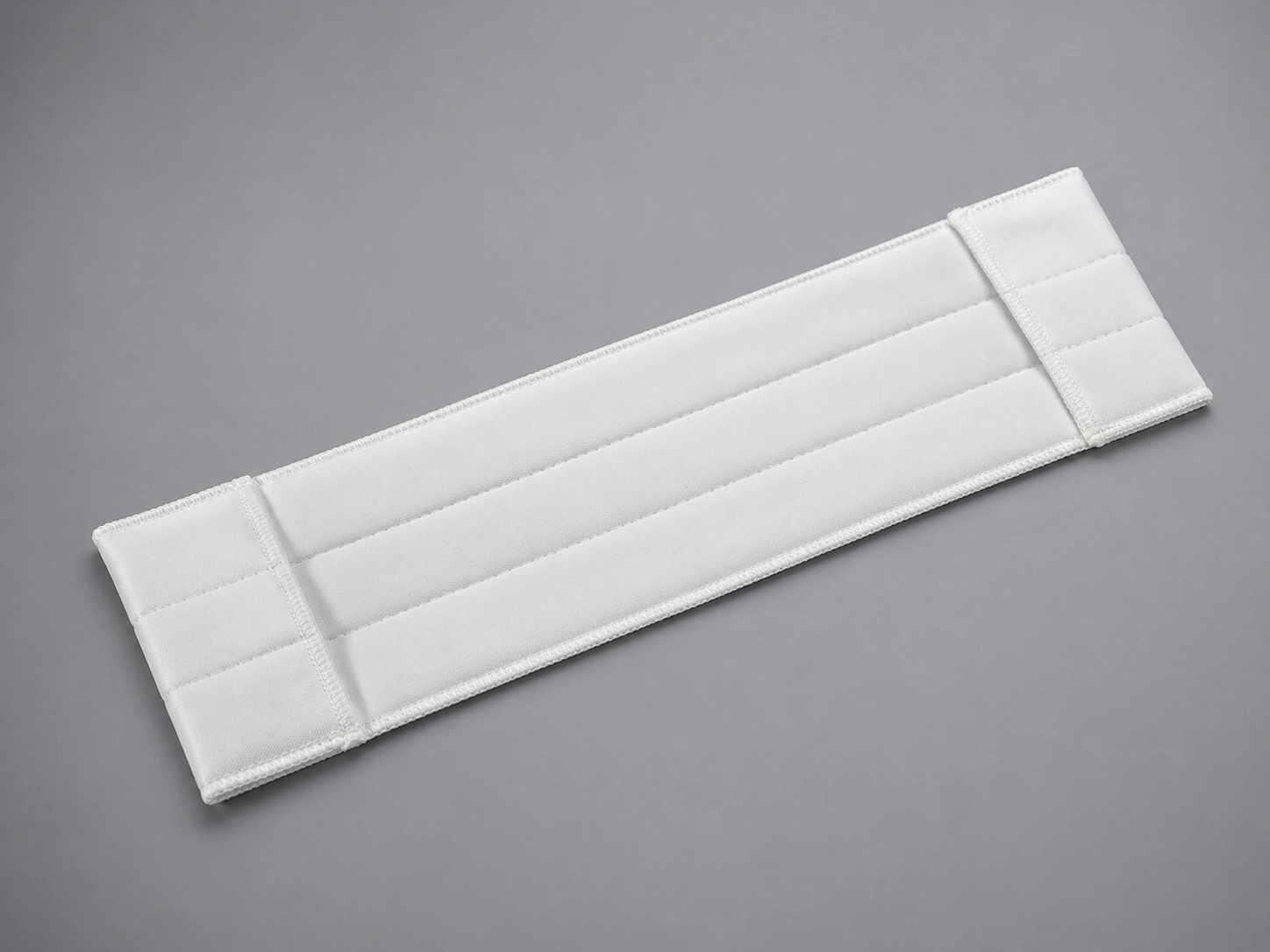
クリーンルームの壁と天井の清掃が必要 さまざまなツール、テクニック、シーケンス 床掃除よりも。壁にフロアモップを使用すると、相互汚染のリスクが生じます。重力によって天井や壁の粒子が作業面や製品接触ゾーンに引き下げられます。正しいアプローチでは次のように使用します。 軽量40gモップヘッド の上 多関節フレーム と 伸縮式ハンドル, following a top-down sequence (ceiling to walls to floors) with designated wall/ceiling tools segregated from floor tools. Overhead cleaning with standard 65g floor mops causes operator fatigue, incomplete coverage, and dripping contamination risks — all of which threaten GMP compliance and audit readiness.
どのクリーンルームでも、最も見落とされている汚染ベクトルは床ではなく、作業面の上の天井と壁です。頭上および垂直面に沈着した粒子は、重力によって下方に落下します。充填ライン、層流フード、またはオープン製品ゾーンの上の天井パネルと壁面が定期的に清掃されていない場合、それらは重要な表面に滝のように落ちる微粒子汚染の溜まり場となります。
これは理論的なものではありません。 GMP 医薬品施設では、環境モニタリング データにより、天井に取り付けられた HEPA フィルター ハウジング、照明器具、天井パネルの接合部が粒子蓄積ゾーンとして特定されることがよくあります。人の移動や HVAC の循環によりこれらの粒子が除去されると、製品の流れに混入する可能性があります。オペレーターの高さの壁面にも、スプレーや充填作業で発生したエアロゾル化した残留物が蓄積します。この残留物はフロアモップでは到達できず、対処することは期待できません。
最も一般的な操作上の近道、そして最も一般的な監査結果の 1 つは、床と壁に同じモップ ツールを使用することです。フロアモップのヘッドは、すすいだ後でも、クリーンルーム内で最もリスクの高い表面である床から微生物や粒子の残留物を運びます。同じモップヘッドを壁の高さまたは天井の高さまで上げると、床レベルの汚染が上方に移動します。
構造化された中で クリーンルームモップシステム、壁と天井の掃除には、色分けされているか、相互使用を防ぐために明確にラベルが付けられた、指定されたツールセット(別個のモップヘッド、別個のフレーム、理想的には別個のハンドル)が必要です。あ 壁掃除専用モップ オプションのアップグレードではありません。それは汚染管理の要件です。
クリーンルームの床清掃の頻度は十分に確立されており、グレードに応じてシフトごと、バッチごと、または毎日行われることがよくあります。壁や天井の清掃頻度は低くなりますが、この頻度が低いと別のリスクが生じます。壁や天井の清掃頻度が低いと、蓄積される粒子負荷が高くなり、正しく管理されないと清掃自体がより重大な汚染リスクになります。
GMP 環境における壁と天井の清掃は通常、イベント駆動型です。つまり、より長い間隔 (毎週、毎月、またはキャンペーン間) でスケジュールされますが、イベントごとに高い徹底性が期待されます。清掃ツールは、オペレーターが頭上の位置で費やす時間を最小限に抑えながら、広い表面積を効率的にカバーできなければなりません。
最初に天井、次に壁、最後に床というトップダウンの掃除順序は好みではありません。それは汚染管理の原則です。天井の掃除中に取り除かれた粒子は壁に落ちます。壁の掃除で出た粒子は床に落ちます。床は取り除かれたすべての汚れが最終的に集まる場所であるため、床は最後に掃除されます。
天井パネル、HEPAフィルターハウジング、照明器具、頭上のユーティリティ配管を清掃します。必要な天井の高さに設定された伸縮式ハンドルを備えた完全関節フレーム上の軽量 40g モップヘッドを使用します。
壁面を上から下まで掃除します。到達可能な最高点から開始し、垂直または水平のストロークを重ねながら下方向に作業を進めます。専用のウォールモップヘッドを使用してください。同じヘッドを天井や床に使用しないでください。
床をきれいにするには、床専用のモップヘッドを使用すると長持ちします。通常、床の被覆効率を高めるためにより重い (55g または 65g) ヘッドが使用されます。この時点までに、天井や壁の掃除から出た粒子はすべて床表面に沈着しています。
トップダウンのシーケンスでは、部屋から部屋、またはゾーンからゾーンの順序も重要です。最高グレードのエリア (グレード A / ISO 5 クリティカル ゾーン) が最初に洗浄されます。低グレードエリア(グレードC、グレードD)はその後清掃されます。これにより、人の移動や機器の移動によって低グレードのエリアから高グレードのエリアに汚染が持ち込まれることが防止されます。
実際には、これは、清掃チームが無菌充填室 (グレード A/B バックグラウンド) から開始し、すべての天井、壁、床の清掃を完了し、次にグレード C のサポート廊下を通って外側に移動し、最後にグレード D の材料エアロックを通過することを意味します。分離を維持するには、モップのヘッド、フレーム、ハンドルをゾーン間で交換する必要があります。
ベストプラクティスの壁と天井の清掃プログラムでは、表面の種類ごとに専用のモップヘッドが割り当てられます。少なくとも、天井ツール、壁ツール、床ツールの 3 つのカテゴリを維持する必要があります。この分離は、色分けされたモップヘッド、明確にラベル付けされたハンドル、またはカテゴリーごとに個別の保管場所によって管理できます。分離されたツールへの投資は、監査観察や製品汚染イベントのコストに比べれば少額です。
モップヘッドの重量は、壁や天井の掃除に最も影響を与える仕様であり、オーバーヘッド用途では 40g が推奨される開始点です。この理論的根拠は、次の 3 つの実際的な現実に基づいています。
モップを天井部分ごとに 10 ~ 20 分間頭上に保持すると、肩、腕、背中に大きな負担がかかります。 40g のモップヘッドとフレームおよびハンドルにより、65g 相当のものよりも蓄積疲労が著しく少なくなります。疲労したオペレーターは、一貫性のない圧力をかけたり、エリアを見逃したり、モップのハンドルやフレームとの偶発的な表面接触のリスクを高めます。
肩の高さより高い位置で作業する場合、ツールが軽いため、清掃面全体にわたってより安定したストローク圧力が生成されます。重いモップヘッドはストロークの遠端でたわむ傾向があり、不均一な接触が生じ、清掃されていないまたは部分的に清掃された表面に縞模様が残ります。これは、清掃後の UV 検査で確認できるパターンです。
40g のモップヘッドに保持できる洗浄液や消毒液は、重いモップヘッドよりも少なくなります。これは頭上作業にとって利点であり、オペレータへの滴下が少なく、壁を伝って洗浄済みの表面に溶液が流れ落ちることが少なく、溶液の保持が本質的に制限されている垂直面での消毒剤の接触時間をより適切に制御できます。
A 55g mop head can be effective for large, flat wall surfaces — particularly in Grade C or D areas where wall surface area is extensive and contamination risk is lower than in aseptic zones. The additional weight provides more solution capacity for large continuous wall sections, reducing the number of solution re-wetting cycles. However, for any overhead ceiling work or walls above shoulder height, 40g remains the preferred specification.
For a detailed comparison of mop head weight options across all cleanroom applications, refer to the mop head weight selection guide.
| Mop Head Weight | Recommended For | Not Recommended For |
|---|---|---|
| 40g | Ceilings, overhead surfaces, walls above shoulder height, Grade A/B areas | Large floor areas where coverage speed matters |
| 55g | Large flat walls in Grade C/D areas, below-shoulder-height walls | Ceilings, overhead cleaning in Grade A/B |
| 65g | Floor cleaning only | All wall and ceiling applications (excessive weight causes fatigue, dripping, and poor coverage consistency) |
Material choice for wall and ceiling mop heads involves different trade-offs than floor applications. Two factors become more important for overhead and vertical cleaning than for floors: lint generation and solution retention on vertical surfaces.
| 材料 | Lint Risk (Overhead) | Vertical Solution Retention | ベストユース |
|---|---|---|---|
| Polyester Knit (Multi-layer) | Low — continuous filament structure minimizes fiber breakage and shedding | Good — knit structure holds solution evenly across pad surface | グレード A/B の天井および壁、糸くずの発生を最小限に抑える必要があるエリア。壁/天井用途に主に推奨されます。 |
| マイクロファイバー | 中程度 - 頭上の摩擦中に分割繊維がマイクロフィラメントを放出する可能性がある | 優れた — 表面積が大きいため、より多くの溶液が保持されます。 | グレード C/D の壁洗浄では、溶液と表面の接触時間が優先され、糸くずはそれほど重要ではありません。グレード A/B の天井清掃には推奨されません。 |
モップヘッドを頭上で使用すると、モップヘッドから落ちた繊維や粒子は真下に落ち、開いた製品ゾーン、機器の表面、または層流の気流経路に落ちる可能性があります。糸くずの少ないポリエステル ニット モップ ヘッドは、グレード A、B、および ISO 5/7 環境での天井または頭上壁の清掃に強く推奨されます。
壁および天井のモップ ヘッドの無菌要件は、フロア モップ ヘッドと同じグレードのロジックに従いますが、追加の考慮事項があります。グレード A/B ゾーンの壁と天井は、生産中にほとんど洗浄されません。洗浄ツールを洗浄するとき (通常はキャンペーン間、シャットダウン中、または定期メンテナンス期間中)、洗浄ツールの無菌状態がゾーンの要件と一致している必要があります。
| クリーンルームグレード | 無菌要件 | モップヘッドの推奨事項 |
|---|---|---|
| グレードA / ISO 5 | 無菌(ガンマ線照射または同等の検証済み滅菌) | 40g 滅菌ポリエステルニット、個別包装、洗浄イベントごとに使い捨て |
| グレードB / ISO 7 | 無菌、または文書化されたバイオバーデン管理を備えた検証済みの非無菌 | 40g の滅菌ポリエステルニットが好ましい。オートクレーブ滅菌済みの再利用可能なヘッドは、施設の SOP によっては許容される場合があります |
| グレード C / ISO 8 | 非滅菌は許容されます。検証済みの洗浄プロセスが必要 | 40g または 55g の非滅菌ポリエステルニット、施設プロトコルが許可する場合、検証済みの洗濯で再利用可能 |
| グレード D / ISO 8 | 非滅菌も可 | 55gの非滅菌ポリエステルニットまたはマイクロファイバー、洗濯で再利用可能 |
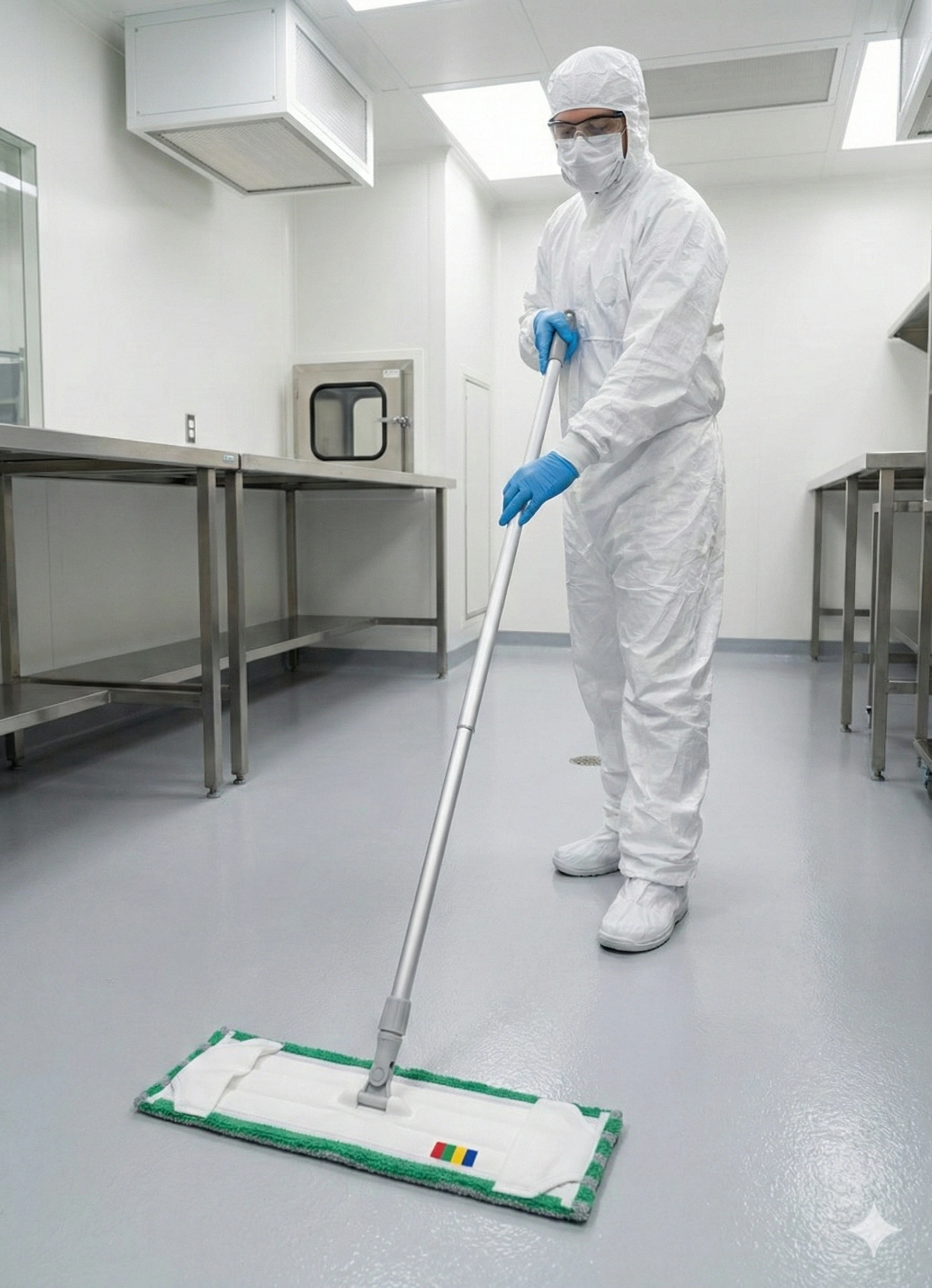
床のモップ掛けでは、フレーム関節が便利です。壁や天井のモップ掛けには必需品です。表面の角度に合わせて関節を動かすことができないフレームは、角、端、天井と壁の接合部、つまり粒子が最も多く蓄積するまさにその部分が掃除されていないままになります。
壁と天井の清掃には 3 つのフレーム タイプが関係しており、間違ったタイプを選択すると、清掃効果に目に見える影響が生じます。
| フレームタイプ | アーティキュレーション | 壁/天井の適合性 | 制限 |
|---|---|---|---|
| 固定フレーム | なし - ハンドルに対する厳密な 90 度の角度 | 壁や天井には弱いです。完全な接触を維持できるのは、オペレーターの目の前にある完全に平らでアクセス可能な表面上のみです。 | オペレーターが離れている場合、壁面に合わせて角度を付けることができません。天井と壁の接合部に三角形の未掃除ゾーンが残ります。 |
| スイベルフレーム | 単一軸(水平面)上で回転します | 壁に適しています。スイベルにより、モップヘッドがオペレーターの左右のアームの動きに追従し、さまざまな作業角度でより良好な接触を維持できます。 | 垂直面内で傾斜しないため、天井から壁への移行能力が制限されます。 |
| ヒンジ付き/多関節フレーム | 多軸関節 - チルトとスイベル | 壁や天井に最適です。 ヒンジ付きフレームにより、モップヘッドを傾けて天井接合部まで垂直な壁の角度に合わせることができ、天井パネルに合わせて平らにすることもできます。オペレーターの位置に関係なく、全面接触を実現します。 | 通常、オーバーヘッドで使用する場合はフレーム重量が軽いことが望ましいため、アルミニウムまたは軽量のステンレス鋼構造を選択してください。 |
天井の清掃には、最も厳しい調音要件が求められます。モップヘッドは天井パネルに平らに押し付け、天井と壁の隅に角度を付けて、天井に取り付けられた障害物 (HEPA ハウジング、照明器具、スプリンクラー ヘッド、ケーブル トレイ) の周囲に届く必要があります。ヒンジ接続ポイントを備えた関節式フレームにより、オペレーターはハンドルを快適な作業角度 (通常は垂直から 30 ~ 45 度) に保ちながら、モップ ヘッドを天井面に接触させ続けることができます。
これは人間工学的に重要な考慮事項です。関節運動がなければ、オペレーターは洗浄する天井部分の真下に立ち、ハンドルをほぼ垂直に保持する必要があります。この姿勢では、肩の疲労が急速に生じ、溶液がオペレーターのフェイスシールドやガウンに直接滴下するため安全上のリスクが生じます。
Standard cleanroom mop frames are 40 cm in width — optimized for floor coverage efficiency. For wall and ceiling applications, especially in areas with equipment against walls, narrow wall returns, or ceiling sections interrupted by service panels, a narrower frame (30 cm or less) provides better access to confined spaces. The trade-off is coverage rate per stroke, which is an acceptable compromise when the alternative is incomplete access.
For a complete technical breakdown of frame types and materials, see the クリーンルームモップのフレームタイプ guide. The importance of selecting the right frame as part of a full system is discussed in cleanroom mop system integration.

クリーンルームの天井の高さは、標準施設では約 2.4 m (8 フィート) から、上げ天井プレナムを備えた一部の生産スイートでは 3.5 m (12 フィート) 以上までさまざまです。固定長ハンドルは、複数の部屋がある施設のすべての天井の高さに対応できるわけではありません。ロック可能な拡張セクションを備えた伸縮式ハンドルにより、単一のハンドルを各部屋の正確な天井の高さに合わせて調整できるため、複数の固定長ハンドルを使用したり、最悪の場合、オペレーターが無菌環境で踏み台やはしごを即席で使用したりする必要がなくなります。
The telescoping mechanism should lock securely at intermediate positions and be operable with gloved hands. Quick-twist or push-button locking mechanisms are preferred over threaded collars, which are difficult to operate with cleanroom gloves and prone to insufficient tightening.
Handle material choice has an outsized impact on overhead cleaning ergonomics. An aluminum handle weighs approximately one-third of a stainless steel handle of equivalent length. When extended to 2.5-3.0 m and held overhead, this weight differential translates directly into operator endurance and coverage quality.
| ハンドル材質 | Typical Weight (2m length) | Overhead Suitability | Best Application |
|---|---|---|---|
| Aluminum | ~0.4 – 0.6 kg | Excellent — lightest option, minimal operator fatigue during extended overhead sessions | All ceiling cleaning, wall cleaning above shoulder height. Preferred choice for dedicated wall/ceiling handles. |
| ステンレス鋼 | ~1.2 – 1.8 kg | Poor for overhead — weight becomes significant when extended and held above shoulders for more than 5-10 minutes | Floor mopping only. Not recommended for ceiling or extended overhead wall cleaning. |
| Composite / Reinforced Polymer | ~0.3 – 0.5 kg | Good — very lightweight, but may lack rigidity at full extension for ceiling work | Lower-height walls, Grade C/D areas. Check autoclave compatibility if sterilization of handle is required. |
For a comprehensive guide to handle types, materials, and attachment systems, see the クリーンルームモップハンドルの選択 ページ。
During wall and ceiling cleaning, mop heads are changed frequently — between ceiling and wall sections, between rooms, and between zones. A quick-connect system between handle and frame allows head changes without the operator fumbling with threaded connections while wearing double gloves in a Grade B environment. Push-button or snap-lock connections are preferred for cleanroom use. The connection must be secure enough that the mop head does not detach during vigorous overhead strokes, but easy enough that changes do not slow the cleaning sequence or introduce operator error.
The standard floor mopping pattern — systematic overlapping strokes with approximately 25% overlap — applies to walls and ceilings with one modification: the stroke direction on walls should be vertical (top-to-bottom) rather than horizontal, to work with gravity rather than against it. On ceilings, strokes should follow a systematic grid pattern, with each pass overlapping the previous by 25% to ensure complete coverage of the ceiling panel or section.
A common operational failure pattern occurs at section boundaries: the operator finishes one ceiling panel or wall section, moves to the adjacent section, and leaves a thin uncleaned strip at the boundary. A deliberate 5 cm overlap into the previously cleaned section prevents this gap.
Over-wetting a mop head before overhead use is one of the most frequent causes of cleaning-related contamination. Excess solution drips onto the operator, onto already-cleaned surfaces below, and onto equipment. The mop head should be dampened — not saturated — before ceiling use. A practical standard: after wetting, the mop head should be pressed or wrung to the point where no free liquid drips when held vertically for 5 seconds.
For disinfectant application on vertical surfaces, the challenge is contact time. Disinfectant applied to a vertical wall surface runs downward under gravity faster than on a horizontal floor. Operators should be trained to apply solution in controlled amounts and to re-apply if necessary rather than over-wetting in a single pass. The cleaning SOP should specify the target disinfectant contact time and confirm that vertical surface application achieves it.
Mop head change frequency during wall and ceiling cleaning should be specified in the cleaning SOP — not left to operator discretion. As a practical guideline:
The following table provides a grade-by-grade reference for wall and ceiling cleaning specifications in GMP cleanrooms. These are industry-practice recommendations aligned with GMP expectations for contamination control; specific facility SOPs and validated cleaning protocols take precedence. For a complete grade-by-grade selection framework across all mop system components, see the GMP mop grade selection guide.
| GMPグレード | ISO相当 | Wall Cleaning Frequency | Ceiling Cleaning Frequency | Recommended Mop Head | 無菌性 | ドキュメントレベル |
|---|---|---|---|---|---|---|
| 甲種 | ISO5 | Per campaign / between batches (minimum); daily wipe-down of critical surfaces within arm’s reach of filling zone | Per campaign / between batches; all ceiling panels, HEPA faces, and overhead utilities | 40g sterile polyester knit | Sterile (gamma-irradiated), single-use | Full batch record entry: date, time, operator, mop lot number, disinfectant lot number, contact time, any observations |
| グレードB | ISO7 | Weekly (routine); more frequent during campaign operations if risk assessment indicates | Monthly or per campaign (whichever is more frequent) | 40g sterile polyester knit | Sterile preferred; validated non-sterile with bioburden monitoring may be acceptable per facility SOP | Cleaning log entry: date, operator, area, mop head type, disinfectant used |
| グレードC | ISO8 | Weekly; twice weekly in high-traffic corridors or material transfer zones | Monthly or quarterly per facility risk assessment | 40g or 55g non-sterile polyester knit | Non-sterile; reusable with validated laundering | Cleaning log / checklist completion; periodic QA review |
| グレードD | ISO8 | 毎週 | Quarterly or as required by cleaning schedule | 55g non-sterile polyester knit or microfiber | Non-sterile; reusable with laundering | Checklist sign-off; trend review during periodic quality review |
The frequencies above represent industry-practice baselines. Actual frequencies should be determined by facility risk assessment, environmental monitoring trend data, and validated cleaning protocols. Facilities with historical EM excursions on ceiling or wall surfaces should increase frequency accordingly. Any change to cleaning frequency should be managed through change control and reflected in updated SOPs.
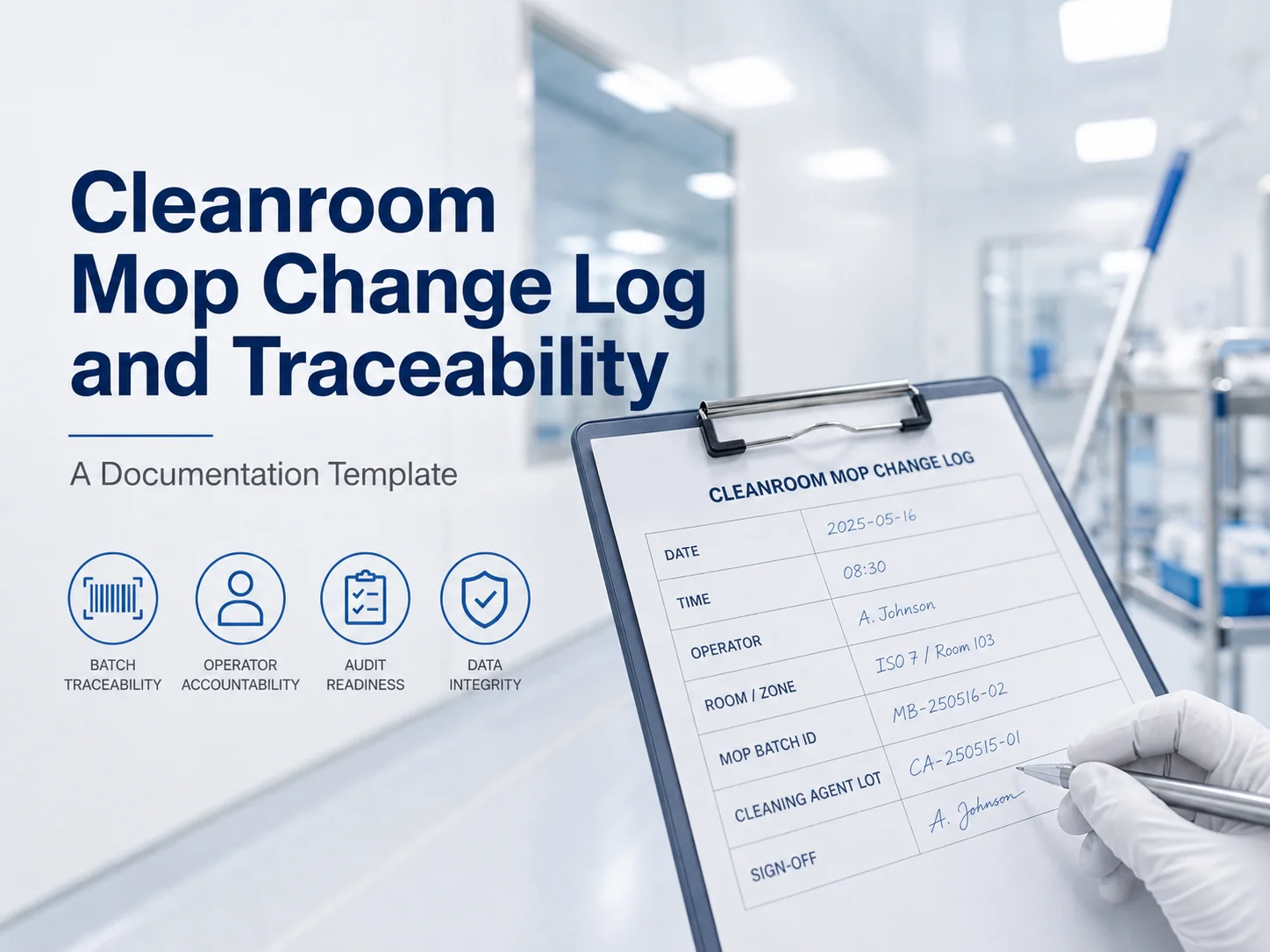
Wall and ceiling cleaning documentation is often less detailed than floor cleaning documentation — and this is precisely what auditors look for. A GMP auditor reviewing cleaning records will check whether wall and ceiling cleaning events are documented with the same rigor as floor cleaning. At minimum, a wall/ceiling cleaning log should capture:
In a GMP audit, the question is not just “did you clean the walls and ceilings?” but “can you prove it?” Two documentation practices strengthen audit readiness:
First, cleaning log traceability to the batch record. For Grade A and B areas, wall and ceiling cleaning events between production campaigns should be referenced in the relevant batch records or campaign documentation. If a batch was produced in a Grade A zone and the previous ceiling cleaning was documented three weeks earlier in a standalone log, the auditor will ask whether that cleaning event was reviewed as part of batch release.
Second, periodic review of wall and ceiling cleaning completeness. Quarterly or semi-annual QA review of cleaning logs should specifically assess whether all scheduled wall and ceiling cleaning events were completed, whether any were deferred or missed, and whether any trends in observations (visible residue, staining, particulate accumulation) indicate a need to increase frequency.
Facilities using a GMP施設用クリーンルームモップ applications should maintain supplier documentation — Certificates of Analysis, Certificates of Sterility, and material specifications — for wall and ceiling mop heads alongside the equivalent documents for floor mop heads. The tool is different; the documentation standard should be the same.
Changing the mop head addresses one cross-contamination vector but does not fully mitigate the risk. The mop frame and handle can carry residues from floor contact (splashed liquids, aerosolized particles from floor cleaning). Best practice is to maintain separate, labeled or color-coded frames and handles for wall/ceiling cleaning. At minimum, if the same handle and frame must be used, they should be thoroughly disinfected between floor and wall applications and the cleaning procedure should specify this step explicitly.
A 40g mop head is the preferred starting point for all overhead ceiling cleaning and for walls above shoulder height in Grade A/B areas. It minimizes operator fatigue, provides better drip control, and delivers more consistent coverage at height. A 55g head can be appropriate for large, below-shoulder-height wall surfaces in Grade C/D areas where solution capacity and coverage speed are priorities. In all cases, the mop head should be dedicated to wall/ceiling use and not shared with floor cleaning operations.
The correct order is ceiling first, then walls, then floors. This top-down sequence ensures that particles dislodged from higher surfaces are collected during the cleaning of lower surfaces. Cleaning floors before walls or ceilings would leave freshly cleaned floor surfaces exposed to falling contamination from above. In multi-room cleaning, the sequence should also progress from highest-grade areas (Grade A/B) to lower-grade areas (Grade C/D) to avoid transporting contamination inward.
No. Non-sterile mop heads are generally acceptable for Grade C (ISO 8) wall and ceiling cleaning, provided a validated cleaning process is in place and environmental monitoring data supports the use of non-sterile cleaning tools. Reusable polyester knit or microfiber mop heads with documented laundering procedures are commonly used. Sterile mop heads are required for Grade A/B zones and should be considered for any area where environmental monitoring data indicates a trend toward action limits.
Frequency depends on cleanroom grade. Grade A (ISO 5) walls and ceilings are typically cleaned between production campaigns or batches — this may mean daily for continuously operating facilities. Grade B (ISO 7) wall cleaning is typically weekly, with ceiling cleaning monthly or per campaign. Grade C/D (ISO 8) walls are cleaned weekly to monthly, and ceilings quarterly or as scheduled. These are industry-practice baselines; actual frequency should be determined by facility risk assessment, environmental monitoring trend data, and validated cleaning protocols.
An articulated (hinged) frame is the best choice for ceiling cleaning. It allows the mop head to tilt and swivel independently of the handle angle, maintaining flat contact with ceiling panels while the operator holds the handle at a comfortable working angle. A fixed frame forces the operator to stand directly under the cleaning zone with the handle nearly vertical — a position that causes rapid fatigue, poor coverage, and safety concerns from dripping solution. For ceiling cleaning, combine an articulated aluminum frame (for weight reduction) with a telescoping handle adjusted to the exact ceiling height.
Auditors expect wall and ceiling cleaning to be documented with the same rigor as floor cleaning. Key documentation includes: a cleaning log with date, time, room/zone, surfaces cleaned, mop head type and lot number, disinfectant used with lot number and contact time, operator identification and signature, and QA review. For Grade A/B areas, cleaning events between campaigns should be referenced in batch records or reviewed as part of batch release. Periodic QA review of cleaning completeness and any trends in observations or deviations should also be documented.
Microfiber mop heads are generally not recommended for ceiling cleaning in Grade B (ISO 7) areas. The primary concern is lint and particle generation: microfiber’s split-fiber structure can release microfilaments during overhead friction, and these particles fall directly downward into the working zone. Polyester knit mop heads with continuous filament construction generate fewer particles and are recommended for overhead use in Grade A/B environments. For Grade C/D wall cleaning where lint risk is less critical, microfiber can offer excellent solution retention and cleaning performance on vertical surfaces.
MIDPOSI’s white cleanroom mop series includes 40g and 55g mop heads, articulated aluminum frames, and telescoping handles — a complete system designed for controlled vertical and overhead cleaning in GMP environments. Available in sterile and non-sterile configurations to match your cleanroom grade requirements.
Built for structured cleanroom cleaning programs in pharmaceutical, biotech, and medical device facilities.