マイクロファイバーとポリエステルのクリーンルームモップ — 製薬施設にはどちらが適していますか?

製薬の QA マネージャーがクリーンルーム モップの仕様を作成するとき、最初に決定するのは多くの場合、素材 (マイクロファイバーかポリエステルか) になります。マーケティングの主張は逆の方向に引っ張られています。マイクロファイバーのベンダーは優れた吸収性と粒子の捕捉性を強調し、ポリエステルのサプライヤーは糸くずの発生が少なく、オートクレーブの寿命が長いことを指摘しています。 ISO 14644-1 および EU GMP Annex 1 に基づいて運営されている施設の場合、この選択は好みの問題ではありません。これは、文書化された汚染管理に関する決定であり、洗浄プログラムが ISO 分類を維持し、環境モニタリングに合格し、規制の調査に耐えられるかどうかを決定します。

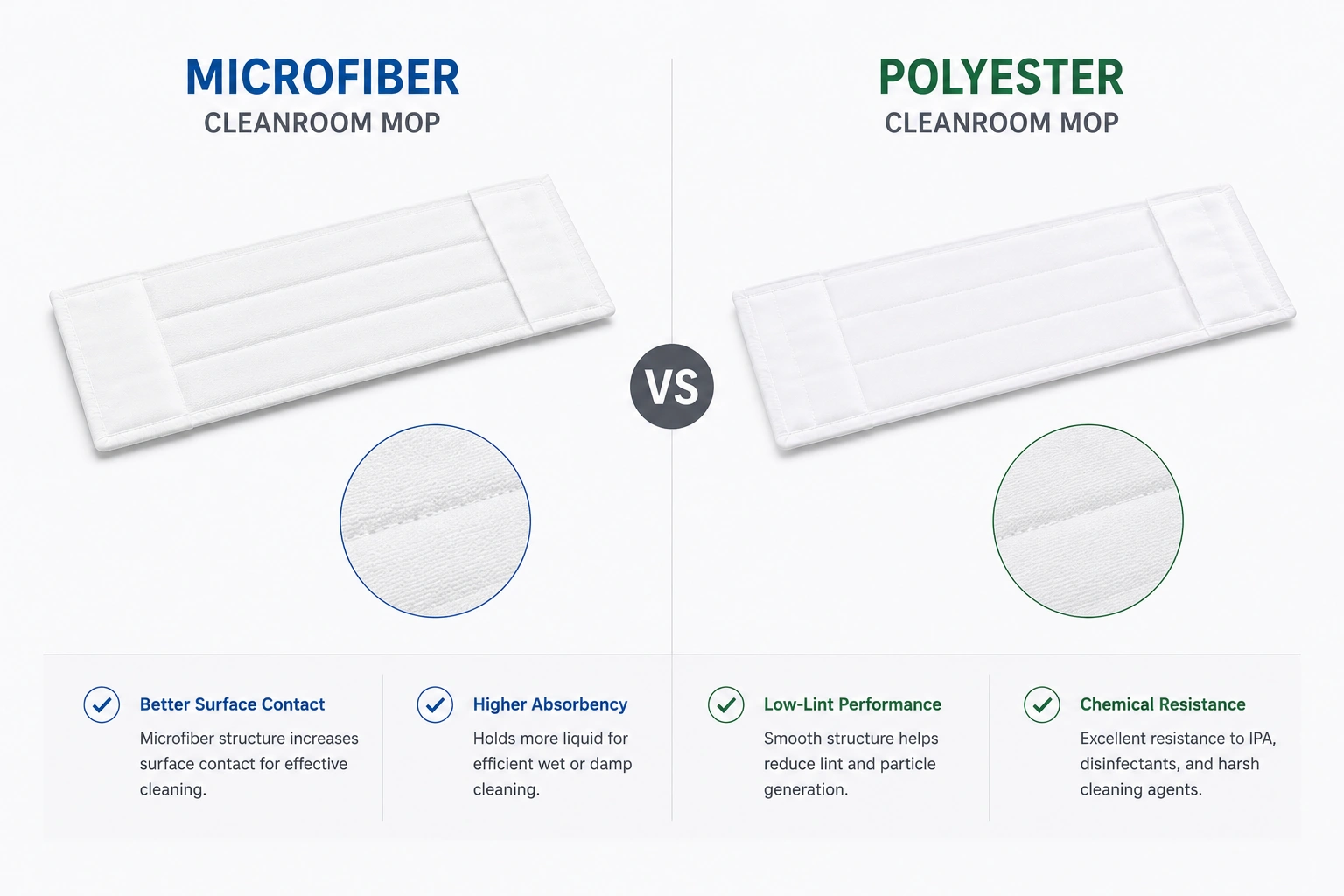
The truth: neither material is universally “better.” Each has optimal use cases determined by fiber architecture, area classification, disinfectant chemistry, and operational priorities. Microfiber’s split-fiber construction delivers 6–8× absorbency and enhanced particle capture—ideal for spill management and large-area mopping in ISO 7–8 zones. Polyester’s continuous-filament design eliminates cut ends and maintains particle generation below 50 particles per stroke across 150–200 autoclave cycles—essential for ISO 5–6 aseptic support areas and aggressive disinfectant rotation programs. Choosing the wrong material for your application introduces contamination risk, shortens mop life, and complicates validation.

このガイドでは、マイクロファイバーとポリエステルのクリーンルーム モップを、繊維構造とエッジ構造の 5 つの側面で比較します。吸収性、耐久性、粒子制御性能。製薬施設の選択基準。 ISO グレード決定フレームワーク。 MIDPOSI 製品の推奨事項。最終的には、粒子生成データ、化学的適合性の検証、および実際の医薬品展開に裏付けられた、材料とクリーンルームの分類、運用ワークフロー、および予算の制約を一致させる明確な意思決定マトリックスが得られるでしょう。

Microfiber vs Polyester — Cleanroom Structural Differences

The performance gap between microfiber and polyester cleanroom mops begins at the fiber level. Understanding how each material is engineered—from filament diameter to edge sealing method—explains why they behave differently under pharmaceutical cleanroom conditions.

Fiber Architecture Overview

Microfiber: Split-Fiber, High Surface Area

マイクロファイバーモップヘッドは、人間の髪の毛の約10分の1の太さである1デニール(直径約10マイクロメートル)未満の極細合成繊維で作られています。ほとんどの医薬品グレードのクリーンルーム用マイクロファイバーは、分割繊維断面で設計された 80/20 ポリエステル/ポリアミド (ナイロン) ブレンドを使用しています。製造中、ポリエステルとポリアミドのポリマーは共押出され、機械的または化学的に分割されて、縦方向に複数の溝がある星形またはくさび形の繊維プロファイルが作成されます。

この分割ファイバー形状は 2 つの機能を果たします。まず、生地 1 グラムあたりの表面積が劇的に増加します。各繊維には表面張力によって液体を逃がす複数の毛細管チャネルがあり、乾燥重量で 6 ~ 8 倍の吸収性を実現します。第 2 に、溝が粒子の機械的なトラップを作り出します。モップ掛け中にサブミクロンの汚染物質がチャネル内に滞留し、滑らかなモノフィラメント繊維と比較して粒子のピックアップ効率が向上します。これは、製薬施設にとって、マイクロファイバーが残留粒子の除去と、一度の通過で大量の消毒液の吸収に優れていることを意味します。

Split-fiber architecture introduces a structural trade-off. The grooves and thin fiber diameter make microfiber more vulnerable to mechanical abrasion and chemical degradation. Repeated autoclaving (steam at 121°C) and exposure to oxidizing disinfectants (hydrogen peroxide, sodium hypochlorite) can cause fiber splitting to progress into fiber breakage, increasing particle shedding over time. Microfiber mops typically qualify for 50–100 autoclave cycles—shorter than polyester, but sufficient for facilities with validated single-use or medium-cycle-life protocols.

Polyester: Continuous Filament, Low Particle Release

Polyester cleanroom mops use continuous-filament 100% polyester yarns—long, unbroken strands knitted into a tight fabric structure with no cut fiber ends. Unlike spun yarns (which twist short fibers together, creating weak points where fibers can pull out), continuous filament eliminates internal discontinuities. Each yarn runs the full length of the mop pad, and the knit structure distributes mechanical stress across the entire fabric.

This construction delivers inherent low-lint performance. With no cut ends to fray and no short fibers to break loose, continuous-filament polyester generates particle counts well below ISO Class 5 limits (<エッジが適切にシールされている場合、1 ストロークあたり 0.5 µm 以上の粒子 10 個)。ポリエステル フィラメントの滑らかで丸い断面は、粒子の捕捉にも耐性があります。吸収性はマイクロファイバーよりも低くなります (通常、乾燥重量の 3 ~ 4 倍)。しかし、材料の化学的不活性性と熱安定性により、寸法変化や性能低下を最小限に抑えながら 150 ~ 200 回以上のオートクレーブ サイクルが可能です。

のために 糸くずの少ないクリーンルーム用モップ連続フィラメント ポリエステルは、ISO クラス 5 ~ 7 の無菌サポート分野の業界標準であり、粒子発生制限が厳しく、長い耐用年数が総所有コストを削減します。ファイバー構造は、70% IPA、3 ~ 35% の過酸化水素、第 4 級アンモニウム化合物 (2,000 ppm)、および最大 1% までの次亜塩素酸ナトリウムなどの強力な消毒剤のローテーションにも、重大なファイバーの損傷や色の損失なしに耐えられます。

繊維の形状が糸くず、洗浄挙動、滅菌安定性を決定する理由

スプリットファイバーマイクロファイバーと連続フィラメントポリエステルの構造上の違いは、あらゆるパフォーマンス指標に反映されます。

  • 糸くず:マイクロファイバーの細い分割繊維は応力を受けると壊れ、繊維粒子が放出されます。連続フィラメント ポリエステルの太い切れ目のない糸は破損しにくく、数百回のサイクルにわたって粒子の発生が少ない状態を維持します。
  • 吸収性: Microfiber’s capillary channels wick liquid aggressively; polyester’s smooth surface absorbs more slowly but releases disinfectant more predictably during mopping.
  • 耐久性: Microfiber degrades faster under oxidizers and heat; polyester maintains dimensional stability and mechanical strength across extended autoclave and chemical exposure.
  • Particle capture: Microfiber traps particles in fiber grooves; polyester relies on knit density and does not capture particles as efficiently, but also does not release captured contaminants as easily during subsequent mopping.

These trade-offs mean material selection cannot be made on absorbency alone. A microfiber mop that absorbs 8× its weight may shed 200 particles per stroke in an ISO Class 6 area, pushing the environment out of classification. A polyester mop that absorbs only 3× its weight but generates <20 particles per stroke maintains compliance and lasts three times as many cycles.

cleanroom microfiber vs polyester fiber structure

Edge Construction Differences

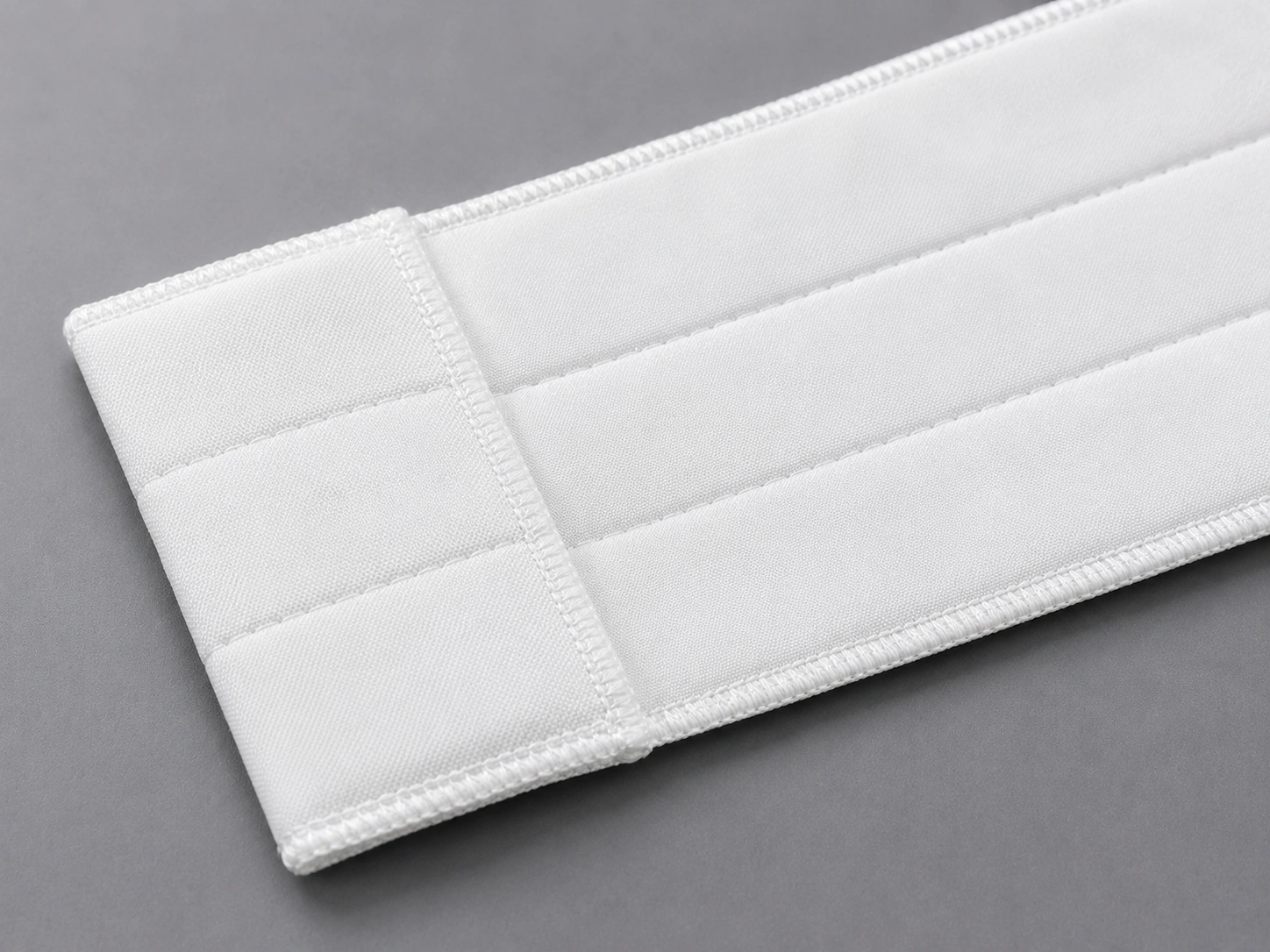
Edge construction is the single most critical factor determining whether a mop qualifies as “low lint” for pharmaceutical use. Even high-quality fiber material becomes a particle source if edges are left unsealed.

Microfiber: Higher Lint Risk Due to Split Ends

Microfiber’s split-fiber architecture makes edge sealing especially important. If edges are simply cut and left unsealed, the thin filaments unravel rapidly—each mopping pass pulls fibers loose, and the split structure accelerates breakage. A cut-edge microfiber mop can shed 500–1,000 particles per stroke, disqualifying it from any ISO-classified environment.

Pharmaceutical-grade microfiber mops address this through sealed-edge construction:

  • Laser cutting: Simultaneous cutting and heat-sealing in a single pass, using focused laser energy to melt fiber ends and fuse them into a solid border. This method delivers the cleanest edge and is preferred for ISO Class 5–6 microfiber applications.
  • Ultrasonic sealing: High-frequency vibration generates heat at the fabric edge, welding fibers together without introducing adhesives or foreign materials. Suitable for ISO Class 6–8 applications.
  • Heat sealing: Thermal welding using heated tools to melt and bond fiber ends. Effective but may leave a thicker, stiffer edge compared to laser or ultrasonic methods.

Even with sealed edges, microfiber’s thin fiber diameter means sealed borders are less robust than polyester equivalents. Edges can separate after 30–50 autoclave cycles if the mop is subjected to aggressive wringing or abrasion, requiring earlier replacement to prevent particle excursions.

Polyester: Heat-Sealed, Ultrasonic Sealed, Continuous Perimeter Construction

Continuous-filament polyester’s thicker yarns create stronger sealed edges that resist separation across 150–200+ cycles. The same edge sealing methods are used—laser cutting, ultrasonic welding, thermal bonding—but the result is a more durable perimeter that tolerates repeated mechanical stress and chemical exposure.

Some polyester mop pads also use continuous perimeter construction, where the knit pattern is designed so yarns loop continuously around all four edges without cut ends. This eliminates edge sealing as a single point of failure, delivering the lowest possible particle generation for Grade A/B aseptic core applications.

Why Sealed Edges Are Mandatory for Pharmaceutical ISO Spaces

ISO 14644-1 では、浮遊粒子濃度によってクリーンルームを分類しています。モップの切断端からは制御されていない粒子源が生じ、環境が仕様の範囲外になる可能性があります。 EU GMP 付属書 1 (パラグラフ 4.10) は、機密区域で使用される材料を粒子の発生を最小限に抑えることを義務付けています。モップの端が密閉されていない、または密閉が不十分である場合は、この要件に違反します。

規制検査中、監査人は清掃用具の認定記録を検査します。 2020年のFDA警告書では、「滅菌室の清掃に使用されるモップヘッドにほつれが観察された」ことと「少なくとも1つのモップヘッドが粒子発生材料で作られている」ことを具体的に引用し、施設が適切な汚染管理を欠いていたと結論づけた。シールエッジ構造は特別な機能ではなく、ISO クラス 5 ~ 8 の領域に入るモップのベースライン GMP 要件です。

6b82fda2 3a7f 48f2 ba06 572b701ec82c

Figure 2: Edge construction determines lint generation for both microfiber and polyester cleanroom mops. Cut edges (left) unravel during use, releasing 500–1,000 particles per stroke and disqualifying mops from ISO-classified environments. Heat-sealed edges (center) use thermal welding to fuse fiber ends, reducing particle generation to <100 particles/stroke—suitable for ISO Class 7–8 areas. Ultrasonic-sealed edges (right) bond fibers through high-frequency vibration without adhesives, achieving <50 particles/stroke for ISO Class 5–7 pharmaceutical applications. Sealed-edge construction is a baseline GMP requirement per EU GMP Annex 1 paragraph 4.10.

Backing & Attachment Variations

How a mop pad attaches to its frame determines ease of use, cross-contamination risk, and compatibility with validated laundering or sterilization protocols.

Hook-and-Loop (Microfiber) vs Pocket/Clip (Polyester Sealed-Edge)

Many commercial microfiber mops use hook-and-loop (Velcro) attachment systems: a plastic or fabric strip sewn onto the mop pad back, mating with corresponding hooks on the mop frame. This design allows quick pad changes and is common in janitorial applications.

For pharmaceutical cleanrooms, hook-and-loop systems introduce two contamination risks:

  1. Particle generation from Velcro hooks: プラスチック製のフックは、繰り返しの取り付け/取り外しサイクルやオートクレーブのストレスにさらされると、微粒子を放出します。 「クリーンルームグレード」のベルクロでも、測定可能な粒子 (通常、取り付けサイクルごとに 50 ~ 100 個の粒子) が生成され、ISO クラス 5 ~ 6 の許容基準を超える可能性があります。
  2. フック構造における粒子の捕捉:前回のモップ掛け作業で発生した糸くず、繊維、バイオバーデンがフックのマトリックスに詰まり、洗濯やオートクレーブ処理中に完全に除去されません。これにより、後続のモップ掛けサイクルで相互汚染を引き起こす隠れた汚染溜まりが形成されます。

その結果、製薬用途のシールエッジポリエステルモップは通常、次のような代替の取り付け方法を使用します。

  • ポケット/袖アタッチメント: The mop frame slides into a sewn pocket along one edge of the mop pad. No Velcro, no adhesives—just continuous-filament fabric throughout. This method is compatible with 200+ autoclave cycles and eliminates hook-related particle generation.
  • Clip attachment: Spring-loaded or magnetic clips on the mop frame grip the mop pad edge. Clips are constructed from stainless steel or autoclave-stable polymers, validated for particle generation and cleanable between uses.

Why Velcro Disqualifies Most Microfiber Pads from ISO Applications

While hook-and-loop attachment is convenient, the particle generation and cross-contamination risks make it unsuitable for ISO Class 5–7 pharmaceutical cleanrooms. Facilities specifying microfiber mops for these areas should require sealed-edge pads with pocket or clip attachment, not Velcro-backed designs.

For ISO Class 8 support areas and non-aseptic zones, where particle limits are more lenient (3,520,000 particles/m³ at ≥0.5 µm), Velcro-backed microfiber may be acceptable if the CCS risk assessment justifies the trade-off between convenience and contamination control. However, best practice remains pocket or clip attachment across all classified areas to maintain system-wide consistency and simplify operator training.

Absorption, Durability & Particle Control Comparison

When procurement teams evaluate cleanroom mop materials, three performance metrics dominate the decision: absorbency (how much disinfectant the mop can hold), particle shedding (whether the mop contaminates the environment), and durability (how many autoclave cycles before replacement). Microfiber and polyester trade off these attributes in opposite directions.

Absorption & Soil Removal Performance

Microfiber = Superior Absorbency (6–8× Dry Weight)

Microfiber’s split-fiber channels create microscopic capillaries that wick liquid through surface tension. A 200-gram dry microfiber mop pad can absorb 1,200–1,600 grams of disinfectant solution—roughly 6–8 times its own weight. This high absorbency translates to practical advantages:

  • Fewer mop changes: A single microfiber pad can clean larger floor areas (200–300 m² in ISO Class 7–8 environments) before requiring re-saturation or replacement.
  • Spill management: Microfiber excels at absorbing and containing liquid spills—critical for facilities handling bulk disinfectants, buffer solutions, or cleaning chemical concentrates.
  • Particle pickup: The fiber grooves mechanically trap particles during mopping, removing residual dust and lint more effectively than smooth-fiber materials.

However, high absorbency is not always an advantage in GMP workflows. Microfiber’s aggressive liquid uptake can make it difficult to control wet film thickness during validated disinfection. If a mop absorbs too much 70% IPA, the residual surface moisture may exceed drying time specifications, delaying room release or creating slip hazards. Operators must learn to pre-saturate microfiber mops to a controlled moisture level—typically wringing to 70–80% saturation before mopping—which adds procedural complexity.

Polyester = Controlled Absorbency, Predictable Disinfectant Release

Pharmaceutical cleaning validation protocols specify contact time, disinfectant concentration, and surface coverage—not “maximum absorbency.” A mop that absorbs 8× its weight but leaves puddles or takes 15 minutes to dry may fail validation even if it removes more soil than a 3× absorbency mop that delivers controlled, compliant application. Procurement decisions should align material absorbency with operational workflow requirements, not assume “more is better.”

  • Uniform wet film thickness: Polyester releases liquid more consistently during mopping, delivering controlled surface coverage that meets validated disinfection protocols (e.g., 10 mL/m² contact time specifications).
  • Faster drying: Less residual moisture on floors reduces drying time and room turnaround, especially important in high-throughput aseptic filling areas where downtime costs are significant.
  • Operator control: Easier to train operators to maintain consistent mopping technique, reducing variability in cleaning validation performance.

For facilities prioritizing compliance and reproducibility over maximum absorbency, polyester’s controlled moisture management is a feature, not a limitation.

Why High Absorbency Is Not Always an Advantage in GMP Cleaning

Pharmaceutical cleaning validation protocols specify contact time, disinfectant concentration, and surface coverage—not “maximum absorbency.” A mop that absorbs 8× its weight but leaves puddles or takes 15 minutes to dry may fail validation even if it removes more soil than a 3× absorbency mop that delivers controlled, compliant application. Procurement decisions should align material absorbency with operational workflow requirements, not assume “more is better.”

粒子脱落 & Linting Behavior

Particle generation is the primary regulatory concern for cleanroom mops. ISO 14644-14 provides the test framework: mops are subjected to simulated-use conditions (mechanical agitation, wet mopping strokes) while optical particle counters measure airborne particle release at ≥0.5 µm and ≥5 µm.

Microfiber Lint Range: 100–500 Particles/m²

Sealed-edge microfiber mops validated for pharmaceutical use typically generate 100–200 particles ≥0.5 µm per square meter mopped when new. After 25–50 autoclave cycles, particle generation increases to 200–500 particles/m² as fiber splitting progresses and sealed edges begin to separate.

This performance envelope makes microfiber acceptable for ISO Class 7–8 environments (352,000 and 3,520,000 particles/m³ limits, respectively) where the mop’s contribution remains a small fraction of total particle budget. However, in ISO Class 5–6 areas (3,520 and 35,200 particles/m³ limits), microfiber’s particle generation can represent 5–10% of the classification limit—significant enough to trigger environmental monitoring excursions when combined with other particle sources (personnel gowning, material transfer, equipment operation).

Key variables affecting microfiber lint performance:

  • Edge sealing method: Laser-cut edges shed 30–40% less than ultrasonic or heat-sealed edges.
  • Autoclave cycle count: Particle generation doubles between cycle 0 and cycle 50 for most microfiber formulations.
  • Disinfectant chemistry: Exposure to >1% sodium hypochlorite or >10% hydrogen peroxide accelerates fiber degradation and lint generation.
  • 機械的応力: Aggressive wringing, abrasive floor surfaces, and high-pressure mopping increase particle release.

Polyester Lint Range: <50–100 Particles/m²

Continuous-filament polyester mops with sealed edges generate <50 particles ≥0.5 µm per square meter mopped when new, and maintain this performance across 100–150 autoclave cycles before increasing to 50–100 particles/m². Even at end of qualified life (150–200 cycles), polyester particle generation remains below microfiber’s new-mop baseline.

This 5× to 10× particle generation advantage makes polyester the only defensible choice for ISO Class 5–6 aseptic support areas, sampling booths, and weighing rooms. For ISO Class 7 environments, polyester reduces baseline particle counts, simplifying environmental monitoring trend analysis and making it easier to detect true contamination events versus tool-related noise.

Why Polyester Dominates in ISO 5–7 Due to Particle Generation Limits

ISO Class 5 allows a maximum of 3,520 particles ≥0.5 µm per cubic meter of air. A typical cleanroom floor area mopped per shift might be 50–100 m². Using microfiber (200 particles/m² generation) introduces 10,000–20,000 particles during cleaning—enough to create measurable particle spikes in continuous monitoring systems. Polyester mops (50 particles/m²) generate 2,500–5,000 particles for the same area—4× lower contamination contribution that keeps the room within specification during and after cleaning.

For facilities operating close to their ISO classification limits—common in high-utilization aseptic filling lines—polyester’s particle control advantage directly translates to fewer EM excursions, reduced investigation burden, and lower batch contamination risk.

f54f5780 4ec7 4c04 8c27 7e6cdc91f823

Figure 3: Particle generation performance across autoclave cycle life. Microfiber (orange bars) starts at 100–200 particles ≥0.5 µm per m² when new, doubles to 200–500 particles/m² by cycle 50, then requires replacement to prevent ISO classification excursions. Polyester (blue bars) maintains <50 particles/m² through cycle 100 and stays below 100 particles/m² through cycle 200—delivering 5× to 10× lower contamination contribution across qualified life. This performance gap makes polyester the only defensible choice for ISO Class 5–7 aseptic support areas where particle limits are tightly controlled.

耐薬品性

Pharmaceutical facilities rotate disinfectants per EU GMP Annex 1 to prevent microbial resistance and address different contamination types (vegetative bacteria, spore-formers, fungi). Mop materials must tolerate weekly or daily exposure to multiple chemistries without degradation.

Common Disinfectant Exposures

  • 70% isopropyl alcohol (IPA): Routine disinfection; daily use
  • Quaternary ammonium compounds (quats, 2,000 ppm): Broad-spectrum disinfection; 2–3× per week
  • 3–6% hydrogen peroxide: Sporicidal treatment; weekly or after contamination events
  • 0.5–1% sodium hypochlorite (5,000 ppm bleach): Sporicidal treatment; monthly or after high-risk events

Microfiber Suffers Faster Degradation

Microfiber’s 80/20 polyester/polyamide blend shows excellent compatibility with IPA and quats—no measurable performance loss after 50 exposures. However, the polyamide component degrades under oxidizing disinfectants:

  • Hydrogen peroxide (>6%): Polyamide fibers yellow and lose tensile strength after 10–15 exposures; particle generation increases by 50–100%.
  • Sodium hypochlorite (>0.5%): Severe degradation after 5–10 exposures; fibers become brittle and break during mopping.

Facilities using aggressive oxidizer programs must either (1) limit microfiber mops to IPA/quat-only applications, or (2) accept shorter service life (25–50 cycles instead of 50–100) and replace mops more frequently.

Polyester Continuous Filament = Broad Chemical Tolerance

100% polyester fiber is chemically inert to alcohols, quats, and moderate oxidizers. Validated polyester mops tolerate:

  • IPA and quats: No degradation across 200+ exposures.
  • 3–35% hydrogen peroxide: <5% dimensional change and no color loss after 100 exposures.
  • 0.5–1% sodium hypochlorite: <10% tensile strength loss after 50 exposures; acceptable for monthly sporicidal treatment.

Polyester’s broad chemical compatibility simplifies disinfectant rotation validation and allows a single mop material to be used across all cleaning protocols—reducing SKU complexity, operator training burden, and the risk of using the wrong mop with incompatible chemistry.

The Impact on Long-Term System Validation

Cleaning validation protocols qualify mop materials through worst-case chemical exposure studies: materials are subjected to maximum disinfectant concentrations at maximum frequency, then tested for particle generation, dimensional stability, and mechanical integrity. Polyester’s chemical resistance allows qualification across full disinfectant rotation programs with 150–200 cycle life. Microfiber requires split qualifications (IPA/quat protocols vs oxidizer protocols) or shorter qualified life, complicating validation documentation and increasing requalification frequency.

Sterilization Durability

Reusable cleanroom mops must maintain performance across repeated sterilization cycles. Autoclave durability determines total cost of ownership and replacement frequency.

Microfiber: 30–50 Autoclave Cycles (ISO Class 7–8)

Pharmaceutical-grade sealed-edge microfiber mops are validated for 50–100 autoclave cycles at 121°C, depending on edge sealing quality and fiber formulation. In practice, most facilities replace microfiber mops at 50 cycles to maintain particle generation within acceptance criteria:

  • Dimensional change: 3–5% shrinkage by cycle 50; 5–10% by cycle 100.
  • Edge integrity: Sealed borders begin separating after 30–50 cycles under aggressive use (frequent wringing, abrasive floors).
  • パーティクルの生成: Doubles between cycle 0 and cycle 50 for typical split-fiber formulations.

For ISO Class 8 support areas and non-critical zones, 50-cycle life is acceptable and delivers reasonable cost-per-use when balanced against microfiber’s superior absorbency. For ISO Class 6–7 areas, shorter cycle life increases replacement frequency and total cost of ownership compared to polyester.

Polyester: 50–100 Autoclave Cycles (ISO Class 5–7)

Continuous-filament polyester mops with sealed edges qualify for 150–200+ autoclave cycles with minimal performance degradation:

  • Dimensional change: <2% shrinkage through cycle 100; 3–5% by cycle 200.
  • Edge integrity: Heat-sealed or ultrasonic-welded edges remain intact through 150+ cycles.
  • パーティクルの生成: <サイクル 100 を通じて 50 粒子/m² を維持。サイクル 150 ~ 200 で粒子数は 50 ~ 100 粒子/m² に増加します (それでも ISO クラス 5 ~ 7 の許容基準内にあります)。

ポリエステルの 3 倍から 4 倍長い耐用年数は、サイクルあたりのコストの削減、交換物流の削減、および再認定の頻度の減少に直接つながります。 1 日あたり 500 ~ 1,000 平方メートルのモップ掛けを行う大量の施設の場合、ポリエステルの耐久性の利点により、マイクロファイバーと比較して年間モップの購入量を 50 ~ 70% 削減できます。

ポリエステルが熱/化学的ストレス後に完全性を維持できる理由

連続フィラメント構造により、熱的ストレスと化学的ストレスが切れ目のない長い糸全体に分散されます。ポリエステルの結晶性分子構造は、ポリアミドブレンドよりも加水分解や酸化に対して優れた耐性を持っています。構造設計 (切断端や繊維接合部による弱点がない) と材料化学 (不活性ポリエステルと反応性ポリアミド) の組み合わせにより、マイクロファイバーには匹敵しないポリエステル本来の耐久性が得られます。

What Pharma Facilities Should Choose

材料の選択は、ファイバーのアーキテクチャを領域分類、運用ワークフロー、および汚染管理の優先順位に適合させるリスクベースのフレームワークに従う必要があります。次のガイダンスでは、施設のタイプとユースケースごとに決定ロジックを示します。

Aseptic Manufacturing (Grade A/B, ISO 5–7)

推奨: ポリエステル製シールエッジのみ

グレード A/B の無菌コア (充填ライン、凍結乾燥ローディング、一方向の空気流下でのバイアルのキャッピング) は、極端な粒子制限 (ISO クラス 5 の場合、0.5 μm 以上で 3,520 粒子/m3) の下で動作します。測定可能な粒子の寄与を生成する洗浄ツールは、分類逸脱やバッチ汚染の危険性があります。

ポリエステルが交渉の余地のない理由:

  • パーティクルの生成: <150 回以上のオートクレーブサイクルにわたって 50 粒子/m² を維持し、マイクロファイバーよりも 5 × 10 倍低い汚染を実現します。
  • 滅菌経路: EU GMP 付属書 1 パラグラフ 4.22 に従って、ガンマ線照射 (滅菌済みの使い捨て製品の場合) または社内オートクレーブ処理 (再利用可能なシステムの場合) に適合します。
  • 化学的適合性: 性能を低下させることなく、殺胞子剤 (6% H₂O₂、0.5% 漂白剤) を含む消毒剤のフルローテーションに耐えます。
  • 検証の簡素化: 単一の材料認定により、すべての無菌ワークフローがカバーされ、IQ/OQ/PQ プロトコルが簡素化され、文書化の負担が軽減されます。

グレード B のサポート領域 (ISO クラス 7) では、隣接するグレード A のコアへの粒子の移動を防ぐために、ポリエステルが依然として最も安全な選択肢です。シールエッジマイクロファイバーは技術的には ISO クラス 7 の制限を満たしている可能性がありますが、安全マージンが狭く耐用年数が短いため、ポリエステルの方がより防御可能な仕様となっています。

Non-Aseptic Manufacturing (Grade C/D, ISO 7–8)

シールエッジ + 粒子テスト済みの場合、マイクロファイバーは許容可能

グレード C/D の製造エリア (非滅菌配合、錠剤製造、二次包装) は、緩和された粒子制限 (0.5 μm 以上で 352,000 および 3,520,000 粒子/m3) の下で運営されています。シールエッジマイクロファイバーは、適切に検証されていれば、これらの制限を満たすことができます。

グレード C/D でマイクロファイバーが適切な場合:

  • 広範囲のモップ掛け: シフトあたり 500 m² 以上の清掃施設では、マイクロファイバーの 6 ~ 8 倍の吸収性の恩恵を受け、モップの交換とオペレーターの疲労を軽減します。
  • 流出反応: 大量の液体を扱うエリア (緩衝液の準備、洗浄用薬品の保管庫) では、流出を迅速に封じ込めるために高い吸収性が必要です。
  • 予算の制約:マイクロファイバーの初期費用の低さ(通常、ポリエステルよりも 30 ~ 40% 低い)は、短い耐用年数が許容される非重要な領域では正当化できます。

グレード C/D マイクロファイバーの資格要件:

  • レーザーカットまたは超音波シールされたエッジ (カットエッジモップなし)
  • ISO 14644-14 に基づく粒子発生テストの結果を示す <新品時 200 粒子/m² <耐用年数終了時に 500 粒子/m²
  • 施設固有の消毒剤プログラムの化学適合性検証
  • 50 回のオートクレーブサイクル、または目視検査でエッジの剥離が明らかになった場合は交換してください。

使用例: サポートルーム、エアロック、機器廊下

マイクロファイバーは以下の用途に適しています。

  • ガウンルームと職員用エアロック: 吸収性と粒子ピックアップ効率が粒子発生の懸念を上回る、人の往来が多い ISO クラス 8 エリア。
  • 機器の廊下とステージングエリア: ISO クラス 7 ~ 8 ゾーンは生産をサポートしますが、製品または製品接触面には直接接触しません。
  • マテリアルエアロック: シールエッジマイクロファイバーが、許容できない汚染を引き起こすことなく洗浄 (IPA/Quat 塗布) と流出封じ込めの両方に対応できる搬送エリア。

これらの用途では、ポケットまたはクリップの取り付け (ベルクロではない) を指定し、最悪の場合の消毒剤への曝露や機械的ストレスなどの実際の使用条件下で粒子の発生を検証します。

High-Soil Areas & Heavy Spills

こぼれを拾うのに優れたマイクロファイバー

大量の消毒剤の流出、バッファーのオーバーフロー、洗浄用化学薬品の放出など、汚染イベントが発生した場合、吸収性が最大の懸念事項になります。マイクロファイバーの 6 ~ 8 倍の容量により、1 つのモップで 1 ~ 2 リットルの液体を吸収して収容できるため、隣接する領域への広がりを防ぎ、掃除時間を短縮できます。

ただし、最終的な消毒パスには低リントポリエステルと組み合わせる必要があります

検証済みの 2 段階のプロトコルは、流出封じ込めと粒子制御の両方に対処します。

  1. ステップ 1 — マイクロファイバーを使用したこぼれの除去: 密封されたエッジのマイクロファイバーモップを使用して、大量の液体を吸収し、目に見える汚れを取り除きます。モップを廃棄するか(使い捨ての場合)、汚染廃棄物ステージに移します(再利用可能な場合)。
  2. ステップ 2 — ポリエステルによる消毒: 流出エリアが乾燥した後、認定された消毒剤 (70% IPA または施設標準プロトコル) を染み込ませたポリエステル製シールエッジモップを使用して、検証済みの消毒を実行します。この最終パスでは、GMP 要件を満たす低粒子数の表面消毒が行われます。

このハイブリッドアプローチは、ポリエステルの低リント仕上げにより粒子制御を維持しながら、マイクロファイバーの吸収性の利点を活用します。

Operators & Ergonomics Consideration

マイクロファイバーで軽くなり、広範囲のモップ掛けが簡単に

Microfiber mop pads weigh 150–200 grams dry; when saturated to 6× absorbency, total weight reaches 1,200–1,400 grams. Polyester pads weigh 200–250 grams dry; at 3× absorbency, total weight is 800–1,000 grams. For operators mopping 200–500 m² per shift, the lighter microfiber system reduces arm and shoulder fatigue.

However, this ergonomic advantage comes with a procedural trade-off: microfiber requires careful wringing to control moisture content before mopping, adding 10–15 seconds per mop change. Polyester’s controlled absorbency allows simpler “dip and wring once” procedures that operators master quickly.

Polyester Preferred for Disinfectant Consistency & Precise Wet Film Thickness

Pharmaceutical cleaning validation specifies wet film thickness to ensure adequate disinfectant contact time. Polyester’s predictable liquid release—depositing 8–12 mL/m² with consistent mopping technique—delivers reproducible surface coverage that meets validation acceptance criteria. Microfiber’s variable absorbency and aggressive wicking make it harder to achieve consistent wet film thickness without extensive operator training and monitoring.

For facilities prioritizing validation compliance and reproducibility, polyester’s operational simplicity outweighs microfiber’s ergonomic advantages.

Which Material Is Best for Different ISO Grades?

The following decision framework maps material selection to ISO classification, balancing particle control requirements with operational priorities and cost constraints.

ISO 5 (Aseptic Core)

Polyester Only

ISO Class 5 environments—Grade A filling zones, lyophilization loading, aseptic compounding—demand particle generation below 10 particles/m² to avoid measurable contamination contribution. Only continuous-filament polyester with sealed edges and validated particle testing meets this threshold.

Prefer Continuous Filament + Gamma Sterile Option

For Grade A cores, specify:

  • Pre-sterilized disposable polyester mops: Gamma-irradiated to SAL 10⁻⁶, individually packaged in double-pouch sterile barrier systems. Eliminates reprocessing risk and simplifies material transfer into aseptic zones.
  • 事前飽和オプション: Polyester mops pre-wetted with sterile 70% IPA in triple-layer packaging for direct use in Grade A areas without additional disinfectant handling.

Reusable polyester mops are acceptable for ISO 5 support areas (sampling booths, weighing rooms) if autoclaved immediately before use and validated for particle generation <10 particles/m² across qualified life.

ISO 6–7 (Background & Grade B/C Support Areas)

Polyester = Best Particle Control

ISO Class 6–7 areas (35,200 and 352,000 particles/m³ at ≥0.5 µm) support aseptic operations through material staging, equipment preparation, and personnel gowning. Particle limits are less extreme than ISO 5, but contamination in these areas can migrate into higher-grade zones via airflow, personnel movement, or material transfer.

Why polyester remains the optimal choice:

  • パーティクルの生成: 認定寿命の終わり(150 ~ 200 サイクル)でも 50 ~ 100 粒子/m²、マイクロファイバーのベースラインを下回る 5 倍の安全マージンを維持します。
  • EMトレンドの安定性: ベースライン粒子数が低いため、環境モニタリングが簡素化され、清掃ツールのノイズに対する真の汚染イベントの検出が容易になります。
  • エリア横断的な汚染防止: 施設全体でポリエステルを使用することで、重要なエリアで抜け毛の多いマイクロファイバーモップを誤って使用してしまうリスクを排除します。

マイクロファイバー = シールエッジ + 検証済みであれば許容可能

シールエッジマイクロファイバーは、次の場合に ISO 6 ~ 7 の粒子制限を満たすことができます。

  • パーティクル生成は次の時点で検証されました。 <新品の場合、200 粒子/m²。 <認定寿命の終わりに 500 粒子/m² (サイクル 50)
  • エッジはレーザーカットまたは超音波シールされています(熱シールされていないため、劣化が早くなります)
  • Pocket or clip attachment (no Velcro)
  • Replacement at 50 autoclave cycles or when edge separation visible
  • CCS risk assessment justifies trade-off between cost/absorbency and particle generation

For risk-averse facilities or those with limited QA resources for ongoing mop qualification, polyester’s superior particle control and longer service life simplify compliance and reduce total cost of ownership.

ISO 8 (General Production & Warehousing)

Microfiber Widely Acceptable

ISO Class 8 areas (3,520,000 particles/m³ at ≥0.5 µm)—general manufacturing, packaging, warehousing adjacent to cleanrooms—have lenient particle limits that both microfiber and polyester easily meet. Material selection in these areas prioritizes cost, absorbency, and operational efficiency over maximum particle control.

ISO 8 でマイクロファイバーを選択する場合:

  • 広範囲の清掃(>1 シフトあたり 300 m²)、6 ~ 8 倍の吸収力によりモップの交換が減少します
  • 液体の迅速な封じ込めが必要な、流出しやすい環境(緩衝液の準備、洗浄薬品の保管場所)
  • 予算を意識した調達により、初期費用が 30 ~ 40% 削減され、耐用年数が短くなることが正当化されます。

消毒剤のローテーションに過酸化物/漂白剤が含まれる場合はポリエステルを推奨

ISO 8 の領域であっても、次の場合にはポリエステルが合理的です。

  • 消毒プログラムには酸化剤の頻繁な使用が含まれます (>6% H₂O₂、 >0.5% 漂白剤)は、マイクロファイバー ポリアミド繊維を劣化させます。
  • 施設は単一素材ポリシーを採用しています(相互汚染のリスクを排除し、オペレーターのトレーニングを簡素化するために、すべてのエリアでポリエステルを使用しています)
  • 長期的なコストの最適化: ポリエステルの 150 ~ 200 サイクル寿命により、前払い価格が高くても、使用あたりのコストが低くなります。

Decision Matrix Summary Table

優先度最適な材質なぜ
粒子制御ポリエステル5×10×糸くずの発生が減少。 <150 サイクル以上で 50 粒子/m²
流出吸収マイクロファイバー吸収性は 6 ~ 8 倍、ポリエステルの場合は 3 ~ 4 倍。より高速な液体封じ込め
オートクレーブ耐久性ポリエステル150 ~ 200 サイクル以上、マイクロファイバーの場合は 50 ~ 100 サイクル。交換コストの削減
ISO 5 ~ 7 への準拠ポリエステル重要な会議のみ <無菌エリアでは 50 粒子/m² 制限
ISO 7 ~ 8 のコスト最適化マイクロファイバー/ポリエステルハイブリッド広い面積に対応するマイクロファイバー & 流出;最終消毒用ポリエステル
クリーンルームモップ化学オートクレーブの耐久性

B2B調達の推奨

製薬施設ビルのクリーンルームモップの仕様:

  • 単一素材アプローチ (ポリエステルのみ): Simplest validation, lowest cross-contamination risk, best long-term cost-per-use. Recommended for facilities with ISO 5–7 areas or limited QA resources.
  • Hybrid approach (polyester for ISO 5–7, microfiber for ISO 8): Balances performance and cost. Requires validated segregation protocols (color-coding, physical separation, operator training) to prevent cross-area contamination.
  • Avoid microfiber in ISO 5–6: Particle generation risk too high; regulatory expectation is continuous-filament polyester or equivalent low-lint material.

MIDPOSI Recommendation — When We Recommend Polyester or Microfiber

MIDPOSI manufactures both continuous-filament polyester and sealed-edge microfiber cleanroom mops validated for pharmaceutical GMP applications. Our material recommendations follow the same risk-based framework outlined in this guide, matching fiber architecture to your facility’s ISO classification, disinfectant program, and operational workflow.

When MIDPOSI Recommends Polyester

ISO 5–7 Pharmaceutical Use

For aseptic manufacturing cores (Grade A/B), sampling/weighing rooms, and Grade C support areas, MIDPOSI specifies continuous-filament polyester as the only material meeting particle generation and durability requirements:

  • MIDPOSI ガンマ線滅菌ポリエステル モップ パッド (Product Code: CMP-DS-POLY-GS): 100% continuous-filament polyester knit, heat-sealed edges, gamma-irradiated to SAL 10⁻⁶. Particle generation <ISO 14644-14 に従って 10 粒子/m² が検証されています。グレード A/B エリアに直接移し替えられる個別の二重パウチ包装。
  • MIDPOSI ポリエステル シールエッジ 再利用可能モップ (製品コード: CMP-RUS-POLY-150): 121°C で 150 サイクル以上のオートクレーブ検証済み。パーティクルの生成 <認定寿命全体にわたって 50 粒子/m² が維持されます。 70% IPA、3 ~ 35% H₂O₂、クワット、および 0.5 ~ 1% 漂白剤と互換性があります。

EU GMP 付属書 1 消毒剤のローテーション

付属書 1 の殺胞子要件に従ってアルコール、クワット、過酸化水素、次亜塩素酸ナトリウムを循環させる施設は、ポリエステルの幅広い化学的適合性の恩恵を受けます。単一のポリエステル モップ素材がすべての消毒プロトコルに適合するため、検証が簡素化され、材料と化学の不適合のリスクが軽減されます。

再利用可能なオートクレーブのワークフロー

検証済みの社内洗濯および滅菌インフラストラクチャを備えた施設では、ポリエステルの 150 ~ 200 サイクルの耐久性により、使用あたりのコストが最も低くなります。 MIDPOSI の再利用可能なポリエステル モップは寸法安定性を維持します (<サイクル 100 での収縮は 3%)、粒子の発生は仕様内であり、マイクロファイバーの耐用年数の短縮に伴う早期の交換コストを回避します。

高リスク環境監視ゾーン

EM エクスカーションの履歴がある地域、または ISO 分類限界に近い地域で稼働している地域では、ポリエステルの 5×10 倍低い粒子発生の恩恵を受けます。グレード C のサポート分野でマイクロファイバーからポリエステルに切り替えることで、複数の顧客施設における慢性的な粒子数の傾向が解決され、調査の負担が軽減され、OOS リスクが軽減されました。

ミッドポジ クリーンルーム モップ システム マイクロファイバー ポリエステル

When MIDPOSI Recommends Microfiber

大面積 ISO 7 ~ 8

粒子制限が緩い (0.5 µm 以上で 352,000+ 粒子/m3) 非無菌の製造、梱包、倉庫エリアでは、シールエッジ マイクロファイバーが運用上の利点をもたらします。

  • MIDPOSI マイクロファイバー再利用可能モップ (シールエッジ) (製品コード: CMP-RUS-MF-100): 80/20 ポリエステル/ポリアミドブレンド、超音波シールされたエッジ。パーティクルの生成 <新品の場合、200 粒子/m²。 <サイクル 50 で 500 粒子/m²。吸収力は乾燥重量の 6 ~ 8 倍で、大面積のモップ掛け効率が向上します。

ISO 8 エリアで 1 シフトあたり 500 m² 以上の清掃を行う施設では、ポリエステルと比較してマイクロファイバーを使用することでモップの交換が 30 ~ 40% 削減され、オペレーターの疲労が軽減され、スループットが向上します。

流出管理/事前洗浄

緩衝液の準備、洗浄薬品の保管庫、機器の洗浄ステーションなど、大量の液体を扱うエリアでは、迅速な流出封じ込めが必要です。 MIDPOSI マイクロファイバー モップは、同等のポリエステル製モップよりもパッドあたり 1.5 ~ 2 倍多くの液体を吸収し、こぼれをより早く阻止し、隣接するクリーンルーム ゾーンへの拡散を防ぎます。

私たちは 2 段階の手順を推奨します。漏出物の吸収と汚れの除去にはマイクロファイバーを使用します。最終的に検証された消毒パスにはポリエステル。

コスト最適化のシナリオ

ISO 8 領域が代表的な予算に制約のある施設向け >クリーンルームの総スペースの 70% にマイクロファイバーを使用すると、次の場合に初期費用が 30 ~ 40% 安くなることが正当化されます。

  • 消毒プログラムは高濃度の酸化剤を回避します (>6% H₂O₂、 >0.5%漂白剤)
  • 50 サイクルでのモップの交換は許容されており、清掃 SOP に文書化されています。
  • パーティクル生成は次の時点で検証されました。 <認定寿命を通じて 500 粒子/m²

MIDPOSI は、マイクロファイバー認定のための顧客の IQ/OQ/PQ プロトコルをサポートするために、粒子生成テスト レポート、化学的適合性マトリックス、およびオートクレーブ検証データを提供します。

非無菌クリーンルーム

バイオテクノロジーR&ISO 7 ~ 8 に分類される D ラボ、細胞培養施設、および非滅菌医薬品配合エリアでは、製品の無菌性が要求されない場合にマイクロファイバーを使用できます。 MIDPOSI マイクロファイバー モップは粒子制限を満たし、IPA/Quat プログラムに耐え、広範囲の効率的な清掃に必要な吸収性を提供します。

サンプルのリクエスト & 検証パッケージ

MIDPOSI は、QA チーム、設備エンジニア、調達専門家による材料の選択と検証を支援する包括的な資格サポートを提供します。

サンプルキット

  • 社内パイロットテスト用の 5 ~ 10 個のモップヘッド (ポリエステルとマイクロファイバーの混合、再利用可能および使い捨て) を含む評価パック
  • 実際の消毒プログラム、モップ掛け技術、およびオートクレーブプロトコルでの並べて比較
  • 施設評価のための無償サンプリング >年間100モップヘッド

粒子試験データ

  • ISO 14644-14 粒子発生試験レポートは、模擬使用条件下で ≥0.5 µm および ≥5 µm での粒子数を示しています
  • テストは新しいモップと加速劣化後に実施 (25、50、75、100 回以上のオートクレーブ サイクル)
  • ISO クラス 5、6、7、および 8 の制限に準拠した合格基準

化学的適合性レポート

  • ASTM D543 70% IPA、3 ~ 35% H₂O₂、クワット (2,000 ppm)、および 0.5 ~ 1% NaOCl に対する暴露検証
  • 10、25、50、100 回の露光後の寸法安定性、引張強度保持率、および色堅牢度のデータ
  • EU GMP 付属書 1 に基づく毎日の消毒剤のローテーションをシミュレートした最悪の場合の化学的ストレス試験

オートクレーブ耐久性チャート

  • 121℃で50、100、150、200回のオートクレーブサイクルにわたる寸法変化、エッジの完全性、粒子の発生を示すサイクル寿命認定
  • 寿命判定の合格基準(パーティクル発生量の増加、エッジ分離、 >5%収縮)
  • ISO グレードおよび使用強度別の推奨交換スケジュール

適格性評価のための SOP (IQ/OQ/PQ)

  • 設置適格性確認のためのテンプレートプロトコル(受入検査、ラベル貼付、保管)
  • 動作適格性評価(粒子発生試験、化学的適合性検証、オートクレーブサイクル検証)
  • パフォーマンス認定 (使用中のモニタリング、EM 傾向分析、オペレータートレーニング)
  • 施設の洗浄検証フレームワークと規制要件に合わせてカスタマイズ

製品カタログ、技術仕様、またはサンプル キットと検証パッケージをリクエストするには、次のサイトにアクセスしてください。 MIDPOSI クリーンルーム用消耗品 または、地域の技術担当者にお問い合わせください。当社の汚染管理専門家は、お客様の施設の ISO 分類、消毒剤プログラム、運用上の優先順位を検討し、粒子制御、耐久性、コスト、GMP 準拠のバランスを考慮した最適なポリエステルまたはマイクロファイバーのモップ構成を推奨します。

ニュースレターを購読する

クリーンルーム消耗品の最新情報をお届けします

さらに探索する

当社の製品についてさらに詳しく知りたいですか?

ラインを送って連絡を取り続けてください

それは無料です!

《中国でクリーンルームの衣服を調達する際の9つの致命的な落とし穴》

電子書籍 400
22

クイック見積もりを依頼する

1営業日以内にご連絡いたします。末尾が次のメールに注意してください 「@midposi.com」.

クイック見積もりを依頼する

1営業日以内にご連絡いたします。末尾が次のメールに注意してください 「*@midposi.com」.