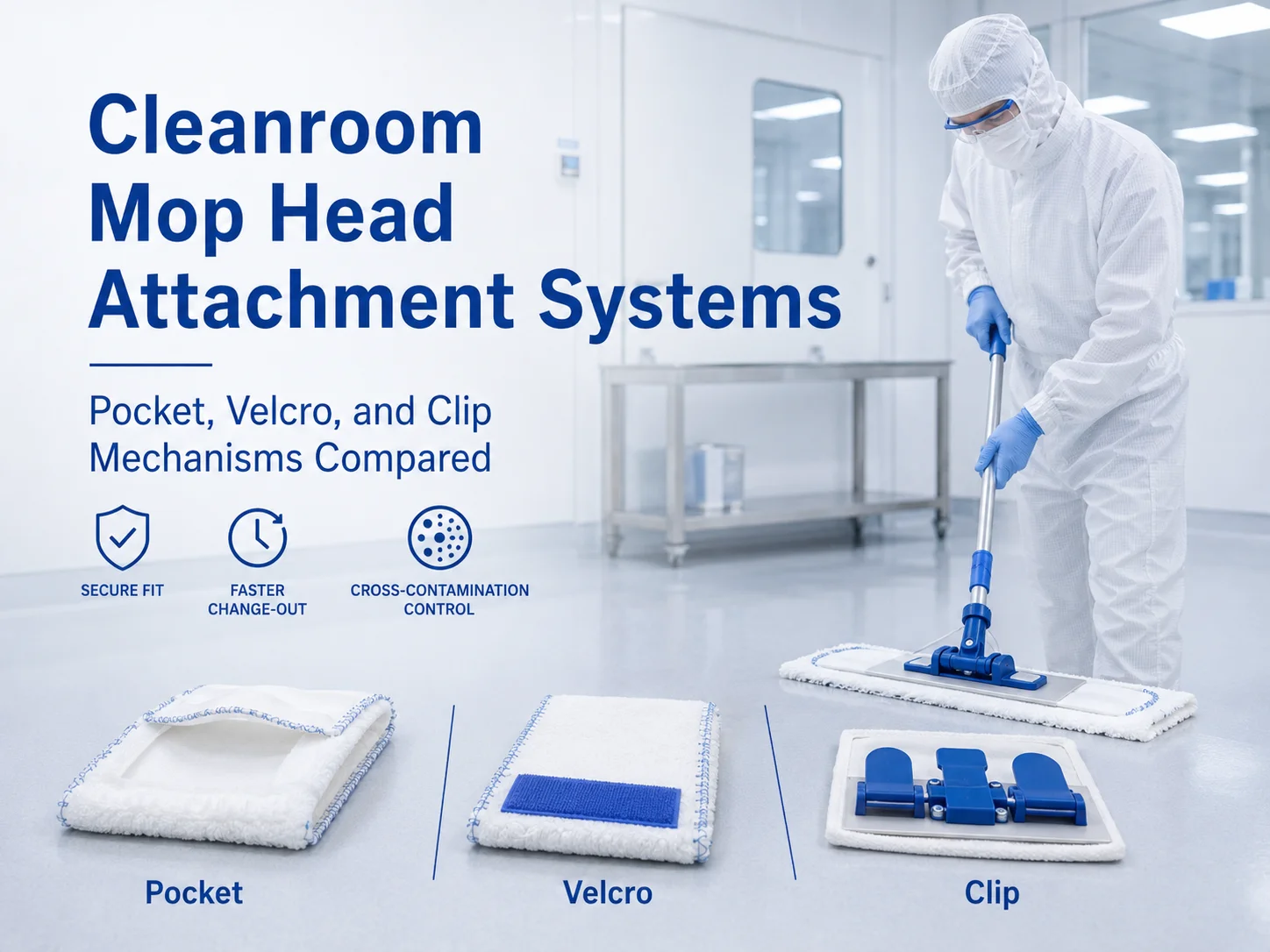
O mecanismo de fixação entre a cabeça do esfregão e a estrutura afeta diretamente três variáveis operacionais: velocidade de troca (o velcro é mais rápido, o clipe é mais seguro), risco de contaminação durante o manuseio (a fixação do bolso minimiza o contato do operador com a superfície suja do esfregão) e confiabilidade a longo prazo (mecanismos de clipe mantêm uma força de fixação consistente através de mais ciclos do que o velcro, que se degrada com lavagens repetidas e autoclavagem). Uma instalação que especifica o material e o peso da cabeça do esfregão, mas não o tipo de acessório, deixou uma variável de especificação como padrão – e os padrões introduzem risco operacional não validado.
| Mecanismo | Velocidade de troca | Segurança de anexos | Risco de Contaminação | Durabilidade de lavagem | Melhor para |
|---|---|---|---|---|---|
| Bolso | Moderado – requer deslizamento da estrutura no bolso | Alto – a estrutura está totalmente fechada | Mais baixo – o operador toca apenas no exterior do compartimento limpo | Excelente – sem peças adesivas ou mecânicas que possam degradar | Trocas de alta frequência, Grau A/B, fluxos de trabalho estéreis |
| Velcro | Mais rápido – pressionar, retirar | Moderado – o envolvimento do hook-loop diminui com os ciclos | Mais alto – o operador pode entrar em contato com a superfície suja durante o desprendimento | Declínio – a força de retenção do gancho reduz após 20-30 lavagens | Frequência de alteração baixa a moderada, Grau C/D, não estéril |
| Grampo | Mais lento – requer alinhamento e envolvimento de clipes | Mais alto – trava mecânica, sem degradação por lavagem | Moderado — depende do design do clipe e da técnica do operador | Excelente – as peças mecânicas podem desgastar-se, mas não se degradam com a lavagem | Uso de longa duração, segurança máxima, Grau A/B |
O acessório de bolso usa bolsos de tecido costurados em ambas as extremidades da cabeça do esfregão. As extremidades da moldura deslizam para esses bolsos, envolvendo totalmente a moldura dentro do tecido da cabeça do esfregão. Este é o acessório mais comum para esfregões para salas limpas por dois motivos: minimiza o contato do operador com a superfície suja do esfregão durante a troca (o operador manuseia o exterior do bolso limpo para remover a cabeça) e não possui componentes mecânicos ou adesivos que possam se degradar com a lavagem ou autoclave. A desvantagem: a troca é moderadamente mais lenta que o velcro – o operador deve alinhar a estrutura com a abertura do bolso e deslizá-la para dentro, o que leva de 5 a 10 segundos a mais por troca. Para tipos de cabeça de esfregão e compatibilidade, consulte tipos e seleção de cabeças de esfregões para salas limpas.
Velcro (hook-and-loop) attachment is the fastest change-out mechanism — press the mop head onto the frame’s hook strip and it is secured. Change-out time is 2-3 seconds, compared to 8-12 seconds for pocket attachment. This speed advantage is meaningful in high-change-frequency workflows where multiple mop heads are changed per cleaning session. The durability trade-off: hook-and-loop holding force degrades with repeated laundering cycles — typically showing measurable reduction after 20-30 wash/dry cycles. Autoclave exposure accelerates this degradation. Facilities evaluating velcro should request cycle-life data from the supplier and establish a retirement criterion based on holding force, not calendar age. For frame compatibility, see tipos de quadros de esfregões para salas limpas.
Clip mechanisms use mechanical fasteners — spring-loaded clips, snap-locks, or toggle clamps — to secure the mop head to the frame. This provides the highest attachment security: a properly engaged clip will not release during aggressive mopping, and unlike velcro, the holding force does not degrade with laundering or autoclaving. The trade-off: change-out is the slowest of the three mechanisms, and the mechanical parts introduce additional components that must be inspected and maintained. Clip mechanisms are most commonly evaluated for applications where attachment failure during use is unacceptable — Grade A/B zones, critical surface cleaning — and where change-out frequency is low enough that the slower change speed does not impact workflow.
A seleção do mecanismo de fixação afeta mais do que o tempo de troca — ela afeta os requisitos de treinamento do operador e a taxa de erros. O velcro é o mais intuitivo (pressione para prender, puxe para remover) e requer menos treinamento. A fixação do bolso exige que o operador alinhe a estrutura com o bolso – um movimento simples, mas que os novos operadores podem atrapalhar. A fixação de clipes requer treinamento no mecanismo específico do clipe e verificação de que todos os clipes estão encaixados. Para o argumento de integração em nível de sistema, consulte por que o sistema completo de esfregona para salas limpas é importante.
The attachment mechanism determines how the operator handles the soiled mop head during removal — and this is the contamination control variable that most procurement specifications overlook. Pocket attachment allows the operator to grip the clean exterior of the pocket to pull the head off the frame — the soiled cleaning surface is never touched. Velcro attachment may require the operator to grip near the soiled surface to generate enough pull force to separate the hook-loop engagement. Clip mechanisms vary by design — some allow tool-free detachment from the clean side, others require handling closer to the soiled surface. For Grade A/B sterile workflows where every operator-surface interaction is a contamination variable, the attachment mechanism’s effect on change-out hygiene should be part of the specification.
Most procurement specs list mop head material and weight but omit attachment type. The supplier defaults to whatever is standard in their catalog — which may not match the facility’s workflow.
Velcro holding force degrades with laundering. In Grade A/B where attachment failure during use is a contamination event, velcro without verified cycle-life data at the facility’s laundering parameters is an unvalidated variable.
A pocket mop head will not attach to a velcro frame. Specifying attachment type on the head without verifying frame compatibility creates a procurement mismatch.
In sterile workflows, how the operator removes the soiled mop head matters. An attachment mechanism that forces contact with the soiled surface introduces a contamination vector that the rest of the sterile protocol is designed to prevent.
If a velcro attachment releases mid-cleaning or a clip disengages, is the operator trained on the response? An attachment failure during use is a deviation event — and the SOP should address it.
Velcro é o mais rápido – 2-3 segundos para pressionar e retirar. A fixação no bolso leva de 8 a 12 segundos. Os mecanismos de clipe são normalmente os mais lentos devido à necessidade de alinhar e encaixar fixadores individuais.
Sim. A força de retenção do gancho e do laço diminui mensuravelmente após 20-30 ciclos de lavagem, e a exposição à autoclave acelera a degradação. As instalações que utilizam velcro devem estabelecer um critério de retirada da força de retenção e solicitar dados de ciclo de vida ao fornecedor.
Sim. A moldura fica totalmente fechada dentro do bolso de tecido – ela não pode se soltar durante o uso, a menos que o tecido do bolso se rasgue. O velcro pode se soltar se o engate do velcro for insuficiente devido ao desgaste ou pressão inadequada durante a fixação.
O acessório de bolso minimiza o contato do operador com a superfície suja – o operador segura o exterior do bolso limpo para remover o cabeçote. O velcro pode exigir uma pegada mais próxima da superfície suja. Os mecanismos de clipe variam de acordo com o design.
Only if the attachment type is identical and dimensions are verified. A pocket mop head from Supplier A may fit a pocket frame from Supplier B — but the pocket dimensions must match the frame dimensions. Verify before procurement.
Attachment type primarily affects cleaning pressure through security — a secure attachment (pocket or clip) maintains consistent pressure across the stroke. A degraded velcro attachment may allow slight movement between the head and frame, reducing pressure transfer efficiency.
Velcro detachment during use — typically caused by worn hook-loop material that was not identified during pre-use inspection. Pocket tears at the seam are less common but more severe when they occur. Clip disengagement is typically caused by incomplete engagement, not mechanical failure.
Specify your change-out frequency, cleanroom grade, and sterilization requirements. MIDPOSI can help match mop head attachment type to your facility’s contamination control workflow.
White Cleanroom Mop Series — pocket attachment standard — compatible with SS frames — sterile and non-sterile configurations — batch documentation for GMP audit support

Relacionado: Este artigo faz parte do Guia do sistema MIDPOSI Cleanroom Mop — um recurso completo que abrange componentes, critérios de seleção, fluxos de trabalho de BPF e suporte de documentação para aquisição de esfregões para salas limpas.

Vestuário para salas limpas & Fornecedor de sistemas Mop para GMP, ISO e ambientes controlados
Roupas reutilizáveis para salas limpas autoclaváveis e sistemas de esfregões para salas limpas para ambientes farmacêuticos, de biotecnologia e de fabricação controlada.