
GMP Cleanroom Mop • Material Selection • Validation-Ready
Polyester vs Microfiber Cleanroom Mops: Which Is Better for GMP Environments?
A technical, procurement-oriented comparison of polyester and microfiber mop materials for GMP cleaning— focused on contamination control, validation repeatability, and long-term supply consistency.

1) Why mop material selection matters in GMP cleanrooms
In GMP environments, cleaning tools are part of the contamination control strategy. A GMP cleanroom mop must remove particles and residues without introducing fibers, extractables, or uncontrolled variability that complicates validation.
- Partícula & fiber control: shedding and lint risk influence cleanroom classification stability.
- Residue control: ability to remove films, disinfectant residues, and process contamination.
- Repeatability: stable cleaning outcomes support validated SOPs and audit readiness.
- Escalabilidade: consistent supply, batch control, and documentation reduce procurement risk.
If your SOPs involve single-use systems, review: Esfregões descartáveis vs reutilizáveis para salas limpas.

2) Polyester cleanroom mops: technical profile
Polyester cleanroom mops are typically manufactured using continuous filament polyester, designed to minimize fiber breakage and lint. In GMP settings, polyester is often selected when predictable shedding performance e validation stability are top priorities.
Where polyester performs strongly
- Low lint risk: continuous filament structure reduces loose fiber release.
- Chemical compatibility: commonly compatible with IPA, quats, and many disinfectant systems (verify site-specific chemistry).
- Process repeatability: stable material behavior supports consistent wetting and wipe-down patterns.
- Batch consistency: easier to control weave, weight, and finished cleanliness across lots.
Typical GMP use cases
- Routine floor cleaning in controlled corridors and support zones
- Wall and ceiling cleaning where lint control is critical
- Validated cleaning steps requiring low-variability consumables
GMP-specific application guidance: Requisitos de esfregões para salas limpas farmacêuticas.
3) Microfiber cleanroom mops: technical profile
Microfiber mops use ultra-fine fibers (often split fiber constructions) that increase surface area and mechanical capture. In GMP cleaning, microfiber can improve removal of fine particles and light residues, but the performance depends heavily on manufacturing control and processing.
Where microfiber performs strongly
- High capture efficiency: dense micro-structure can trap fine particles effectively.
- Residue removal: often performs well for thin films and light oily residues in controlled protocols.
- Absorbency: can hold more aqueous solution, supporting controlled wet mopping where appropriate.
Key controls to confirm for GMP
- Shedding data: lint/particle performance should be consistent across lots and documented.
- Processing cleanliness: validated washing/finishing is essential to reduce extractables and residues.
- Compatibility testing: confirm performance with your disinfectant and contact-time SOP.
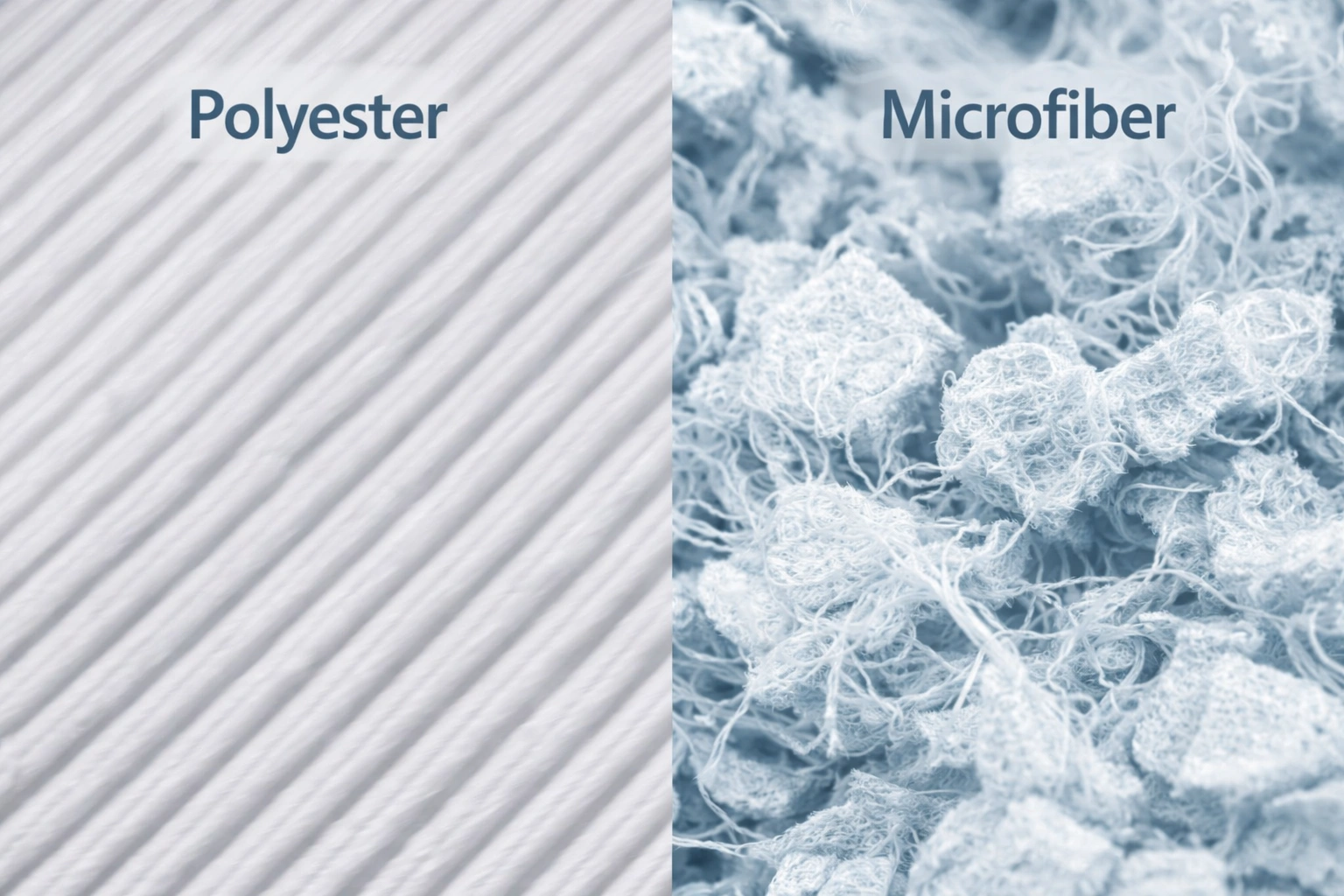
4) Polyester vs microfiber: GMP-focused comparison table
| Decision criterion | Polyester mop | Microfiber mop |
|---|---|---|
| Fiber/particle shedding risk | Typically lower and more predictable | Can be low, but depends on fiber split quality & finishing |
| Absorbency (aqueous) | Moderado | Alto |
| Fine particle capture | Bom | Often stronger due to high surface area |
| Residue removal (light films) | Good with validated technique | Often stronger mechanical capture |
| Validation repeatability | High (stable behavior across runs) | Moderate to high (requires tighter controls) |
| Best-fit GMP zones | Routine GMP cleaning, fiber-sensitive areas | Targeted steps requiring higher capture efficiency |
For compliance mapping and ISO/GMP linkage, see: ISO 14644 & Esfregonas para salas limpas PBF.
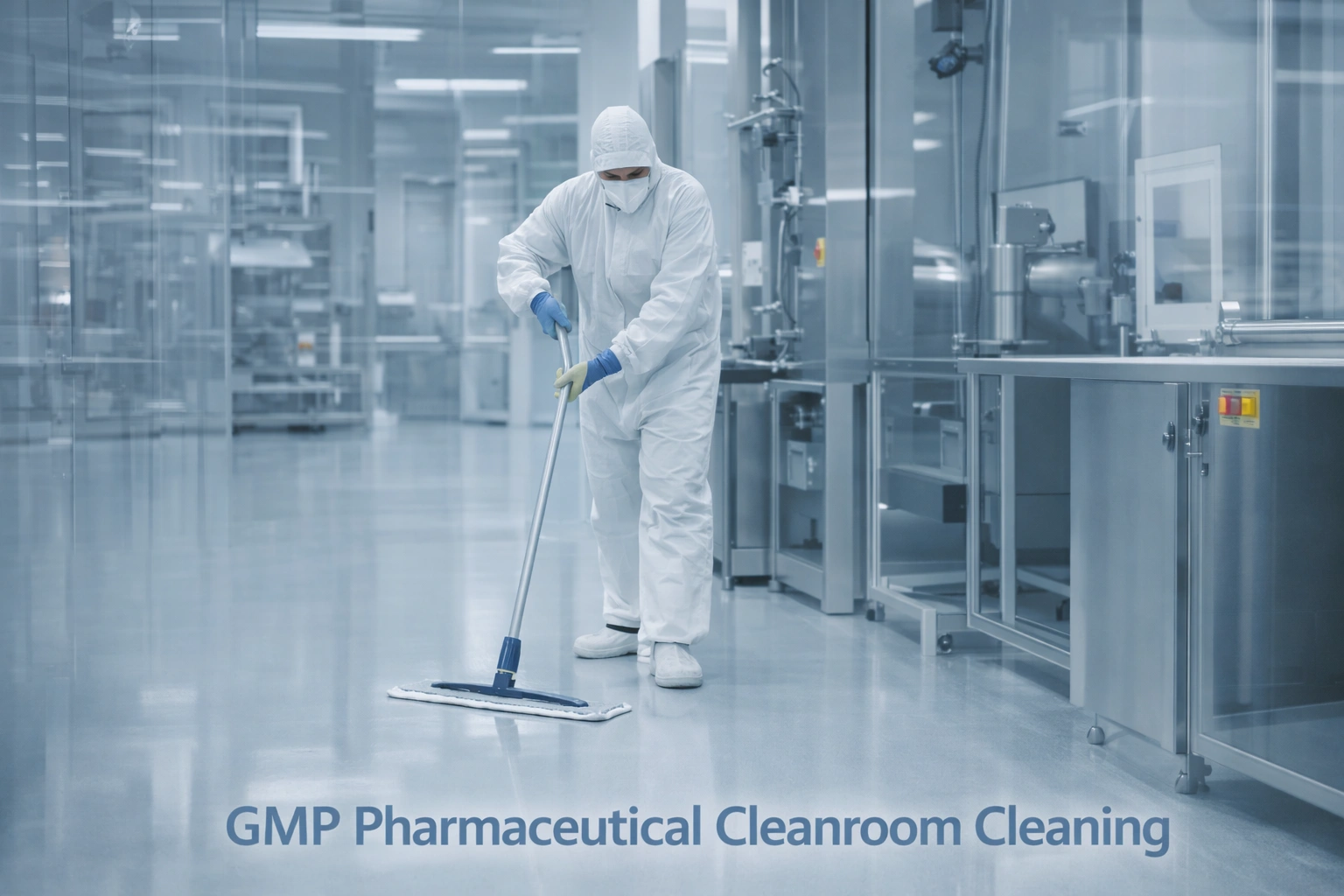
5) Industry-specific requirements (what buyers typically document)
Farmacêutico & GMP
Procurement and QA teams typically require material stability, batch consistency, and documentation to support validation and audit readiness. The mop material should align with SOP-defined wetting, contact time, and residue acceptance criteria.
Hospitals & healthcare clean areas
Buyers emphasize disinfectant compatibility, cleaning effectiveness, and consistency across multiple wards or controlled spaces.
Fabricação de dispositivos médicos
A strong focus is placed on fiber control and residue risk that could impact device performance or packaging integrity.
Eletrônica & semiconductor
Fine particle capture is often critical, while fiber shedding must remain controlled to protect yield and prevent defects.
6) Compliance, validation & documentation (what makes a mop “GMP-ready”)
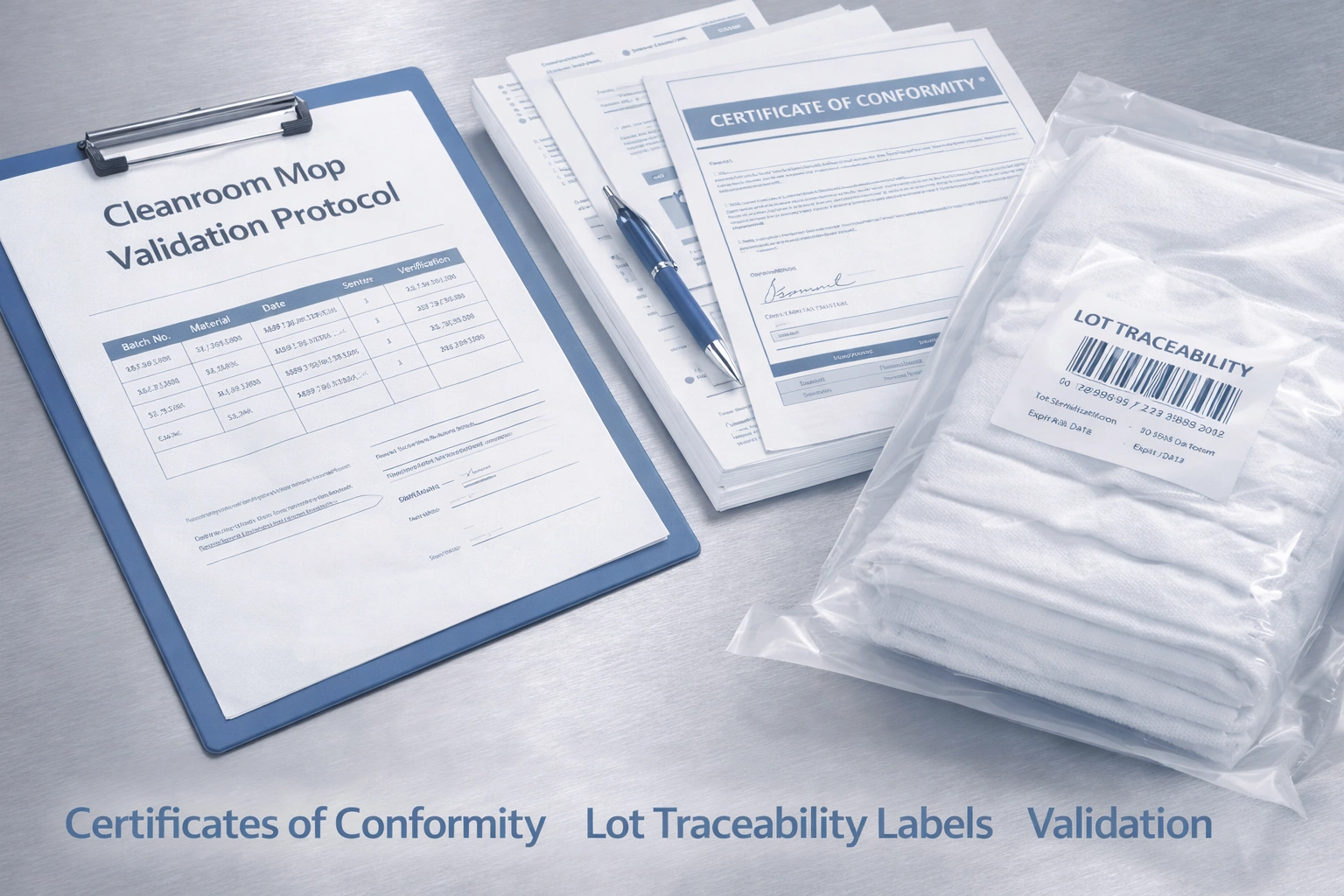
In GMP procurement, the material is only half the decision. The supplier’s ability to provide documentation and batch controls often determines whether a mop can be approved for controlled use.
- Lot traceability: consistent labeling and batch tracking for investigation readiness
- CoC / Conformance: basic compliance documentation aligned to buyer requirements
- Finished cleanliness controls: controlled processing to reduce residues and extractables
- Controle de alterações: controlled material/process changes to protect validated performance
Supplier evaluation framework (for procurement teams): Como escolher um fornecedor atacadista de esfregões para salas limpas.
7) Procurement checklist for GMP buyers
- Define zone risk: align mop material to GMP area classification and contamination risk.
- Confirme o ajuste do SOP: wetting method, disinfectant, contact time, and residue criteria.
- Request documentation: CoC, lot traceability, and quality consistency evidence.
- Verify batch control: stable materials, controlled finishing, and supplier change management.
- Escalabilidade do plano: MOQ, lead time, and stable long-term supply capability.
If you want a full sourcing playbook, start here: Esfregona para salas limpas no atacado – Guia completo.
Need help selecting a GMP cleanroom mop material?
MIDPOSI supports B2B buyers with stable batch supply, documentation support, and configurable mop formats aligned to cleanroom grades. Share your application (industry, zone, disinfectant, and cleaning SOP focus), and we’ll recommend a controlled, validation-friendly option.