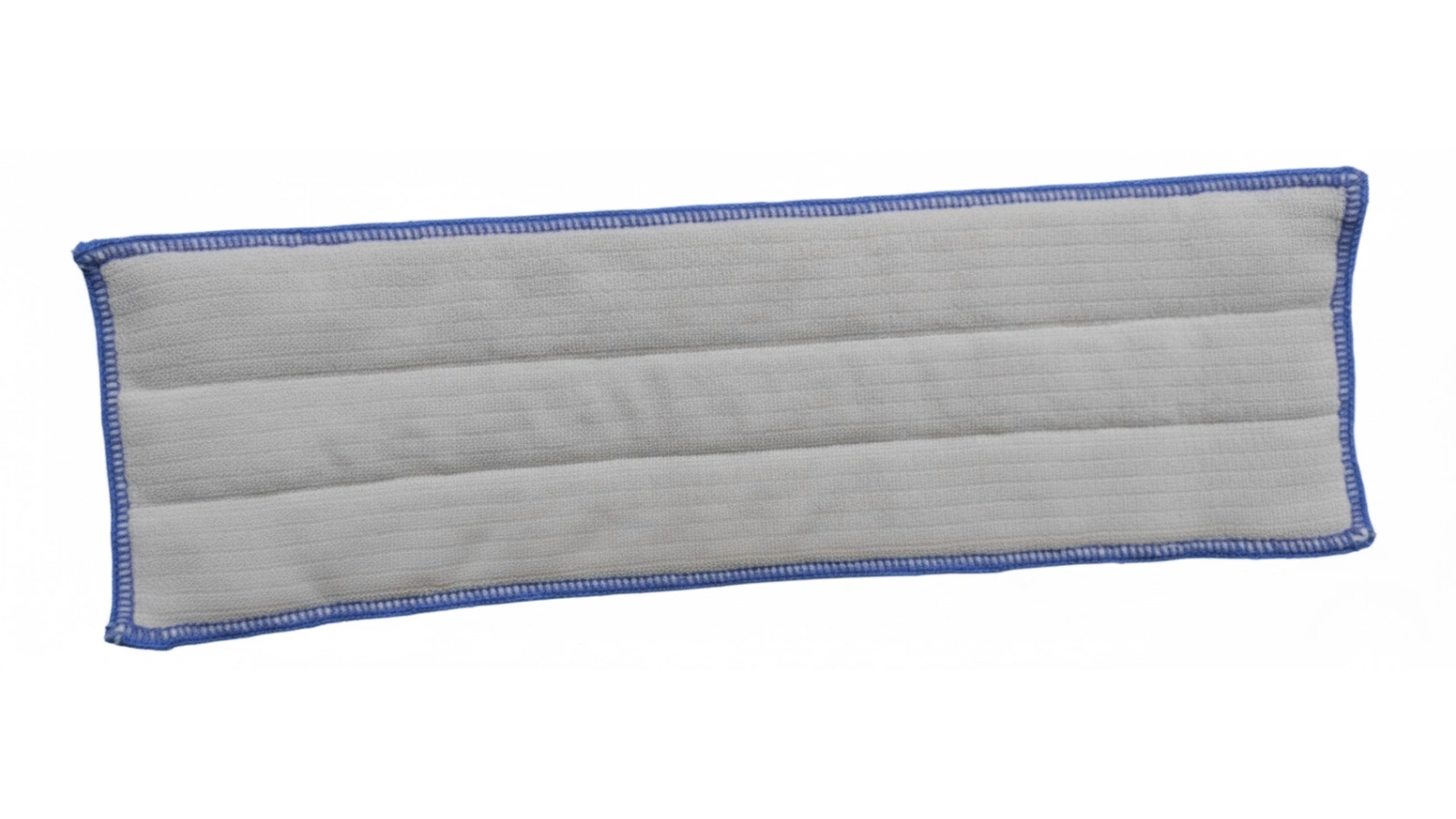
Техническое, научно обоснованное сравнение двух основных технологий изготовления швабр для чистых помещений. Охватывает механизмы образования частиц, впитывающую способность, химическую совместимость, долговечность, стоимость жизненного цикла, а также структуру принятия решений на уровне объекта для руководителей контроля качества, групп закупок и менеджеров чистых помещений.
Выбор между швабрами для чистых помещений из микрофибры и полиэстера не простое решение «один лучше». Это зависит от классификации чистого помещения по ISO/GMP, используемых чистящих химикатов, приемлемого порога образования частиц, а также от того, отдает ли предприятие приоритет абсорбирующей способности и эффективности очистки или контролю над частицами и химической стойкости.
А однокомпонентный синтетический материал изготовлены из непрерывных полиэфирных нитей, сплетенных в многослойную тканевую структуру. Края запечатаны с помощью методов лазерной резки, ультразвука или термосварки для предотвращения высвобождения волокон по периметру.
Обычно это более подходящий выбор, когда: Предприятие работает по стандарту ISO 5.–6/GMP класс А–B, используются агрессивные окислительные дезинфицирующие средства, требуется многократное автоклавирование в программе многоразового использования, или основной проблемой загрязнения является контроль над частицами.
Ан ультратонкая смесь синтетических волокон (обычно полиэстер/полиамид), изготавливаемый путем разделения отдельных нитей на несколько клиновидных микронитей. Это создает большую площадь поверхности и капиллярное действие для улавливания жидкости и частиц.
Обычно это более подходящий выбор, когда: Предприятие работает по стандарту ISO 7.–8/GMP класс C–D, эффективность очистки и удаление остатков являются приоритетами, химия очистки является мягкой или одноразовые применения предпочтительнее, когда желательна максимальная очищающая способность за одно использование.
Короткий ответ: Полиэстер (особенно непрерывный трикотаж с герметичными краями) обычно образует меньше частиц и обеспечивает более высокую химическую совместимость.—что делает его более распространенной рекомендацией для ISO 5.–6/GMP класс А–Б среды. Микроволокно (конструкция из разделенных нитей) обычно обеспечивает более высокую впитывающую способность и превосходное улавливание механических частиц.—что делает его сильным в ISO 7–8/GMP класс C–D Среды, где эффективность очистки может иметь приоритет над требованиями к сверхнизкому содержанию частиц. Оба материала остаются актуальными в современных чистых помещениях; Правильный выбор зависит от конкретного объекта.
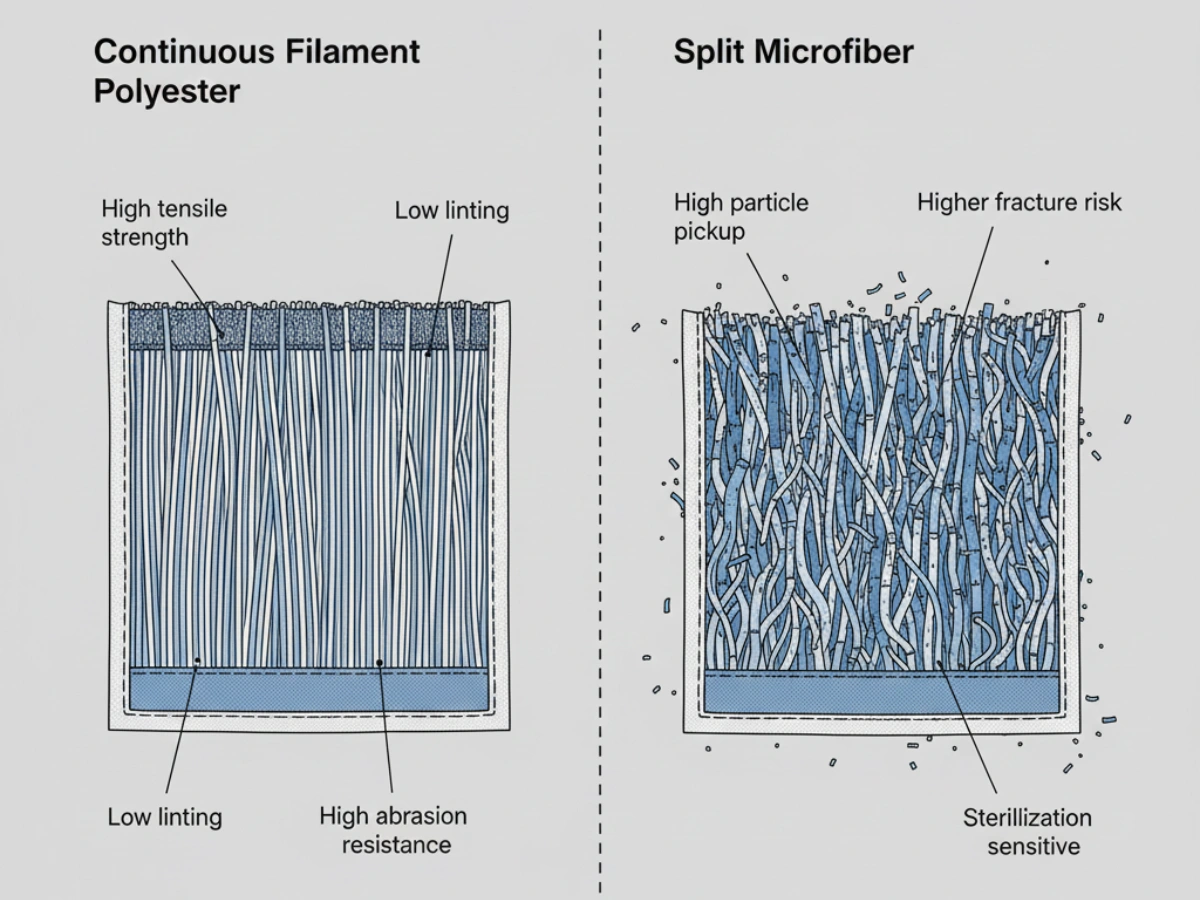
Различия в характеристиках швабр для чистых помещений из микрофибры и полиэстера возникают на уровне волокон. Понимание того, как устроен каждый материал, дает основу для оценки образования частиц, впитывающей способности, химической совместимости и долговечности.—вместо того, чтобы полагаться на маркетинговые заявления поставщиков.
Швабры из полиэстера, предназначенные для чистых помещений, изготовлены из полиэстер с непрерывной нитью (ПЭТ)—длинные непрерывные синтетические волокна, экструдированные и сплетенные в ткань. В отличие от тканей со штапельным волокном, в которых короткие волокна сплетены вместе, конструкция из непрерывных нитей намеренно сводит к минимуму количество свободных концов волокон в основной ткани, что является основным структурным фактором, способствующим низкому осыпанию частиц.
Одиночные длинные волокна проходят через ткань непрерывно. Меньше концов нити = меньше точек разрыва = теоретически меньше выбросов частиц. Это основополагающее структурное преимущество для чистых помещений, чувствительных к частицам.
Швабры из полиэстера, предназначенные для использования в чистых помещениях.—например, серия White Mop от MIDPOSI.—обычно используют многослойную трикотажную структуру. Рисунок вязки и количество слоев влияют на распределение жидкости, впитывающую способность и механическую стабильность насадки швабры во время использования.
Because the mop perimeter represents a concentrated zone of cut fiber ends, edge finishing is a critical manufacturing quality indicator. Cleanroom polyester mops use laser-cut, ultrasonic, or heat-sealed edges to seal the perimeter and prevent edge fraying. The quality of edge sealing can have as much impact on particle performance as the filament type itself.
Fiber thickness (denier) affects the mop’s hand feel, liquid contact efficiency, and durability. Finer denier polyester fibers produce a softer fabric with potentially better surface contact for liquid application; coarser denier fibers may offer greater abrasion resistance. This is a manufacturer-specific variable, not a material constant.
Использование швабр из микрофибры, предназначенных для чистых помещений. технология расщепления нитей. Во время производства одна двухкомпонентная нить (обычно полиэфирная сердцевина + полиамид/нейлоновая оболочка или конфигурация, расположенная рядом из полиэстера/полиамида) механически или химически разделяется на несколько клиновидных микронитей. Каждая исходная нить может производить 8–16 отдельных микроволокон значительно увеличивают количество волокон и общую площадь поверхности при том же весе ткани.
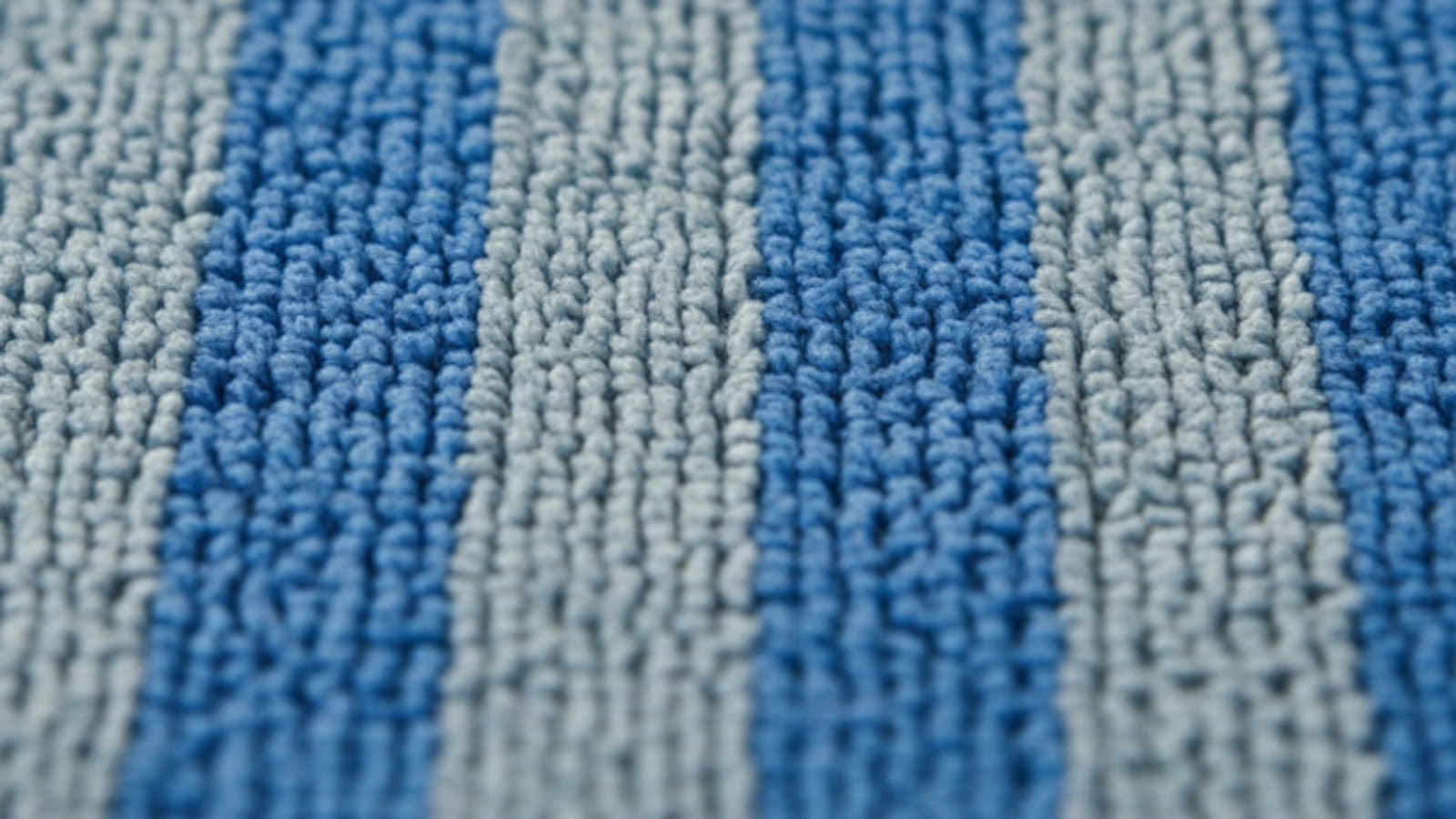
Клиновидное поперечное сечение каждой микронити является источником очищающих преимуществ микроволокна. Острые края клина механически соскребают и улавливают мелкие частицы, а зазоры между нитями создают капиллярные каналы, втягивающие жидкость. Это физический механизм захвата, а не химический.
В большинстве микроволокон для чистых помещений используется смесь полиэстера и полиамида (нейлона).—обычно 70–80% полиэстер и 20–30% полиамид. Полиэстер обеспечивает структурную целостность; полиамид способствует впитывающей способности и самому расщеплению. Такое соотношение смеси является источником как преимуществ в производительности, так и проблем химической чувствительности, обсуждаемых далее в этой статье.
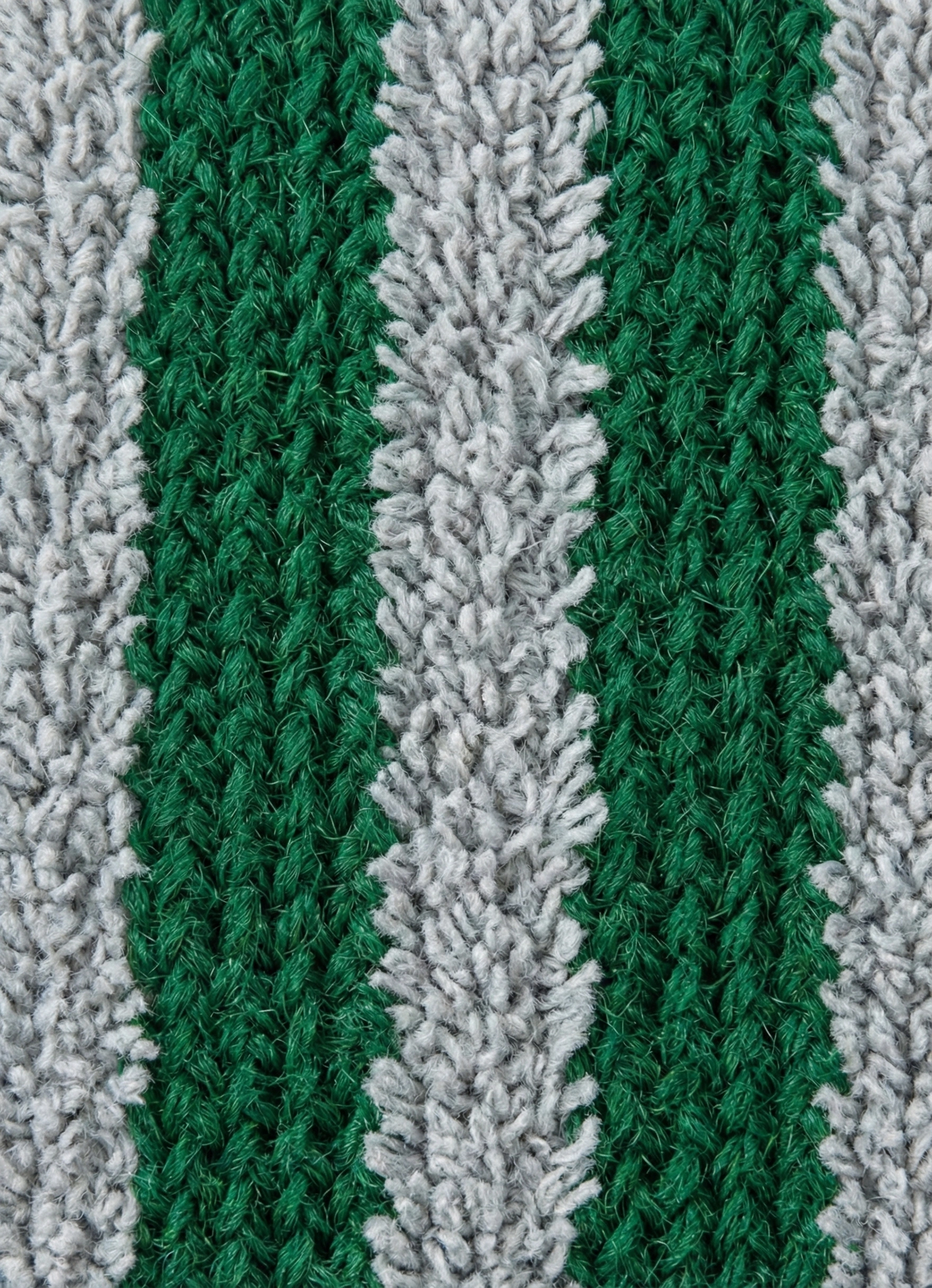
Швабры из микрофибры для чистых помещений могут иметь петлеобразную или разрезную конструкцию поверхности. Петлеобразные конструкции обычно высвобождают меньше свободных волокон во время использования, поскольку каждая нить закреплена на обоих концах; конструкции с разрезными сваями обнажают больше концов нитей, что потенциально увеличивает выброс частиц. Это критически важный параметр качества для чистых помещений. Такие продукты, как подушечка для швабры в полоску из микрофибры для чистых помещений используйте петлеобразную конструкцию с герметичными краями для совместимости с чистыми помещениями.
Поскольку каждая исходная нить разделена на несколько микронитей, общая площадь поверхности волокна на грамм материала существенно выше, чем у полиэстера, полученного традиционным способом прядения. Это структурная основа более высокой впитывающей способности микроволокна и способности улавливать частицы.—but the same surface area also means more potential sites for fiber degradation and particle release as the material ages.
The structural distinction between continuous filament polyester and split-filament microfiber is not merely academic. It directly explains the observable performance tradeoffs:
| Измерение | Полиэстер (непрерывное вязание) | Микрофибра (сплит-филамент) |
|---|---|---|
| Fiber Type | Continuous single filament | Split multi-filament wedge |
| Composition | 100% polyester (PET) | Polyester/polyamide blend (typical: 70–80/20–30) |
| Surface Area per Gram | Relatively lower | Relatively higher (split geometry) |
| Primary Particle Release Mechanism | Primarily edge-related; low from continuous filament body | Fiber breakage from split filaments; also edge-related |
| Edge Finishing | Laser-cut, ultrasonic, or heat-sealed | Varies by manufacturer; sealed edges required for cleanroom use |
| Typical Cleanroom Suitability | ИСО 5–8 / GMP A–D (depending on construction quality) | ИСО 7–8 / GMP C–D more commonly; ISO 5–6 with qualification |
| Water Interaction | Inherently hydrophobic; absorbency from knit structure | Capillary action from wedge geometry; naturally hydrophilic in polyamide component |
Note: This table compares material-level structural characteristics. Actual product performance depends on manufacturer-specific variables including filament anchoring quality, knit density, edge-sealing method consistency, and overall manufacturing quality control. These characteristics should be verified with the specific product and supplier, not assumed from material type alone.
This is the dimension that most directly determines whether a mop material is suitable for a given cleanroom classification. The question is not simply “which material is cleaner?” but “which material generates particles through what mechanism, and under what conditions?”
Cleanroom mops generate particles through three primary mechanisms:
The filament type—continuous or split—directly affects which of these mechanisms dominates and at what magnitude. Fluid presence and mechanical action accelerate all three mechanisms, which is why wet-mopping particle data may differ from dry-state measurements.
Continuous filament polyester’s structural advantage for particle control is straightforward: fewer filament ends = fewer potential particle sources. Because each filament runs uninterrupted through the fabric, there are fewer breakage initiation points compared to a fabric composed of shorter, individual staple fibers or split microfilaments.
Additional factors contributing to polyester’s typically lower particle profile:
Important caveat: This profile assumes a well-manufactured product. Particle performance is manufacturing-process-dependent. A poorly edge-sealed polyester mop with loose surface fibers will generate more particles than a well-made microfiber mop with sealed edges and anchored filaments. Material type establishes a structural tendency; manufacturing quality determines whether that tendency is realized.
Microfiber’s split-filament construction creates an inherent particle risk tradeoff: the same structural feature that provides superior particle capture also creates more potential particle release points. Each split microfilament is thinner and more fragile than a continuous polyester filament, and there are many more of them per unit area.
Key variables affecting microfiber particle generation:
Important caveat: Quality-grade microfiber from a reputable manufacturer, with sealed edges and anchored loop construction, can perform well within the particle requirements of ISO 7–8 environments and may, with qualification testing, be suitable for ISO 5–6 zones. The material type alone does not disqualify microfiber from cleanroom use; it signals that particle performance must be verified rather than assumed.
Particle generation data from different mop suppliers can be difficult to compare directly because test methodologies differ. When evaluating supplier particle data, consider:
Critical disclaimer: This comparison describes material-level structural tendencies. Particle performance must be verified on the specific product under consideration, using test conditions relevant to the intended cleanroom application. No material-level claim in this article constitutes a performance guarantee for any specific product.
If particle generation is the dimension where polyester tends to hold an advantage, cleaning efficacy is the dimension where microfiber earns its place in cleanroom operations. The observable performance difference in absorbency and mechanical particle removal is real—but it must be weighed against the particle generation tradeoff and the specific requirements of each cleanroom zone.
Microfiber’s cleaning advantage is rooted in its physical structure, not in a chemical cleaning agent:
Continuous filament polyester is inherently hydrophobic—the base polymer does not absorb water. However, this does not mean polyester cleanroom mops cannot absorb liquid. Absorbency in polyester mops is a function of the fabric construction:
Парадокс эффективности очистки: Microfiber’s superior cleaning power is real and demonstrable in standardized cleaning efficacy tests. However, in a cleanroom, “better cleaning” is only net beneficial if it does not create a contamination risk—specifically through particle generation—that exceeds the cleaning benefit. For ISO 5 / GMP Grade A environments, particle control may be the dominant concern, and polyester’s adequate (rather than maximal) absorbency may be the more appropriate choice. For ISO 7–8/GMP класс C–D environments, where particle thresholds are less stringent, microfiber’s cleaning efficacy advantage can drive meaningful operational improvements.
This is a dimension that many cleanroom mop procurement evaluations overlook—and one that can render a technically correct material choice operationally problematic if the wrong mop material is paired with the facility’s disinfectant formulary.
Polyester (PET) as a polymer class exhibits broad resistance to a wide range of chemical agents commonly used in cleanroom disinfection:
The chemical compatibility profile of cleanroom microfiber is more nuanced because most cleanroom-grade microfiber is a polyester/polyamide (nylon) blend. The polyamide component introduces chemical sensitivity that pure polyester does not have:
The degradation of the polyamide component manifests as: fiber brittleness, increased particle shedding, reduced absorbency (as the capillary structure degrades), and shorter overall service life in reusable applications.
Важный: Chemical compatibility is product-specific, not just material-specific. Variations in fabric construction, edge-binding chemistry, stitching thread material, and any fabric treatments can affect overall chemical resistance. Always request chemical compatibility data from the mop manufacturer specific to your facility’s disinfectant formulary, and verify through in-facility compatibility testing under your actual use conditions.
The following table consolidates the material-level comparison across all six performance dimensions discussed above and in the sections that follow. Use this as a high-level reference, not as a substitute for product-specific evaluation.
| Performance Dimension | Полиэстер (непрерывное вязание) | Микрофибра (сплит-филамент) | When This Dimension Is Decisive |
|---|---|---|---|
| 1. Particle Generation | Generally lower (continuous filament advantage; fewer breakage points) | Generally higher (split-filament structure; more potential release points) | ИСО 5–6/GMP класс А–B: polyester typically preferred |
| 2. Absorbency / Cleaning Efficacy | Moderate; controlled liquid release; adequate for routine cleaning | Higher; capillary action + mechanical particle entrapment | ИСО 7–8 / GMP C–D with residue-heavy protocols: microfiber advantage |
| 3. Chemical Resistance | Broad compatibility; oxidation-resistant (100% PET) | Polyamide sensitivity to oxidizers and acids | Facilities using aggressive disinfectants: polyester typically preferred |
| 4. Durability (Reusable) | Higher cycle count; slower degradation | Lower cycle count; progressive filament breakage with laundering | High-frequency reusable programs: polyester typically preferred |
| 5. Disposable (Single-Use) | Available; focused on sterility and contamination control | Available; focused on maximum per-use cleaning power | Choice depends on priority: particle control vs cleaning power per use |
| 6. Cost (Directional) | Lower upfront; longer reusable service life | Higher upfront; shorter reusable service life | Reusable programs with high usage volume: polyester cost advantage |
Disclosure: This table presents material-level directional comparisons. Actual product performance depends on manufacturer-specific variables including filament quality, knit density, edge-sealing method, layer construction, and overall manufacturing quality control. No absolute performance claims are made for any product or material type. All comparisons should be verified through product-specific evaluation and, where possible, in-facility testing.
Durability directly affects total cost of ownership and replacement frequency. The two materials degrade through different mechanisms and at different rates, and these differences are amplified in reusable (laundered/sterilized) applications.
Note: Фактические данные о цикле замены следует получать от поставщиков и—для многоразовых программ—проверено в ходе испытаний по отмыванию на конкретном предприятии, которые воспроизводят фактические параметры очистки, стирки и стерилизации на предприятии. Данные о сроке службы, опубликованные поставщиком, носят ориентировочный характер, а не являются гарантией.
Решения о закупках, основанные только на цене единицы швабры, вводят в заблуждение. Следующая схема определяет компоненты затрат, которые различаются в зависимости от типа материала, что позволяет сравнить совокупную стоимость владения (TCO) для конкретного объекта.
Однако первоначальные затраты на материалы — это лишь один из компонентов общей стоимости, и зачастую не самый крупный.
Полное сравнение затрат должно основываться на стоимость за уборку, без учета стоимости насадки для швабры:
(Стоимость насадки швабры / количество используемых циклов на насадку швабры) + (стоимость стирки/стерилизации за цикл) + (затраты на рабочую силу за чистку) = стоимость за уборку
Эта структура раскрывает несколько важных динамик:
Избегать: Эта система не включает абсолютные цифры затрат, заявления «X долларов на насадку для швабры» или конкретные проценты экономии совокупной стоимости владения. Каждое учреждение должно построить свою собственную модель затрат, используя фактические закупочные цены, расценки на рабочую силу, расходы на коммунальные услуги и эксплуатационные расходы на стирку/стерилизацию.
В этом разделе предыдущий технический анализ объединяется в действенную схему выбора. Используйте приведенные ниже условия и сценарии, чтобы самостоятельно определить, какой материал соответствует профилю вашего учреждения.
На практике несколько сценариев снижают чувствительность к выбору материала:
Ключевое предостережение: Материал является одним из многих факторов при оценке швабры для чистых помещений. Совместимость рамы, тип ручки, конфигурация стерильности, вес насадки швабры и обработка кромок являются одинаково важными критериями выбора. Это сравнение должно дать информацию для более широкой оценки системы швабры.—он не должен заменять один. Структурированный подход к оценке всей швабры представлен в нашей статье. Схема оценки покупателя системы швабры для чистых помещений.
| Сценарий объекта | Класс чистых помещений | Типичная рекомендация по материалам | Ключевое обоснование |
|---|---|---|---|
| Асептический фармацевтический розлив | ИСО 5/ГМП А | Полиэстер | Контроль частиц имеет первостепенное значение в зонах асептического наполнения. Полиэстер с непрерывными нитями и запечатанными краями обеспечивает более предсказуемый профиль с низким содержанием частиц для этого применения. |
| Зона фармацевтического фона | ИСО 7/ГМП Б–С | Полиэстер или качественная микрофибра | Решение зависит от химического дезинфицирующего средства и частоты очистки. Если регулярно используются окислительные дезинфицирующие средства, полиэстер может быть более безопасным выбором. Если химический состав нейтральный и при очистке остается много остатков, высококачественная микрофибра может обеспечить преимущества в эффективности. |
| Сборка медицинского оборудования | ИСО 7–8 / GMP C–Д | Микрофибра | Более высокая эффективность очистки при удалении частиц с контактных поверхностей устройства является преимуществом. Пороговые значения частиц менее строгие, что позволяет полностью реализовать преимущества чистки микроволокна. |
| Биотех Р&Д/общие лаборатории | ИСО 7–8 | Любой материал | Требования к частицам менее строгие. Решающими факторами могут быть стоимость, удобство поставки и совместимость с существующими чистящими химикатами, а не различия в характеристиках конкретного материала. |
| Полупроводники/электроника | ИСО 5–7 | Полиэстер | Контроль частиц в сочетании с агрессивными чистящими средствами, типичными для чистых помещений, производящих полупроводники. Соображения ESD (электростатического разряда) могут отдавать предпочтение конкретным конфигурациям материалов. |
| Больничная рецептура (USP <797>/<800>) | ИСО 5–7 | Полиэстер | Ключевым требованием является низкий уровень образования частиц в зонах первичного технического контроля. Трикотаж из полиэфирных непрерывных нитей с герметичными краями соответствует ожиданиям по контролю частиц в средах производства компаундов USP. |
Обратите внимание на рекомендации: Это целевые предложения на уровне материалов, а не сертификаты для конкретного продукта. Оценка конкретного объекта—включая тестирование частиц, проверку химической совместимости и проверку протокола очистки.—требуется всегда. Рекомендуемый материал должен быть проверен на соответствие параметрам очистки конкретного продукта, поставщика и объекта.
Следующие шесть заблуждений часто встречаются при обсуждении закупок швабр для чистых помещений. Каждая коррекция подтверждается техническим анализом, представленным в предыдущих разделах.
Реальность: Образование ворса зависит от типа волокна (непрерывное или расщепленное), качества обработки кромок и контроля производственного процесса.—нет на этикетке «микрофибра». Хорошо сделанная швабра из полиэстера с заклеенными краями, вырезанными лазером, и закрепленными непрерывными нитями может генерировать меньше частиц, чем швабра из микрофибры низкого качества с плохо закрепленными разделенными нитями и незапечатанными краями. Категория материала не гарантирует производительность частиц; Качество изготовления конкретного продукта имеет значение.
Реальность: Более низкая впитывающая способность полиэстера по сравнению с микрофиброй — это компромисс дизайна, а не дефект. В тех случаях, когда важно контролируемое применение дезинфицирующих средств.—достижение заданного времени контакта без переувлажнения, управление временем высыхания для минимизации сбоев в работе и обеспечение постоянного объема дезинфицирующего средства на площадь поверхности.—polyester’s controlled liquid release can be an advantage. “Absorbs more” does not always mean “performs better” in all cleanroom contexts.
Реальность: Microfiber is widely and successfully used in ISO 7–8/GMP класс C–D cleanroom environments when sourced from quality manufacturers with sealed edges, anchored loop construction, and documented particle test data. The concern is about fit-for-purpose evaluation, not absolute exclusion. Many facilities use microfiber mops in support zones with good results. Excluding microfiber categorically from all cleanroom use is an oversimplification that ignores the diversity of cleanroom requirements.
Реальность: Polyester mop quality varies significantly across manufacturers. Key differentiating factors include: continuous vs staple filament, knit density and pattern, number of fabric layers and their bonding method, edge-sealing technology (laser-cut vs ultrasonic vs heat-seal), thread chemistry compatibility, and overall manufacturing quality control. Two “polyester cleanroom mops” from different manufacturers may perform very differently in particle testing. The material name is a starting point for evaluation, not a guarantee of equivalence.
Реальность: Sterilization (gamma irradiation, EtO, or autoclave) addresses bioburden—the microbial contamination on the mop at the point of use. It does not address non-viable particulate contamination. A sterile mop made from a particle-shedding material can still introduce non-viable particles into the cleanroom environment, which is a concern in ISO 5 and higher-classification zones where total particulate counts—not just viable counts—are monitored and controlled. Material and sterility are independent selection criteria that must both be evaluated.
Реальность: A zone-based hybrid approach is common and often optimal. Many facilities deploy polyester mops in critical/Grade A–B zones (where particle control is paramount) and microfiber mops in support/Grade C–D zones (where cleaning efficacy drives the choice). The key to a successful hybrid approach is protocol management: clear zone segregation, zone-specific mop assignment with visual identification (color-coding), and staff training to prevent cross-use. The materials are complementary, not mutually exclusive.
The technical analysis in this article equips you to evaluate cleanroom mop materials. The following questions translate that analysis into a practical supplier evaluation framework. Asking these questions when engaging any cleanroom mop supplier helps differentiate between marketing claims and verifiable product characteristics.
This question establishes the baseline material identity. The answer should be specific: “100% continuous filament polyester, X denier per filament” or “X% polyester / Y% polyamide split-filament microfiber, Z denier per filament before splitting.” Vague answers (“it’s polyester” or “it’s microfiber”) should be clarified before proceeding.
The edge is a concentrated zone of potential particle release. Laser-cut, ultrasonic, and heat-sealed edges each produce different edge profiles. A supplier who can provide a microscopy image of their sealed edge demonstrates both capability and transparency. If edge-sealing quality cannot be visually confirmed, particle performance at the perimeter is unverified.
Request particle data with the test method clearly identified (e.g., Helmke drum, biaxial shake, liquid particle count). Without the methodology, particle numbers are not interpretable or comparable. If the supplier cannot provide particle test data from a recognized methodology, the material’s suitability for a particle-sensitive zone cannot be confirmed.
Provide the supplier with the complete list of disinfectants used in your facility, including concentrations and contact times. Ask for documented compatibility data. If the supplier cannot provide chemical compatibility information for a specific disinfectant, request that they provide material samples for your own compatibility testing.
This question addresses the reusable lifecycle question directly. The supplier should be able to describe not just the nominal cycle count, but the expected performance degradation curve—particle shedding increase, absorbency decrease, and visible wear indicators—across the stated service life. A supplier who cannot discuss lifecycle performance changes has either not tested it or is unwilling to disclose it.
This question is critical for chemical compatibility evaluation. If the material is a polyester/polyamide blend, the polyamide percentage determines the extent of potential sensitivity to oxidizing disinfectants. A supplier should be able to state the exact composition, not just “microfiber” or “polyester blend.”
A COA should confirm the material composition, physical properties, and any relevant test data for the specific production batch. This supports audit trail requirements and allows verification that the received product matches the specification that was evaluated. See our guide on Документы, подтверждающие швабру для чистых помещений, и сертификат подлинности for more detail.
Material consistency across batches is a critical quality attribute. Understand what tests the manufacturer performs on each batch—weight per unit area, fiber composition verification, edge-seal integrity, visual inspection criteria, and any particle testing—and at what sampling frequency. Batch-to-batch variation in material quality can create inconsistency in cleaning performance and contamination control.
A supplier that offers both materials and can provide zone-specific recommendations based on your facility’s parameters is demonstrating product breadth and consultative capability. A supplier that only offers one material may advocate for it regardless of fit, since they have no alternative to offer.
Оценка на объекте в реальных условиях использования — наиболее надежный способ подтвердить, что материал соответствует требованиям объекта. Запросите образцы из текущей производственной партии (а не специально подготовленные демонстрационные образцы) для собственного тестирования частиц, проверки химической совместимости и сбора отзывов операторов.
Это сравнение охватывает различия на уровне материала между швабрами для чистых помещений из микрофибры и полиэстера. Следующие ресурсы посвящены дополнительным аспектам оценки и выбора швабр для чистых помещений:
Основное различие находится на уровне волокон. Швабры из полиэстера для чистых помещений обычно изготавливаются из непрерывного полиэстера (ПЭТ).—длинные, непрерывные однокомпонентные синтетические волокна, сплетенные в тканевую структуру. Швабры для чистых помещений из микрофибры изготовлены по технологии расщепления нитей—двухкомпонентные нити (обычно смесь полиэстера и полиамида), которые во время производства расщепляются на несколько микронитей клиновидной формы. Это структурное различие приводит к различным профилям образования частиц, впитывающей способности, химической совместимости и долговечности при использовании в чистых помещениях.
Полиэстер с непрерывными нитями обычно образует меньше частиц, чем микроволокно с расщепленными нитями, из-за структурного преимущества меньшего количества точек разрыва нитей в ткани с непрерывными нитями. Однако качество изготовления является критически важной переменной: хорошо сделанная швабра из микрофибры с заклеенными краями и закрепленными нитями может превзойти плохо изготовленную швабру из полиэстера с рыхлыми волокнами и незапечатанными краями. Тип материала устанавливает структурную тенденцию; конкретный продукт и производитель определяют, реализуется ли эта тенденция. Всегда запрашивайте данные испытаний на частицы, используя указанную методологию испытаний.
Как правило, не рекомендуется, если конкретный продукт из микроволокна не прошел квалификацию путем тестирования на частицы и не прошел проверку на соответствие классификации ISO 5 / класса A предприятия с данными, подтверждающими его пригодность. Структурные свойства микроволокна с разделенными нитями создают более высокий базовый риск высвобождения частиц по сравнению с полиэфиром с непрерывными нитями. Для сред ISO 5 / класса A и B более распространенной рекомендацией является вязание из полиэстера с непрерывными нитями и запечатанными краями. Если предприятие оценивает микроволокно для использования класса A/B, оно должно провести собственное тестирование частиц в реальных условиях использования и быть готовым документально подтвердить обоснование квалификации для целей аудита.
В стандартизированных испытаниях эффективности очистки микроволокно обычно демонстрирует более высокую впитывающую способность и лучший захват механических частиц по сравнению с полиэстером того же веса. Это обусловлено клиновидной структурой разделенных нитей, которая обеспечивает капиллярное действие для поглощения жидкости и механического захвата мелких частиц. Однако в чистых помещениях «улучшенная очистка» приносит чистую выгоду только в том случае, если она не приводит к риску образования частиц, превышающему выгоду от очистки. Для ИСО 7–8/GMP класс C–D, преимущество эффективности очистки микрофибры может быть полностью реализовано. Для ИСО 5–6 / Оценка А–B, где контроль над частицами является первостепенной задачей, компромисс должен быть тщательно оценен.
Полиэстер (100% ПЭТ) обладает более широкой химической совместимостью с рядом дезинфицирующих средств, обычно используемых в чистых помещениях. В частности, полиэстер устойчив к окислительной деструкции под действием таких агентов, как перекись водорода и надуксусная кислота. Микрофибра—который содержит полиамид (нейлон)—более подвержен разложению под действием окислительных дезинфицирующих средств и средств на основе хлора. Полиамидный компонент может разрушаться при многократном воздействии, что приводит к хрупкости волокон, увеличению осыпания частиц и снижению впитывающей способности. Всегда проверяйте совместимость с вашим конкретным рецептурным дезинфицирующим средством и конкретным продуктом для швабры, поскольку химическая стойкость может варьироваться в зависимости от конструкции ткани и химического состава нитей.
Полиэстер обычно имеет более низкую первоначальную стоимость материала и более длительный срок службы в многоразовых приложениях, что делает его потенциально более экономически эффективным в высокочастотных программах многоразового использования. Микрофибра может быть более рентабельной в одноразовых конфигурациях, поскольку ее превосходная очищающая способность за одно использование сокращает время очистки или доработку. Сравнение должно основываться на стоимости жизненного цикла (затраты на чистку), а не на цене за единицу продукции. Модель стоимости каждого мероприятия должна учитывать: стоимость насадки для швабры, амортизированную в зависимости от используемых циклов, затраты на стирку и стерилизацию, а также затраты на рабочую силу на каждое мероприятие по уборке. Стоимость материала сама по себе часто является наименьшим компонентом общей стоимости уборки.
Да. Гибридный подход на основе зон является распространенным и часто оптимальным для многозонных объектов. Например: используйте полиэфирные швабры с непрерывным волокном в критическом ISO 5.–6 / Оценка А–B основные зоны, где контроль частиц является приоритетом, и швабры из микрофибры в соответствии с ISO 7.–8 / Оценка С–D Поддерживает зоны, где эффективность очистки и удаление остатков определяют выбор. Гибридный подход требует четких СОП, назначения швабр для конкретных зон с визуальной идентификацией (цветовой кодировкой) и обучения персонала для предотвращения перекрестного использования между зонами. Эти два материала дополняют друг друга, а не исключают друг друга.
Ключевые вопросы включают в себя: (1) Каков тип нити и ее плотность? (2) Какой метод герметизации краев используется и можете ли вы предоставить изображение, полученное под микроскопом? (3) Можете ли вы предоставить данные испытаний на образование частиц с использованием указанной методологии? (4) Совместим ли материал со специальным формуляром дезинфицирующих средств нашего учреждения? (5) Сколько циклов проверено для многоразовых швабр и какие изменения в характеристиках происходят в течение срока службы? (6) Каков точный состав ткани и соотношение смеси? (7) Можете ли вы предоставить сертификат анализа партии? (8) Какие тесты контроля качества проводятся для каждой производственной партии? (9) Предлагаете ли вы варианты из полиэстера и микрофибры? (10) Можете ли вы предоставить образцы текущей производственной партии для нашей внутренней оценки? Полная схема оценки представлена в разделе «Вопросы для оценки поставщиков».
В серии швабр для чистых помещений MIDPOSI White используется многослойная конструкция из 100% непрерывного полиэстера.—разработан для низкого образования частиц, широкой химической совместимости и многократного использования в автоклаве в средах, контролируемых GMP и ISO. Также доступны в стерильных и нестерильных конфигурациях весом 40, 55 и 65 г. Для предприятий, рассматривающих варианты из микрофибры, MIDPOSI также предлагает качественные подушечки для швабры из микрофибры для чистых помещений с герметичными краями и конструкцией с закрепленной петлей.
MIDPOSI предоставляет документацию на уровне партии, включая сертификат анализа (COA), по запросу, а также может поддержать оценку конкретного материала и предоставление образцов для квалифицированных покупателей. Варианты изделий из полиэстера и микрофибры доступны с полным пакетом документации.