Управление жизненным циклом валидации чистых помещений: комплексное руководство
Understand the full cleanroom validation lifecycle from DQ, IQ, OQ, and PQ through ongoing verification, requalification, and change control for GMP and ISO environments.

Ответ на выделенный фрагмент
Cleanroom validation lifecycle management covers the complete control framework from design qualification through ongoing performance verification. It helps manufacturers maintain GMP and ISO compliance, reduce contamination risk, and keep cleanroom performance documented throughout the facility’s operational life.
Ключевые выводы
- Валидация чистых помещений — это процесс жизненного цикла, а не разовое квалификационное мероприятие.
- DQ, IQ, OQ и PQ проверяют различные аспекты готовности и контроля чистых помещений.
- Постоянная проверка и анализ тенденций необходимы для поддержания проверенного состояния.
- Переквалификация должна быть инициирована графиком, событиями и отклонениями в производительности.
- Строгий контроль изменений защищает целостность валидации и качество продукции.
Введение
Cleanroom validation is a continuous lifecycle that extends beyond initial IQ, OQ, and PQ certification. Ongoing performance verification and periodic requalification are essential to maintain compliance and ensure product quality throughout the cleanroom’s operational life.
Many regulatory findings stem from weak lifecycle control, including inadequate requalification, incomplete documentation, poor trend analysis, and ineffective change control. A lifecycle-based validation approach helps close these gaps and strengthen GMP inspection readiness.
Обзор жизненного цикла валидации
The cleanroom validation lifecycle includes initial validation, ongoing verification, and long-term maintenance of the validated state. In practical terms, this means building a system that not only qualifies the room at the beginning, but also keeps it under control over time.
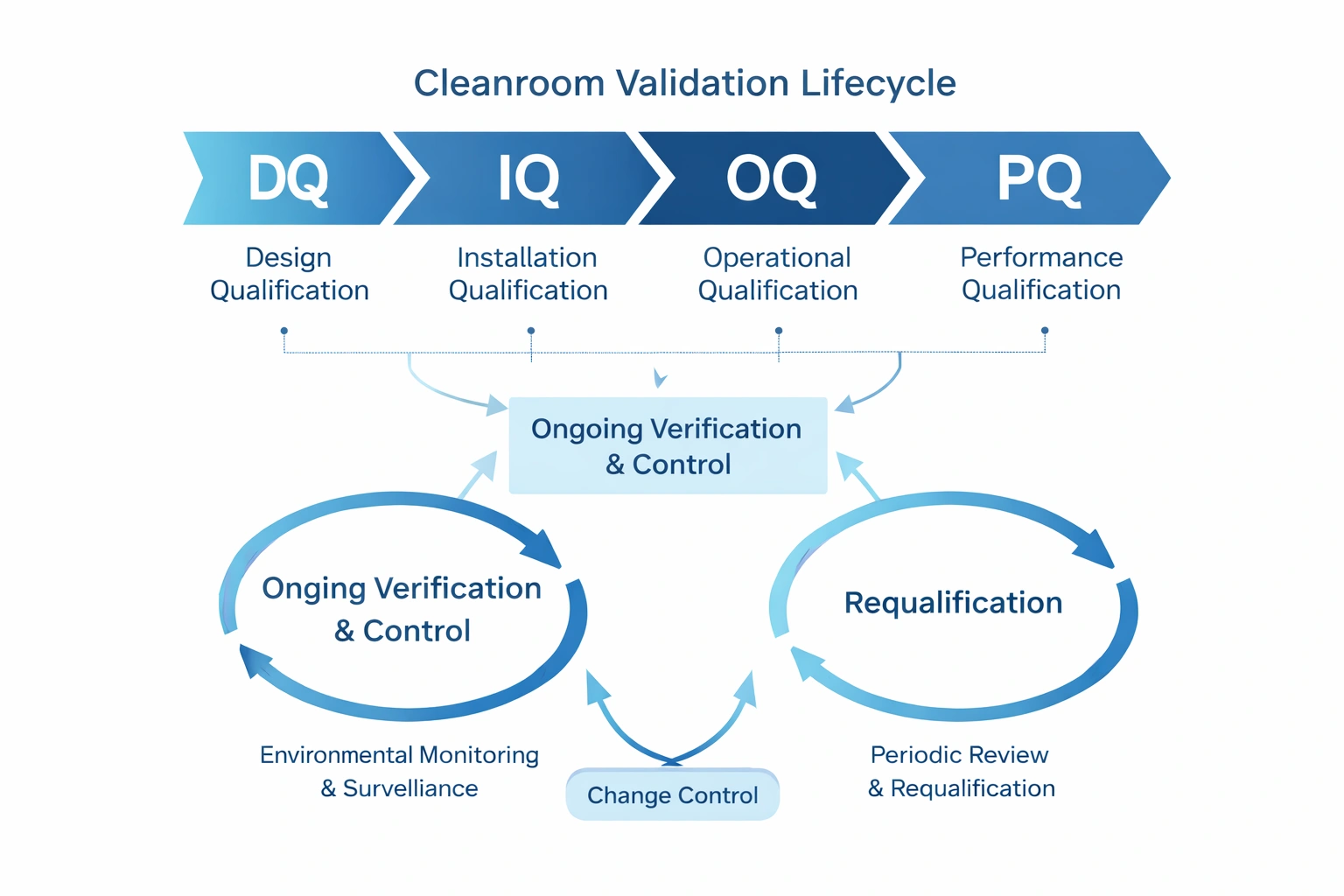
Начальная проверка
DQ, IQ, OQ, PQ и первоначальный выпуск для использования.
Текущая проверка
Экологический мониторинг, анализ тенденций, обзор и контроль.
Переквалификация & Изменять
Переквалификация и оценка изменений поддерживают целостность жизненного цикла.
| Фаза | Типичная продолжительность | Курок | Владелец |
|---|---|---|---|
| ДК | 2–4 недели | Инициирование нового проекта | Инженерное дело |
| IQ | 2–4 недели | Строительство завершено | Удобства |
| ОК | 4–8 недель | IQ полный | Валидация |
| ПК | 3–6 месяцев | ОК завершено | Валидация |
| Текущая проверка | Непрерывный | Первичная сертификация завершена | контроль качества |
| Переквалификация | 2–4 недели | Ежегодное или триггерное событие | Валидация |
Квалификация дизайнера (DQ)
Design Qualification verifies that the cleanroom design meets user requirements and is suitable for the intended process, cleanliness class, and contamination control strategy.

ДК Фокус
- Спецификация требований пользователя (URS)
- Спецификация функционального проектирования (FDS)
- Оценка рисков и анализ загрязнения
- Обзор проекта заинтересованными сторонами
- Документированное одобрение DQ
Ключевые вопросы
- Соответствует ли конструкция предполагаемым требованиям пользователя?
- Может ли система достичь заданного уровня чистоты?
- Выявлены ли основные риски загрязнения и смягчены ли они?
- Является ли проектная документация полной и подлежащей проверке?
Квалификация установки (IQ)
IQ provides documented verification that the cleanroom and its supporting systems have been installed according to design specifications, approved drawings, and utility requirements.
Пакет документации IQ
- протокол IQ
- Исполнительные чертежи
- Записи об установке
- Записи о подключении к инженерным сетям
- Сертификаты калибровки
- Сводный отчет IQ
Фокус принятия IQ
- Установлен согласно утвержденной спецификации
- Коммуникации подключены и работают
- Критическое оборудование откалибровано
- Документация полная и прослеживаемая
- Все необходимые проверки при установке пройдены
Операционная квалификация (OQ)
OQ demonstrates that the cleanroom operates within predetermined limits under anticipated operating conditions. Typical OQ activities include airflow, pressure, particle, temperature, humidity, alarm, and interlock verification.
| Критерий | Типичное требование | Фокус принятия |
|---|---|---|
| Скорость воздушного потока | В пределах указанного диапазона | Все критические места в радиусе действия |
| Равномерность воздушного потока | ±20% от среднего | Стабильный и повторяемый профиль |
| Перепад давления | В пределах целевого каскада | Все отношения давления сохраняются |
| Количество частиц | Соответствует классу ISO | Классификация в состоянии покоя достигнута |
| Температура/относительная влажность | В пределах заданного диапазона | Окружающая среда остается контролируемой |
Квалификация производительности (PQ)
PQ verifies that the cleanroom performs effectively and reproducibly under normal operating conditions with actual personnel activity, process simulation, and product-related contamination risk.

Период 1
Базовая проверка в контролируемых условиях низкой активности.
Период 2
Рутинное моделирование процессов с мониторингом в соответствии с планом EM.
Период 3
Расширенная или наихудшая проверка производительности на предмет согласованности.
Текущая проверка
Ongoing verification is what keeps the validated state alive after release. It typically includes environmental monitoring, continuous parameter monitoring, periodic trend analysis, deviation review, and assessment of whether requalification is needed.
Типичная деятельность
- Экологический мониторинг по утвержденному плану
- Обзор давления, температуры и влажности
- Ежеквартальный или периодический анализ тенденций
- Проверка готовности к аудиту
- Сопровождение реквалификации
Почему это важно
- Раннее обнаружение отклонения производительности
- Поддерживает CAPA и снижение рисков
- Повышает готовность к инспекциям GMP
- Предоставляет доказательства постоянного контроля
Стратегия переквалификации
Requalification should be based not only on a schedule, but also on change events and performance signals. A robust strategy combines annual review with event-based and trend-based triggers.
Запланированные триггеры
Годовой цикл проверки и интервалы квалификации, определенные СОП.
Триггеры событий
Капитальный ремонт, замена HEPA, модификации систем отопления, вентиляции и кондиционирования, изменения в процессах.
Триггеры производительности
Повторяющиеся отклонения, повышение уровня тревоги, необъяснимое ухудшение состояния, дрейф.
Контроль изменений
Change control protects validation integrity by ensuring each relevant modification is assessed before implementation. The goal is to determine whether the change has no validation impact, requires partial requalification, or requires expanded requalification.
Обязательные записи контроля изменений
- Запрос на изменение
- Оценка воздействия
- Обзор рисков
- План переквалификации
- Доказательства утверждения и внедрения
- Обновлены записи проверки
Типичные результаты
- Нет влияния — не требуется переквалификация
- Незначительное воздействие — требуется целенаправленная квалификация
- Серьезное воздействие — требуется полная или расширенная переквалификация
Часто задаваемые вопросы
Как часто следует проводить реквалификацию чистых помещений?
Annual review is common, but requalification should also be triggered by significant maintenance, process changes, major modifications, repeated excursions, or evidence of performance degradation.
В чем разница между первоначальной аттестацией и реквалификацией?
Initial validation establishes the original validated state through DQ, IQ, OQ, and PQ. Requalification confirms that the validated state remains acceptable after time, use, or change.
Как определить, требует ли изменение повторной квалификации?
Review whether the change affects airflow, pressure cascade, filtration, environmental control, process conditions, contamination risk, or documentation status. The higher the impact, the broader the scope.
Какая документация необходима для управления жизненным циклом валидации?
Typical records include DQ, IQ, OQ, and PQ protocols and reports, environmental monitoring records, trend analyses, requalification files, change control records, and approval evidence.
Почему управление жизненным циклом валидации важно для качества продукции?
Because cleanroom control is not static. Lifecycle management helps maintain the validated state, detect drift early, reduce contamination risk, and support consistent product quality.