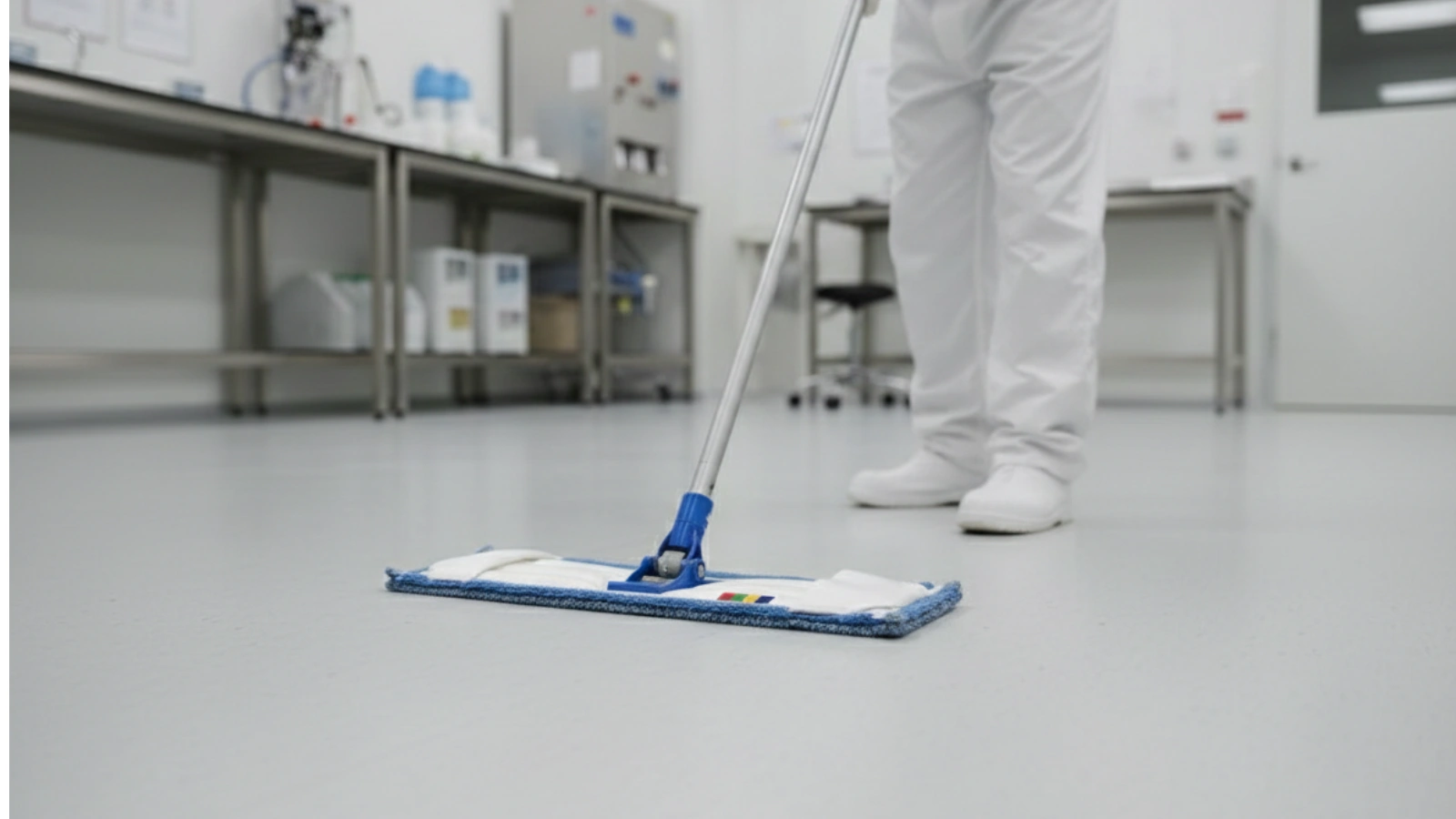
کلین روم موپ بمقابلہ ریگولر موپ—What Is the Difference and Why It Matters
If you are sourcing mops for a controlled environment, understanding the fundamental differences between cleanroom-grade and regular cleaning tools is the first step toward making a compliant procurement decision.
فوری جواب—What Is the Difference Between a Cleanroom Mop and a Regular Mop?
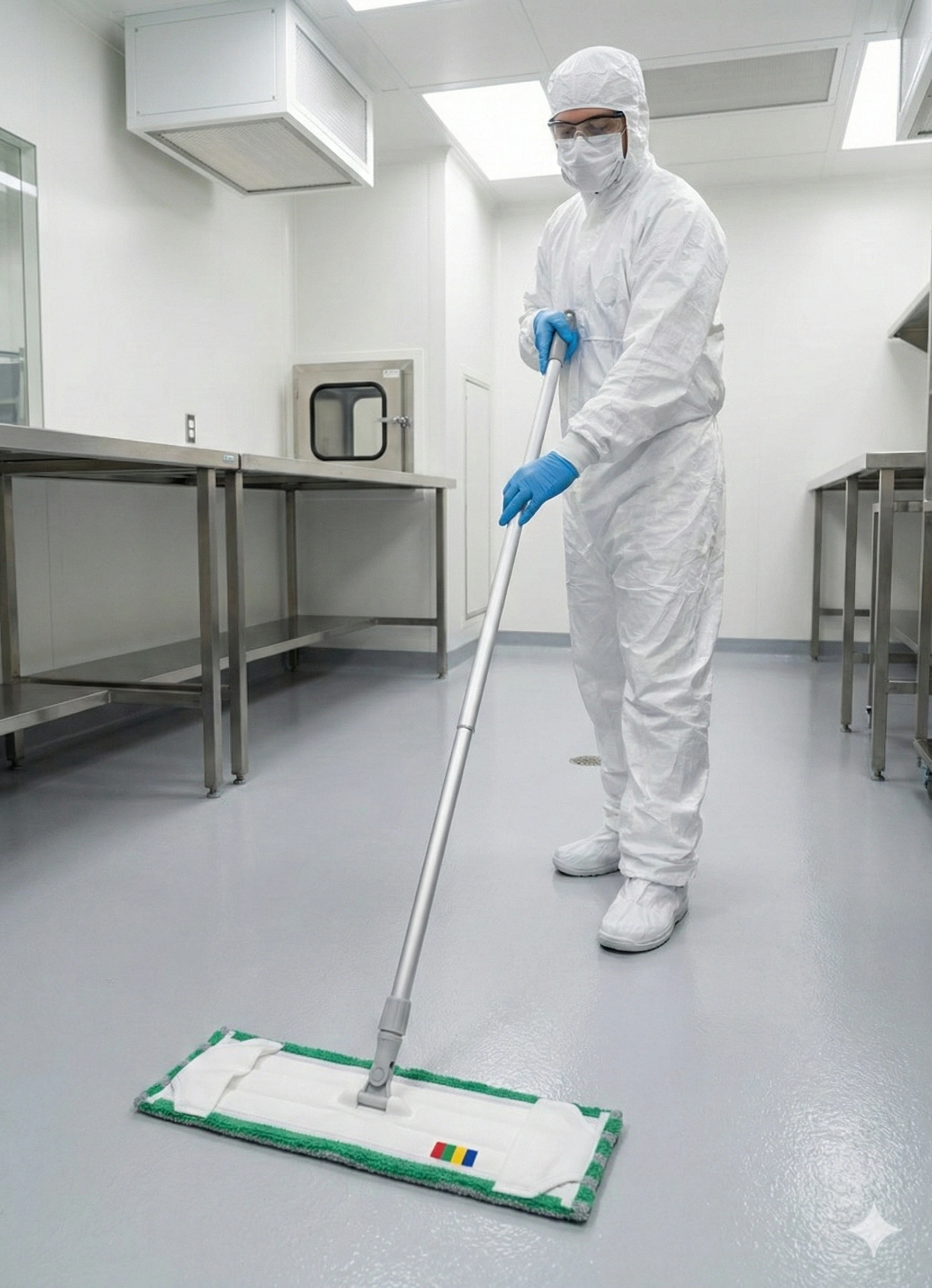
اے صاف کرنے کا کمرہ is an engineered cleaning tool designed specifically for controlled environments: it uses low-particle-shedding materials, is built as part of an integrated mop system (head, frame, handle), and is manufactured under documented quality systems with available batch-level certification. A regular mop—whether a commercial janitorial mop or an industrial cleaning mop—is built for general cleaning effectiveness, not for contamination control. It introduces unknown particle loads, uncontrolled materials, and no performance documentation.
Five Key Differences at a Glance
- 1. Material: Cleanroom mops use engineered polyester knit or microfiber with continuous filament construction to minimize fiber breakage. Regular mops typically use cotton, blended synthetics, or sponge—materials not designed for particle control.
- 2. Particle Control: Cleanroom mops are tested for particle generation and shedding under controlled conditions. Regular mops release uncontrolled particles with each use, incompatible with ISO 14644 classification limits.
- 3. Documentation: Cleanroom mops are supplied with batch-level Certificate of Analysis, material certifications, and (for sterile products) Certificate of Sterility. Regular mops come with no performance documentation.
- 4. System Integration: Cleanroom mops are part of an integrated system—mop head, frame, handle, and bucket are designed to work together. Regular mops are standalone products with no system compatibility.
- 5. Manufacturing Environment: Cleanroom mops are produced under controlled manufacturing conditions with documented quality systems. Regular mops are produced in standard industrial facilities without cleanroom-grade controls.
What Is a Regular Mop? (and Its Limitations in Controlled Environments)
A regular mop—the type found in commercial janitorial supply catalogs, industrial cleaning distributors, or retail stores—is designed for one purpose: visible cleaning effectiveness. It is built to remove visible soil, absorb liquids, and withstand mechanical scrubbing on standard flooring surfaces. The design criteria are durability, absorbency, and cost—not particle control, material traceability, or cleanroom compatibility.
Typical Construction
Regular mops are commonly made from cotton, blended synthetic fibers (e.g., polyester-cotton blends), rayon, or sponge materials. These fibers are typically staple (cut) fibers rather than continuous filaments, meaning they naturally shed short fiber fragments during use. The backing material, stitching thread, and any attached scrub strips are selected for durability, not for low-particle performance.
Cleaning Mechanism
Absorption plus mechanical friction—the mop soaks up liquid and the friction of the fibers against the floor dislodges soil. During this process, the mop itself releases fiber fragments, embedded particles from previous use (if reused), and residues from detergents or previous cleaning agents if not thoroughly rinsed.
Key Limitations for Cleanroom Use
- No particle performance data: No test results for particle generation, fiber shedding rate, or airborne particulate contribution.
- No material certification: Unknown fiber composition, no documentation of material origin or processing.
- No sterility option: Regular mops are not available in pre-sterilized, validated packaging configurations.
- Chemical compatibility unknown: The fiber material may degrade or react with cleanroom disinfectants (hydrogen peroxide, quaternary ammonium, peracetic acid).
- No system compatibility: A regular mop head will not fit cleanroom-specific mop frames or handles designed for controlled-environment workflows.
This is not a statement about regular mops being poorly made—many are well-constructed for their intended use. The limitation is that their intended use does not include controlled environments where airborne particle counts are monitored, documented, and regulated.
What Is a Cleanroom Mop? (and What Makes It Different)
A cleanroom mop is designed from material selection through final packaging to support contamination control in classified environments. Every aspect of its design serves a defined purpose in maintaining or improving the cleanliness of the controlled space.
Engineered Material
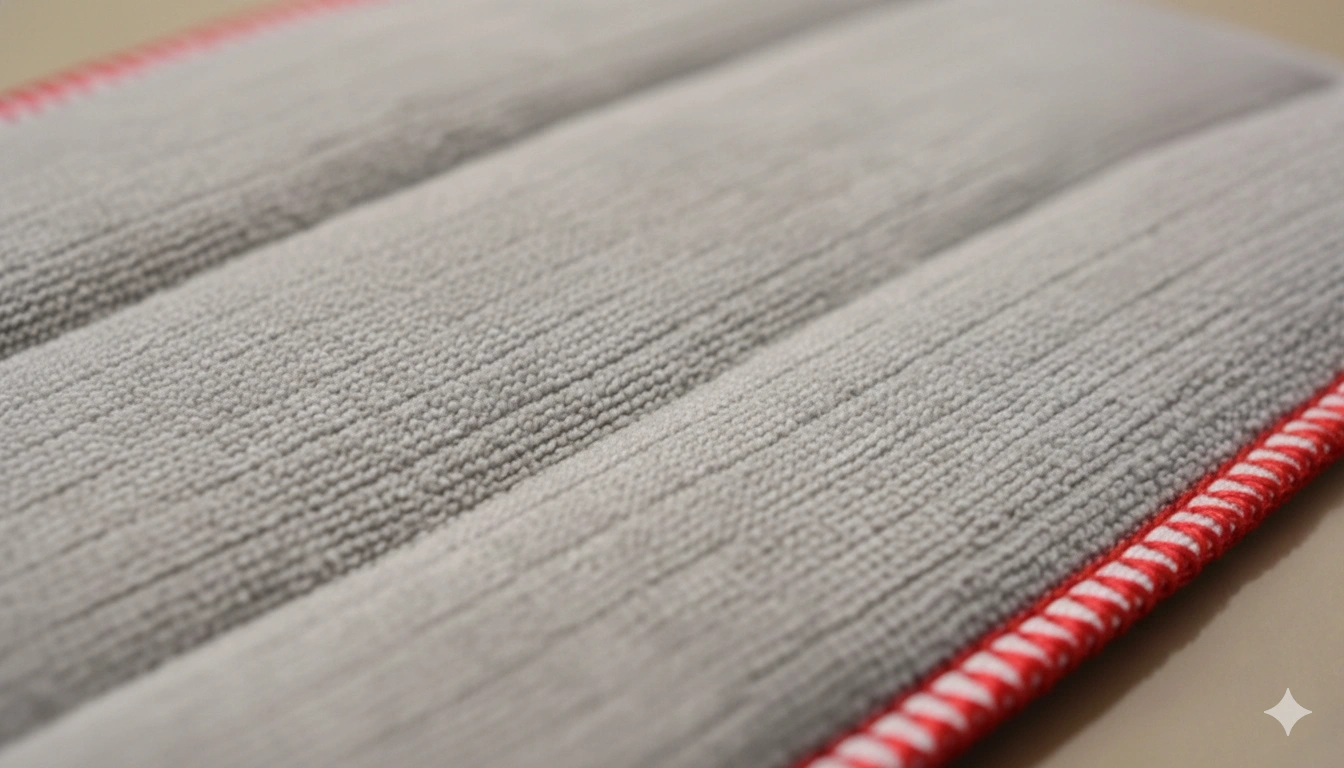
Cleanroom mops use polyester knit یا مائکرو فائبر constructions—typically continuous filament polyester—that minimize fiber breakage and particle generation. The fiber structure is selected for specific performance characteristics: polyester knit for durability and low shedding, microfiber for absorbency and particle capture efficiency. Each material choice is traceable to a specification and, when required, to a batch.
Integrated System Design
A cleanroom mop is not a standalone product. It is part of a mop system: the mop head attaches to a compatible frame (typically stainless steel or autoclavable polymer), which connects to a handle (often telescoping or fixed-length), which may interface with a cleanroom-grade bucket and wringer system. All components are designed to work together in a contamination-controlled workflow—no component is selected in isolation.
Documented Performance
Cleanroom mop suppliers provide batch-level documentation: Certificate of Analysis (COA) confirming material and construction specifications, Certificate of Sterility (CoS) for sterile products with sterility assurance level and sterilization method, Certificate of Conformance (CoC), and—when relevant—particle test data demonstrating low-lint performance. This documentation supports audit trail requirements and regulatory inspection readiness.
Sterile Configurations Available
For sterile manufacturing environments (GMP Grade A/B, ISO 5), cleanroom mops are available in pre-sterilized configurations: gamma-irradiated or EtO-sterilized, individually sealed in single or double-bagged packaging with validated integrity for aseptic transfer into the cleanroom. Regular mops offer no equivalent.
Controlled Manufacturing
Cleanroom mops are manufactured under documented quality management systems. While not all cleanroom mop manufacturing takes place inside a cleanroom, the production process includes controls for material cleanliness, particulate management, and batch traceability that are absent from regular mop production.
کلیدی اختلافات—کلین روم موپ بمقابلہ ریگولر موپ
The table below provides a side-by-side reference across the seven dimensions that most clearly distinguish cleanroom mops from regular cleaning mops.
| طول و عرض | کلین روم موپ | باقاعدہ Mop | یہ کیوں اہمیت رکھتا ہے۔ |
|---|---|---|---|
| مواد | Polyester knit or microfiber, continuous filament construction. Material spec traceable to batch. | Cotton, blended synthetics, rayon, sponge. Staple fibers. No material specification. | Continuous filament polyester minimizes fiber breakage and particle shedding—a direct requirement for ISO 14644 compliance. |
| پارٹیکل کنٹرول | Designed for low particle generation. Particle test data available on request. | No particle control in design. Unknown particle release during use—potentially thousands of particles per use event. | Uncontrolled particle shedding from a regular mop can push a cleanroom above its ISO classification particle count limit. |
| Sterility Option | Available pre-sterilized (gamma or EtO), individually packaged in single or double-bag configuration. CoS provided. | No sterile option. Cannot be sterilized post-purchase with validated sterility assurance. | GMP Grade A/B and EU GMP Annex 1 aseptic processing require sterile cleaning tools. |
| دستاویزات | COA, CoS (sterile), CoC, particle test data, material certifications. Batch-level traceability. | No documentation beyond basic product labeling. | During a regulatory audit, the auditor may request documentation for cleaning tools. A regular mop provides nothing to show. |
| System Design | Integrated system: mop head + frame + handle designed as a matched set for cleanroom workflow. | Standalone product. Head may not fit cleanroom frames or handles. | Using a regular mop head on a cleanroom frame creates an uncontrolled interface—the head may not attach securely or may detach during use. |
| Quality Manufacturing | Manufactured under documented QMS. Batch traceability from raw material to finished product. | Standard industrial manufacturing. No cleanroom-relevant quality controls. | Manufacturing consistency and traceability are prerequisites for supplier qualification in regulated industries. |
| Regulatory Suitability | Supports GMP, ISO 14644, and Annex 1 cleaning protocol requirements. | Not designed for any regulated cleanroom application. | Using a regular mop in a GMP-regulated cleanroom is a non-conformance that an auditor will note. |
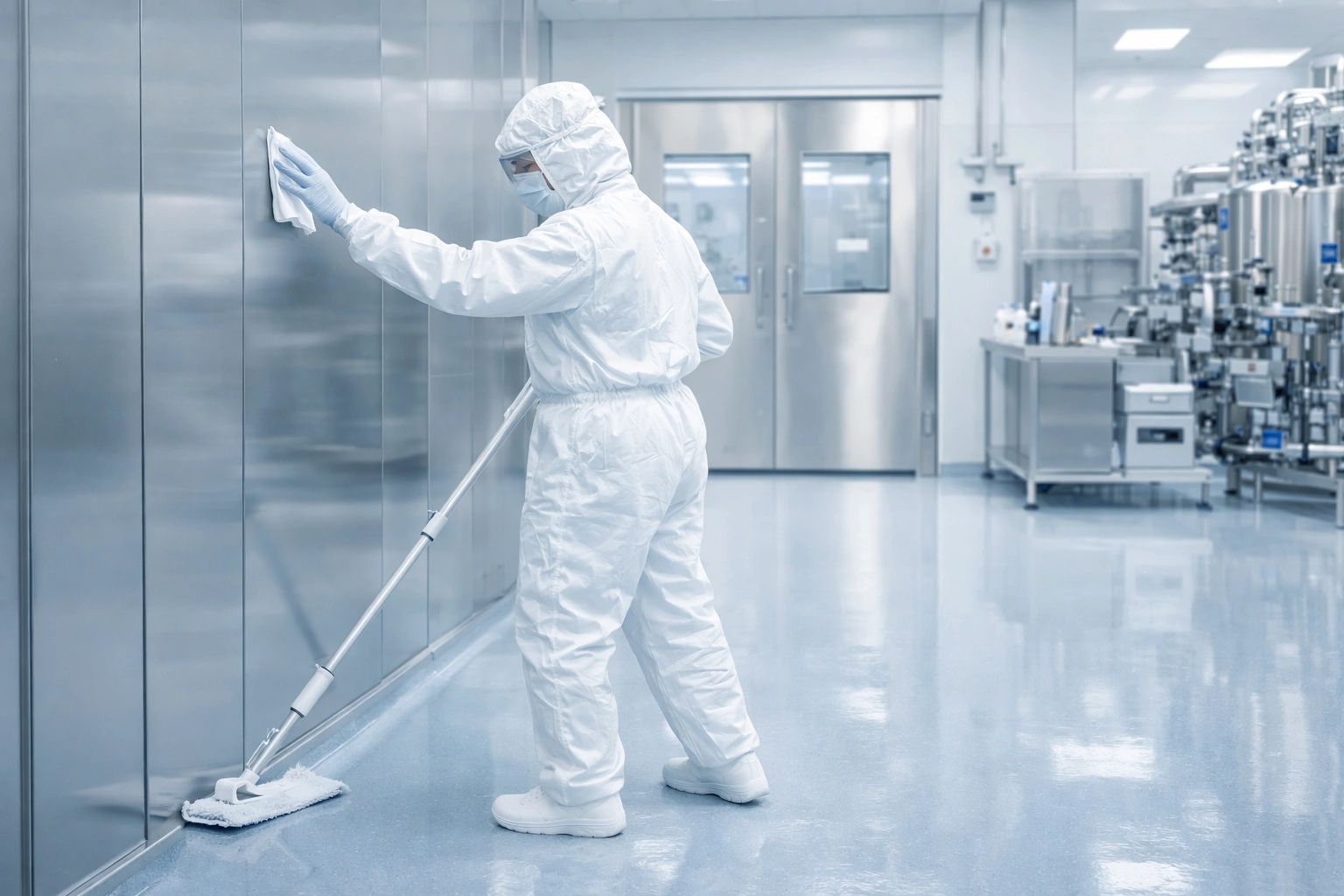
Why You Cannot Simply Use a Regular Mop in a Cleanroom
This is a question that procurement teams, new facility managers, and cost-review committees ask—and it deserves a direct answer. Using a regular mop in a cleanroom is not simply “not recommended”; it introduces specific, identifiable compliance and contamination risks.
1. Particle Contamination Exceeding ISO Classification Limits
Every cleaning event with a regular mop releases uncontrolled fiber fragments into the cleanroom air. These particles—ranging from visible lint to sub-micron fragments—contribute to the airborne particulate count that your facility monitors against ISO 14644-1 classification limits. A single regular mopping event can temporarily elevate particle counts above the classification threshold, triggering an environmental monitoring excursion.
2. Unknown Material Composition and Chemical Compatibility
When you don’t know exactly what a mop is made of, you cannot predict how it will interact with your cleaning and disinfection chemicals. Some synthetic materials degrade when exposed to hydrogen peroxide vapor, sodium hypochlorite, or peracetic acid—commonly used cleanroom disinfectants. Degradation may release additional particles, chemical residues, or both.
3. Audit Documentation Gap
During a GMP inspection or ISO audit, the auditor may ask: “What cleaning tools are used in your controlled areas? Please provide the material certification and particle performance data.” If a regular mop is in use, there is no documentation to provide—and the absence itself is an audit finding. This is not hypothetical: cleaning tools fall within the scope of contamination control review in both GMP and ISO 14644 audits.
4. System Mismatch with Existing Cleanroom Equipment
Regular mop heads are not designed to fit cleanroom mop frames. Attempting to use a regular mop head on a cleanroom frame—or a regular mop and handle in a cleanroom—creates an uncontrolled cleaning interface. The mop head may detach, the material may bunch, and the cleaning result is inconsistent and undocumented.
5. The Cost of Non-Compliance Exceeds the Savings
The appeal of using a regular mop is cost savings. But a single environmental monitoring deviation, audit finding, or—in the worst case—batch rejection triggered by contamination linked to cleaning tools will cost far more than the price difference between regular and cleanroom-grade mops over the facility’s operating lifetime. The risk-reward calculation is heavily one-sided.
When You Might Encounter This Question—Real Scenarios
The question “why can’t we just use a regular mop?” does not arise in a vacuum. It typically surfaces in one of the following situations. Recognizing the scenario helps you provide the right answer to the right audience.
New Facility Manager Inherits a Cleanroom With No Cleaning SOP
A newly hired facility manager walks into a cleanroom and finds cleaning staff using whatever mops were available from general procurement. There is no cleaning SOP, no tool specification, and no documented rationale for the cleaning tools in use. The manager needs to understand: what is actually different about cleanroom mops, and what needs to change—immediately.
What this person needs: A clear definition of cleanroom mop requirements backed by regulatory context, plus a practical transition plan.
Procurement Generalist Receives a Purchase Order for “Mops” Without Context
A procurement officer receives an internal requisition: “Buy 200 mops for the cleanroom.” Without understanding the distinction, they order industrial cleaning mops from the facility’s regular janitorial supplier—the same supplier that provides break-room supplies. The mops arrive, and QA rejects them.
What this person needs: A checklist of what “cleanroom mop” means in procurement terms—material requirements, documentation expectations, and supplier qualification criteria.
Cost-Cutting Proposal to Replace Cleanroom Mops With Industrial Mops
A cost-review committee identifies cleanroom mop procurement as a line item that is “more expensive than regular mops” and proposes switching to industrial-grade alternatives as a cost-saving measure. The QA team needs a defensible, evidence-based rebuttal that explains why the cost difference is justified.
What this person needs: A risk-based argument covering particle control, regulatory audit readiness, and the cost of non-compliance versus the savings from switching to regular mops.
Distributor Explaining the Difference to a First-Time Cleanroom Buyer
A distributor new to the cleanroom segment receives an inquiry from a customer building their first cleanroom. The customer asks: “I already have mops. Why do I need different ones for the cleanroom?” The distributor needs simple, accurate language to explain the distinction without overwhelming the customer with jargon.
What this person needs: Customer-facing language that translates technical requirements into business-accessible terms: “A cleanroom mop is documented, tested, and built not to add particles to your cleanroom.”
What to Look for When Selecting a Cleanroom Mop Supplier
Once you have established that regular mops are not suitable for your controlled environment, the next question is: how do you identify a genuine cleanroom mop supplier versus a supplier that simply labels standard products as “cleanroom-grade”?
Where to Go Next: From Definition to Decision
Now that you understand what makes a cleanroom mop different, the following resources help you move from understanding the category to making a specific procurement decision:
- Cleanroom mop system overview: A complete guide to cleanroom mop system components, material options, and application-fit assessment. Read the Cleanroom Mop System Overview
- Cleanroom Mop System Buyer Evaluation Framework: A structured guide to evaluating cleanroom mop systems across suppliers, comparing components, and verifying certifications. Read the Buyer Evaluation Framework
- Cleanroom Mop Head Weight Guide (40g, 55g, 65g): How to choose the right mop head weight based on cleaning area, absorbency requirements, and operator handling. Read the Mop Head Weight Guide
- Cleanroom mop head types: Detailed comparison of cleanroom mop head materials, constructions, and color-coding options. Explore Cleanroom Mop Head Types
- How to choose a cleanroom mop system: A practical selection framework covering facility grade, cleaning zone, material choice, and supplier evaluation. Read the Selection Guide
- ڈسپوز ایبل بمقابلہ دوبارہ پریوست کلین روم موپس — The Complete Buyer Decision Framework: Once you understand what a cleanroom mop is, the next strategic question is which operational model—disposable or reusable—fits your facility. Read the Disposable vs Reusable Decision Guide
اکثر پوچھے گئے سوالات
کلین روم ایم او پی اور ریگولر ایم او پی میں کیا فرق ہے؟
A cleanroom mop uses engineered low-particle-shedding materials (polyester knit or microfiber with continuous filament construction), is supplied with batch-level documentation (COA, material certifications), is part of an integrated mop system (head + frame + handle), and may be available in pre-sterilized configurations. A regular mop is built for visible cleaning effectiveness with uncontrolled materials and no performance documentation—it is not designed for, tested for, or suitable for controlled environments.
Why can’t I use a regular mop in a cleanroom?
A regular mop introduces uncontrolled particle shedding that can push your cleanroom above its ISO 14644 classification particle count limits. It also lacks material certification (audit documentation gap), may be chemically incompatible with cleanroom disinfectants, does not fit cleanroom mop frames, and offers no sterility option for sterile manufacturing zones. The cost savings of a regular mop are dwarfed by the compliance risk it introduces.
What materials are cleanroom mops made of?
Cleanroom mops are typically made from polyester knit (continuous filament construction for low particle shedding and durability) or microfiber (split-fiber construction for high absorbency and particle capture). Some specialty cleanroom mops use polyvinyl alcohol (PVA) sponge for specific liquid-handling applications. The key distinction is not the material name but that the material is engineered, specified, and tested for controlled-environment use.
Are cleanroom mops more expensive than regular mops?
On a per-unit basis, yes—cleanroom mops cost more because they use engineered materials, are manufactured under documented quality systems, and carry batch-level certification. However, the comparison is not meaningful because the two products serve fundamentally different purposes. The relevant comparison is the cost of compliant cleaning versus the cost of a potential contamination-related deviation, audit finding, or batch rejection.
Can I use my existing mop frame and handle with a cleanroom mop head?
In most cases, no. Cleanroom mop heads are designed to attach to specific cleanroom mop frames (typically stainless steel wire frames or autoclavable polymer frames with a specific pocket or clamp attachment mechanism). Regular mop frames may not provide a secure connection, and the frame material itself may not be cleanroom-compatible. It is recommended to purchase the mop head, frame, and handle as a matched system from the same supplier.
How do I know if a mop is truly suitable for cleanroom use?
Three indicators: (1) The supplier provides batch-level documentation—COA, material certifications, and particle test data—as standard, not only on request. (2) The mop is part of an integrated system with compatible frame, handle, and bucket components. (3) The supplier can answer technical questions about material specification, particle performance, and suitability for your specific cleanroom classification and cleaning protocol. If a supplier cannot provide these three things, the product may be a general cleaning product labeled as “cleanroom” without the supporting evidence.
Do cleanroom mops come in sterile and non-sterile options?
Yes. Cleanroom mops are available in both sterile (pre-sterilized via gamma irradiation or ethylene oxide, individually packaged with Certificate of Sterility) and non-sterile configurations. Sterile mops are used in GMP Grade A/B (ISO 5) aseptic manufacturing zones. Non-sterile mops are used in Grade C/D (ISO 7–8) support areas and non-sterile manufacturing environments. The same mop model may be available in both sterile and non-sterile versions, allowing consistent cleaning protocols across different facility zones.
Ready to Select the Right Cleanroom Mop System for Your Facility?
MIDPOSI provides complete cleanroom mop systems—mop heads, frames, handles, and bucket/wringer solutions—engineered for controlled environments with full documentation support. If you are transitioning from regular cleaning tools to cleanroom-grade equipment, our team can help you identify the right system configuration for your facility classification and cleaning protocol.
All MIDPOSI cleanroom mop systems include batch-level COA documentation. Sterile products include Certificate of Sterility. Technical consultation available for facility-specific system configuration.