دليل نظام دلو ممسحة غرف الأبحاث - إعداد GMP والمواد والاختيار
دلو ممسحة غرف الأبحاث ليس سلعة حراسة. في بيئة مصنفة وفقًا لمعايير GMP أو ISO، يصبح نظام الدلو جزءًا من استراتيجية التحكم في التلوث. تؤثر كيفية فصل المطهر ومياه الشطف والنفايات السائلة بشكل مباشر على استقرار المطهر والتحكم في العبء الحيوي وتكرار المشغل واستعداد التدقيق.
This guide explains how to evaluate single-, dual-, and triple-bucket configurations, when to choose stainless steel (SS304/SS316) or cleanroom-grade polypropylene, how wringer design affects particle control, and how to integrate the bucket system into a validated GMP cleaning workflow.
What Makes a Cleanroom Mop Bucket Different from Standard Commercial Buckets?
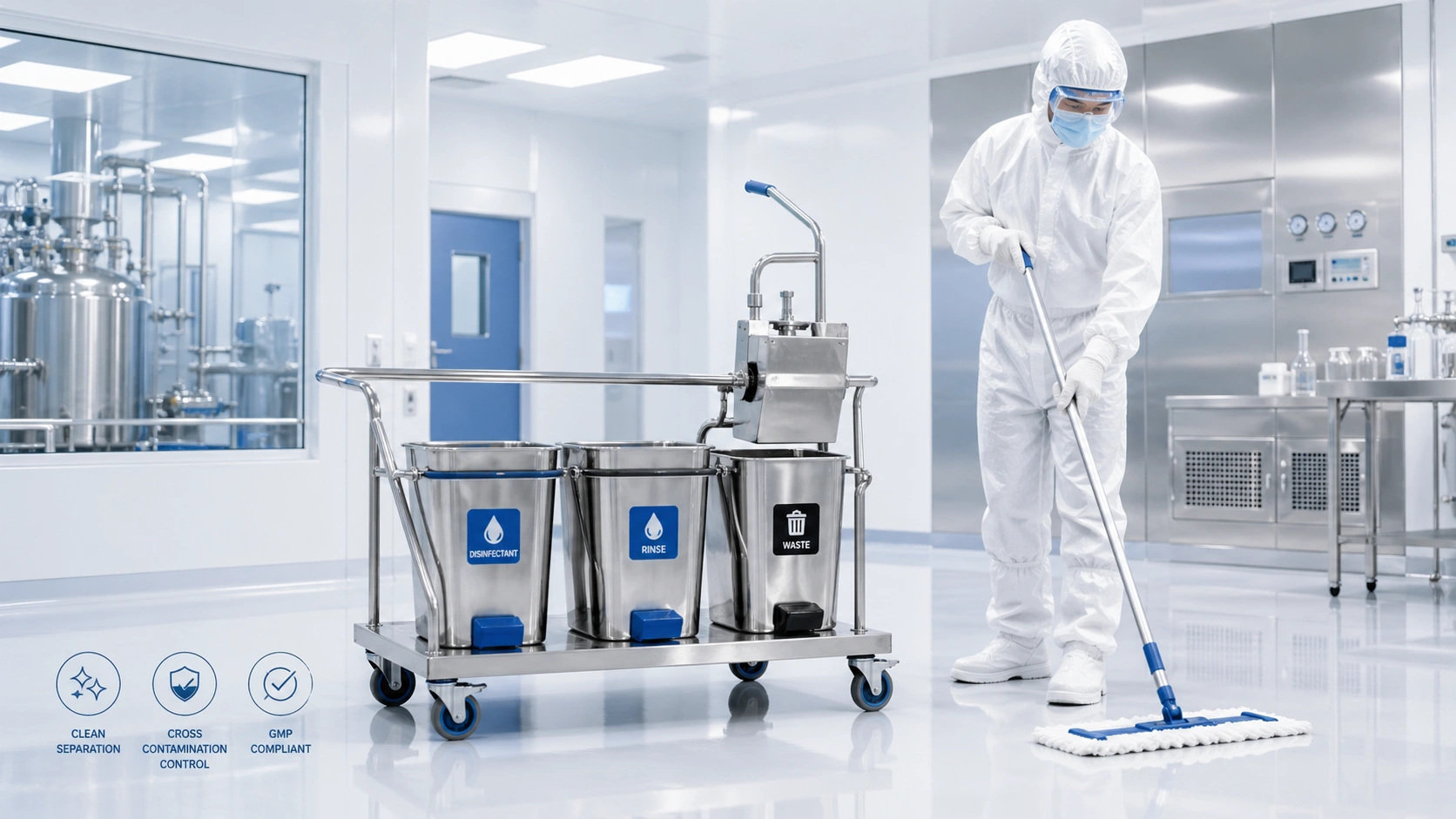
تم تصميم دلو ممسحة النظافة القياسية لتوفير السرعة والراحة. تم تصميم نظام دلو ممسحة غرف الأبحاث للتنظيف المتحكم فيه، وفصل السوائل، والأداء القابل للتكرار داخل البيئات المصنفة أو الخاضعة لأنظمة GMP.
تشتمل الدلاء التجارية الشائعة عادةً على أسطح بلاستيكية خشنة، أو طبقات مكشوفة، أو وصلات مفتوحة، أو عجلات منخفضة الجودة، أو مجموعات عصارة تحبس البقايا ويصعب تنظيفها. يمكن أن تؤدي هذه التفاصيل إلى إلقاء جزيئات أو تلوث أو تجعل من المستحيل التحقق من أن المعدات جاهزة للاستخدام التالي.
في غرفة الأبحاث، يجب أن يدعم الدلو عملية التنظيف بدلاً من أن يصبح مصدرًا إضافيًا للتلوث. تشمل متطلبات التصميم الرئيسية ما يلي:
- أسطح ناعمة وخالية من الشقوق ويمكن مسحها وفحصها
- اللحامات المستمرة والزوايا الداخلية المستديرة (لأنظمة الفولاذ المقاوم للصدأ)
- أسطح مصبوبة ناعمة ذات حواف قابلة للتنظيف (لأنظمة البولي بروبيلين)
- تصريف مناسب حتى لا يتجمع السائل في الزوايا أو حول حوامل العصارة
- التوافق الكيميائي مع الدورة المطهرة للمنشأة
- التوافق مع متطلبات SOP المكتوبة للتنظيف والتجفيف والتخزين
وتتوقع بيئات GMP وISO 14644 أيضًا أن تقلل أدوات التنظيف من توليد الجسيمات، وتدعم الإجراءات الموثقة، وتساعد المشغلين على الحفاظ على فصل واضح بين المطهر ومياه الشطف وسائل النفايات. إن نظام الجرافة المختار جيدًا يجعل تلبية هذه التوقعات أسهل وإظهارها أثناء عمليات التدقيق الداخلي وعمليات التفتيش التنظيمية.
إذا كنت تقوم بتقييم مواد الدلو إلى جانب رؤوس الممسحة والإطارات والمقابض، فراجعها بالكامل نظرة عامة على نظام ممسحة غرف الأبحاث لفهم كيفية عمل كل مكون معًا في سير عمل تنظيف متحكم فيه.
تكوينات دلو ممسحة غرف الأبحاث - أنظمة جرافة فردية، ومزدوجة، وثلاثية
نظام دلو واحد
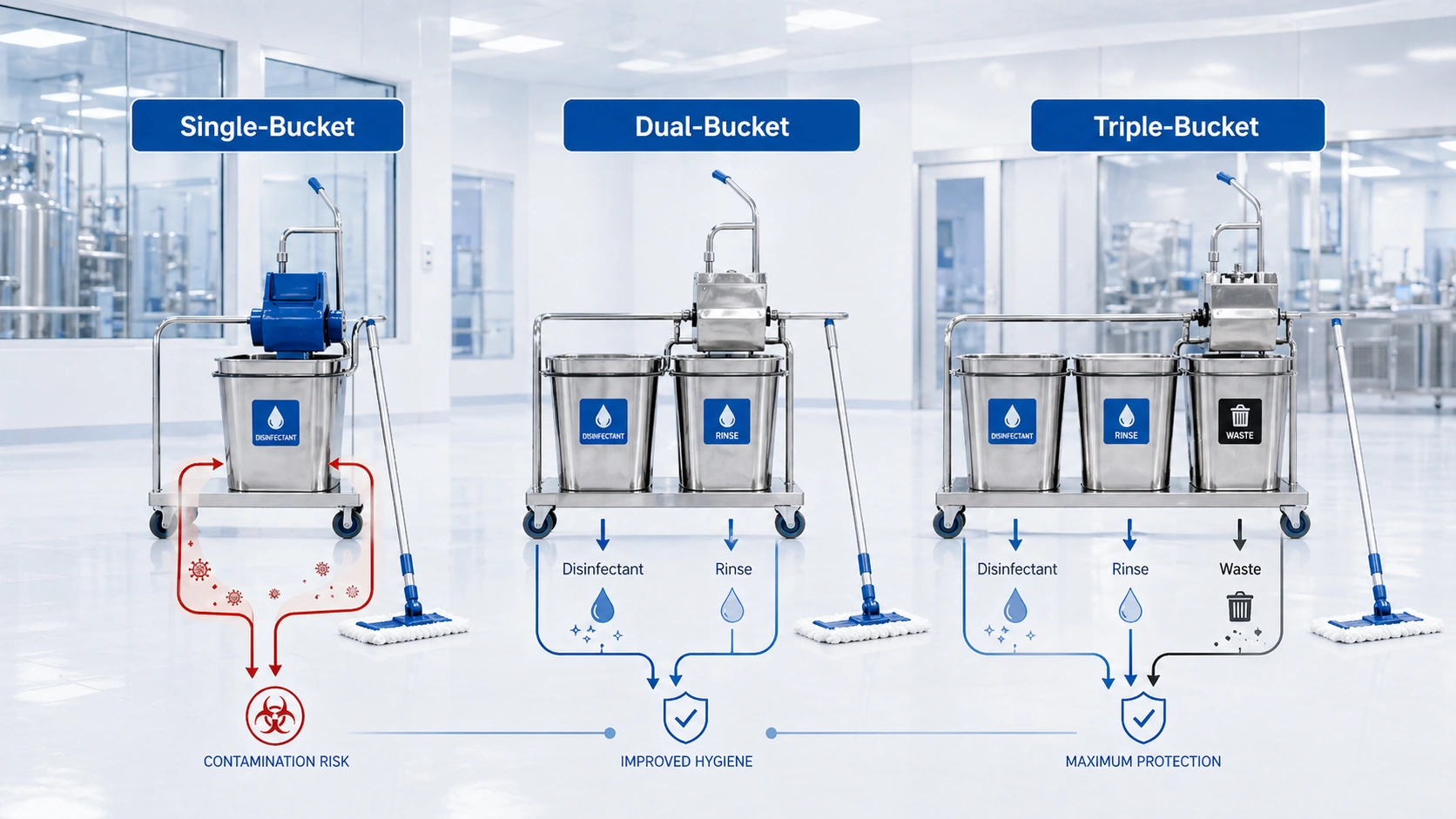
A single-bucket system uses one vessel for the cleaning or disinfectant solution. The mop is dipped, applied to the surface, and returned to the same bucket. This is the simplest arrangement but also the weakest from a contamination-control perspective — soil and removed bioburden flow back directly into the active solution.
Single-bucket systems may be acceptable for non-critical support areas where risk is low and the procedure is clearly defined. For GMP cleanroom cleaning, a single-bucket approach is difficult to justify because it provides no separation between clean solution and dirty return liquid.
Dual-Bucket System
A dual-bucket system separates the active cleaning or disinfectant solution from rinse water. Operators apply solution from the clean bucket, rinse the mop in the second bucket, wring the mop, and then return to the clean solution. This prevents dirty liquid from returning directly into the disinfectant bucket.
Dual-bucket configurations are commonly used in controlled areas where cleaning risk is moderate and the facility has defined change-out rules for rinse water and mop heads. They represent a practical balance between process control and operational simplicity.
Triple-Bucket System
A triple-bucket system separates disinfectant, rinse water, and waste liquid. The waste bucket receives all liquid wrung from the mop, which prevents contaminated liquid from mixing back into either the disinfectant or rinse bucket.
For pharmaceutical, biotech, aseptic support, and higher-grade GMP cleaning workflows, this layout provides the strongest process control. Each bucket has a clear single function: one for active solution, one for rinse, and one for waste collection. This clarity simplifies operator training and audit documentation.
Single-Bucket
Lowest complexity, weakest separation. Best reserved for low-risk or non-critical support areas where the procedure does not require fluid segregation.
Dual-Bucket
Separates clean solution and rinse water. Suitable for controlled cleaning routines when rinse water change-out and mop handling are clearly defined.
Triple-Bucket
Separates disinfectant, rinse water, and waste liquid. Preferred when contamination control, disinfectant stability, and process repeatability are priorities.
Wringer vs Press Systems — Which Mechanism for Your Facility?
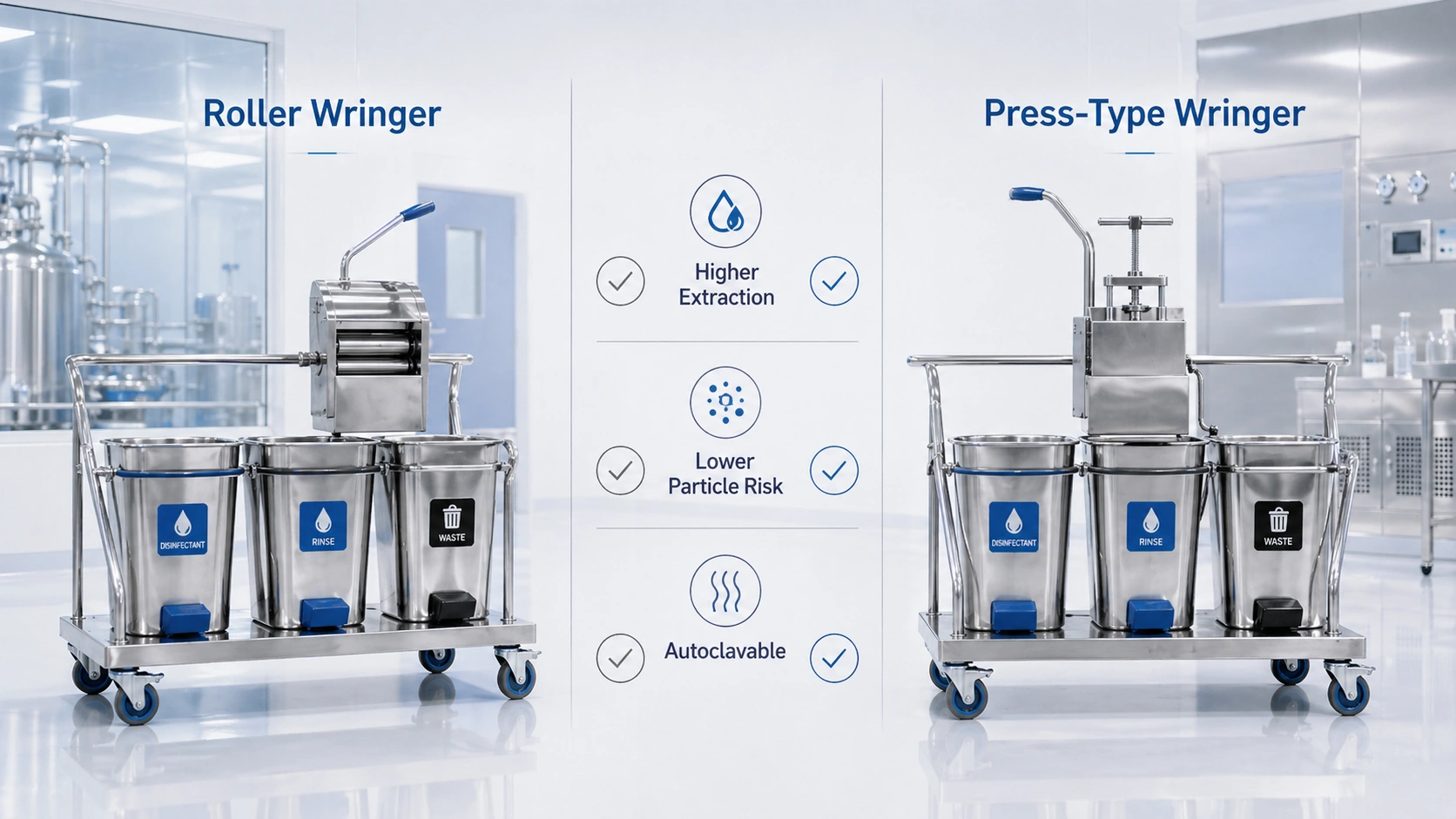
Roller Wringer
Roller wringers use rotating rollers to squeeze liquid from the mop head. They can provide efficient liquid extraction and are useful when operators need faster handling during larger-area cleaning.
The trade-off is mechanical complexity. Bearings, shafts, rollers, and connection points should be carefully reviewed for cleanability, corrosion resistance, and particle generation risk. Roller systems with exposed lubrication points or inaccessible joints may not be suitable for higher-grade cleanroom environments.
Press-Type Wringer
Press-type wringers use a basket, plate, or compression mechanism to remove liquid from the mop head. They are typically simpler in construction with fewer moving parts, which can make them easier to clean, inspect, and validate.
For Grade A/B support zones and other sensitive cleanroom workflows, a press-type wringer is often preferred because it reduces the number of components that must be assessed for particle shedding and cleanability. The final decision should be based on mop head type, cleaning area size, operator ergonomics, and sterilization requirements.
| عامل | Roller Wringer | Press-Type Wringer |
|---|---|---|
| Liquid extraction | Generally stronger, consistent across the mop head | May vary by operator pressure and mop head thickness |
| Mechanical complexity | More moving parts (rollers, bearings, shafts) | Fewer moving parts; simpler construction |
| قابلية التنظيف | Requires inspection of roller gaps and bearing points | Easier to wipe down; fewer inaccessible areas |
| خطر الجسيمات | Roller wear can generate particles over time | Lower moving-part risk; inspect compression surfaces |
| التوافق الأوتوكلاف | Must verify all roller components rated for steam | Must verify basket/plate material rated for steam |
| Best suited for | Larger-area cleaning; Grade C/D environments | Grade A/B support zones; sensitive workflows |
How Bucket Configuration Affects Bioburden Control and Disinfectant Use
Bucket configuration directly affects how quickly the cleaning liquid becomes loaded with soil, residue, and removed bioburden. The more separation the system provides, the easier it is to maintain the active solution at an effective concentration throughout the cleaning cycle.
Fluid Separation and Bioburden Management
When contaminated liquid returns to the same bucket holding the disinfectant, the active solution is progressively diluted and loaded with organic material. This can reduce disinfectant efficacy and increase the risk of re-depositing contamination onto cleaned surfaces. A system that directs waste liquid into a dedicated bucket preserves the integrity of both the disinfectant and rinse water.
Disinfectant Dilution Prevention
Disinfectant dilution is a practical risk in any workflow that allows used liquid to return to the active solution. In a triple-bucket system, waste liquid is wrung into the waste bucket, so the disinfectant remains concentrated at its prepared level for a longer practical duration. This can help facilities define clearer rules for solution change-out, waste handling, and cleaning coverage per batch.
Residue Re-Deposition Control
When a mop head carries soil and returns it to the disinfectant, the next application may transfer residue back onto surfaces already cleaned. Clear fluid separation — between disinfectant, rinse, and waste — helps reduce this cycle. Combined with defined mop head change-out rules, it supports a more consistent cleaning outcome.
Operator Movement and Particle Generation
Bucket system design also affects operator movement. Unstable carts, awkward wringer positions, or difficult-to-push configurations can force operators to use excessive motions. In cleanrooms, unnecessary movement contributes to particle generation. Smooth-rolling casters, stable frames, appropriate wringer height, and clear bucket positioning support controlled, low-friction cleaning operations — especially when operators are in full gowning.
When evaluating how bucket design fits into a complete cleaning program, see the إطار تقييم مشتري نظام ممسحة غرف الأبحاث for a structured approach to comparing equipment across material, workflow, and validation dimensions.
Recommended Bucket Materials — Stainless Steel (304/316) vs Polypropylene

SS304 and SS316 Stainless Steel
Stainless steel bucket systems are commonly selected for facilities that need long service life, repeated cleaning cycles, and strong mechanical durability. SS316 is preferred when the system may contact stronger disinfectants or when enhanced corrosion resistance is required — for example, in facilities using chlorine-based disinfectants or aggressive oxidizers.
When evaluating stainless steel systems, review weld quality, surface finish (polished surfaces are preferred for cleanability), caster design, and whether the wringer and frame components are also constructed from compatible, cleanroom-suitable materials.
Cleanroom-Grade Polypropylene (PP)
Polypropylene bucket systems are lightweight, easy to maneuver, and cost-effective. They are practical for facilities that need multiple dedicated sets, area-specific allocation, or lower initial capital investment. PP is also inherently resistant to pitting corrosion from chloride-based disinfectants, which can be an advantage in certain chemical environments.
The main consideration is service life. PP buckets should be inspected regularly for cracking, whitening, warping, surface degradation, or loss of fit around lids and wringer components. Facilities should define a replacement schedule based on observed wear rather than waiting for visible failure.
مصفوفة التوافق الكيميائي
| Disinfectant or Process | SS316 Stainless Steel | Cleanroom-Grade PP |
|---|---|---|
| 70% كحول الأيزوبروبيل (IPA) | Generally compatible when surfaces are properly maintained | Generally compatible at normal room temperature |
| Hydrogen Peroxide (H2يا2) | Good compatibility, dependent on concentration and exposure time | Good compatibility for many controlled cleaning applications |
| Sodium Hypochlorite (NaOCl) | Requires careful control; chloride exposure increases pitting corrosion risk | No pitting corrosion; repeated oxidizer exposure may age the polymer over time |
| مركبات الأمونيوم الرباعية | Generally compatible | Generally compatible |
| Peracetic Acid | Compatibility depends on concentration; review per manufacturer specifications | Generally compatible at typical use concentrations |
| Autoclave Exposure (121°C / 134°C) | Strong long-term durability when all components are designed for steam exposure | Can be suitable depending on resin grade and cycle frequency; requires regular inspection |
| Weight and Handling | Heavier, more stable, higher operator effort to maneuver | Lighter, easier to move, lower physical strain on operators |
| Typical Selection Logic | Best for long service life and high-frequency GMP cleaning programs | Best for lightweight handling, dedicated-area sets, or lower initial investment |
How Material Choice Affects Long-Term Cost
Stainless steel typically has a higher initial purchase cost but may provide better long-term value when the system is used frequently and needs durable, long-term performance. PP can be more economical when use volume is lower, the system is dedicated to a single area, or the facility benefits from lighter handling.
The best financial decision includes more than the purchase price. Factor in expected replacement frequency, cleaning method, disinfectant exposure, operator ergonomics, and the operational cost of requalification when equipment is changed or replaced.
Ideal Mop Bucket Setup by Facility Type
Different facility types present different cleaning risk profiles, room classifications, and regulatory expectations. The table below provides a practical starting point for matching bucket system configurations to facility types.
| Facility Type | Typical Grade / ISO Class | Recommended Configuration | Preferred Material | الاعتبار الرئيسي |
|---|---|---|---|---|
| تصنيع الأدوية | Grade A/B (ISO 5) — aseptic filling | Triple-bucket | SS316 stainless steel | Strongest fluid segregation required; compatible with aggressive disinfectant rotation; autoclave-ready components |
| تصنيع الأدوية | Grade C/D (ISO 7/8) — support areas | Triple-bucket or dual-bucket | SS304 or cleanroom-grade PP | Balance segregation needs with operational throughput; defined change-out rules |
| التكنولوجيا الحيوية / البيولوجيا | Grade A/B (ISO 5) — cell therapy, aseptic processing | Triple-bucket | SS316 stainless steel | Dedicated systems per product area; strong visual management with clear labeling and color coding |
| التكنولوجيا الحيوية / البيولوجيا | Grade C/D (ISO 7/8) — process support | Dual-bucket minimum | SS304 or PP | Coordinate with disinfectant rotation schedule; confirm change-out frequency |
| تصنيع الأجهزة الطبية | ISO 7/8 (Class 10,000/100,000) | Dual-bucket or triple-bucket | Cleanroom-grade PP or SS304 | May benefit from PP for lighter handling across larger floor areas; verify chemical compatibility with cleaning agents |
| Compounding Pharmacy (USP <797>/<800>) | ISO 5/7 (buffer and ante areas) | Triple-bucket | SS304 or cleanroom-grade PP | Strong waste segregation for hazardous drug compounding; dedicated systems per HD/non-HD area |
SOP Integration Points
Regardless of facility type, the bucket system should support — not complicate — the written SOP. Key integration points include:
- Solution preparation: Which bucket holds what; preparation time and expiry labelling
- Fill levels: Bucket size should balance coverage area against operator handling; overfilled buckets are harder to move and more likely to spill
- Mop change-out: When mop heads are replaced (per area, per room, after visible soil, per batch)
- التعامل مع النفايات: When and how waste liquid is emptied, treated, and disposed
- Post-use cleaning: Bucket cleaning, rinsing, drying, inspection, and storage before next use
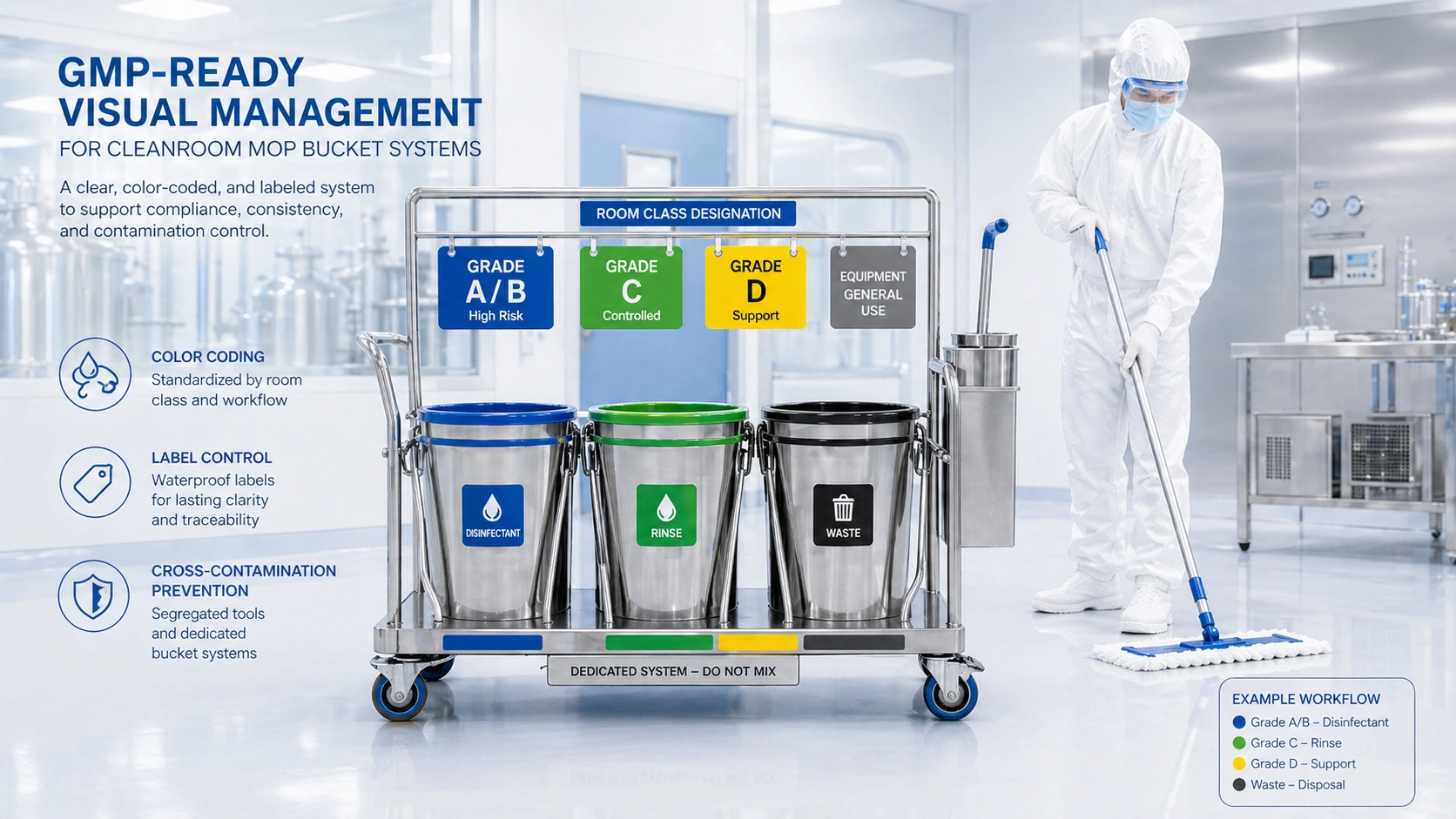
- Visual management: Labels, color coding, and area dedication that operators can recognize quickly and reliably
For application-specific guidance on matching cleaning tools to GMP grade requirements, review the دليل اختيار درجة ممسحة غرف الأبحاث GMP و cleanroom mop solutions for GMP facilities.
Cleanroom Mop Bucket Selection Checklist
Use this checklist when evaluating or procuring a bucket system for GMP-controlled cleaning. Each point addresses a factor that affects contamination control, operator workflow, or audit readiness.
- Room classification and risk level. Identify the target ISO class, GMP grade, and cleaning risk for each area. Higher-risk areas (Grade A/B, ISO 5) should default to triple-bucket systems with maximum fluid segregation.
- Bucket configuration requirement. Determine whether single, dual, or triple-bucket fits the cleaning risk. For GMP cleanroom areas, single-bucket should be the exception, not the default.
- Material selection: stainless steel or PP. Match material to disinfectant chemistry, sterilization method, cleaning frequency, and expected service life. Document the rationale for the selected material.
- Wringer type. Evaluate roller wringer vs press-type wringer based on particle generation risk, cleanability, autoclave compatibility, and operator handling. Consider having the wringer evaluated by the facility’s contamination control or validation team.
- Caster and mobility assessment. Check caster material, smoothness, locking mechanism, and compatibility with the cleanroom floor surface. Unstable or rough-rolling carts increase operator movement and particle generation.
- Drainability and cleanability. Inspect bucket shape, internal corners, wringer mounting points, and drainage. The system should allow complete emptying, rinsing, drying, and visual inspection without complicated handling.
- Visual management setup. Plan labels, color coding, and area designation before deployment. Labels must be durable enough to survive the cleaning and sterilization process.
- SOP compatibility. Confirm the bucket system supports — rather than complicates — the written procedures for solution preparation, mop change-out, waste handling, and post-use cleaning.
- Sterilization method. If autoclaving, verify all components are rated for steam exposure. Confirm loading procedures allow proper steam contact and drainage. If chemical sterilization is planned, verify full material compatibility.
- Spare parts and replacement schedule. Identify wear items (casters, wringer components, seals, labels) and establish a replacement schedule. Document the procurement lead time for critical spare parts.
- تدريب المشغلين. Plan training on the exact workflow: where to load the mop, where to wring, when to rinse, when to change the mop head, and when to empty the waste bucket. Training records should be maintained per SOP.
- Validation and monitoring integration. حدد كيف يتناسب نظام الدلو مع اتجاهات المراقبة البيئية. إذا تغيرت نتائج الجسيمات أو الميكروبات بعد التنفيذ، فيجب أن يكون نظام الدلو - جنبًا إلى جنب مع رأس الممسحة وتقنية المشغل - جزءًا من نطاق التحقيق.
سير عمل التنظيف سهل التحقق من الصحة باستخدام أنظمة الجرافات
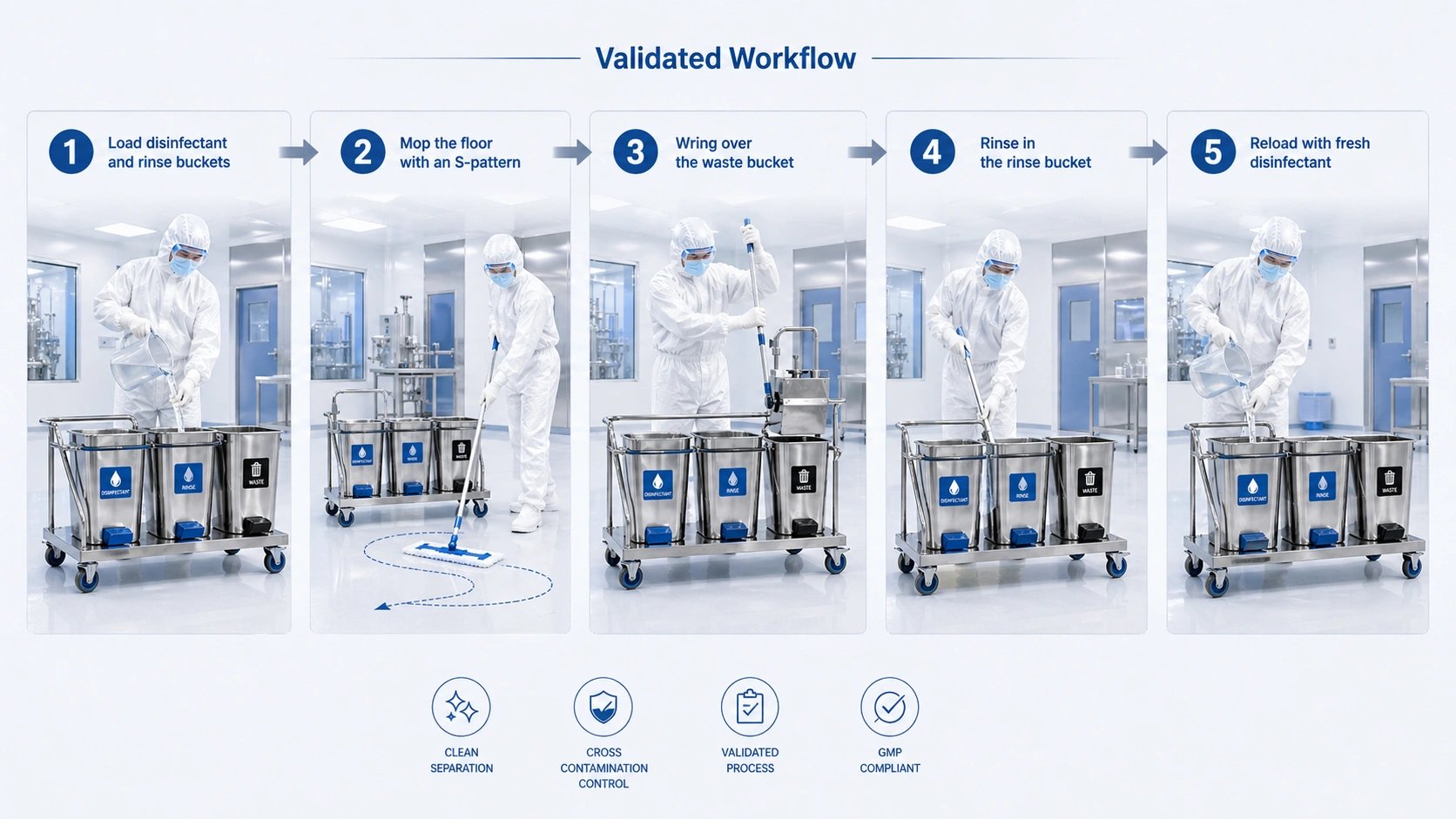
A validation-friendly workflow is repeatable, documentable, and designed so that each step has a clear purpose. The triple-bucket workflow below is structured for GMP environments where fluid segregation and operator consistency are priorities.
Prepare the Bucket System
Verify bucket labels and confirm the target area. Load disinfectant into the first bucket, rinse water (WFI or purified water as specified) into the second bucket, and leave the third bucket ready for waste collection. Record disinfectant type, concentration, preparation time, and expiry time per the facility SOP.
Mop with a Controlled Pattern
قم بتطبيق محلول التنظيف باستخدام نمط S متناسق ومتداخل. الهدف هو تحقيق تغطية كاملة للسطح مع تجنب المناطق المفقودة أو حركة المشغل غير الضرورية. اعمل من المناطق الأنظف إلى الأقل نظافة داخل الغرفة.
نعصر في دلو النفايات
بعد أن تلامس الممسحة الأرض، قم بعصر السائل الملوث في دلو النفايات. لا تعيده إلى دلو المطهر. هذه هي ميزة التحكم المركزي في سير العمل ثلاثي الجرافة.
اشطف الممسحة
اشطف الممسحة في دلو ماء الشطف للتخلص من الأتربة والمطهر المتبقي من رأس الممسحة. بعد الشطف، اعصر مرة أخرى في دلو النفايات، وليس في دلو الشطف.
أعد تحميله بمطهر طازج
Return the mop to the disinfectant bucket only after the rinse and waste steps are complete. This sequence keeps the active solution cleaner and more stable throughout the cleaning cycle.
Post-Cleaning: Empty, Clean, Inspect, Store
After cleaning is complete, empty all buckets per the facility waste-handling procedure. Clean, rinse, dry, inspect, and store the bucket system. Document any observations per the SOP and prepare for the next use.
Operator Technique: Common Pitfalls
- Skipping the rinse step. Returning a soiled mop directly to the disinfectant dilutes and contaminates the active solution.
- Walking over wet cleaned surfaces. This re-contaminates the cleaned area and can transfer particles from footwear to the floor.
- Over-wetting the floor. يمكن أن يتجمع السائل الزائد في المناطق المنخفضة ويترك بقايا مطهرة مما يعقد عملية مراقبة السطح.
- أدوات الخلط بين المناطق. إن استخدام نفس نظام الدلو عبر المناطق دون إزالة التلوث يتعارض مع غرض فصل المنطقة.
- الاستمرار في استخدام رأس الممسحة المتسخة بشكل واضح. يجب تغيير رؤوس الممسحة وفقًا للفاصل الزمني المحدد — وليس عندما يقرر المشغل أنها تبدو متسخة.
للحصول على نهج منظم لتوثيق إجراءات التنظيف، راجع دليل SOP لتطهير غرف الأبحاث للامتثال لـ GMP و قائمة التحقق من صحة سير عمل ممسحة غرف الأبحاث.
نظام دلو ممسحة غرف الأبحاث — الأسئلة المتداولة
ما هو نظام دلو ممسحة غرف الأبحاث؟
نظام دلو ممسحة غرف الأبحاث عبارة عن إعداد تنظيف يتم التحكم فيه مصمم لإدارة المطهر وشطف الماء والنفايات السائلة أثناء تنظيف أرضية غرفة الأبحاث والأسطح. وعلى عكس جرافات النظافة التجارية، فهي مصنوعة من أسطح قابلة للتنظيف، ومواد مقاومة للمواد الكيميائية، وقدرة على فصل السوائل لدعم سير عمل التنظيف المصنف وفقًا لمعايير GMP وISO. ويتمثل دورها الأساسي في مساعدة المشغلين على الحفاظ على الفصل النظيف إلى المتسخ مع اتباع إجراء موثق قابل للتكرار.
هل نظام الدلو الثلاثي أفضل دائمًا من نظام الدلو المزدوج؟
يوفر نظام الدلو الثلاثي فصلًا أقوى للسوائل لأنه يحافظ على فصل النفايات السائلة عن كل من المطهر ومياه الشطف. ويُفضل هذا بشكل عام بالنسبة لعمليات سير عمل التنظيف GMP من الدرجة A/B، والمعقمة، وذات المخاطر العالية. قد يكون نظام الجرافة المزدوج مناسبًا للمناطق من الدرجة C/D والتنظيف الخاضع للتحكم منخفض المخاطر عندما يتم تحديد واتباع قواعد التغيير لمياه الشطف ورؤوس الممسحة بشكل واضح. يجب أن يتوافق الاختيار النهائي مع مخاطر التنظيف، وليس الافتراضي العالمي.
هل يجب أن أختار الفولاذ المقاوم للصدأ (SS316) أو البولي بروبيلين (PP) لدلاء ممسحة غرف الأبحاث الخاصة بي؟
SS316 stainless steel is typically selected for long service life, frequent use, and high-durability GMP cleaning programs. It offers strong corrosion resistance and withstands repeated autoclave cycles. Cleanroom-grade polypropylene is lighter, easier to maneuver, and cost-effective — suitable for dedicated-area use, lower-volume cleaning, or facilities that prefer reduced operator physical strain. The selection should be based on disinfectant chemistry compatibility, sterilization method, cleaning frequency, and budget. Neither material is universally correct — each serves different operational priorities.
Which wringer type — roller or press — is better for cleanroom cleaning?
Press-type wringers are generally simpler, with fewer moving parts, making them easier to clean, inspect, and validate. They are often preferred for Grade A/B support zones and sensitive workflows. Roller wringers may provide more consistent liquid extraction across the mop head but introduce additional mechanical components (bearings, shafts, rollers) that should be carefully reviewed for particle generation risk and cleanability. The decision should weigh cleanability requirements against liquid extraction efficiency, operator ergonomics, and sterilization compatibility.
How does a cleanroom mop bucket system support GMP compliance?
وهو يدعم الامتثال لممارسات التصنيع الجيدة (GMP) من خلال تمكين عملية تنظيف خاضعة للرقابة وقابلة للتكرار. يساعد النظام المختار بشكل صحيح المشغلين على فصل السوائل النظيفة والقذرة، واتباع قواعد التغيير المحددة، وإدارة النفايات، وتوثيق سير العمل بشكل أكثر وضوحًا. كما أنه يوفر الاتساق الهيكلي اللازم لاتجاهات المراقبة البيئية - عندما تتغير نتائج الجسيمات أو الميكروبات، يكون نظام الدلو متغيرًا محددًا وقابلاً للمراجعة وليس متغيرًا غير قابل للتحكم.
هل يمكنني استخدام نظام دلو واحد في غرفة الأبحاث GMP؟
A single-bucket system is difficult to justify in GMP cleanroom areas because it provides no separation between clean disinfectant and dirty return liquid. It may be acceptable for non-classified support spaces, corridors, or areas where the cleaning risk is demonstrably low and the procedure is clearly defined. For any area subject to GMP cleaning requirements, a dual-bucket or triple-bucket configuration provides stronger process control and is easier to defend during audits.
What role does visual management play in cleanroom bucket systems?
تعمل الإدارة المرئية - ترميز الألوان، وتسميات الوظائف، وتعيين المنطقة، وتحديد الحلول - على تقليل ارتباك المشغل واختلاط الأدوات أثناء التنظيف الروتيني. قد يتم ترميز المنشأة حسب درجة الغرفة، أو منطقة المنتج، أو نوع المطهر، أو تسلسل التنظيف. الشرط الرئيسي هو الاتساق: يجب أن يكون المشغلون قادرين على التعرف على الجرافة الصحيحة والاستخدام المقصود منها على الفور. يجب أن تظل الملصقات وأشرطة الألوان متينة خلال دورات التنظيف والتطهير والتعقيم.
كم مرة يجب استبدال أو إعادة تأهيل دلاء ممسحة غرف الأبحاث؟
يعتمد تكرار الاستبدال على المادة وكثافة الاستخدام وكيمياء التنظيف وطريقة التعقيم. قد تعمل أنظمة SS316 لسنوات مع الصيانة والفحص المناسبين. يجب فحص أنظمة PP بشكل متكرر بحثًا عن التشقق أو التزييف أو تدهور السطح أو فقدان ملاءمة المكونات. استبدل أي نظام دلو عندما يؤدي التلف المرئي أو التآكل أو التآكل إلى إضعاف قابلية التنظيف أو السلامة الهيكلية. قم بتضمين إعادة التأهيل في إجراء التحكم في التغيير عند تبديل مادة الجرافة أو التكوين أو المورد.
Need a Cleanroom Mop Bucket System for Your GMP Facility?
يدعم MIDPOSI برامج تنظيف غرف الأبحاث للأجهزة الصيدلانية والتكنولوجيا الحيوية والطبية باستخدام أنظمة الممسحة وتكوينات الدلاء وخيارات الممسحة التي يمكن التخلص منها وإرشادات الاختيار الخاصة بالتطبيق. سواء كنت تقوم بتقييم عملية شراء لأول مرة أو ترقية سير عمل التنظيف الحالي، تحدث معنا لمقارنة خيارات التكوين والمواد والتوافق لمتطلبات التنظيف في منشأتك.
أدوات تنظيف غرف الأبحاث الاحترافية للبيئات الخاضعة للرقابة - مدعومة بإرشادات الاختيار المنظمة ووثائق التطبيق.