
Diese Standardarbeitsanweisung legt einen risikobasierten Ansatz für die Umgebungsüberwachung in GMP-Reinräumen fest und umfasst die Auswahl von EM-Standorten, Probenahmeverfahren, Überwachungshäufigkeit, Alarm- und Aktionsgrenzen, Trends, CAPA, Änderungskontrolle und Schulung.
Es ist für Pharma-, Biotech-, Medizingeräte- und kontrollierte Produktionsanlagen konzipiert, die ein dokumentiertes und vertretbares Umweltüberwachungsprogramm benötigen, das auf Reinraumrisiken, Prozesskritikalität und Erwartungen an die Kontaminationskontrolle abgestimmt ist.

Eine risikobasierte Umweltüberwachungs-SOP hilft GMP-Reinräumen, die mikrobiologische Kontrolle aufrechtzuerhalten, indem sie Überwachungsorte, Probenahmemethoden, Häufigkeiten, Alarmgrenzen, Aktionsniveaus, Trendregeln und CAPA-Arbeitsabläufe basierend auf dem Kontaminationsrisiko definiert.
Verwenden Sie ein strukturiertes Risikomodell, um Überwachungspunkte nach Personalaktivität, Luftstromstörung, Nähe zu Klasse A, Materialtransfer und historischer Alarmrate zu priorisieren.
Passen Sie die Überwachungsmethoden und -frequenzen an die Reinraumqualität, die Risikobewertung und die Prozesskritikalität an.
Überwachen Sie kontinuierlich Trends und definieren Sie Alarm- und Aktionsreaktionen, bevor es zu Abweichungen kommt.
Verknüpfen Sie Warnungen mit dokumentierten Untersuchungen, Ursachenanalysen, Korrekturmaßnahmen und Wirksamkeitsüberprüfungen.
Kontrollieren Sie alle EM-Programmänderungen durch von der Qualitätssicherung genehmigte Änderungskontrolle und regelmäßige Schulungen.
| Version | Datum | Beschreibung | Hergestellt von | Genehmigt von |
|---|---|---|---|---|
| 1,0 | 23.03.2026 | Erstausgabe | Qualitätssicherung | Qualitätsmanager |
Diese SOP legt einen risikobasierten Ansatz für die Umweltüberwachung (EM) in GMP-Reinräumen fest. Der Zweck besteht darin, sicherzustellen, dass Reinraumumgebungen innerhalb spezifizierter mikrobiologischer Grenzen bleiben, einen systematischen Rahmen für die EM-Standortauswahl bereitzustellen, Überwachungshäufigkeiten festzulegen, die dem Risikoniveau entsprechen, Verfahren für Probenahme, Analyse und Datenverwaltung zu definieren und die Einhaltung von EU GMP Annex 1, FDA cGMP und ISO-basierten Reinraumbetriebserwartungen zu unterstützen.
MIDPOSI-Hinweis: Die Ergebnisse der Umgebungsüberwachung stehen in engem Zusammenhang mit der Durchführung der Reinigung, der Kleidungsdisziplin, den Reinraumwerkzeugen und den Verbrauchsmaterialien zur Kontaminationskontrolle. Informationen zu entsprechenden Reinigungskontrollen finden Sie im Leitfaden von MIDPOSI Pharmazeutischer Reinraum-Mopp-Reinigungs-SOP.
| Begriff | Definition |
|---|---|
| Aktive Luftprobenahme | Volumetrische Luftprobenahme mit Impaktoren, Schlitzprobenehmern oder anderen geeigneten Geräten zur Erfassung von in der Luft befindlichen Mikroorganismen. |
| Alarmstufe | Ein festgelegter Grad an mikrobieller Kontamination, der auf eine mögliche Abweichung von den normalen Betriebsbedingungen hinweist. |
| Aktionsebene | Ein festgelegter Grad an mikrobieller Kontamination, der eine Untersuchung, dokumentierte Reaktion und Korrekturmaßnahmen erfordert. |
| Kritische Zone | Ein Bereich der Klasse A oder mit dem höchsten Risiko, in dem es zu aseptischen Vorgängen oder direkter Produktexposition kommen kann. |
| Risikobasierte EM-Standortmatrix | Ein strukturiertes Risikobewertungstool zur Bewertung von EM-Standorten basierend auf Aktivität, Luftstrom, Materialbewegung, Nähe zu kritischen Betrieben und historischen Daten. |
| Absetzplatte | Eine Nähragarplatte, die zur passiven Luftüberwachung über einen definierten Expositionszeitraum der Umgebung ausgesetzt wird. |
| CAPA | Korrektur- und Vorbeugemaßnahmen zur Behebung bestätigter oder potenzieller Fehler im Qualitätssystem. |
| Rolle | Verantwortlichkeiten |
|---|---|
| Qualitätssicherungsmanager | Gesamtgenehmigung des EM-Programms, Änderungskontrolle, Einhaltung gesetzlicher Vorschriften, Überprüfung von Abweichungen und CAPA-Genehmigung. |
| Mikrobiologie-Manager | Durchführung von EM-Programmen, Methodenqualifizierung, Probenüberprüfung, Untersuchungsunterstützung und Schulungsaufsicht. |
| Mikrobiologietechniker | Probenentnahme, Inkubation, Kolonieablesung, Dateneingabe und sofortige Benachrichtigung über Alarm- oder Aktionsergebnisse. |
| Produktionsleiter | Wartung des Reinraumbetriebs, Kontrolle des Personalverhaltens, Einhaltung der Kleidung und Produktionsunterstützung bei Untersuchungen. |
| Technischer Leiter | HVAC-Wartung, Überprüfung des Luftstrommusters, Druckkaskadenunterstützung und technikbezogene CAPA-Aktionen. |
| Qualitätskontrollmanager | Datenüberprüfung, Trendanalyse, wiederkehrende Alarmauswertung und technischer Support für die Ursachenanalyse. |
Alle Umweltüberwachungsstandorte werden anhand eines risikobasierten Bewertungsrahmens ausgewählt. Das Ziel besteht darin, die Probenahmeintensität auf Bereiche mit höherem Kontaminationsrisiko, höherer Produktexposition, mehr Personalaktivität, stärkerer Luftstromstörung und wiederkehrendem Alarmverlauf zu konzentrieren.
RISK SCORE = (Personnel Activity × 0.30) + (Airflow Disturbance × 0.25)
           + (Proximity to Critical Zone × 0.20) + (Material Transfer × 0.15)
           + (Historical Alert Rate × 0.10)
Punktebereich: 0–100. Die Bewertung sollte während der anfänglichen Reinraumqualifizierung, nach Layoutänderungen, nach wesentlichen Prozessänderungen und während der regelmäßigen Überprüfung des EM-Programms überprüft werden.
| Risikobewertung | Einstufung | Überwachung erforderlich |
|---|---|---|
| 80–100 | Kritisch | Kontinuierliche oder sehr hochfrequente Überwachung erforderlich. |
| 60–79 | Hoch | Feste Standortüberwachung mindestens einmal pro Schicht oder pro definiertem Produktionszeitraum. |
| 40–59 | Mäßig | Rotierende Überwachung, typischerweise wöchentlich oder basierend auf der Prozessfrequenz. |
| 20–39 | Niedrig | Regelmäßige Überwachung, normalerweise monatlich oder während der Routineüberprüfung. |
| 0–19 | Minimal | Eine Überwachung ist möglicherweise nicht erforderlich, es sei denn, Risikoänderungen oder Trenddaten geben Anlass zur Sorge. |
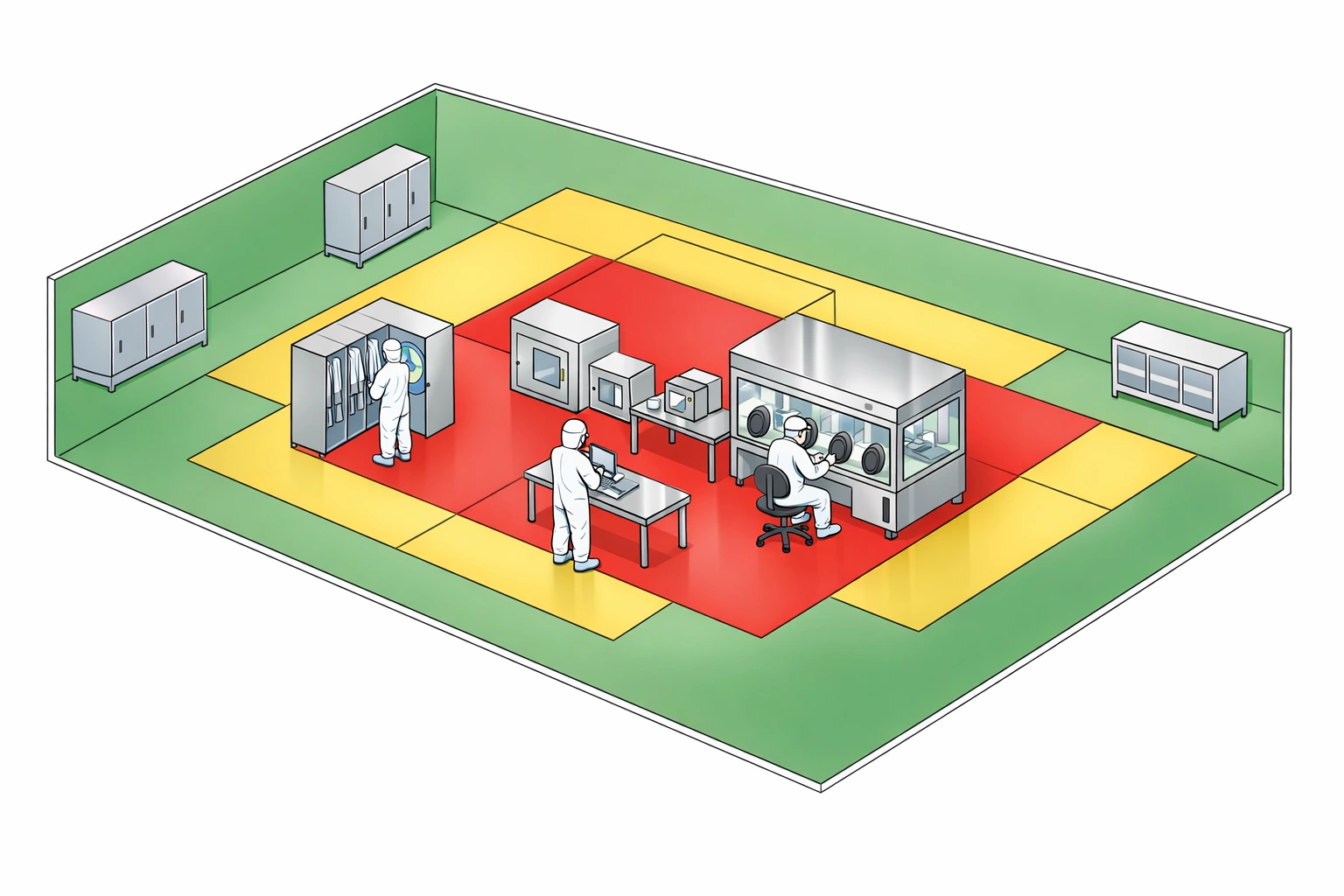
Probenahmeorte und -häufigkeiten sollten nach Reinraumqualität, Risikobewertung, Produktexpositionsrisiko, historischer Alarmrate und Betriebsverkehr zugewiesen werden. Höherwertige Bereiche erfordern eine engere Frequenz, eine stärkere Ausrichtung und eine geringere Abweichungstoleranz.
| Reinraumqualität | Typische EM-Priorität | Sampling-Logik |
|---|---|---|
| Klasse A | Kritisch | Überwachen Sie kritische Zonen, aseptische Eingriffe, Abfüllstellen, exponierte Produktbereiche und Orte, die direkt von der ersten Luft betroffen sind. |
| Note B | Hoch | Überwachen Sie die Hintergrundumgebung rund um die Klasse A, die Bewegungswege des Personals, Übergabepunkte und Interventionszonen. |
| Klasse C | Mäßig | Überwachen Sie Unterstützungsbereiche, Vorbereitungsräume, Bereitstellungsbereiche für Geräte und Zonen mit Materialbewegungen. |
| Klasse D | Niedrig bis mittel | Überwachen Sie Supportbereiche mit geringerem Risiko, Eingangskorridore, Bereitstellungsbereiche und Standorte mit wiederkehrendem Alarmverlauf. |
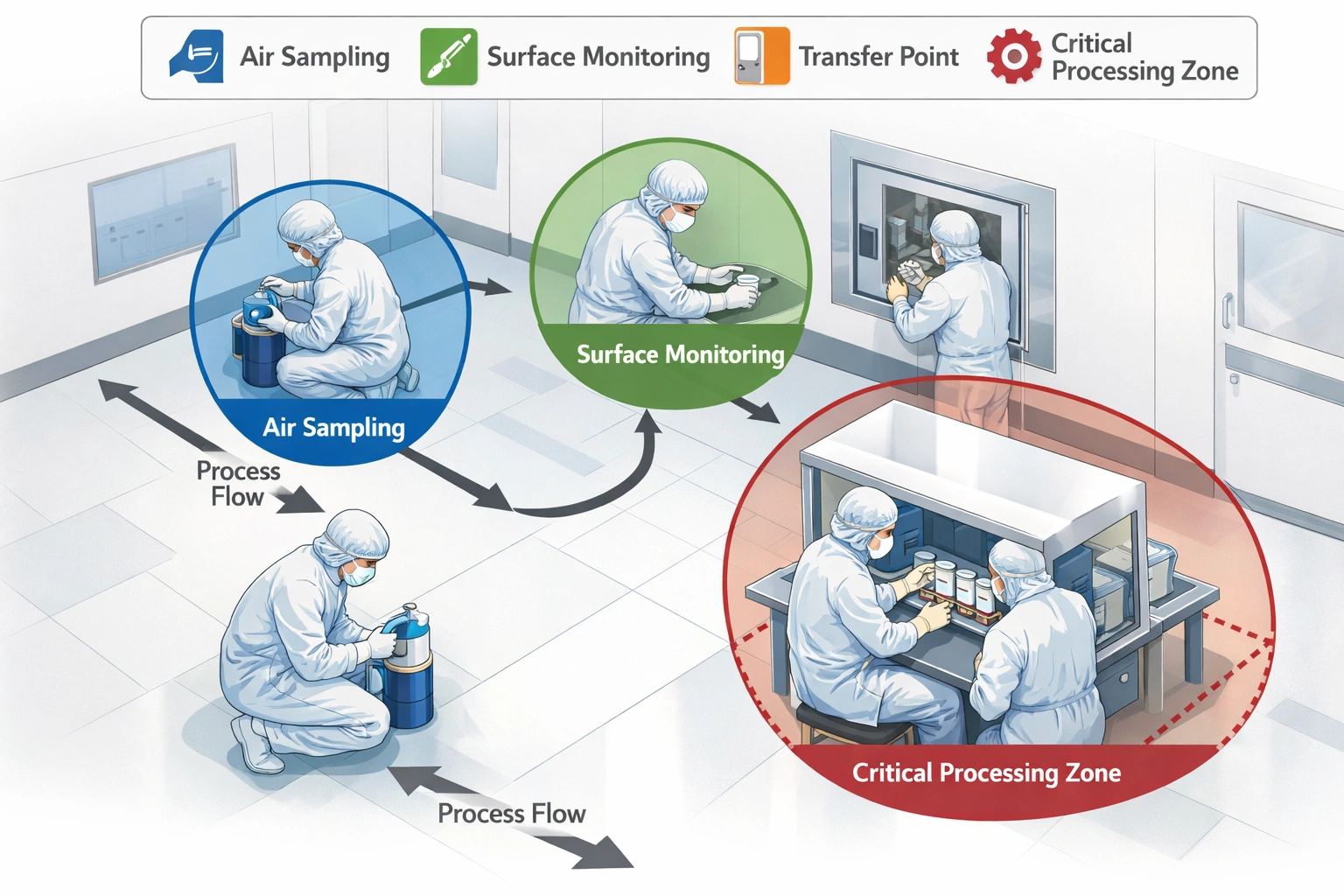
| Ausrüstung | Spezifikation | Platzierung | Durchflussrate | Dauer |
|---|---|---|---|---|
| SAS-Probenehmer oder qualifizierter Luftkeimsammler | Einstufiges oder anlagenzugelassenes Gerät | In der Nähe einer kritischen Oberfläche, ohne den Prozessluftstrom zu stören | Pro Gerätequalifikation | Pro Probenahmeplan und Gebietsgrad |
| Plattentyp | Größe | Platzierung | Expositionszeit | Höhe |
|---|---|---|---|---|
| TSA | 90mm | Unter oder in der Nähe des definierten Überwachungspunkts | Pro SOP oder Prozessdauer | Repräsentativ für die Arbeitshöhe |
| SDA | 90mm | Angrenzend an den definierten Überwachungspunkt | Pro SOP oder Prozessdauer | Repräsentativ für die Arbeitshöhe |
Die Oberflächenüberwachung sollte sich auf produktberührende Bereiche, Transferpunkte, häufig berührte Oberflächen, Geräteschnittstellen, Böden in der Nähe stark frequentierter Zonen und Standorte mit historischen Alarmtrends konzentrieren. Die Personalüberwachung sollte Handschuhe, Kittelärmel, Brust, Unterarme oder andere vor Ort definierte Stellen umfassen, basierend auf dem Kittelrisiko und der aseptischen Aktivität.
Die Ergebnisse der Oberflächenüberwachung können durch Bodenreinigungswerkzeuge und die Technik des Bedieners beeinflusst werden. Auch Einrichtungen, die wiederholte bodenbezogene Exkursionen prüfen, können eine Bewertung vornehmen Reinraum-Flachwischsysteme, Mikrofaser-Reinraummopps, Und Validierungsdokumente für Reinraummopps.
Die Überwachungshäufigkeit sollte entsprechend der Reinraumklasse, der Risikobewertung, der Prozesskritikalität und der historischen Trendleistung zugewiesen werden. Kritische Standorte und Standorte mit hohem Risiko erfordern eine kontinuierliche oder einmal pro Schicht durchgeführte Überprüfung, während Standorte mit mittlerem und geringem Risiko möglicherweise wechselnde wöchentliche oder monatliche Zeitpläne verwenden.
| Risikokategorie | Typische Häufigkeit | Beispielstandorte |
|---|---|---|
| Kritisch | Kontinuierlich, pro Charge oder pro Vorgang | Kritische Zonen der Klasse A, aseptische Eingriffe, exponierte sterile Produktbereiche |
| Hoch | Jede Schicht oder jeder Produktionstag | Hintergrund der Klasse B, Transferpunkte, berührungsempfindliche Oberflächen |
| Mäßig | Wöchentlicher oder rotierender Zeitplan | Supporträume der Klasse C, Vorbereitungszonen, Bereitstellungsbereiche für Ausrüstung |
| Niedrig | Monatliche oder regelmäßige Überprüfung | Korridore der Klasse D, Lagerunterstützungszonen, Bereiche mit geringem Verkehrsaufkommen |

Alarmgrenzen weisen auf eine mögliche Abweichung von den normalen Betriebsbedingungen hin und lösen eine Überprüfung aus. Aktionsstufen erfordern eine sofortige Untersuchung, gegebenenfalls eine Bewertung der Produktauswirkungen, Korrekturmaßnahmen und eine Überprüfung der Wirksamkeit. Die Grenzwerte sollten an der Reinraumqualität, der Probenart, der Prozesskritikalität, der historischen Leistungsfähigkeit und den behördlichen Erwartungen ausgerichtet sein.
| Ebene | Bedeutung | Typische Reaktion |
|---|---|---|
| Alarmstufe | Frühzeitige Warnung vor möglichen Abweichungen von den Normalbedingungen. | Dokumentieren, überprüfen Sie den Trend, benachrichtigen Sie die verantwortliche Funktion und erwägen Sie eine verbesserte Überwachung. |
| Aktionsebene | Bestätigter inakzeptabler Zustand oder erhebliche Abweichung. | Abweichungen offenlegen, Untersuchungen durchführen, Produktauswirkungen bewerten, CAPA definieren und Wirksamkeit überprüfen. |
| Wiederkehrende Warnung | Wiederholter Alarm an demselben Ort, derselben Methode, demselben Organismustyp oder demselben Zeitraum. | Führen Sie Trenduntersuchungen durch und überprüfen Sie Reinigung, Personal, HVAC, Materialfluss und Werkzeugleistung. |
Die Daten sollten nach Möglichkeit in Echtzeit überprüft und nach Standort, Grad, Methode, Organismus, Schicht, Kampagne und Exkursionsverlauf analysiert werden. Monatliche KPI-Dashboards sollten die Qualitätssicherungsüberprüfung, die Managementüberprüfung, Entscheidungen zur Kontaminationskontrolle und die CAPA-Priorisierung unterstützen.
Wenn eine Alarm- oder Aktionsstufe überschritten wird, sollte die Untersuchung Probenahmefehler, Personalverhalten, Reinigungsausführung, Leistung von Reinraumgeräten, HVAC-Zustand, Materialtransfer, Gerätestatus und Prozessaktivität zum Zeitpunkt der Probenahme bewerten.
[ALERT OR ACTION TRIGGERED]
       │
       ▼
Immediate Notification and Documentation
       │
       ▼
Initial Assessment
       │
   ┌───┼───┐
   │   │   │
Sampling  Personnel  Environment/
Method    Behavior    Equipment
   │   │   │
   └───┼───┘
       ▼
Root Cause Analysis
       │
       ▼
Corrective and Preventive Action
       │
       ▼
Effectiveness Verification and Trend Review
Wenn CAPA auf die Leistung des Reinigungsgeräts, die Lieferantendokumentation oder das mit dem Mopp verbundene Kontaminationsrisiko hinweist, lesen Sie die Leitlinien von MIDPOSI So qualifizieren Sie einen Lieferanten für pharmazeutische Reinraummopps Und Chargenrückverfolgbarkeit für pharmazeutische Reinraummopps.
Jede Änderung, die sich auf das Anlagenlayout, die Ausrüstung, den Personalfluss, den Überwachungsort, die Risikobewertung, die Probenahmemethode, den Reinraumreinigungsprozess, den Umkleideprozess oder die Auswahl der Verbrauchsmaterialien auswirkt, muss vor der Implementierung oder gegebenenfalls vor der Wiederaufnahme der Produktion unter Änderungskontrolle überprüft werden.
Das gesamte relevante Personal muss vor der Durchführung von EM-Aktivitäten geschult werden. Die Schulung sollte aseptisches Verhalten, Probenahmedurchführung, Dateneingabe, Alarmreaktion, CAPA-Workflow, Änderungskontrollanforderungen und Datenintegritätserwartungen abdecken.
| Trainingsbereich | Erforderlich für | Frequenz |
|---|---|---|
| EM SOP und Probenahmetechnik | Personal für Mikrobiologie und Probenahme | Erste und jährliche Auffrischung |
| Aseptisches Verhalten und Ankleiden | Reinraumpersonal | Anfänglich, jährlich und abweichungsgesteuert |
| Warnung/Aktionsreaktion | Qualitätssicherung, Qualitätskontrolle, Produktion, Technik | Anfänglich und nach SOP-Änderung |
| Datenintegrität | Alle Mitarbeiter, die EM-Aufzeichnungen bearbeiten | Erste und regelmäßige Auffrischung |
Die Umweltüberwachung ist eng mit Reinigungswerkzeugen, Reinraumkleidung, Verbrauchsmaterialien zur Kontaminationskontrolle und Lieferantendokumentation verknüpft. Diese zugehörigen MIDPOSI-Ressourcen können dabei helfen, EM-Ergebnisse mit praktischen Reinraumkontrollen zu verbinden.
MIDPOSI liefert Reinraumbekleidung, Wischsysteme und Verbrauchsmaterialien zur Kontaminationskontrolle für Pharmazeutik, Biotechnologie, medizinische Geräte und kontrollierte Produktionsumgebungen. Wenn Ihre EM-Trends auf Risiken im Zusammenhang mit der Reinigung, der Kleidung oder den Verbrauchsmaterialien hinweisen, kann unser Team Ihnen bei der Prüfung geeigneter Produktoptionen behilflich sein.