~9 minutes de lecture
Trois décisions de configuration définissent chaque combinaison de salle blanche. Ce guide aide les responsables des programmes d'approvisionnement, d'assurance qualité et d'habillage à faire correspondre la bonne configuration au bon niveau de salle blanche.
Qu'est-ce qu'une combinaison pour salle blanche et pourquoi la configuration est importante
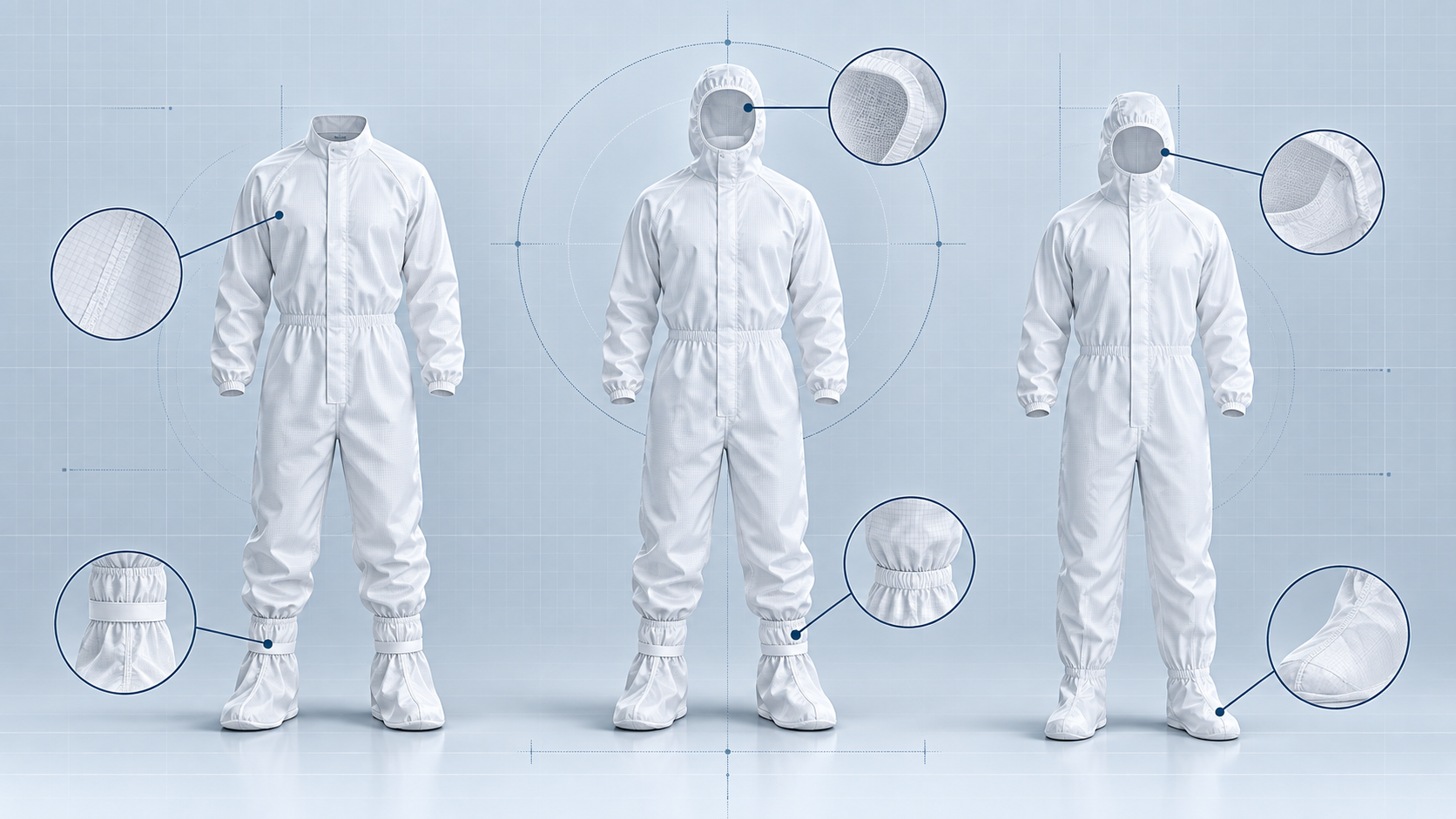
UN combinaison de salle blanche est un vêtement intégral d'une seule pièce qui couvre le torse, les bras et les jambes - le composant de confinement de plus grande surface dans tout programme de vêtements pour salle blanche. Contrairement aux vêtements de protection à usage général, une combinaison pour salle blanche est conçue pour minimiser la perte de particules provenant de l'opérateur tout en fournissant une barrière constante entre la personne et l'environnement contrôlé.
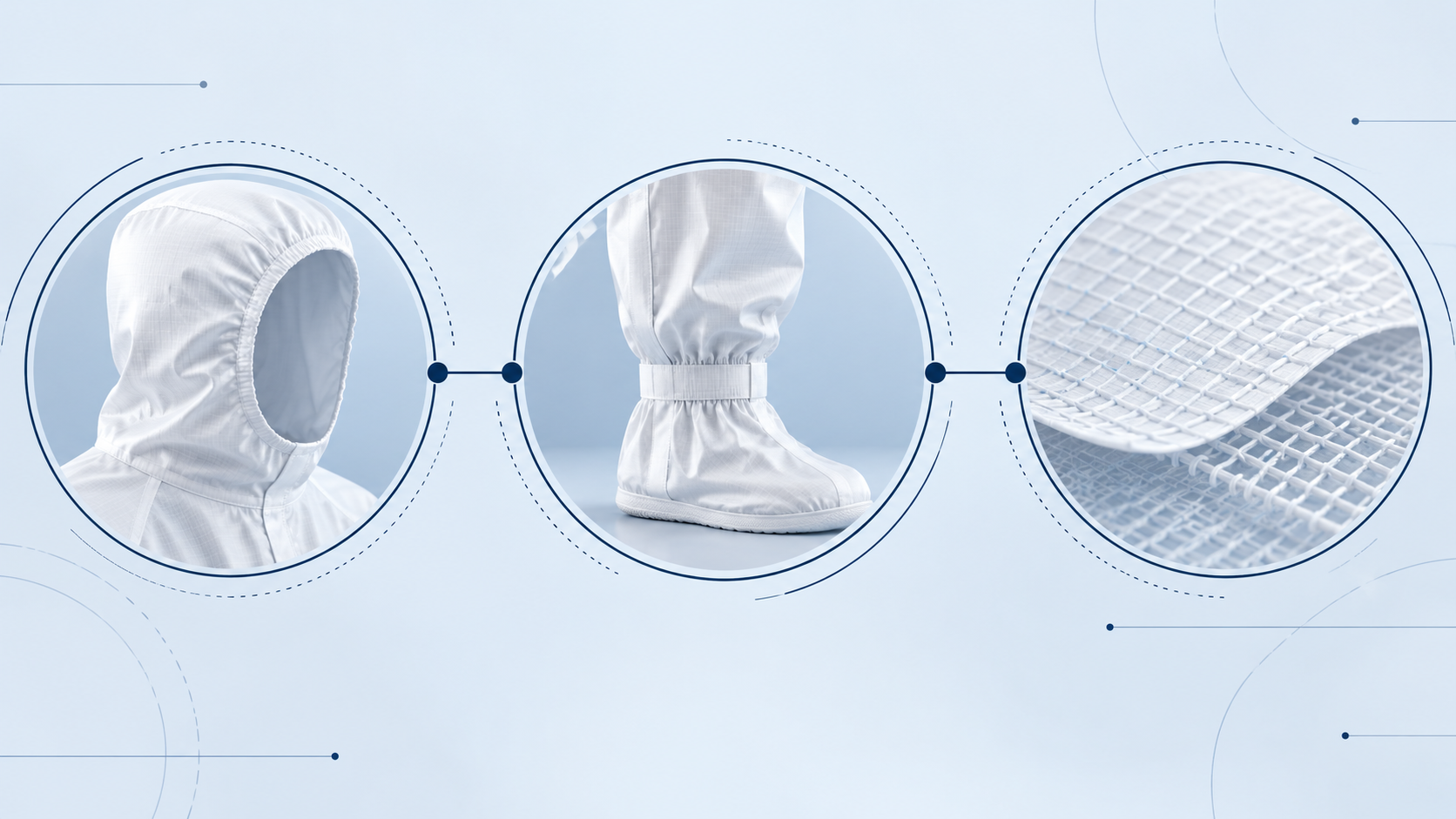
Chaque combinaison est définie par trois décisions de configuration qui affectent directement les performances de contrôle de la contamination, le confort de l'opérateur et l'efficacité de l'habillage :
Ces trois décisions sont interdépendantes. Une zone aseptique de grade A/B nécessite une combinaison spécifique (stériles, à capuche, bottes intégrées, polyester) où la modification d'une configuration crée un risque de contamination. Comprendre les compromis pour chaque décision est le point de départ de la sélection globale. Pour le contexte complet du système de vêtements, voir le guide du système de vêtements pour salles blanches.
Configuration de la combinaison — Décision n°1 : style de capuche
La hotte est l’interface entre la tête de l’opérateur (source primaire de particules) et l’environnement de la salle blanche. Le fait que la cagoule soit intégrée à la combinaison ou portée en tant que composant séparé affecte le risque de contamination, la flexibilité du dimensionnement et le confort de l'opérateur.
| Dimension | Combinaison à capuche | Combinaison sans capuche |
|---|---|---|
| Construction | La capuche est fixée en permanence au corps de la combinaison au niveau du col ; un vêtement continu de la tête aux chevilles. | La combinaison se termine au col ; une capuche séparée s'enfile indépendamment |
| Risque de contamination | Inférieur – pas d’espace entre l’interface capuche-combinaison. Les particules de la tête et du cou n'ont aucun chemin pour s'échapper entre les composants du vêtement | Plus haut – l’interface capuche-combinaison crée un espace potentiel au niveau du cou. Un chevauchement et un repli appropriés réduisent mais n'éliminent pas ce risque |
| Flexibilité de dimensionnement | Inférieur — l'opérateur reçoit une taille combinée pour la tête + le corps. Une combinaison de taille L signifie une cagoule de taille L | Plus haut — la capuche et la combinaison peuvent être dimensionnées indépendamment. Un opérateur peut porter une combinaison taille L avec une cagoule taille M |
| Vitesse d'habillage | Plus rapide : un vêtement au lieu de deux. Réduit le nombre d’étapes d’habillage | Plus lent – nécessite une étape distincte d’enfilage de la cagoule dans la séquence d’habillage |
| Coût | Légèrement plus élevé par vêtement (construction intégrée) | Légèrement inférieur par vêtement ; les hottes peuvent être remplacées indépendamment |
| Idéal pour | Zones aseptiques de catégorie A/B, production de catégorie C — où le contrôle de la contamination l'emporte sur la commodité du dimensionnement | Zones de grade D, R&Laboratoires D, habillage des visiteurs — où la flexibilité du dimensionnement et le remplacement indépendant sont plus importants |
Recommandation: Pour les grades BPF A/B et C, les combinaisons à capuche sont la norme car l'élimination de l'espace entre la cagoule et la combinaison réduit une voie de contamination connue. Pour les environnements de classe D et non contrôlés par les BPF, les combinaisons sans capuche avec capuches séparées offrent une protection acceptable avec une meilleure flexibilité de dimensionnement et un coût de remplacement inférieur.
Configuration de la combinaison — Décision n°2 : style de démarrage
Le confinement des chaussures est la deuxième décision de configuration. Le choix entre des chaussons intégrés et des bottes séparées affecte l'étanchéité de la cheville, un point critique de contrôle de la contamination car la cheville est l'une des zones les plus actives mécaniquement lors des mouvements de l'opérateur.
| Dimension | Chaussons intégrés | Bottes séparées |
|---|---|---|
| Construction | Le tissu de la combinaison s'étend pour couvrir les pieds avec une section de pied en forme de chausson. Le vêtement s'étend en continu de la capuche aux orteils | La combinaison se termine à la cheville par une fermeture élastique ou à bouton-pression. Des bottes de salle blanche séparées sont portées par-dessus ou par-dessous |
| Écart de cheville | Aucune — le tissu de la combinaison recouvre la cheville et le pied comme une barrière continue | Présent — la cheville est le point de transition entre la combinaison et la botte. La méthode de fermeture (élastique, bouton-pression, repli) détermine la qualité de l'étanchéité de cet espace. |
| Complexité du dimensionnement | Taille unique corps + pieds. Une combinaison de taille L signifie des pieds de taille L. Les opérateurs ayant une taille disproportionnée entre le corps et les pieds peuvent avoir des problèmes d'ajustement. | Deux tailles indépendantes : taille de combinaison et taille de botte. Chacun peut être adapté à l'opérateur indépendamment |
| Coût de remplacement | Plus élevé — si la section des chaussons s'use, la combinaison entière doit être remplacée | Plus bas – les bottes s’usent plus vite que les combinaisons. Des bottes séparées peuvent être remplacées sans remplacer la combinaison |
| Idéal pour | Aseptique de catégorie A/B — contrôle maximal de la contamination. Élimine complètement l'écart de la cheville | Grade C/D — où un certain risque d'écartement de la cheville est acceptable en échange d'une flexibilité de dimensionnement et d'un coût de remplacement inférieur |
Fermeture élastique à la cheville – le juste milieu : Certaines combinaisons utilisent une fermeture élastique à la cheville sans chaussons intégrés. L'élastique crée un joint au niveau de la cheville et des bottes séparées sont portées par-dessus, soit en recouvrant l'élastique, soit en rentrant la jambe de la combinaison à l'intérieur. Cette option réduit (mais n’élimine pas) l’écart entre les chevilles tout en préservant le dimensionnement et le remplacement indépendants des bottes. Il est couramment utilisé dans les établissements de grade C où les chaussons intégrés ne sont pas obligatoires mais où une meilleure étanchéité de la cheville qu'un brassard ouvert est souhaitée.
Configuration de la combinaison — Décision n°3 : Sélection des matériaux
Le tissu détermine les performances de la combinaison en matière d’élimination des particules, sa compatibilité avec les autoclaves, sa résistance chimique et le confort de l’opérateur. Trois matériaux dominent la fabrication des combinaisons pour salles blanches.
| Matériel | Particules | Autoclave | ESD | Confort | Meilleure note |
|---|---|---|---|---|---|
| Polyester à filament continu | Faible : aucune extrémité de fibre coupée ne risque de se perdre | Oui – 121-134 °C, 50-100+ cycles | Non | Bon – léger, respirant | Aseptique et production de grade A/B/C |
| Mélange polyester-carbone (ESD) | Faible-Moyen : les fibres de carbone ajoutent une charge de particules | Oui – 121 °C, moins de cycles (30-60) | Oui — la grille conductrice dissipe l'électricité statique | Bon – légèrement plus lourd que le polyester pur | Semi-conducteur, électronique, sensible aux ESD, grade C/D |
| Polypropylène (PP) jetable | Moyen – construction en fibres discontinues | Non | Non | Modéré – moins respirant | Grade D, zones visiteurs, R&Laboratoires D |
Le polyester à filament continu est la norme pour les salles blanches pharmaceutiques et biotechnologiques GMP. Sa faible perte de particules et sa compatibilité en autoclave en font le choix par défaut pour les grades A/B/C. Les mélanges polyester-carbone ESD ajoutent des propriétés de dissipation statique pour la fabrication électronique avec un léger compromis en termes de performances des particules et de durée de vie. Les combinaisons jetables en polypropylène sont destinées aux applications de qualité inférieure et aux visiteurs où l'infrastructure de blanchisserie est absente. Pour une comparaison complète des matériaux pour tous les types de vêtements, consultez le guide des matériaux pour les vêtements de salle blanche. Pour le cadre de décision réutilisable/jetable, voir vêtements autoclavables ou jetables.
Sélection des combinaisons par qualité de salle blanche — GMP A/B/C/D et ISO 5-8
La combinaison des trois décisions de configuration produit des recommandations de combinaison spécifiques à chaque grade. Le tableau suivant fournit la configuration standard pour chaque catégorie de salle blanche.
| Paramètre | Catégorie A/B (ISO 5) | Catégorie C (ISO 7) | Catégorie D (ISO 8) |
|---|---|---|---|
| Style de capuche | À capuche (intégré) | À capuche (intégré) | Avec ou sans capuche |
| Style de démarrage | Chaussons intégrés | Bottes séparées ou cheville élastique avec bottes séparées | Bottes ou couvre-chaussures séparés |
| Matériel | Polyester à filament continu | Polyester à filament continu | Polyester (autoclavable) ou PP (jetable) |
| Stérilisation | Stérile (gamma ou autoclave validé) | Autoclavable, non stérile acceptable | Non stérile acceptable ; stérile si la SOP l'exige |
| Changer la fréquence | Par session ou par quart de travail – validé par les données EM | Par équipe ou quotidiennement - défini par SOP | Quotidiennement ou par intervalle défini |
| Exigence clé | Pas de peau exposée, pas d'espace d'interface, emballage stérile, double emballage pour un transfert aseptique | Couverture complète du corps, capuche, libération contrôlée de particules | Couverture corporelle de base, contrôle général de la contamination |
Chaque établissement doit valider ces recommandations par rapport à ses propres données de surveillance environnementale, ses SOP en matière d'habillage et son évaluation des risques. Un établissement de niveau B disposant de données EM solides et d'un protocole de pansement validé peut accepter des bottes séparées si les données le soutiennent. Un établissement de grade C se préparant à un audit de l'Annexe 1 peut choisir d'élever ses spécifications globales au niveau des chaussons intégrés à titre de mesure proactive.
Dimensionnement des combinaisons – Comment dimensionner une équipe de production
La taille d’une combinaison constitue un défi en matière d’approvisionnement et d’exploitation. Une combinaison mal dimensionnée crée un risque de contamination quelle que soit la qualité de sa matière ou de sa configuration. L'approche de dimensionnement dépend du fait que la combinaison comporte ou non des chaussons intégrés.
Pour une référence complète des tailles pour tous les types de vêtements, consultez le Guide des tailles et des ajustements des vêtements pour salles blanches.
Inspection et remplacement des combinaisons — Gestion du cycle de vie
Les combinaisons autoclavables se dégradent au fil des cycles de stérilisation répétés. Un programme d’inspection structuré détecte la dégradation avant qu’elle ne devienne un événement de contamination.
Inspection avant utilisation (à chaque enfilage)
- Vérifiez la fermeture éclair : est-elle fluide sur toute la longueur sans s'accrocher ni se séparer ?
- Inspectez les poignets aux poignets et aux chevilles : l'élastique est-il intact et assure-t-il une étanchéité, n'est-il pas lâche ou étiré ?
- Vérifiez les coutures : séparation visible des fils, amincissement ou trous aux points de tension (épaules, entrejambe, genoux) ?
- Vérifiez la fixation de la capuche (combinaison à capuche) : la couture du col est-elle intacte et sans espaces ?
- Recherchez la décoloration, l’amincissement ou le boulochage du tissu – indicateurs de dégradation chimique ou thermique
Inspection post-stérilisation (chaque cycle)
- Répétez tous les contrôles avant utilisation après le cycle de stérilisation
- Vérifiez la rigidité ou la fragilité du tissu – signes de sur-autoclavage
- Vérifiez que les étiquettes et les marquages restent lisibles : une décoloration indique une exposition excessive au cycle.
- Si l'installation effectue des tests de particules, testez un échantillon de chaque lot à des intervalles définis.
Critères de retraite
- Amincissement du tissu visible à l'œil nu ou confirmé par mesure d'épaisseur
- Séparation des coutures >5 mm à tout point de contrainte
- Dysfonctionnement de la fermeture éclair : elle se coince, se sépare ou ne parvient pas à se fermer complètement
- Rupture de l'élastique aux poignets ou aux chevilles - n'assure plus l'étanchéité
- Échec du test de rejet de particules par rapport aux critères d’acceptation de l’installation
- Dépassement de la durée de vie maximale indiquée par le fournisseur, même si l'inspection visuelle réussit
Tenez un journal de mise hors service des vêtements. Enregistrez la date, l’identifiant du vêtement, le nombre de cycles à la retraite et la raison spécifique de l’échec. Ce journal fournit des preuves d'audit d'un programme de gestion des vêtements fonctionnel et aide les achats à prévoir les commandes de remplacement. Pour l'intégration de la procédure d'habillage, voir le Guide SOP pour la procédure d'habillage en salle blanche.
FAQ sur les combinaisons pour salles blanches
Dois-je choisir une combinaison de salle blanche avec ou sans capuche ?
Les combinaisons à capuche sont recommandées pour les grades BPF A/B/C car elles éliminent l'espace entre la capuche et la combinaison, une voie de contamination connue. Les combinaisons sans capuche sont acceptables pour les grades D et R.&Les laboratoires D et l'habillage des visiteurs où la flexibilité du dimensionnement et le remplacement indépendant de la cagoule sont plus précieux que l'avantage supplémentaire de contrôle de la contamination d'une cagoule intégrée.
Les chaussons intégrés sont-ils meilleurs que les chaussons séparés pour salle blanche ?
Les chaussons intégrés offrent le meilleur contrôle de la contamination car ils éliminent l’espace entre les chevilles : il n’y a aucun point de transition entre la combinaison et les chaussures. Cependant, ils réduisent la flexibilité en matière de taille (la taille du pied est liée à la taille de la combinaison) et augmentent le coût de remplacement (le port des chaussons signifie le remplacement de la combinaison entière). Pour les grades A/B, les chaussons intégrés sont standard. Pour les grades C/D, des bottes séparées avec fermeture élastique à la cheville offrent un équilibre pratique.
Quel matériau convient le mieux pour une combinaison GMP Grade B ?
Le polyester à filament continu est la norme pour le GMP Grade B. Il combine une faible perte de particules (pas d'extrémités de fibres coupées), une compatibilité en autoclave (121-134 °C, 50-100+ cycles), une bonne résistance chimique aux désinfectants courants et le confort de l'opérateur. La combinaison doit être stérile, à capuche et avoir des chaussons intégrés pour une protection aseptique complète.
À combien de cycles d’autoclave une combinaison en polyester peut-elle résister ?
Les combinaisons en polyester à filament continu résistent généralement à plus de 50 à 100 cycles d'autoclave à 121 °C et à 30 à 60 cycles à 134 °C. La durée de vie réelle dépend de la construction du tissu, des paramètres de stérilisation, de l'exposition aux produits chimiques et de la manipulation. Inspectez après chaque cycle et mettez hors service lorsqu'un critère de mise hors service est rempli - et non sur la base d'un nombre de cycles fixe.
Comment dimensionner une combinaison avec bottes intégrées ?
Mesurez la taille, la poitrine, la taille, l'entrejambe et la longueur du pied. Utilisez le tableau des tailles du fournisseur. Pour les opérateurs présentant une taille disproportionnée entre le corps et les pieds, privilégiez l'ajustement du corps (un chausson légèrement ample est préférable à une combinaison serrée qui restreint les mouvements ou stresse les coutures). Si plus de 10 à 15 % des opérateurs ont des conflits de tailles, envisagez de passer à des combinaisons à chevilles élastiques avec des bottes séparées.
À quelle fréquence les combinaisons de salle blanche doivent-elles être remplacées ?
Basé sur une inspection et non sur un calendrier. Retirez une combinaison lorsque : l'amincissement du tissu est visible, les coutures montrent une séparation >5 mm, la fermeture éclair fonctionne mal, les poignets ou l'élastique de la cheville échouent, le test d'élimination des particules échoue aux critères d'acceptation ou la durée de vie maximale du fournisseur est dépassée. Tenir un journal de retraite pour les preuves d'audit et les prévisions d'approvisionnement.
Besoin de combinaisons autoclavables pour salle blanche ?
MIDPOSI propose des combinaisons à capuche avec bottes intégrées, des combinaisons à capuche avec cheville élastique, des combinaisons antistatiques et des blouses de laboratoire autoclavables. Indiquez-nous votre qualité de salle blanche, la configuration requise, la quantité et la méthode de stérilisation : notre équipe vous recommandera des options appropriées.