Vadrouilles jetables ou réutilisables pour salle blanche—Le cadre décisionnel complet de l'acheteur
Une comparaison structurée en 7 dimensions pour les responsables des achats, de l'assurance qualité et des installations évaluant les stratégies de nettoyage des salles blanches pour les environnements contrôlés GMP et ISO.
Réponse rapide—Serpillères jetables ou réutilisables pour salle blanche : laquelle choisir ?
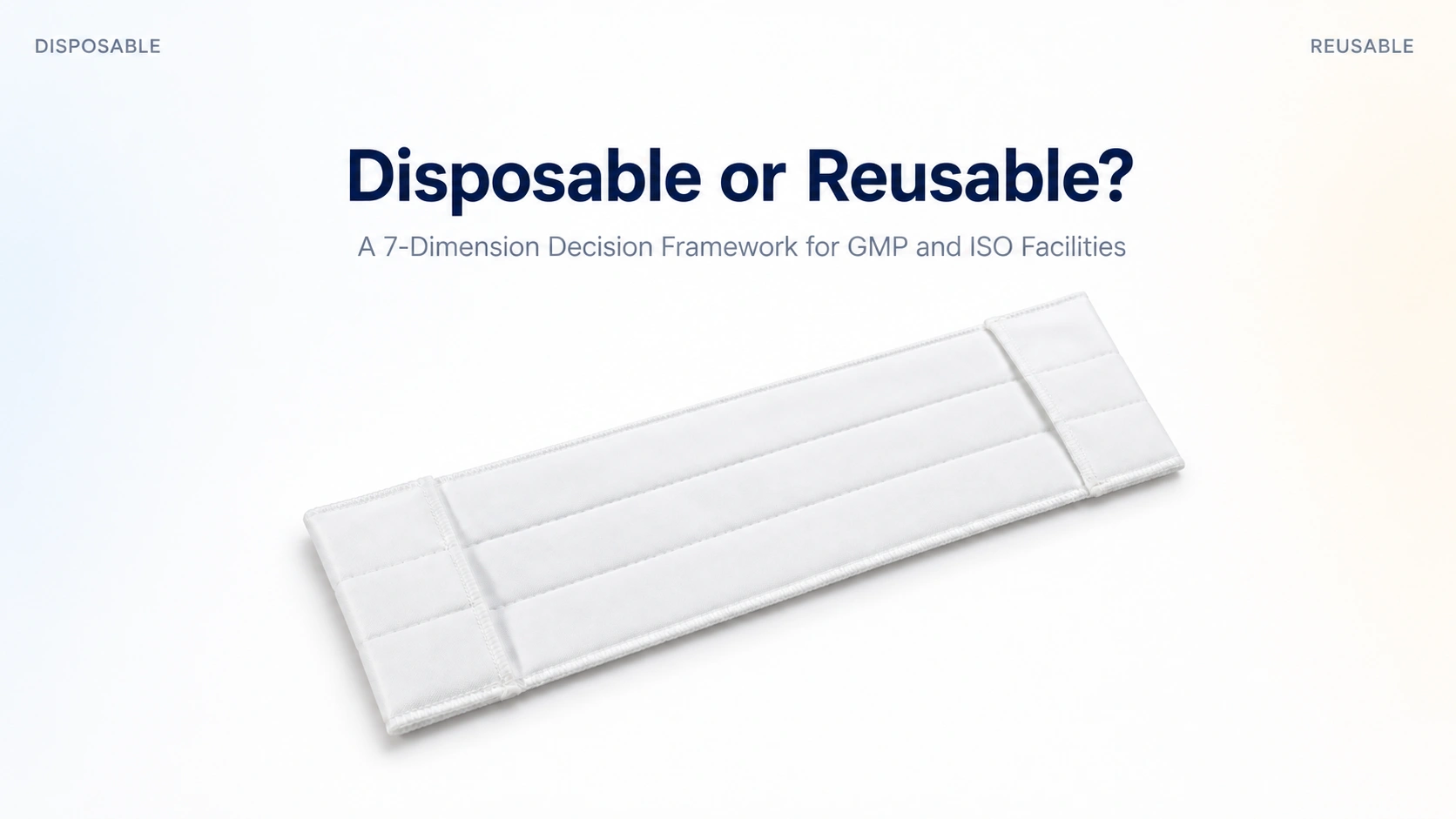
Le choix entre les vadrouilles jetables et réutilisables pour salle blanche est pas une simple comparaison des coûts. Il s'agit d'une décision stratégique au niveau de l'installation qui doit tenir compte des exigences de stérilité, des protocoles de contrôle de la contamination, du coût total de possession (TCO), de la gestion des déchets et de la classification spécifique de votre salle blanche.
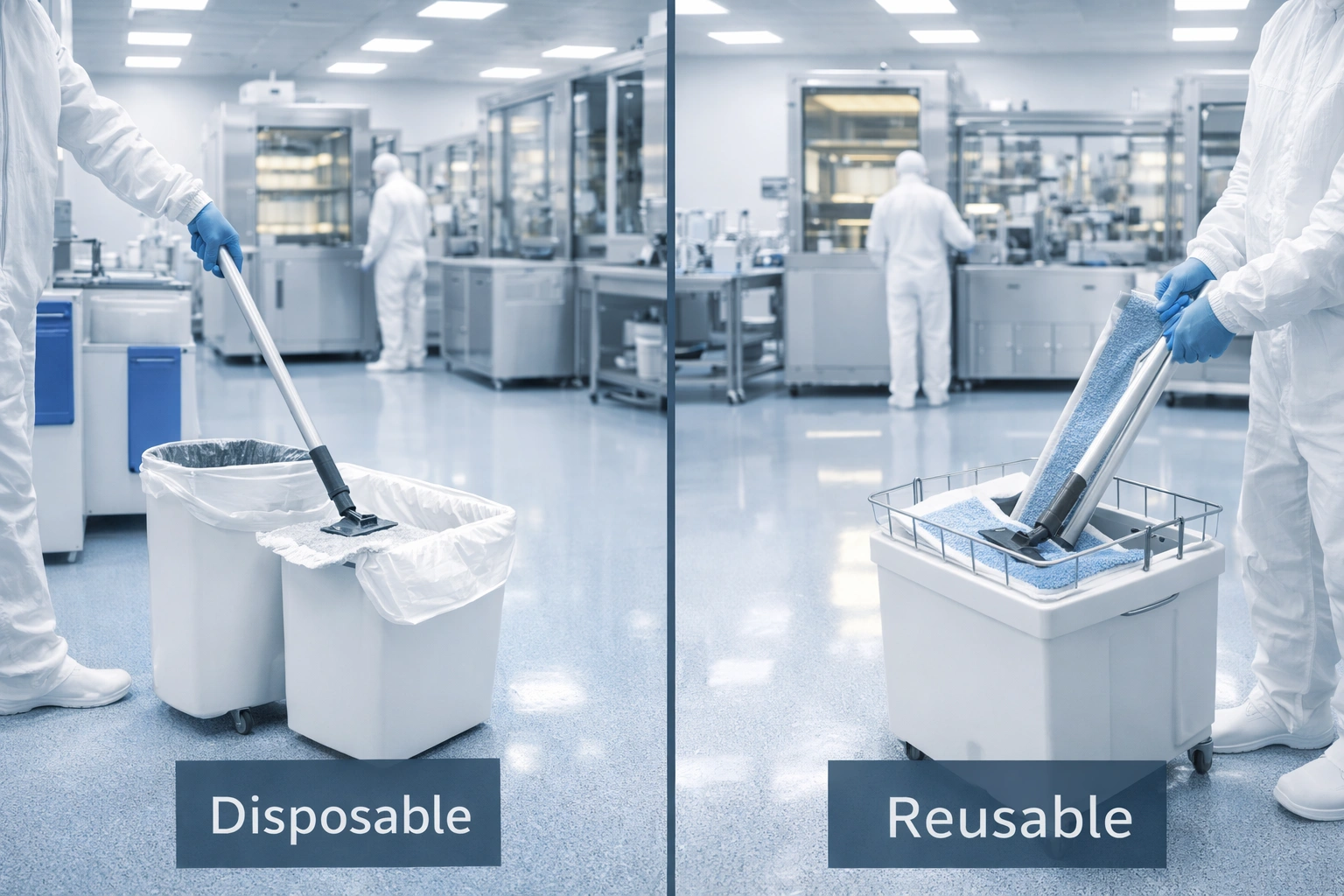
Stratégie jetable
UN vadrouille à usage unique et pré-stérilisée qui est emballé individuellement, utilisé une fois et jeté. Chaque vadrouille arrive prête à l'emploi avec une documentation au niveau du lot, éliminant ainsi les risques de blanchiment, de stérilisation et de contamination entre lots.
Idéal pour : Fabrication stérile (GMP Grade A/B), campagnes à lots uniques, installations où l'assurance de la stérilité est la principale exigence et opérations sans capacités de blanchisserie internes validées.
Stratégie réutilisable
UN vadrouille lavable et à usages multiples qui est nettoyé, stérilisé (si nécessaire) et réutilisé sur plusieurs cycles. Nécessite des processus de blanchiment et de stérilisation validés, un suivi de l'utilisation et une gestion des stocks pour la rotation.
Idéal pour : Nettoyage quotidien haute fréquence en ISO 7–8 environnements, zones non stériles GMP Grade C/D, installations dotées d'une infrastructure de blanchisserie et de stérilisation établie et opérations cherchant à minimiser les déchets solides.
La réponse courte : Si votre établissement exploite des zones stériles de grade A/B, un stratégie jetable pré-stérilisée fournit généralement une assurance de stérilité plus forte avec une complexité de protocole moindre. Si votre établissement effectue un nettoyage quotidien à haute fréquence en ISO 7 non stérile–8 zones, un stratégie réutilisable offre souvent un coût inférieur par événement de nettoyage—à condition que vos processus de lavage et de stérilisation soient entièrement validés.
Comprendre les deux stratégies de vadrouille pour salle blanche
Avant de comparer les dimensions, il convient d’établir ce qu’implique chaque stratégie dans le contexte d’un nettoyage en environnement contrôlé. Les termes « jetable” et « réutilisable” ont des implications différentes dans les opérations en salle blanche et dans le nettoyage commercial en général.
La stratégie des vadrouilles jetables pour salles blanches
Une vadrouille jetable pour salle blanche est un produit à usage unique conçu pour être utilisé pour un événement de nettoyage ou une zone de nettoyage désignée, puis jeté. Dans le contexte des salles blanches, le jetable ne signifie pas une qualité inférieure—cela signifie que la vadrouille est fabriquée, emballée et (lorsque spécifié) stérilisée dans des conditions contrôlées, chaque unité ou lot étant accompagné d'une documentation qui prend en charge les exigences en matière de piste d'audit.
Les principales caractéristiques d’une stratégie jetable comprennent :
- Disponibilité pré-stérilisée : Les vadrouilles peuvent être fournies irradiées aux rayons gamma ou stérilisées à l'EtO, scellées individuellement dans un emballage simple ou double pour un transfert aseptique dans les zones de catégorie A/B.
- Pas de cycle de retraitement : Pas de blanchiment, de stérilisation, d'inspection ou de gestion de rotation—réduisant la complexité du protocole et éliminant le retraitement comme source de variabilité.
- Documentation au niveau du lot : Le certificat d'analyse (COA), le certificat de stérilité (CoS) et le certificat de conformité sont liés à chaque lot de production, fournissant des enregistrements d'audit propres et traçables.
- Performances prévisibles des particules : Chaque tête de vadrouille est utilisée une fois dans sa fenêtre de performance conçue—il n’y a aucune dégradation au cours des cycles de réutilisation.
Les vadrouilles jetables sont apparues en réponse aux exigences strictes de stérilité de la fabrication pharmaceutique aseptique et sont devenues la stratégie par défaut pour de nombreuses opérations stériles réglementées par l'annexe 1 des BPF de l'UE.
La stratégie des vadrouilles réutilisables pour salles blanches
Une vadrouille réutilisable pour salle blanche est un produit à usage multiple conçu pour résister aux cycles de lavage répétés et (lorsque le protocole l’exige) de restérilisation. La tête de vadrouille est fabriquée à partir de matériaux durables—généralement en tricot de polyester ou en microfibre—qui maintiennent la stabilité dimensionnelle et les performances de faible perte de particules sur plusieurs cycles d'utilisation.
Les principales caractéristiques d’une stratégie réutilisable comprennent :
- Coût des matériaux par utilisation réduit : Le coût initial de la tête de vadrouille est amorti sur plusieurs événements de nettoyage, ce qui réduit potentiellement les dépenses par événement de nettoyage pour les opérations à haute fréquence.
- Exigence de blanchiment validée : L'installation doit mettre en œuvre un processus de blanchissage validé (ou s'associer à un service de blanchisserie qualifié) qui élimine de manière démontrable les résidus, maintient l'intégrité des matériaux et offre une propreté constante après le lavage.
- Suivi du cycle et gestion des stocks : Les têtes de vadrouille doivent être suivies tout au long des cycles d'utilisation et de lavage, avec des critères de mise hors service définis basés sur une inspection visuelle, des tests de performance des particules ou des limites de nombre de cycles.
- Volume de déchets solides réduit : Les vadrouilles réutilisables génèrent beaucoup moins de déchets solides par événement de nettoyage par rapport à une stratégie jetable.
Les vadrouilles réutilisables sont largement utilisées dans la norme ISO 7–8 environnements non stériles et zones de support GMP de grade C/D où la fréquence de nettoyage est élevée et la stérilité n'est pas une exigence principale.
Les deux stratégies restent pertinentes dans les opérations de salles blanches modernes—non pas parce que l'on est universellement supérieur, mais parce que les profils des installations diffèrent. Le cadre en 7 dimensions suivant fournit la base structurée pour évaluer quelle stratégie correspond aux exigences spécifiques de votre établissement.
Un cadre décisionnel en 7 dimensions pour choisir entre des vadrouilles jetables et réutilisables pour salle blanche
Chacune des sept dimensions suivantes représente un facteur qui influence la décision entre le jetable et le réutilisable. Les dimensions sont classées de la priorité la plus élevée à la plus basse pour la plupart des installations, mais votre pondération spécifique peut différer en fonction de votre contexte opérationnel et réglementaire.
Assurance stérilité
Jetable
Pré-stérilisé au point de fabrication—généralement via irradiation gamma ou oxyde d'éthylène (EtO)—et livré dans un emballage individuel scellé et validé. La stérilité est garantie au point d'utilisation lorsque l'emballage est ouvert à l'intérieur de la salle blanche. Chaque lot est accompagné d'un Certificat de Stérilité liant l'assurance de stérilité à un lot de fabrication spécifique.
Cela élimine la plus grande variable de la stérilité réutilisable : la cycle de restérilisation effectué par l'établissement de l'utilisateur final. Avec les produits jetables, l’assurance de la stérilité relève de la responsabilité du fabricant, appuyée par un processus de stérilisation validé et auditable.
Réutilisable
La stérilité dépend entièrement du processus de lavage et de restérilisation de l’établissement. Après utilisation, la tête de vadrouille doit être lavée pour éliminer les résidus chimiques et la contamination particulaire, puis stérilisée (généralement par autoclave si l'installation en est équipée, ou par gamma/EtO par un tiers).
Chaque étape—blanchissage, séchage, stérilisation, emballage et transfert—doit être validé individuellement. Il doit être démontré que le cycle de restérilisation atteint le niveau d'assurance de stérilité (SAL) requis et que l'emballage utilisé pour la restérilisation doit maintenir son intégrité jusqu'au transfert dans la salle blanche. Toute lacune dans cette chaîne compromet la stérilité.
Quand cette dimension est déterminante : Pour les zones de remplissage aseptique GMP Grade A (ISO 5) et les zones de fond de Grade B, la stratégie jetable pré-stérilisée offre généralement une assurance de stérilité plus forte et plus défendable avec une piste d'audit plus simple.
Contrôle de la contamination & Risque de contamination croisée
Jetable
La conception à usage unique élimine entièrement le risque de contamination entre lots. Une vadrouille utilisée dans une campagne de produit, une zone ou un événement de nettoyage est jetée—il ne peut jamais transmettre de contamination à un lot ou une zone ultérieur.
Ceci est particulièrement utile dans les installations multi-produits où différents ingrédients pharmaceutiques actifs (API), lignées cellulaires ou matériaux biologiques sont traités dans un espace de salle blanche partagé. Les vadrouilles jetables offrent une rupture physique dans la chaîne de contamination que les contrôles procéduraux ne peuvent à eux seuls garantir.
Réutilisable
Le risque de contamination croisée existe à deux points : (1) entre les utilisations au sein d’une même installation, si les têtes de vadrouille ne sont pas correctement séparées par zone ou par campagne de produits, et (2) pendant le lavage, si des vadrouilles provenant de différentes zones ou types de produits sont traitées ensemble.
Un contrôle efficace de la contamination croisée avec une stratégie réutilisable nécessite : une attribution de têtes de vadrouille spécifiques à une zone avec identification visuelle (code couleur), une collecte et un transport séparés, des processus de lavage validés qui éliminent de manière démontrable les résidus et une vérification de la propreté après lavage.
Quand cette dimension est déterminante : Dans les installations multi-produits, les zones de manipulation de composés puissants ou les opérations où même des traces de contamination croisée comportent un risque élevé pour la sécurité des patients ou la qualité des produits, la stratégie jetable fournit une solution de contrôle de la contamination plus simple et plus robuste.
Coût total de possession (TCO)
Jetable
Coût unitaire plus élevé, mais avec une structure de coûts beaucoup plus simple. Le prix d’achat de la tête de vadrouille correspond effectivement au coût total—il n'y a pas de travail de blanchisserie, pas d'équipement de stérilisation, pas d'eau ni d'énergie pour le retraitement, pas de travail d'inspection et pas de gestion de rotation des stocks.
Composants clés du TCO pour la stratégie jetable :
- Coût unitaire de la tête de vadrouille × événements de nettoyage par période
- Expédition et stockage (volume plus élevé requis vs réutilisable)
- Frais de traitement et d'élimination des déchets
- Inférieur : pas de main d'œuvre, d'équipement, de services publics ou de contrôle qualité pour le retraitement
Réutilisable
Coût des matériaux par utilisation réduit une fois le stock initial acheté, mais le coût total comprend d'importants composants opérationnels et d'infrastructure qui sont souvent négligés dans une simple comparaison de prix unitaires.
Composants clés du TCO pour une stratégie réutilisable :
- Coût unitaire de la tête de vadrouille ÷ cycles moyens utilisables (amortis)
- Coûts de la main-d'œuvre, de l'équipement, de l'eau, de l'énergie et des détergents
- Équipement de stérilisation/frais de tiers (si stérile requis)
- Inspection et travail de contrôle qualité
- Gestion des stocks et suivi des rotations
- Stock de remplacement pendant le cycle de lavage
Quand cette dimension est déterminante : À de faibles fréquences de nettoyage (par exemple, hebdomadaires ou basées sur une campagne), les frais généraux fixes d'un programme réutilisable peuvent rendre les produits jetables globalement plus rentables. À des fréquences quotidiennes élevées, le coût amorti par utilisation des produits réutilisables peut générer des économies—mais seulement si l’établissement dispose déjà d’une infrastructure de blanchiment validée.
Conformité réglementaire & Piste d'audit
Jetable
La documentation suit un modèle lot à lot: chaque expédition ou lot de production est accompagné de COA, CoS et CoC. À des fins d'audit, un seul lot de vadrouilles jetables = une unité d'approvisionnement et d'utilisation documentée, avec une traçabilité claire depuis le numéro de lot du fournisseur jusqu'aux événements de nettoyage spécifiques.
La piste d'audit est simple : le lot X de vadrouilles a été reçu, la documentation a été examinée, le lot X a été utilisé à la date Y dans la zone Z, le lot X a été entièrement consommé. Il n’y a pas de suivi de cycle continu ni de requalification à documenter.
Réutilisable
Les exigences en matière de documentation augmentent considérablement. En plus de la documentation initiale du fournisseur (COA, certificats de matériaux), l'établissement doit conserver des enregistrements pour : chaque cycle de lavage (paramètres, lots de détergents, opérateur), chaque cycle de stérilisation (données de charge de l'autoclave, paramètres de cycle), chaque inspection post-traitement et l'historique d'utilisation et de mise hors service de chaque tête de vadrouille.
Lors d'un audit réglementaire, l'auditeur peut—et je le ferai—demander les enregistrements du cycle de lavage et de stérilisation. Si la documentation d’un programme réutilisable est incomplète, les résultats de l’audit feront référence au système d’outils de nettoyage dans le cadre d’un examen plus large du contrôle de la contamination.
Quand cette dimension est déterminante : Les installations disposant d'équipes AQ/CQ réduites ou celles opérant sous surveillance réglementaire où l'exhaustivité de la documentation est primordiale peuvent trouver le modèle de documentation jetable plus facile à maintenir et à défendre lors des audits.
Gestion des déchets & Durabilité
Jetable
Génère des déchets solides à chaque événement de nettoyage. Pour une installation effectuant 20 opérations de nettoyage par jour avec des vadrouilles jetables, le volume annuel de déchets solides peut être important. La manipulation des déchets doit tenir compte de la classification des déchets contaminés si la vadrouille est entrée en contact avec des API, des matières biologiques ou des agents de nettoyage dangereux.
Du point de vue de la durabilité, l'approche jetable consomme des matières premières et génère des déchets à un taux plus élevé par événement. Cependant, cela évite la consommation d’eau, d’énergie et de produits chimiques associés au blanchissage.
Réutilisable
Génère moins de déchets solides mais consomme beaucoup d’eau, d’énergie et de produits chimiques de nettoyage tout au long du cycle de lavage. Une tête de vadrouille réutilisable peut subir 50–Plus de 100 cycles de lavage avant la mise hors service, répartissant son empreinte matérielle sur de nombreuses utilisations.
Le profil de durabilité dépend de l’efficacité de l’opération de blanchiment—le recyclage de l’eau, les équipements économes en énergie et la sélection de détergents respectueux de l’environnement affectent tous l’impact environnemental net.
Quand cette dimension est déterminante : Cette dimension est rarement le principal facteur de décision pris isolément, mais elle devient pertinente lorsque les objectifs de développement durable de l'entreprise ou les limitations des infrastructures de traitement des déchets influencent les décisions d'achat. Une installation avec une capacité d'élimination des déchets limitée ou des coûts d'élimination élevés peut tendre vers le réutilisable ; une installation avec des restrictions d’utilisation de l’eau peut pencher vers le jetable.
Complexité du protocole & Formation des opérateurs
Jetable
Le protocole destiné à l'opérateur est plus simple : ouvrir l'emballage, fixer la tête de vadrouille au cadre, nettoyer la zone désignée, détacher, jeter. Il y a moins de points de décision pour l'opérateur—pas de tri par zone, pas de collecte pour la lessive, pas de contrôle visuel avant réutilisation.
Les exigences de formation sont d'autant plus légères, même si les opérateurs doivent toujours être formés à la bonne technique d'ouverture aseptique des emballages afin de maintenir l'intégrité de l'emballage tout au long du transfert.
Réutilisable
La complexité des protocoles augmente tout au long du cycle de vie complet de la vadrouille. Les opérateurs doivent être formés sur : le tri et la collecte corrects par zone, la manipulation appropriée pour éviter la propagation de la contamination après utilisation, les procédures de soumission du linge, les critères d'inspection avant réutilisation et la reconnaissance des indicateurs de fin de vie.
Cela ajoute des étapes SOP et une charge de formation, mais renforce également les connaissances institutionnelles autour de la gestion des outils de nettoyage.—des connaissances qui peuvent rapporter des dividendes dans la maturité globale du contrôle de la contamination.
Quand cette dimension est déterminante : Les installations avec un taux de rotation élevé des opérateurs, les entrepreneurs effectuant le nettoyage ou les opérations où des écarts de protocole sont fréquemment observés peuvent bénéficier d'un flux de travail jetable plus simple. Les installations dotées d’équipes de nettoyage stables et bien formées et d’une culture SOP mature peuvent gérer la complexité réutilisable sans problème.
Chaîne d'approvisionnement & Inventaire
Jetable
Nécessite un volume de stockage plus élevé par rapport au taux d'utilisation—chaque événement de nettoyage consomme une tête de vadrouille, le stock en rayon doit donc être maintenu pour couvrir le délai de commande. Les besoins de stockage évoluent linéairement avec la fréquence de nettoyage.
La fréquence de réapprovisionnement doit être calibrée pour éviter à la fois les ruptures de stock (qui perturberaient les opérations de nettoyage) et les commandes excessives (qui consomment de l'espace dans l'entrepôt et immobilisent le fonds de roulement).
Réutilisable
Le volume des achats en cours est inférieur, car chaque tête de vadrouille dessert plusieurs cycles. Cependant, l'établissement doit maintenir un stock suffisant pour couvrir : les vadrouilles en utilisation active, les vadrouilles en cours de rotation du linge, les vadrouilles retirées/de remplacement et une zone tampon de sécurité.
Le modèle d'inventaire passe de linéaire (X vadrouilles par jour) à rotationnel (un pool de Y vadrouilles passant d'une utilisation à l'autre), l'approvisionnement étant axé sur le remplacement des unités mises hors service plutôt que sur la fourniture de chaque événement de nettoyage.
Quand cette dimension est déterminante : Les installations disposant d'un espace d'entrepôt limité ou celles opérant dans des endroits où les délais d'expédition internationaux sont longs peuvent préférer le modèle réutilisable en raison de son volume de stockage inférieur. À l’inverse, les établissements disposant d’un stockage adéquat et préférant la simplicité de la chaîne d’approvisionnement peuvent préférer le modèle de réapprovisionnement simple du modèle jetable.
Résumé en 7 dimensions : jetables ou réutilisables en un coup d'œil
| Dimension | Avantage jetable | Avantage réutilisable | Décisif quand… |
|---|---|---|---|
| 1. Stérilité | Pré-stérilisé, garanti par le fabricant | — | Opérations aseptiques de grade A/B |
| 2. Contrôle des contaminations | Zéro risque de lots croisés | — | Installations multi-produits ou composés puissants |
| 3. Coût total de possession | Abaisser à faible fréquence de nettoyage | Inférieur à une fréquence quotidienne élevée | Fréquence de nettoyage et infrastructure de blanchisserie existante |
| 4. Piste d'audit | Documentation plus simple au niveau des lots | — | Équipes d'assurance qualité réduites, contrôle réglementaire élevé |
| 5. Durabilité | — | Réduire les déchets solides | Capacité de déchets ou contraintes en eau |
| 6. Protocole | Flux de travail de l'opérateur plus simple | — | Chiffre d’affaires élevé ou nettoyage par un entrepreneur |
| 7. Chaîne d'approvisionnement | Modèle de commande simple | Volume de stockage inférieur | Contraintes d’espace d’entrepôt ou de délai de livraison |
Tableau de décision—Quelle stratégie de vadrouille convient à votre établissement ?
Utilisez ce tableau de décision basé sur des scénarios pour identifier quelle stratégie correspond au profil de votre établissement. Ces scénarios reflètent les configurations d'installations réelles courantes rencontrées dans les opérations en salle blanche GMP et ISO.
| Scénario d'installation | Stratégie recommandée | Justification clé |
|---|---|---|
| Produits pharmaceutiques stériles — Remplissage aseptique de catégorie A/B Fabrication aseptique de produits injectables selon EU GMP Annexe 1 |
Jetable pré-stérilisé | L’assurance de la stérilité est l’exigence primordiale. Les produits jetables pré-stérilisés éliminent le risque de restérilisation et simplifient la préparation à l’audit de l’Annexe 1. |
| Produits pharmaceutiques non stériles — Zones de support de qualité C/D Nettoyage quotidien des zones de fabrication des comprimés ou de conditionnement secondaire |
Réutilisable | La stérilité n'est pas requise. Le nettoyage à haute fréquence favorise le coût d'utilisation inférieur des produits réutilisables, et le nettoyage dans ces zones ne nécessite pas d'assurance de stérilité au niveau de la vadrouille. |
| Biotechnologie — Installation multi-produits Salle blanche partagée traitant différentes lignées cellulaires ou produits biologiques |
Jetable (zones critiques) | Le risque de contamination croisée entre les campagnes de produits est une préoccupation majeure. Les produits jetables constituent une barrière physique entre les campagnes que la ségrégation procédurale ne peut à elle seule garantir. |
| Dispositif médical — Salle blanche ISO 7-8 Assemblage de dispositif non stérile avec nettoyage quotidien |
Réutilisable | Des exigences modérées en matière de contrôle de la contamination et une fréquence de nettoyage quotidienne rendent les produits réutilisables rentables. La stérilité au niveau de la vadrouille n'est généralement pas requise. |
| Dispositif médical stérile — OIN 5-6 Conditionnement de dispositifs stériles ou fabrication d'implants |
Jetable pré-stérilisé | La stérilité des outils de nettoyage est requise dans les zones de fabrication de dispositifs stériles. Les produits jetables pré-stérilisés fournissent une assurance de stérilité documentée. |
| Installation BPF multizone Combinaison de grade A/B (stérile) et de grade C/D (support) |
Modèle hybride | Utilisez des vadrouilles jetables pré-stérilisées dans les zones centrales stériles (grade A/B) et des vadrouilles réutilisables dans les zones de support (grade C/D). Cela permet d'adapter la stratégie au profil de risque de chaque zone. |
| Nettoyage quotidien à haute fréquence (ISO 7-8) Nettoyage 3+ fois par jour dans des zones contrôlées non stériles |
Réutilisable | Avantage de coût lié à la fréquence : en cas d'utilisation quotidienne élevée, le coût amorti par utilisation des vadrouilles réutilisables permet généralement de réaliser des économies significatives par rapport aux jetables. |
| Nettoyage basé sur des campagnes/à basse fréquence Nettoyage hebdomadaire ou en campagne dans les opérations à petite échelle |
Jetable | Aux basses fréquences, les frais généraux fixes d'un programme réutilisable (blanchisserie, stérilisation, contrôle qualité) peuvent dépasser le coût d'utilisation des produits jetables. Les produits jetables éliminent les coûts d’infrastructure inutilisés. |
Scénarios de comparaison des coûts
L'analyse des coûts ci-dessous utilise comparaisons directionnelles plutôt que des chiffres absolus. Les coûts réels dépendent des tarifs de main-d’œuvre spécifiques à votre installation, des coûts des services publics, des frais de traitement des déchets et des volumes d’approvisionnement. Utilisez ces scénarios comme cadre pour créer votre propre modèle de coûts spécifique à votre installation.—pas pour le remplacer.
Scénario 1 : Nettoyage quotidien à haute fréquence
Une grande installation effectuant plus de 20 événements de nettoyage par jour, 5–7 jours par semaine. L'installation exploite déjà une blanchisserie interne validée, capable de traiter les textiles des salles blanches.
Recherche directionnelle : Une stratégie réutilisable, en supposant que l’infrastructure de blanchiment existe déjà en tant que coût irrécupérable, peut générer un coût par événement de nettoyage considérablement inférieur à cette fréquence. Le coût amorti de la tête de balai se rapproche du coût unitaire jetable après relativement peu de cycles, et tous les cycles ultérieurs représentent des économies.
Remarque : Les économies proviennent de l'amortissement de la réutilisation, et non du fait que les vadrouilles jetables sont « chères ».” La comparaison est entre le prix d’achat d’une tête de vadrouille amorti sur de nombreuses utilisations et celui de plusieurs têtes de vadrouille achetées chacune une fois.
Scénario 2 : Nettoyage hebdomadaire à basse fréquence
Une petite installation effectuant 5–8 événements de nettoyage par semaine. L'établissement ne dispose pas de capacité de blanchisserie interne et devrait faire appel à un service de blanchisserie tiers ou investir dans du matériel de blanchisserie.
Recherche directionnelle : Une stratégie jetable peut être plus rentable—non pas parce que les produits jetables sont moins chers à l'unité, mais parce que les coûts fixes d'établissement et de validation d'un programme réutilisable (contrat de service de blanchisserie, pipeline d'inventaire, système de suivi des cycles) répartis sur un faible volume d'événements entraînent un coût élevé par événement de nettoyage.
Remarque : Le seuil de rentabilité varie selon les installations. L'essentiel est de comparer les entièrement chargé coût par événement, pas seulement le prix unitaire de la tête de vadrouille.
Scénario 3 : Installation mixte (modèle hybride)
Une installation multizone avec des zones centrales stériles de grade A/B (6–8 événements de nettoyage/jour) et zones de support non stériles de grade C/D (15+ événements de nettoyage/jour). Une infrastructure de blanchisserie existe pour les textiles non stériles.
Recherche directionnelle : Un modèle hybride peut optimiser les coûts tout en maintenant l’assurance de la stérilité si nécessaire. Déployer des vadrouilles jetables pré-stérilisées dans le noyau stérile (priorité : stérilité, pas coût par événement) et des vadrouilles réutilisables dans les zones de support (priorité : rentabilité à haute fréquence).
Remarque : Le modèle hybride nécessite des SOP claires, une affectation de vadrouille spécifique à la zone et une formation pour empêcher les opérateurs d'utiliser le mauvais type de vadrouille dans la mauvaise zone. Le codage couleur et l’identification visuelle soutiennent cette ségrégation.
Erreurs de décision courantes lors du choix entre des vadrouilles jetables et réutilisables
Les acheteurs évaluant les stratégies de nettoyage des salles blanches sont régulièrement confrontés aux mêmes erreurs de décision. Les reconnaître à l’avance peut éviter des faux pas coûteux en matière d’approvisionnement.
Comparaison du prix unitaire au lieu du coût total par événement de nettoyage
Une tête de vadrouille jetable achetée au prix unitaire de X $ peut paraître plus chère qu'une tête de vadrouille réutilisable à Y $. Mais cette comparaison ne tient pas compte du travail de blanchisserie, des coûts de stérilisation, du temps d'inspection, de l'eau, de l'énergie, du détergent, de la gestion des stocks et de la fréquence de remplacement des têtes de vadrouille.—qui doivent tous être ajoutés au côté réutilisable pour atteindre un coût complet par événement de nettoyage.
Correction: Créez un modèle TCO qui inclut tous les éléments de coût pour les deux stratégies sur une période définie (par exemple, 12 mois). Ensuite seulement, comparez le coût par événement.
Utilisation de vadrouilles réutilisables de qualité stérile A/B sans re-stérilisation validée
Une installation achète des vadrouilles réutilisables pour salle blanche dans l'intention de les autoclaver pour une utilisation dans des zones de catégorie B, mais le cycle d'autoclave n'a pas été validé pour le matériau de vadrouille spécifique, la configuration de l'emballage et le modèle de chargement. La stérilité de la vadrouille au point d'utilisation n'est pas vérifiée—et donc indéfendable dans un audit.
Correction: Si des vadrouilles réutilisables doivent être utilisées dans des zones stériles, le processus complet de restérilisation—y compris les paramètres de nettoyage, de séchage, d'emballage et de cycle d'autoclave—doit être validé et documenté avant les vadrouilles entrent en utilisation opérationnelle.
En supposant que « Jetable = Qualité inférieure”
Certains acheteurs assimilent « jetable” avec « inférieur,” basé sur l'expérience avec les produits jetables de grande consommation. Dans le contexte d’une salle blanche, cela est incorrect. Les vadrouilles jetables pré-stérilisées modernes pour salles blanches sont fabriquées dans des conditions contrôlées, utilisent des matériaux techniques à faible rejet de particules et comportent le même niveau de documentation (COA, CoS, certificats de matériaux) que les vadrouilles réutilisables.
Correction: Évaluez les vadrouilles jetables selon les mêmes critères que les vadrouilles réutilisables : spécifications des matériaux, données de performance des particules, exhaustivité de la documentation et systèmes de qualité de fabrication. Le format jetable est un choix de stratégie, pas un niveau de qualité.
Ignorer la capacité de traitement des déchets lors du choix du jetable
Une installation passe entièrement aux vadrouilles jetables sans évaluer si son infrastructure de traitement des déchets peut absorber l’augmentation du volume de déchets solides. Trois mois plus tard, les zones de stockage des déchets débordent, les coûts d'élimination ont augmenté et l'installation doit augmenter la fréquence de collecte des déchets ou investir dans des équipements supplémentaires de traitement des déchets.
Correction: Avant de vous engager dans une stratégie entièrement jetable, calculez le volume projeté de déchets solides (unités × poids par unité × fréquence) et confirmer que la capacité de traitement des déchets—y compris la classification des déchets contaminés, le cas échéant—peut l'accueillir.
Ne pas évaluer un modèle hybride pour les installations multizones
Un établissement comprenant des zones stériles et non stériles applique la même stratégie de vadrouille dans toutes les zones.—soit tous jetables (surpayés dans les zones non stériles), soit tous réutilisables (risquant des lacunes de stérilité dans les zones stériles). Cette approche binaire ne bénéficie pas de l'optimisation disponible via un modèle hybride adapté aux zones.
Correction: Pour les installations multizones, envisagez de déployer des produits jetables dans les zones où le risque de stérilité ou de contamination croisée détermine la décision, et des produits réutilisables dans les zones où la fréquence de nettoyage et la rentabilité sont les principaux facteurs déterminants. Les stratégies sont complémentaires et ne s’excluent pas mutuellement.
Comment exécuter un essai comparatif
Si votre établissement ne sait vraiment pas quelle stratégie adopter, un essai comparatif structuré fournit des preuves fondées sur des données pour étayer la décision. Le cadre suivant présente une évaluation pratique côte à côte.
Étape 1 : Définir la période d'essai et la portée
Exécutez les deux stratégies en parallèle pendant 2–4 semaines, dans des zones comparables de même classification de salle blanche. N'essayez pas les produits jetables de grade B et les réutilisables de grade D et comparez les résultats.—les zones doivent être équivalentes pour que la comparaison soit valable.
Étape 2 : Suivez le coût par événement de nettoyage
Enregistrez tous les coûts de chaque stratégie au cours de l'essai : achat de têtes de vadrouille (amorties par cycle pour les réutilisables), coûts de blanchisserie et de stérilisation (main-d'œuvre, matériaux, utilitaires pour les réutilisables), coûts d'élimination des déchets (pour les jetables) et tous les consommables utilisés dans la préparation (emballages, étiquettes, etc.).
Étape 3 : Commentaires de l'opérateur du document
Recueillez des commentaires structurés auprès des opérateurs de nettoyage : facilité de fixation et de retrait de la tête de vadrouille, efficacité de nettoyage perçue, toute confusion dans le protocole et temps requis par événement de nettoyage. L’acceptation de l’opérateur affecte matériellement la conformité du protocole.
Étape 4 : Mesurer la conformité au protocole
Pendant le procès, effectuez des observations inopinées des événements de nettoyage. Enregistrez : Le bon type de vadrouille a-t-il été utilisé dans la bonne zone ? Les procédures d’emballage et d’élimination (ou de collecte du linge) ont-elles été respectées ? Les dossiers de documentation ont-ils été complétés ?
Étape 5 : Évaluer l'exhaustivité de la documentation
À la fin de l’essai, vérifiez la piste de documentation des deux stratégies. Tous les enregistrements de lots, les journaux de blanchisserie, les enregistrements de stérilisation et les journaux d'utilisation sont-ils complets ? Identifiez toutes les lacunes dans la documentation qui seraient signalées lors d’un audit réglementaire.
Étape 6 : Prendre une décision basée sur les données
Compilez les données de l'essai dans un rapport de comparaison concis couvrant : le coût par événement de nettoyage (entièrement chargé), les préférences de l'opérateur et les taux de conformité au protocole, l'exhaustivité de la documentation et tout incident ou quasi-accident. Utiliser ce rapport comme justification documentée de la stratégie sélectionnée—il sera précieux lors des audits.

Où aller ensuite : ressources de décision connexes
Ce cadre couvre la comparaison jetable/réutilisable. Les ressources suivantes traitent des décisions complémentaires dans le processus d’approvisionnement en vadrouilles pour salles blanches :
- Options de vadrouilles jetables pour salle blanche : Parcourez la gamme MIDPOSI de vadrouilles pour salles blanches pré-stérilisées à usage unique avec une documentation au niveau des lots pour la conformité aux BPF. Explorez les options de vadrouilles jetables pour salles blanches
- Cadre d’évaluation des acheteurs de systèmes de vadrouille pour salles blanches : Un cadre structuré d'évaluation des acheteurs expliquant comment évaluer les systèmes de vadrouille pour salles blanches parmi les fournisseurs, la compatibilité des composants et les exigences de certification. Lire le cadre d'évaluation des acheteurs
- Présentation du système de vadrouille pour salle blanche : Le guide de base sur les composants du système de vadrouille pour salle blanche, les considérations relatives aux matériaux et l'évaluation de l'adéquation à l'application. Explorez la présentation du système de vadrouille pour salle blanche
- Vadrouille pour salle blanche pour installation GMP : Exigences de nettoyage spécifiques aux BPF et comment la sélection du système de vadrouille prend en charge la conformité aux niveaux A/B/C/D. Voir le guide GMP sur la vadrouille pour installations
- Options de vadrouille stérile pour salle blanche : Informations détaillées sur les configurations de vadrouilles pré-stérilisées, y compris les emballages en double sac pour le transfert aseptique. Examiner les options de vadrouille stérile
- Vadrouilles stériles pour salle blanche en double sac : Configuration de l'emballage et procédures de transfert aseptique pour maintenir la stérilité jusqu'à l'entrée dans la zone de grade A/B. En savoir plus sur les emballages en double sac
- Documents de validation des vadrouilles pour salles blanches : Quelle documentation demander à un fournisseur de vadrouille et comment vérifier les certifications COA, CoS et matériaux. Afficher les exigences en matière de documentation
Questions fréquemment posées
Quelle est la différence entre les vadrouilles jetables et réutilisables pour salle blanche ?
Une vadrouille jetable pour salle blanche est un produit à usage unique—pré-stérilisé (si spécifié), emballé individuellement, utilisé une fois et jeté. Une vadrouille réutilisable pour salle blanche est un produit lavable à usage multiple qui passe par des cycles de nettoyage validés et (si nécessaire) de restérilisation avant d'être réutilisé. La principale différence n'est pas la qualité—les deux peuvent répondre aux normes de performance des salles blanches—mais le modèle opérationnel et de documentation requis par chacun.
Quand une installation doit-elle choisir des vadrouilles jetables pour salle blanche ?
Les vadrouilles jetables pour salles blanches sont généralement le choix préféré lorsque : (1) l'établissement exploite des zones aseptiques stériles de grade A/B nécessitant des outils de nettoyage pré-stérilisés, (2) le risque de contamination croisée entre les campagnes de produits est une préoccupation majeure dans les installations multi-produits, (3) l'établissement ne dispose pas d'infrastructures internes validées de blanchisserie et de stérilisation, ou (4) la fréquence de nettoyage est faible (hebdomadaire ou basée sur une campagne) et les frais généraux fixes d'un programme réutilisable ne seraient pas justifiés par le volume.
Les vadrouilles jetables pour salles blanches sont-elles plus chères que réutilisables à long terme ?
Pas nécessairement. À de faibles fréquences de nettoyage, le coût total par événement de nettoyage pour les produits jetables peut être inférieur au coût complet d'un programme réutilisable (qui comprend la main d'œuvre de blanchisserie, la stérilisation, l'inspection et la gestion des stocks). À des fréquences quotidiennes élevées, les produits réutilisables peuvent offrir un coût par événement inférieur—mais seulement si l’installation exploite déjà une infrastructure de blanchiment validée. La comparaison doit être basée sur le coût total de possession et non sur le prix unitaire de la vadrouille.
Les vadrouilles réutilisables pour salle blanche peuvent-elles être utilisées dans les zones stériles GMP Grade A/B ?
Oui—en principe, les vadrouilles réutilisables peuvent être utilisées dans des zones stériles, à condition que le processus complet de restérilisation (blanchiment, séchage, emballage et stérilisation) soit validé pour atteindre le niveau d'assurance de stérilité requis et que les vadrouilles soient transférées dans la salle blanche via une procédure de transfert aseptique validée. Cependant, dans la pratique, de nombreuses usines de fabrication de produits stériles choisissent des serpillières pré-stérilisées jetables parce que le fabricant assume la charge de l'assurance de la stérilité et que la documentation est plus simple. L’utilisation de produits réutilisables dans les zones de grade A/B alourdit considérablement la charge de travail de validation et de documentation de l’établissement.
Comment le choix entre le jetable et le réutilisable affecte-t-il la préparation aux audits réglementaires ?
La stratégie jetable simplifie la préparation à l'audit : la documentation est fournie par le fournisseur au niveau du lot (COA, CoS, CoC), et il n'y a pas de cycle de retraitement géré par l'installation que l'auditeur puisse examiner. La stratégie réutilisable nécessite que l'établissement conserve des enregistrements du cycle de lavage, des données sur le cycle de stérilisation, des journaux de suivi d'utilisation et des enregistrements d'inspection.—qui entrent tous dans le champ d’examen de l’auditeur. Les deux stratégies peuvent satisfaire aux exigences réglementaires, mais la charge de documentation réutilisable est plus lourde.
Quelles sont les implications de chaque option en matière de déchets et de durabilité ?
Les vadrouilles jetables génèrent des déchets solides par événement de nettoyage ; le volume des déchets évolue de manière linéaire en fonction de l’utilisation et peut inclure une classification des déchets contaminés. Les vadrouilles réutilisables génèrent moins de déchets solides mais consomment de l'eau, de l'énergie et des produits chimiques lors du lavage. Le meilleur choix environnemental dépend des conditions locales : capacité et coût d’élimination des déchets par rapport à la disponibilité de l’eau et à la capacité de traitement des eaux usées.
Une installation peut-elle utiliser des vadrouilles jetables et réutilisables dans différentes zones ?
Oui. Un modèle hybride est courant et souvent optimal pour les installations multizones. Par exemple : déployez des vadrouilles préstérilisées jetables dans les zones centrales stériles de grade A/B où la stérilité est la principale exigence, et des vadrouilles réutilisables dans les zones de support non stériles de grade C/D où la fréquence de nettoyage est élevée et la stérilité n'est pas requise. Le modèle hybride nécessite des SOP claires, une affectation de vadrouille spécifique à une zone avec un code couleur et une formation des opérateurs pour éviter toute utilisation croisée.—mais elle peut offrir le meilleur des deux stratégies lorsque les profils des installations diffèrent selon la zone.
Prêt à choisir la bonne stratégie de vadrouille pour salle blanche pour votre installation ?
MIDPOSI fournit à la fois des vadrouilles stériles jetables pour salles blanches et des systèmes de vadrouilles réutilisables hautes performances pour salles blanches.—avec des packages de documentation complets pour les deux options. Notre équipe peut vous aider à évaluer quelle stratégie correspond à la classification de salle blanche, à la fréquence de nettoyage et aux exigences réglementaires de votre installation.
Tous les produits de vadrouille pour salle blanche MIDPOSI sont fournis avec une documentation au niveau du lot, notamment un certificat d'analyse, un certificat de stérilité (pour les produits stériles) et un certificat de conformité. Assistance technique disponible pour une évaluation spécifique à l’installation.