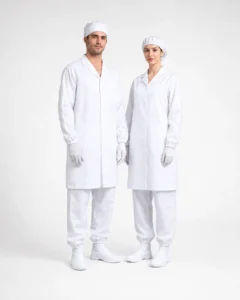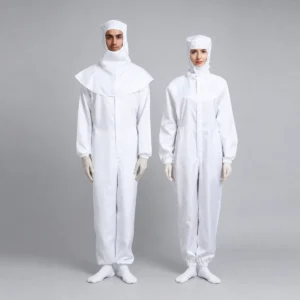
Cleanroom lab coats, also called cleanroom frocks or smocks, are the lightest outer garment in a cleanroom gowning system. They are quick to put on, comfortable for long shifts and easy to launder, which is why they are common in laboratories, electronics assembly, inspection rooms and support areas. They also have clear limits. This guide explains where a cleanroom lab coat fits, where EU GMP Annex 1 expects a trouser suit or coverall instead, and what to specify when you buy.
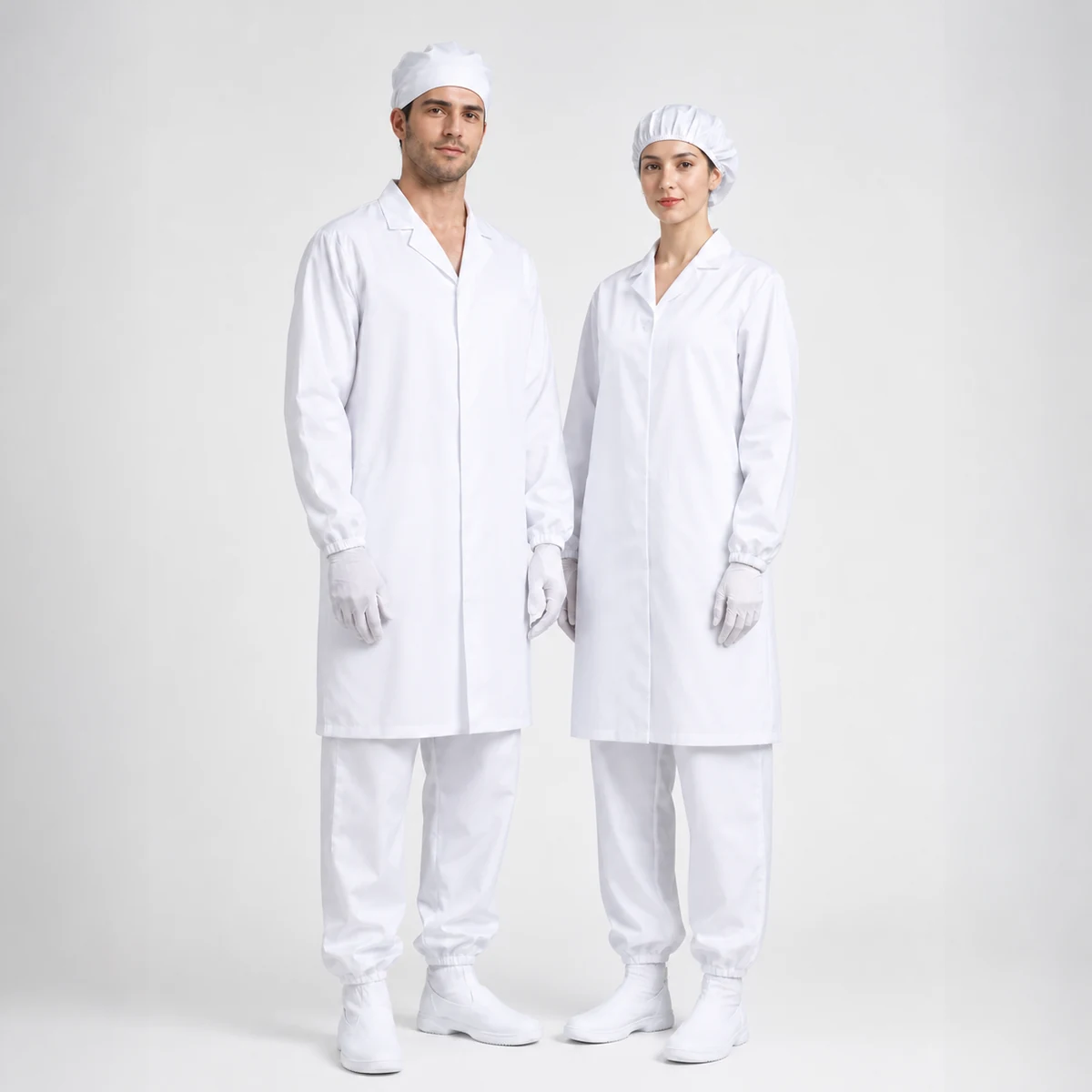
Resposta rápida: a cleanroom lab coat is a low-linting, knee-length coat with closed cuffs and a high collar, made for controlled areas where full coveralls are not required. It is a practical choice for less critical areas such as ISO Class 8 rooms, many Grade D areas and gowning-room transitions, when your Contamination Control Strategy (CCS) supports it. It is not enough on its own for EU GMP Grade C, where Annex 1 describes a trouser suit gathered at the wrists with a high neck, or for Grade A/B, where sterilized coveralls are required.
Cleanroom lab coat vs ordinary lab coat
An ordinary cotton or poly-cotton lab coat protects the wearer from splashes and dirt. A cleanroom lab coat protects the product and the room from the wearer. The differences are in the details:
| Recurso | Ordinary lab coat | Cleanroom lab coat |
|---|---|---|
| Tecido | Cotton or poly-cotton blends that shed fibers | Low-linting synthetic fabric, often with a conductive stripe or grid for static control |
| Punhos | Open sleeves | Elastic or knitted cuffs that close around the wrist |
| Collar | Open lapel | Higher collar that limits shedding from inner clothing |
| Pockets | Several open pockets | Few or no exterior pockets, so particles are not trapped and released |
| Cuidado | Normal industrial laundry | Cleanroom laundry, with autoclaving where the garment is rated for it |
| Propósito | Protects the wearer | Limits particles from the wearer reaching the product and the room |
If your site still issues ordinary lab coats in controlled areas, switching to cleanroom lab coats is often the simplest upgrade in a gowning program.
Where a cleanroom lab coat fits, and where it does not
ISO 14644 classifies cleanrooms by airborne particle concentration but does not prescribe specific garments. Garment choice comes from your risk assessment, industry practice such as IEST-RP-CC003, and, for EU GMP sites, Annex 1. Annex 1 paragraph 7.13 describes typical clothing for each grade:
- Grade B (and access to Grade A): sterilized coverall-type garments, sterile headgear, mask, eye coverings, two pairs of sterile gloves and sterilized footwear.
- Grade C: “A single or two-piece trouser suit gathered at the wrists and with high neck and appropriately disinfected shoes or overshoes”, with hair covered.
- Grade D: “A general protective suit and appropriately disinfected shoes or overshoes”, with hair covered.
| Área | Is a cleanroom lab coat suitable? | Usual alternative |
|---|---|---|
| Grade A/B aseptic areas | Não | Sterile coverall with hood, mask, goggles and over-boots |
| Grau C | No, not on its own | Two-piece trouser suit or coverall with high neck and closed cuffs |
| Grau D | Often, if the CCS supports it | Two-piece suit where the site standardizes on one style |
| ISO Class 8 electronics or assembly | Common | Coverall where products are more sensitive |
| Laboratories and QC rooms | Common | Disposable coat for visitors or short tasks |
| Gowning rooms and corridors | Common for transition zones | Facility suit worn under the next garment layer |
The table reflects common practice, not a rule. Your CCS and room classification decide the final choice. For Grade C requirements in detail, read our Grade C cleanroom requirements guide. For an overview of all garment types, see cleanroom garments: the complete guide.
Lab coat, two-piece suit or coverall?
| Garment | Cobertura | Melhor para | Limits |
|---|---|---|---|
| Cleanroom lab coat (frock) | Torso, arms, upper legs | ISO 8, many Grade D areas, labs, support rooms | Lower legs and inner clothing partly exposed |
| Two-piece trouser suit | Full arms and legs, high neck | Grade C, Grade D, electronics | More donning time than a coat |
| One-piece coverall | Full body, often with attached hood and boots or socks | Grade A/B (sterile), sensitive ISO 5 to 7 work | Highest cost and donning time |
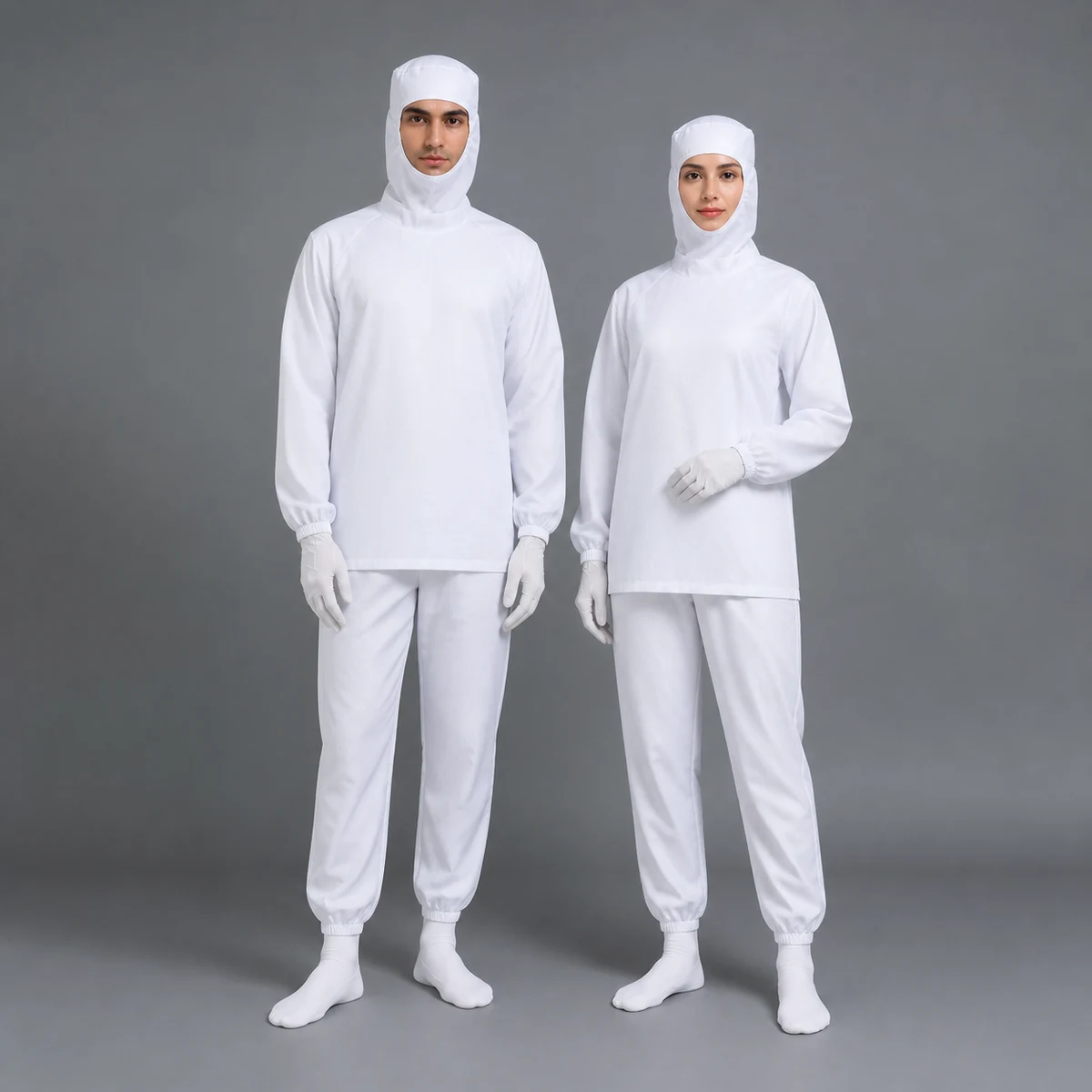
If a room is moving from Grade D to Grade C, plan to replace lab coats with two-piece suits. MIDPOSI’s MD-1A01 Grade C/D clean workshop workwear is one example: a hooded pullover top with separate pants connected to socks. For other styles, browse autoclavable cleanroom suits and sets ou autoclavable coveralls.
What to specify when you buy cleanroom lab coats
A clear specification saves time when you compare suppliers. Cover these points:
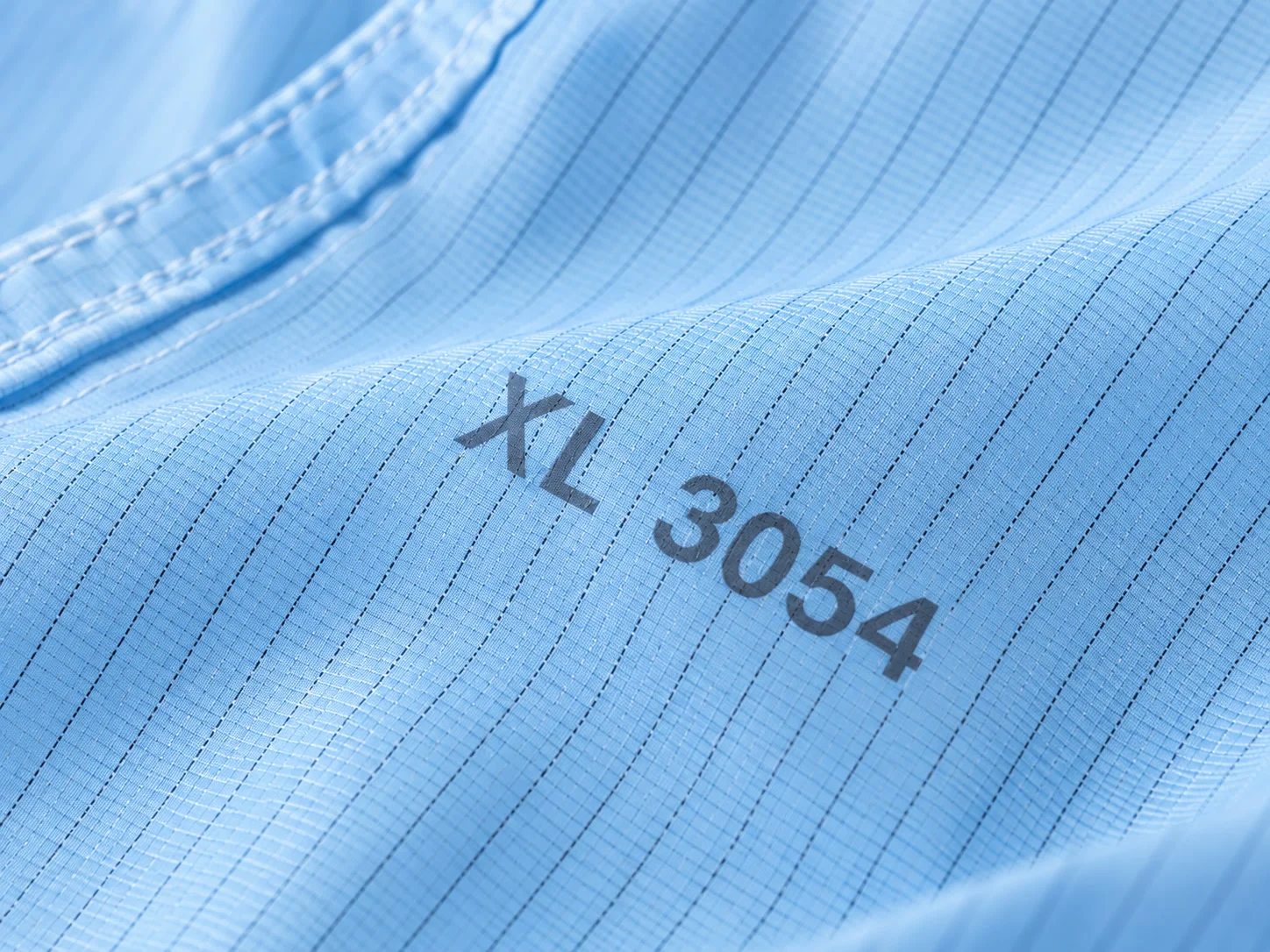
- Fabric: low-linting polyester, with a conductive stripe or grid if static control matters. MIDPOSI’s A1301 lab coat is available with 5 mm stripe or 5 mm grid conductive fiber fabric.
- Length: knee length or longer, so the coat covers the upper legs when the wearer sits or bends.
- Closure: snaps or a covered zipper that closes to the collar.
- Collar: a high or stand collar that covers inner clothing at the neck.
- Cuffs: elastic or knitted cuffs that fit under gloves.
- Pockets: as few as possible; internal pockets only if your SOP allows them.
- Color and marking: colors or labels for zoning, departments or sizes, so coats do not move between areas.
- Sizes: a full size range and a stock plan for each size.
- Care rating: whether the coat is washable only or also autoclavable, and the maximum number of cycles you will allow.
- Documents: fabric and finished garment test reports for particle and ESD performance.
Nosso guia de tamanho e ajuste e comparação de materiais de vestuário cover sizing and fabric choices in more depth.
Laundering and lifecycle
Reusable lab coats last longer than single-use coats, but only if laundry and inspection are controlled. Annex 1 paragraph 7.17 expects reusable clean area clothing to be cleaned in a segregated laundry using a qualified process, visually inspected after washing, and managed against a maximum number of laundry and sterilization cycles. Even outside GMP, the same discipline keeps particle levels stable:
- Launder cleanroom coats separately from ordinary workwear.
- Inspect for torn cuffs, damaged snaps and worn seams after each cycle.
- Record cycles per coat, or per batch, and retire coats at your set limit.
- Store clean coats bagged until use.
MIDPOSI garments are rated for up to 100 autoclave cycles. Your own validation and inspection results set the limit you use. See how many times cleanroom garments can be autoclaved para mais detalhes.
Why buy cleanroom lab coats from MIDPOSI
MIDPOSI has manufactured cleanroom garments since 2004. We are ISO 13485 certified, hold a CE certificate, and test reports (particle, filtration and ESD) are available on request. Details are on our quality and certifications página.
- A1301 autoclavable cleanroom lab coat: reusable, washable, low-lint and anti-static
- Lab coat range e lab coat solutions for labs and support areas
- Production MOQ of 50 pieces per style, samples and trial orders from 10 pieces, and a lead time of about 25 days
- OEM and private label on the same terms
Not sure whether a room needs lab coats, two-piece suits or coveralls? The seletor de roupas para salas limpas suggests a set by grade, and the estimador de cotação de sala limpa helps you plan quantities.
Perguntas frequentes
Can cleanroom lab coats be used in Grade C?
Not on their own. Annex 1 describes a single or two-piece trouser suit gathered at the wrists with a high neck for Grade C. A lab coat may still be used in Grade D or in transition areas if your CCS supports it.
Are cleanroom lab coats anti-static?
Many are. Cleanroom lab coats made with conductive fiber in a stripe or grid pattern help reduce static build-up. Ask for ESD test results for the finished garment.
Can cleanroom lab coats be autoclaved?
Only coats rated for it. The MIDPOSI A1301 lab coat is autoclavable. Check the cycle rating and include the maximum cycle count in your laundry procedure.
What is the difference between a cleanroom frock and a lab coat?
In cleanroom use the terms usually mean the same garment: a knee-length coat with closed cuffs and a high collar made from low-linting fabric. The term frock is more common in electronics and semiconductor facilities.
Obtenha amostras ou um orçamento
Tell us the rooms where the coats will be used, your preferred color, conductive fabric pattern and size breakdown. We can send samples from 10 pieces. Envie uma consulta através do nosso formulário de contato ou mande-nos uma mensagem no WhatsApp.