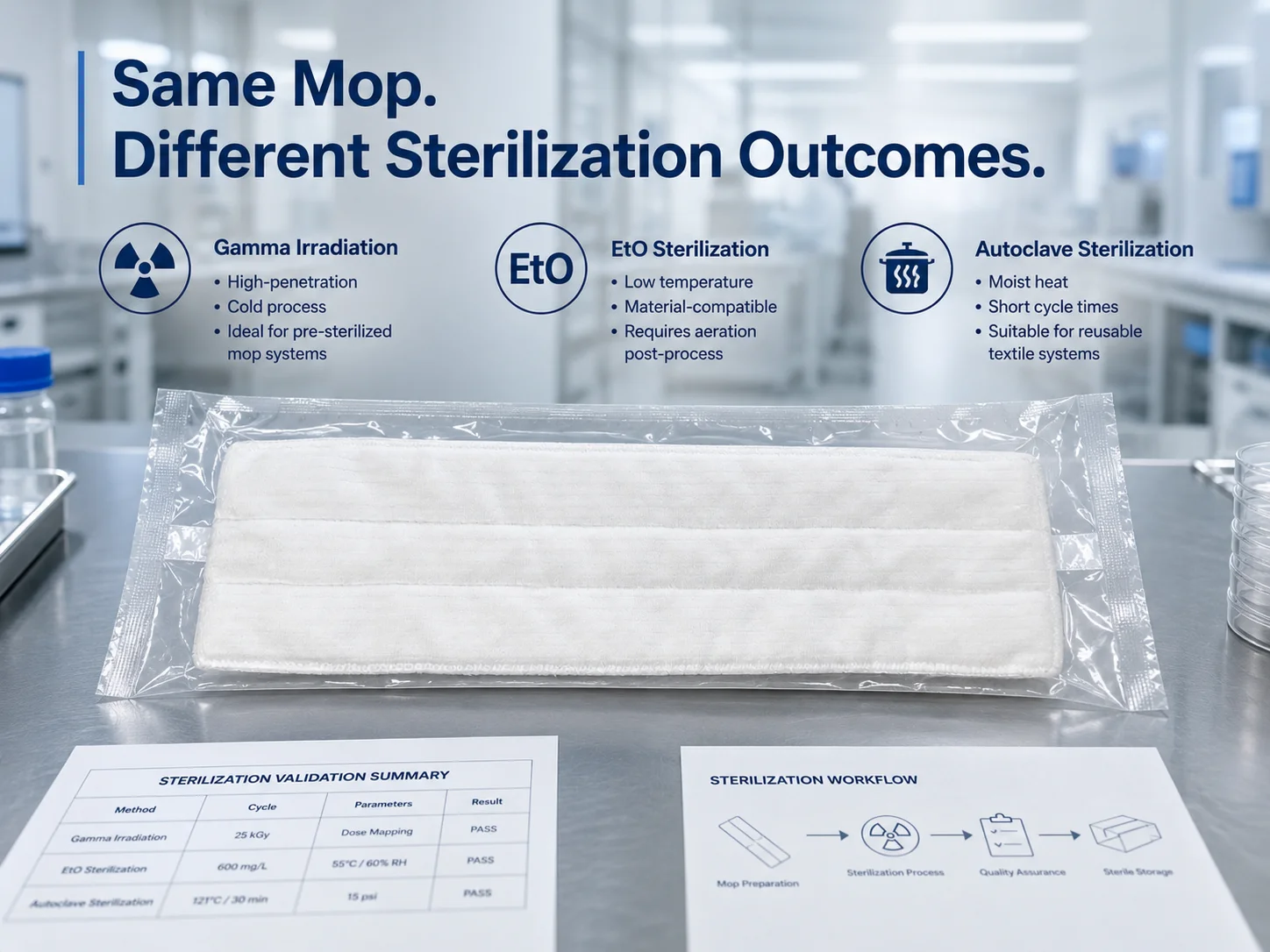
Steril temiz oda paspasları üç ana yöntemle sterilize edilebilir: gama ışınlaması, etilen oksit ve buhar otoklavı; bunların her biri paspas malzemeleri, paketleme gereksinimleri, sterilite güvence seviyeleri, doğrulanmış raf ömrü ve belgeler üzerinde temelde farklı etkilere sahiptir. Seçim birbirinin yerine geçemez: Gama için onaylanmış bir paspas, otoklav ısısı altında bozunabilir ve EtO gaz penetrasyonu için tasarlanmış bir paspas, gama'nın belirli polimerler üzerindeki radyasyon etkileriyle uyumsuz olabilir. Bu kılavuz, GMP ortamları için steril paspasları belirlerken QA, satın alma ve doğrulama ekiplerinin değerlendirmesi gereken teknik ödünleşimlerin haritasını çıkarır.
Sterilizasyon yönteminin seçimi üç ana faktöre bağlıdır: malzeme uyumluluğu (Paspas malzemesi bozulmadan yönteme dayanabilir mi?), paketleme gereksinimleri (ambalaj sterilizasyona izin veriyor mu ve sterilliği koruyor mu?) ve tesis doğrulama yeteneği (Sterilizasyon tedarikçi tarafından mı yoksa şirket içinde mi yapılıyor?). Gama ışınlaması, tek kullanımlık steril paspaslar için en yaygın yöntemdir; kapalı ambalajlara kalıntı bırakmadan nüfuz eder ve onaylanmış en uzun raf ömrünü sağlar. Otoklav, yeniden kullanılabilir paspas sistemleri için standarttır; şirket içinde gerçekleştirilebilir ancak kümülatif termal stres uygular. Etilen oksit malzemelere karşı en nazik olanıdır ancak kalan gazı uzaklaştırmak için uzun süreli havalandırma gerektirir ve paspaslarda tıbbi cihazlara göre daha az yaygındır.
| Yöntem | Nasıl Çalışır? | En İyisi | Anahtar Sınırlaması |
|---|---|---|---|
| Gama Işınlaması | Kobalt-60 kaynağı mikrobiyal DNA'yı bozan iyonlaştırıcı radyasyon yayar. Kapalı ambalajlara nüfuz eder. | Tek kullanımlık steril paspaslar. Uzun raf ömrü gereklidir. Tedarikçi tarafından yönetilen sterilizasyon. | Daha yüksek kümülatif dozlarda poliamidi (mikrofiber bileşen) bozabilir. Bazı malzemelere ambalajlama sonrası uygulanamaz. |
| Etilen Oksit (EtO) | Gaz halindeki EtO mikrobiyal DNA'yı alkile eder. Gaz geçirgen paketleme ve sterilizasyon sonrası havalandırma gerektirir. | Isıya duyarlı veya radyasyona duyarlı malzemeler. Gama polimer için uygun olmadığında. | Artık EtO, doğrulanmış havalandırma süresi gerektirir. Gaz penetrasyonu sınırlamaları. Daha uzun çevrim süresi. |
| Buharlı Otoklav | 121°C veya 134°C'de basınç altındaki doymuş buhar, mikrobiyal proteinleri denatüre eder. | Yeniden kullanılabilir otoklavlanabilir paspaslar. Evde sterilizasyon. Kimyasal kalıntı yok. | Kümülatif termal stres, yeniden kullanılabilir paspas ömrünü sınırlar. Sterilite raf ömrü otoklav sonrası kullanıma bağlıdır. |
Paket servis: Hiçbir yöntem evrensel olarak “daha iyi” değildir. Doğru seçim, paspas malzemesine, kullanım modeline (tek kullanımlık veya yeniden kullanılabilir) ve tesisin dokümantasyon gereksinimlerine göre yapılır. Steril veya steril olmayan paspasların belirlenip belirlenmeyeceğine ilişkin üst karar için bkz. steril ve steril olmayan temiz oda paspas karar çerçevesi. Steril paspas seçenekleri için bkz. steril temiz oda paspas seçenekleri sayfa.
Gama ışınlaması, ürüne ve ambalajına nüfuz eden yüksek enerjili fotonları (gama ışınları) yaymak için bir Kobalt-60 radyoaktif kaynağı kullanır. İyonlaştırıcı radyasyon, mikroorganizmaların DNA'sını bozar, çoğalmayı engeller ve onları yaşayamaz hale getirir. Isı ve neme dayanan otoklavdan farklı olarak gama sterilizasyonu "soğuk" bir işlemdir: ışınlama sırasında ürün sıcaklığı önemli ölçüde artmaz, bu da onu termal stresi tolere edemeyen malzemeler için uygun hale getirir.
Gama radyasyonu kapalı ambalaja tamamen nüfuz eder; ürün, ışınlama öncesinde son steril bariyer sisteminde paketlenebilir. Bu kritik bir avantajdır: Kapalı ambalajın içinde sterilite sağlanır ve ambalaj bozulmadan kaldığı sürece ürün steril kalır. Sterilizasyon olayının tamamı paketleme sonrasında gerçekleşir, bu da bir kontaminasyon değişkeni olarak sterilizasyon sonrası işlemleri ortadan kaldırır.
Gama ışınlaması polimer malzemeleri kimyasal yapılarına bağlı olarak farklı şekilde etkiler:
Bu malzemelerin temizleme uygulamalarında nasıl performans gösterdiğine ilişkin ayrıntılı bir analiz için bkz. mikrofiber ve polyester temiz oda paspas karşılaştırması.
Temiz oda sarf malzemeleri ve tıbbi cihazlar için standart sterilizasyon dozu 25 kGy'dir (kilogray). Bu doz, 10⁻⁶'lik bir Sterilite Güvence Düzeyine (SAL) ulaşmak için doğrulanmıştır; bu, işlenen bir milyon ünite başına birden fazla steril olmayan ünitenin bulunmama olasılığı anlamına gelir. Doz keyfi değildir: ürünün başlangıçtaki biyolojik yüküne (sterilizasyondan önce mevcut olan mikrobiyal yük) dayanmaktadır ve doz denetim prosedürleri aracılığıyla doğrulanmaktadır.
Gama ile sterilize edilmiş paspaslar, tipik olarak Tyvek (flaşla eğrilmiş yüksek yoğunluklu polietilen) veya tıbbi sınıf polietilen film gibi radyasyon altında stabil kalan malzemelerle paketlenmelidir. Ambalaj: (1) bozulmadan gama nüfuzuna izin vermeli, (2) ışınlama işlemi boyunca mühür bütünlüğünü korumalı, (3) sterilizasyondan sonra mikrobiyal bir bariyer sağlamalı ve (4) onaylanmış raf ömrü boyunca stabil kalmalıdır. Aseptik alanlara giren ürünler için çift torbalama yaygındır; dış torba Sınıf C/D sınırında çıkarılır ve iç torba, Sınıf B önlük alanından Sınıf A'ya kadar steriliteyi korur. çift torbalı steril temiz oda bezleri Paketleme yapılandırma ayrıntıları için sayfa.
Gamma-sterilized products typically carry a validated shelf life of 3–5 years from the date of irradiation, contingent on packaging integrity. This is the longest shelf life of the three methods. Documentation includes: Certificate of Irradiation per batch (confirming the dose delivered and date of irradiation), dosimetry records (measurements of actual dose received at multiple positions in the irradiation chamber), and sterility test results (performed on samples from each batch to verify SAL). The Certificate of Irradiation is the primary document a buyer should request — it is the equivalent of a Certificate of Sterility for gamma-sterilized products.
Etilen oksit, mikroorganizmaların DNA'sını alkilleyen gazlı bir sterilandır; DNA bazlarını kimyasal olarak değiştirerek replikasyonu önler. İşlem, kontrollü sıcaklıkta (tipik olarak 30-60°C), nemde ve EtO gaz konsantrasyonunda kapalı bir odada gerçekleşir. Otoklava kıyasla sıcaklığın düşük olması ve mekanizmanın radyasyon bazlı değil kimyasal olması nedeniyle EtO, polimer malzemeler için en yumuşak sterilizasyon yöntemidir.
Tam EtO döngüsü şunları içerir: ön koşullandırma (sıcaklık ve nem stabilizasyonu), EtO gazına maruz kalma (sterilizasyon aşaması) ve havalandırma (artık EtO gazının uzaklaştırılması). Havalandırma aşaması kritiktir — EtO bilinen bir kanserojendir ve ürün piyasaya sürülmeden önce kalıntı düzeylerinin yasal sınırların (ISO 10993-7) altına düşürülmesi gerekir. Havalandırma, ürünün malzemesine, ambalajına ve hazne koşullarına bağlı olarak 12–72 saat sürebilir.
EtO, üç yöntem arasında malzeme açısından en uyumlu olanıdır. Gamanın neden olabileceği polimer zincirinin kesilmesine veya otoklavın neden olabileceği termal bozulmaya neden olmaz. Polyester, poliamid, polipropilen — hepsi EtO'yu standart proses parametrelerinde iyi tolere eder. Bu, ürün, otoklav sıcaklıklarında deforme olabilecek veya bozulabilecek gama duyarlı malzemeler (mikrofiberdeki poliamid gibi) veya ısıya duyarlı bileşenler içerdiğinde EtO'yu tercih edilen yöntem haline getirir.
Ancak malzeme uyumluluğu proses uygunluğuyla aynı şey değildir: Paspas malzemesi EtO'yu tolere edebilse de gazın tüm yüzeylere ulaşabilmesi için ürüne ve ambalajına nüfuz etmesi gerekir. Yoğun veya sıkı paketlenmiş ürünler, tüm yüzeylere yeterli miktarda gaz maruziyeti alamayabilir, bu da sterilizasyonun etkinliğini azaltabilir. Ürünlerin yalnızca uyumlu olduğu varsayılmamalı, belirli EtO döngüsü parametreleri açısından da doğrulanması gerekir.
EtO sterilizasyonu gaz geçirgen ambalaj gerektirir; ambalaj, EtO gazının sterilizasyon aşamasında girmesine ve havalandırma aşamasında çıkışına izin vermelidir. Yaygın malzemeler arasında Tyvek (gaz geçirgen) veya tıbbi kalitede kağıt bulunur. Geçirgen olmayan filmler (katı polietilen, folyo laminatlar) EtO penetrasyonunu engeller ve EtO sterilizasyonu için birincil ambalaj olarak kullanılamaz. Ambalaj aynı zamanda sterilizasyondan sonra da mikrobiyal bir bariyer sağlamalıdır; gaz geçirgen olması, mikroorganizmalara karşı geçirgen olduğu anlamına gelmez.
EtO'nun birincil dezavantajı artık yönetimidir. EtO ve reaksiyon yan ürünleri (etilen klorohidrin, etilen glikol), ürün piyasaya sürülmeden önce ISO 10993-7'de belirtilen seviyelere düşürülmelidir. Gereken havalandırma süresi ürünün malzemesine, ambalajına ve yük konfigürasyonuna bağlıdır. EtO kullanan tesislerin EtO gazına mesleki maruz kalma sınırlarını yönetmesi gerekir; bu genellikle son kullanıcının değil, sterilizasyon yüklenicisinin (tedarikçi veya üçüncü taraf sterilizasyon hizmeti) sorumluluğundadır. Ancak alıcılar, tedarikçinin EtO kalan test verilerinin belge paketinde yer aldığını doğrulamalıdır.
EtO-sterilized products should be accompanied by: Certificate of Sterility per batch (confirming the EtO cycle parameters and sterility test results), EtO residual test results (confirming residuals below ISO 10993-7 limits), and cycle parameter records (temperature, humidity, gas concentration, exposure time, aeration time). The Certificate of Sterility for EtO is not the same document as the Certificate of Irradiation for gamma — each is method-specific and should reference the relevant process validation.
Buharlı otoklav sterilizasyonu, suyun kaynama noktasının üzerindeki sıcaklıklara ulaşmak için basınç altında doymuş buhar kullanır - tipik olarak 15 psi'de (yerçekimi döngüsü) 121°C veya 30 psi'de (ön vakum döngüsü) 134°C. Yüksek sıcaklık, mikrobiyal proteinleri denatüre eder ve hücre zarlarını bozarak termal enerji yoluyla sterilizasyonu sağlar. Otoklav, GMP tesislerinde en yaygın kullanılan sterilizasyon yöntemidir; çoğu farmasötik ve biyoteknoloji üretim tesisi, ekipmanı, giysileri ve sarf malzemelerini sterilize etmek için onaylanmış otoklavlara sahiptir.
Tipik olarak tedarikçi veya sözleşmeli sterilizasyon servisi tarafından gerçekleştirilen gama ve EtO'nun aksine, otoklav son kullanıcı tarafından şirket içinde gerçekleştirilebilir. Bu önemli bir operasyonel avantajdır: Tesis, sterilizasyon programını, döngü parametrelerini ve dokümantasyonu kontrol ederek tedarikçinin sterilizasyon zaman çizelgelerine bağımlılığı azaltır.
Otoklav sterilizasyonu, paspas malzemelerini her döngüde üç yöntemin en agresif koşullarına (yüksek sıcaklık, nem ve basınç) maruz bırakır. Etkiler kümülatiftir:
These cycle counts are triggers for intensified inspection — not automatic retirement thresholds. Facilities should implement the inspection criteria described in the temiz oda paspası bakımı ve uzun ömürlülük kılavuzu.
Otoklavla sterilize edilen paspaslar, tesisin protokolüne bağlı olarak sterilizasyondan önce veya sonra paketlenebilir. Önceden paketlenmiş otoklav sterilizasyonu, buhar nüfuzuna izin veren nefes alabilen ambalaj (EtO'ya benzer) kullanır. Sterilizasyon sonrası paketleme, paspasların otoklav döngüsünden sonra steril bir ortamda paketlenmesini gerektirir; bu da, bir kontaminasyon değişkeni olarak elleçlemeyi ortaya çıkarır.
Gama ile sterilize edilmiş ürünlerden farklı olarak, otoklavla sterilize edilmiş paspaslar, sterilizasyon sonrası kontrollü koşullar altında paketlenmedikçe ve ambalaj bütünlüğü doğrulanmadıkça, üretici tarafından onaylanmış bir raf ömrüne sahip değildir. Kurum içi otoklav sterilizasyonunu kullanan tesisler genellikle paketleme yöntemine, depolama ortamına ve risk değerlendirmesine dayalı olarak kendi raf ömrünü tanımlar; tesiste kullanılan ürünler için genellikle 30-90 gün.
Autoclave documentation is generated by the facility, not the supplier: autoclave cycle log (date, cycle type, temperature, pressure, duration), biological indicator results (spore strip or self-contained BI placed in the load to verify sterilization), and chemical integrator results (confirming that temperature and time parameters were met). These records form part of the facility’s GMP documentation — not a Certificate of Sterility in the supplier-issued sense. During an audit, the facility must demonstrate that autoclave cycles were valid, biological indicators passed, and the items were used or stored within the defined shelf life.
Aşağıdaki matris, üç yöntemi sekiz operasyonel boyutta birleştirir. Hangi yöntemin paspas malzemenize, tesis kapasitesine ve belge gereksinimlerinize uygun olduğunu değerlendirmek için bunu kullanın.
| Boyut | Gama Işınlaması | Etilen Oksit (EtO) | Buharlı Otoklav |
|---|---|---|---|
| Malzeme Uyumluluğu - Polyester | İyi | Harika | İyi (kümülatif termal stres) |
| Malzeme Uyumluluğu - Mikrofiber | Orta (poliamid hassasiyeti) | Harika | Sınırlı (10–20 döngü aralığı) |
| Sterilite Güvence Düzeyi | 10⁻⁶ (standart) | 10⁻⁶ (standart) | Tesis onaylı (genellikle 10⁻⁶) |
| Paketleme Gereksinimi | Radyasyona dayanıklı kapalı ambalaj | Gaz geçirgen ambalaj | Buhar geçirgen paketleme (veya çevrim sonrası steril paketleme) |
| Doğrulanmış Raf Ömrü | 3–5 yıl (tedarikçi tarafından doğrulanmış) | 2–3 yıl (tedarikçi tarafından doğrulanmış) | Tesis tanımlı (genellikle 30-90 gün) |
| Dokümantasyon Türü | Parti başına Işınlama Sertifikası | Parti başına Sterilite Sertifikası | Autoclave cycle log (facility-generated) |
| Residuals | Hiçbiri | EtO gas and byproducts (requires aeration) | None (chemical) |
| Best Application | Single-use sterile mops. Supplier-managed. Long shelf life. | Radiation/heat-sensitive materials. | Reusable autoclavable mops. In-house sterilization. |
Feragatname: This comparison describes general characteristics of each sterilization method. Specific mop products may behave differently based on material formulation, construction, and supplier validation. Always consult the supplier’s sterilization validation documentation for product-specific compatibility and performance data. For a complete framework of supplier documentation to request, see the temiz oda paspası doğrulama belgeleri rehber.
Temiz oda paspasları için bir sterilizasyon yönteminin seçilmesi, aşağıda özetlenen karar mantığını takip eder. Her kriter, malzeme, kullanım modeli ve tesis gereksinimlerinin kesişiminden uygun yöntem ortaya çıkana kadar seçenekleri daraltır.
Tek kullanımlık paspaslar → gama veya EtO (tedarikçi tarafından sterilize edilmiştir). Yeniden kullanılabilir paspaslar → otoklav (tesiste sterilize edilmiştir). Bu, ilk ve en kesin filtredir: Temizlikten sonra yeniden kullanılacak bir paspasın, tekrarlanan sterilizasyon döngülerini tolere etmesi gerekir, bu da otoklavı tercih eder. Bir kullanımdan sonra atılan bir paspasın steril olması gerekir; bu da gama veya EtO'yu tercih eder.
Polyester mops → all three methods are viable (with supplier validation). Microfiber mops → gamma may degrade polyamide at higher doses; EtO is the gentlest option for preserving microfiber structure; autoclave limits microfiber cycle life to 10–20 cycles. The material decision drives the method decision — selecting a material without considering its sterilization compatibility results in a specification that looks valid on paper but fails under production conditions.
Long shelf life (years) → gamma (3–5 years validated). Medium shelf life → EtO (2–3 years). Short shelf life → autoclave (30–90 days, facility-defined). The required shelf life should reflect the procurement cycle: if sterile mops are ordered monthly and used within 30 days, a long shelf life is unnecessary. If sterile mops are ordered quarterly and held in inventory, gamma’s 3–5 year shelf life provides buffer against expiration.
Cevabınız evet ise otoklav, yeniden kullanılabilir paspaslar için bir seçenektir ve sterilizasyon için tedarikçiye bağımlılığı azaltır. Hayırsa ve yeniden kullanılabilir paspaslar kullanılıyorsa, tesis harici bir sterilizasyon servisiyle sözleşme yapmalı veya tedarikçi tarafından sterilize edilmiş tek kullanımlık paspaslara (gamma veya EtO) geçiş yapmalıdır. Onaylanmış şirket içi otoklavın mevcudiyeti, malzeme uyumluluğuna bakılmaksızın otoklav seçeneğini ortadan kaldıran veya mümkün kılan pratik bir kısıtlamadır.
Supplier-issued Certificate of Irradiation (gamma) or Certificate of Sterility (EtO) → externally generated documentation that transfers to the buyer. In-house autoclave cycle logs → internally generated documentation that the facility owns and controls. The documentation path should match the quality system’s preference: some facilities prefer supplier-managed documentation for audit simplicity; others prefer in-house documentation for process control.
The upstream decision — whether to specify sterile or non-sterile mops in the first place — is covered in the steril ve steril olmayan temiz oda paspas karar çerçevesi. The method selection described in this guide applies once the sterile specification decision has been made.
A facility switches from gamma-sterilized single-use mops to autoclaving reusable mops, assuming the same sterility outcome. The mop material was validated for gamma, not for repeated autoclave cycling. By cycle 15, the quilting stitches begin to separate. The sterility outcome was the same, but the material durability was not — because the sterilization method affects material longevity as well as sterility.
Düzeltme: Treat the sterilization method as part of the mop specification, not as an interchangeable final step. A mop validated for gamma has not been validated for autoclave unless the supplier explicitly confirms autoclave compatibility and provides cycle limit data.
EtO residuals are regulated and validated. A properly aerated EtO-sterilized product has residual levels below ISO 10993-7 limits — which are conservative safety thresholds. The concern is valid (EtO is a carcinogen) but the risk is controlled through validated aeration and residual testing. Avoiding EtO entirely eliminates the gentlest sterilization option for polymer materials — which may force the use of gamma or autoclave on materials that do not tolerate them well, creating a material durability problem that is more operationally significant than the residual risk from validated EtO sterilization.
Düzeltme: Evaluate EtO based on the supplier’s residual testing data and aeration validation — not on the hazard classification of EtO gas alone. A supplier that provides complete EtO residual documentation has managed the risk. A supplier that cannot provide residual data has not.
SAL 10⁻⁶ (one non-sterile unit per million) is the standard for sterile medical devices and cleanroom consumables. Achieving SAL 10⁻⁷ or 10⁻⁸ is technically possible but requires higher radiation doses, longer EtO exposure, or more aggressive autoclave cycles — all of which accelerate material degradation. The incremental sterility benefit between 10⁻⁶ and 10⁻⁷ is negligible for cleanroom mop applications, but the material degradation penalty may not be. Specifying a higher SAL than necessary trades material service life for a sterility margin that provides no practical contamination control benefit.
Düzeltme: Verify that the product achieves SAL 10⁻⁶ — the standard threshold. Do not request or specify higher SAL unless a documented risk assessment demonstrates that 10⁻⁶ is insufficient for the specific application. In cleanroom mop applications, 10⁻⁶ is the appropriate standard.
Packaging maintains sterility — it does not create it. If the packaging is compromised (pinhole, seal failure, abrasion during transport), the product inside is no longer sterile regardless of the original sterilization method or documentation. Packaging integrity is validated at the time of sterilization, but it must be maintained through storage, transport, and transfer into the cleanroom. A gamma-sterilized mop with a pinhole in the outer bag may have been sterile when irradiated, but it is not sterile when the operator opens the bag at the Grade B gowning bench.
Düzeltme: Include packaging integrity verification in the incoming inspection procedure for sterile mops. Train operators to inspect packaging before opening — damaged packaging = do not use. For aseptic transfer protocols, see the steril temiz oda paspası aseptik transfer kılavuzu for staged packaging verification.
A facility autoclaves reusable mops, packages them in-house, and stores them for six months — assuming the same shelf life as gamma-sterilized supplier-packaged mops. Gamma-sterilized mops carry a supplier-validated shelf life (3–5 years) based on packaging integrity testing conducted under controlled conditions. In-house autoclaved mops carry no supplier-validated shelf life — the shelf life is defined by the facility based on their packaging method, storage environment, and risk assessment. A six-month storage without validated packaging integrity is outside the typical facility-defined shelf life for autoclaved items.
Düzeltme: Define and document the shelf life for autoclaved mops in the facility’s cleaning SOP. Base the shelf life on packaging method, storage conditions, and environmental monitoring data from the storage area. If no packaging integrity validation has been performed, adopt a conservative shelf life (30 days) and adjust with data.
Gamma irradiation (Cobalt-60 ionizing radiation), ethylene oxide (EtO gas alkylation), and steam autoclave (saturated steam at 121°C or 134°C under pressure). Gamma and EtO are typically performed by the supplier or a contract sterilization service. Autoclave can be performed in-house by the facility and is the standard method for reusable autoclavable mops.
Gamma irradiation at standard sterilization doses (25 kGy) is generally well-tolerated by polyester, which maintains structural integrity and cleaning performance. Microfiber’s polyamide component is more gamma-sensitive — it can undergo chain scission, leading to reduced tensile strength and accelerated degradation of the split-fiber structure at higher cumulative doses. Polyester mops are the more conservative choice for gamma-sterilized products.
All three methods can achieve SAL 10⁻⁶ (one non-sterile unit per million) when properly validated. This is the standard for sterile medical devices and cleanroom consumables. Gamma and EtO achieve this through validated supplier processes with dosimetry (gamma) or cycle parameter verification (EtO). Autoclave achieves this through validated facility cycles with biological indicator testing. Specifying higher SAL (>10⁻⁶) is generally unnecessary for cleanroom mop applications and may accelerate material degradation without providing practical contamination control benefit.
Gamma: Certificate of Irradiation per batch (dose delivered, date of irradiation), dosimetry records, sterility test results. EtO: Certificate of Sterility per batch, EtO residual test results (confirming residuals below ISO 10993-7 limits), cycle parameter records. Autoclave: Autoclave cycle log (facility-generated), biological indicator results, chemical integrator results. The documentation type differs fundamentally between supplier-sterilized (gamma/EtO) and facility-sterilized (autoclave) products.
Gamma: 3–5 years (supplier-validated, contingent on packaging integrity). EtO: 2–3 years (supplier-validated). Autoclave: 30–90 days (facility-defined, based on packaging method, storage environment, and risk assessment). Autoclave-sterilized items do not carry a manufacturer-validated shelf life unless packaged under controlled conditions and validated for packaging integrity — which is uncommon in facility-operated autoclave programs.
No method is universally better — the appropriate method depends on the mop material, use model (single-use or reusable), required shelf life, and facility capability. Gamma is the most common for single-use sterile mops because it provides the longest shelf life and penetrates sealed packaging without residuals. Autoclave is the standard for reusable mops because it can be performed in-house. EtO is the best choice for materials that cannot tolerate gamma or heat — but is less common for mops than for medical devices. The method should follow the material and the application, not be selected independently.
Technically possible but requires re-validation. A gamma-sterilized mop is not automatically validated for autoclave re-sterilization, and an autoclaved mop is not automatically validated for gamma. The cumulative effect of different sterilization mechanisms on the same material is not predictable without testing. If a facility needs to re-sterilize mops using a different method than the original sterilization, the supplier should be consulted for compatibility data — and the re-sterilization should be validated before production use. In practice, switching sterilization methods on the same item should be avoided unless specifically validated.
Each method imposes different packaging requirements. Gamma requires radiation-stable materials (Tyvek, medical-grade PE) that remain stable under irradiation and maintain seal integrity. EtO requires gas-permeable packaging that allows EtO penetration during sterilization and outgassing during aeration. Autoclave requires steam-permeable packaging if packaged before sterilization, or sterile packaging applied post-cycle in a controlled environment. The packaging must maintain a microbial barrier regardless of method — the sterilization method determines how the packaging is validated, not whether a barrier is required.
Specify your sterilization method, target SAL, packaging requirements, and cleanroom grade. MIDPOSI provides sterile mop specifications with sterilization validation documentation and material compatibility data.
Belgelerin kullanılabilirliği ürün yapılandırmasına göre değişebilir. Her soruşturmayla birlikte sağlanan standart teknik belgeler.
{
“@bağlam”: “https://schema.org”,
“@grafik”: [
{
“@type”: “Makale”,
“headline”: “Cleanroom Mop Sterilization Methods — Gamma, EtO, and Autoclave Compared”,
“description”: “Sterile cleanroom mops can be sterilized by gamma irradiation, ethylene oxide, or steam autoclave — each with different effects on materials, packaging, shelf life, and documentation. This comparison helps QA and procurement teams select the appropriate method.”,
“yazar”: { “@type”: “Kuruluş”, “ad”: “MIDPOSI” },
“yayıncı”: { “@type”: “Kuruluş”, “ad”: “MIDPOSI”, “url”: “https://midposi.com/” },
“datePublished”: “2026-06-01”,
“tarihModifiye”: “2026-07-14”,
“mainEntityOfPage”: { “@type”: “WebPage”, “@id”: “https://midposi.com/cleanroom-mop-sterilization-gamma-eto-autoclave/” },
“image”: “https://midposi.com/wp-content/uploads/2025/12/Double-bagging-for-aseptic-products-for-sterile-cleanroom-mop.webp”,
“articleSection”: “Cleanroom Mop Sterilization”,
“keywords”: “cleanroom mop sterilization gamma eo autoclave, sterile mop sterilization comparison, gamma irradiation cleanroom mop”
},
{
“@type”: “SSS Sayfası”,
“ana Varlık”: [
{
“@type”: “Question”, “name”: “What are the three primary sterilization methods for cleanroom mops?”,
“acceptedAnswer”: { “@type”: “Answer”, “text”: “Gamma irradiation (Cobalt-60 ionizing radiation), ethylene oxide (EtO gas alkylation), and steam autoclave (saturated steam at 121°C or 134°C). Gamma and EtO are typically supplier-performed. Autoclave can be performed in-house for reusable mops.” }
},
{
“@type”: “Question”, “name”: “How does gamma irradiation affect cleanroom mop materials?”,
“acceptedAnswer”: { “@type”: “Answer”, “text”: “Polyester tolerates gamma well at standard 25 kGy doses, maintaining structural integrity. Microfiber’s polyamide component is more gamma-sensitive — it can undergo chain scission leading to reduced strength and accelerated split-fiber degradation at higher cumulative doses.” }
},
{
“@type”: “Question”, “name”: “What sterility assurance level (SAL) do these methods achieve?”,
“acceptedAnswer”: { “@type”: “Answer”, “text”: “All three methods can achieve SAL 10⁻⁶ when properly validated — the standard for sterile medical devices and cleanroom consumables. Specifying higher SAL is generally unnecessary for mop applications and may accelerate material degradation without practical benefit.” }
},
{
“@type”: “Question”, “name”: “What documentation should a buyer request for each sterilization method?”,
“acceptedAnswer”: { “@type”: “Answer”, “text”: “Gamma: Certificate of Irradiation per batch with dosimetry records. EtO: Certificate of Sterility with EtO residual test results. Autoclave: Cycle log, biological indicator results, chemical integrator results — facility-generated, not supplier-issued.” }
},
{
“@type”: “Question”, “name”: “What is the validated shelf life for each sterilization method?”,
“acceptedAnswer”: { “@type”: “Answer”, “text”: “Gamma: 3–5 years supplier-validated. EtO: 2–3 years supplier-validated. Autoclave: 30–90 days facility-defined, based on packaging method, storage environment, and risk assessment.” }
},
{
“@type”: “Question”, “name”: “Is one sterilization method inherently better for cleanroom mops?”,
“acceptedAnswer”: { “@type”: “Answer”, “text”: “No method is universally better. Gamma is most common for single-use sterile mops. Autoclave is standard for reusable mops. EtO is best for materials that cannot tolerate radiation or heat. The method should follow the material and application.” }
},
{
“@type”: “Question”, “name”: “Can a mop sterilized by one method be re-sterilized by a different method?”,
“acceptedAnswer”: { “@type”: “Answer”, “text”: “Technically possible but requires re-validation. The cumulative effect of different sterilization mechanisms is not predictable without testing. Switching methods on the same item should be avoided unless specifically validated by the supplier.” }
},
{
“@type”: “Question”, “name”: “How does the sterilization method affect cleanroom mop packaging?”,
“acceptedAnswer”: { “@type”: “Answer”, “text”: “Gamma requires radiation-stable packaging. EtO requires gas-permeable packaging. Autoclave requires steam-permeable packaging if packaged pre-cycle, or sterile post-cycle packaging. The packaging must maintain a microbial barrier regardless of method.” }
}
]
},
{
“@type”: “Kırıntı Listesi”,
“itemListElement”: [
{ "@type": "ListItem", "position": 1, "name": "Home", "item": "https://midposi.com/" },
{ “@type”: “ListItem”, “position”: 2, “name”: “Blog”, “item”: “https://midposi.com/blog/” },
{ “@type”: “ListItem”, “position”: 3, “name”: “Cleanroom Mop Sterilization Methods”, “item”: “https://midposi.com/cleanroom-mop-sterilization-gamma-eto-autoclave/” }
]
}
]
}