A structured decision framework for determining when each cleanroom zone in your facility should specify sterile mops and when non-sterile options are functionally adequate and cost-appropriate. Covers GMP grade requirements, Annex 1 risk assessment, product-contact proximity, transfer path considerations, and the cost-validity tradeoffs that inform a defensible procurement specification.
How this article is different: This is a decision framework — Ne zaman Steril ve steril olmayanı seçmek için. Bu, steril paspasların genel bir tanımı değildir ve aseptik transfer protokollerine derinlemesine bir bakış değildir. Bu konular için Bölüm 8'de bağlantısı verilen ilgili makalelere bakın.

Steril mi yoksa steril olmayan mı paspas kararı tesis çapında tek bir cevap değildir. Bölge katmanlıdır. Aşağıdaki matris, sterilite tavsiyesinin yaygın temiz oda senaryolarına göre nasıl değiştiğine dair hızlı referanslı bir genel bakış sunmaktadır. Her satır, evrensel bir düzenleyici talimatı değil, genel bir değerlendirme başlangıç noktasını temsil eder. Tesise özel risk değerlendirmeleri, ürünle temas yakınlığı ve temizlik doğrulama verileri nihai spesifikasyonları bilgilendirmelidir.
| Temiz Oda Durumu | Tavsiye | Birincil Gerekçe |
|---|---|---|
| A Sınıfı / ISO 5 aseptik dolum bölgesi | Steril | Ürünle temas riski en yüksektir; Aseptik çekirdeğe giren tüm sarf malzemelerinin steril olması, AB GMP Ek 1 kapsamında temel bir beklentidir. Steril olmayan giriş, bu bölgede uyumlu olarak değerlendirilmez. |
| B Sınıfından A Sınıfına geçiş | Steril (varsayılan) | B Sınıfı, A Sınıfı için koruyucu arka plan görevi görür; Temizlik araçlarının steril olması çevresel kontrolü destekler. Steril olmayan ürünler, yalnızca Kalite Güvencesi onayına sahip resmi, belgelenmiş bir risk değerlendirmesi kapsamında bağımsız Sınıf B olarak değerlendirilebilir. |
| Grade C / ISO 7 solüsyon hazırlama | Steril Olmayan | Steril olmayan, parçacık kontrollü paspaslar genellikle kabul edilebilir. Tamamen C Sınıfı bölgelere yönelik steril spesifikasyon, yeterli kontaminasyon kontrolü faydası olmadan maliyeti artırır. Bunun yerine malzeme kalitesine ve bölge ayrımına odaklanın. |
| D Sınıfı / ISO 8 malzeme kademesi | Steril Olmayan | D Sınıfındaki steril paspaslar genellikle maliyet açısından verimsiz bir aşırı spesifikasyondur. Havadaki partikül limitleri aseptik bölgelere göre önemli ölçüde yüksektir. Uygun malzeme özelliklerine ve renk kodlu bölge ayrımına sahip steril olmayan paspaslar standart öneridir. |
| Ortak temizlik ekibiyle çok kademeli tesis | Karışık (bölge katmanlı) | Tüm bölgeler için tek bir sterilite spesifikasyonu ne maliyet açısından verimli ne de operasyonel açıdan optimaldir. Sınıflandırılmış bir yaklaşım (Sınıf A/B için steril, Sınıf C/D için steril olmayan) önerilen uygulamadır. İki spesifikasyonu yönetmenin operasyonel karmaşıklığı, genellikle steriliteyi gerçek bölge gereklilikleriyle eşleştirmenin maliyet ve uyumluluk avantajlarıyla ağır basmaktadır. |
Feragatname: Bunlar, düzenleyici zorunluluklara değil, ortak endüstri uygulamalarına ve AB GMP Ek 1 / ISO 14644 çerçeve ilkelerine dayanan genel değerlendirme kılavuzlarıdır. Spesifik tesis risk değerlendirmeleri, temizlik doğrulama protokolleri, ürünle temas yakınlığı ve geçerli bölgesel düzenleyici gereklilikler, paspasın nihai sterilite spesifikasyonlarını yönlendirmelidir.
Steril ve steril olmayan temiz oda paspası kararı tek bir faktöre dayanmaz. Birbiriyle bağlantılı beş kriter tipik olarak bir tesisin belirli bir bölge için steril paspas belirlemesi gerekip gerekmediğini belirler. Her bir kriterin ağırlığını ve bunların nasıl etkileşimde bulunduğunu anlamak, savunulabilir bir satın alma spesifikasyonunun temelidir. A temiz oda paspas sistemine genel bakış bileşenleri tanımlar; bu bölüm, her bölge için hangi sterilite spesifikasyonunun geçerli olduğunu tanımlar.
Neyi belirler: Temel kısırlık beklentisi. A Sınıfı / ISO 5 bölgeleri, bölgeye giren tüm sarf malzemelerinin son aşamada sterilize edilmesi ve doğrulanmış aseptik transfer yoluyla uygulanmasına ilişkin açık bir düzenleyici beklenti taşımaktadır. Grade C/ISO 7 ve Grade D/ISO 8 bölgeleri temizlik aletleri açısından aynı beklentiyi taşımamaktadır. Bununla birlikte, sınıflandırma tek başına tek belirleyici değildir; A Sınıfı operasyonlara fiziksel olarak bağlı bir B Sınıfı bölgesi, her ikisi de aynı GMP sınıflandırmasını taşısa bile, bağımsız bir B Sınıfı araştırma laboratuvarından farklı bir analiz gerektirir.
Neyi belirler: Kısırlığı isteğe bağlı bir kalite seçeneğinden ziyade bir uyumluluk gereksinimi haline getiren düzenleyici bağlam. AB GMP Ek 1, "A Sınıfı ve B Sınıfı alanlarda kullanılan dezenfektanların ve deterjanların kullanımdan önce steril olması gerektiğini" gerektirmektedir. Metin öncelikle sıvıları ele alsa da, kontaminasyon kontrol prensibi bu bölgelere giren temizleme araçlarını da kapsar: Steril dezenfektanla doyurulmuş, steril olmayan bir paspas kafası kontaminasyon kontrol boşluğu yaratır. Aseptik üretim tesislerindeki temizlik programlarını inceleyen düzenleyici otoriteler, her bölge sınırında kısırlık kararlarının neden alındığına dair bir gerekçe görmeyi bekleyeceklerdir. Resmi olarak belgelenmemiş bir kararın kendisi de potansiyel bir denetim bulgusudur.
Neyi belirler: Temizlenen yüzeyin ürüne ne kadar yakın olduğuna bağlı olarak kabul edilebilir sterilite eşiği. A Sınıfı aseptik dolum odasında temizlenen bir zemin, D Sınıfı malzeme deposunda temizlenen bir zemine göre açık ürüne daha yakındır; her ikisi de zemin olsa bile. Yakınlık ilkesi şudur: Bir paspasın temizleme yüzeyi ürünle temas eden yüzeye ne kadar yakınsa, sterilite standardı da o kadar yüksek olmalıdır. Bu kriter özellikle zeminin fiziksel olarak A Sınıfı dolum hattına bitişik olduğu ancak hava akımı bariyeri ile A Sınıfı dolum hattından ayrıldığı B Sınıfı bekleme odaları gibi sınır durumlarında geçerlidir. Bu gibi durumlarda risk değerlendirmesinde, Sınıf B tarafındaki steril olmayan bir paspasın kabul edilemez bir kontaminasyon yolu oluşturup oluşturmadığı dikkate alınmalıdır.
Neyi belirler: Sterilite zincirinin ambalajlamadan kullanım noktasına kadar korunup korunamayacağı. Steril bir paspas spesifikasyonu yalnızca onu temiz odaya ileten transfer yolu kadar geçerlidir. Bir tesis son olarak sterilize edilmiş, çift torbalı paspaslar belirtiyorsa ancak doğrulanmış bir aşamalı aseptik transfer protokolüne (bölge sınırında dış torbanın çıkarılması, aseptik koşullar altında alıcı bölge içinde iç torbanın çıkarılması) sahip değilse, sterilite spesifikasyonu giriş noktasında zayıflar. Bu kriter aynı zamanda ters yönde de çalışır: C Sınıfı bir bölgeden C Sınıfı bir depolama alanına transfer yolu, sterilliğin korunabileceği veya doğrulanabileceği herhangi bir aşamayı içermiyorsa, o bölge için steril paspasların belirtilmesi, elde edilebilir herhangi bir sterilite avantajı olmadan maliyet getirir.
Neyi belirler: Steril spesifikasyonun artan maliyetinin, belirli bir bölgedeki ölçülebilir kontaminasyon kontrolü avantajıyla haklı gösterilip gösterilmediği. Steril paspaslar, ek sterilizasyon işlemi, doğrulanmış paketleme, parti başına sterilite testi ve her steril partiyle birlikte gelen dokümantasyon paketi nedeniyle steril olmayan eşdeğerlerine göre daha fazla maliyet taşır. Bölgenin düzenleyici çerçevesi sterilite gerektirmiyorsa ve ürünle temas riski düşükse, steril prim minimum düzeyde kontaminasyon kontrolü getirisi sağlar. Bu durum Bölüm 4’te ayrıntılı olarak incelenmektedir.
Bu bölüm yukarıdaki beş kriteri bölgeye özgü sterilite önerilerine dönüştürür. Çerçeve dört GMP temiz oda sınıfı etrafında yapılandırılmıştır çünkü sterilite beklentisi en güçlü şekilde temiz oda sınıflandırmasıyla ilişkilidir. Yalnızca sterilitenin ötesinde, malzemeyi, ağırlığı ve sınıf başına ambalajı kapsayan tam spesifikasyon matrisi için, bkz. GMP temiz oda paspas sınıfı seçim kılavuzu. Giriş sırasında steriliteyi koruyan spesifik aseptik transfer protokolleri için bkz. steril temiz oda paspası aseptik transfer ve paketleme kılavuzu.
Karar: Steril. A Sınıfı aseptik işleme bölgeleri için steril olmayan güvenilir bir argüman yoktur.
Gerekçe: A Sınıfı, açık ürünün, steril bileşenlerin ve aseptik bağlantıların doğrudan çevreye maruz kaldığı bölgedir. AB GMP Ek 1, Derece A'yı "yüksek riskli operasyonlar için yerel bölge" olarak tanımlamaktadır. Bu bölgeye giren her sarf malzemesinin (temizlik araçları da dahil) son aşamada sterilize edilmesi ve doğrulanmış bir aseptik transfer süreci yoluyla tanıtılması bekleniyor. A Sınıfına giren steril olmayan bir paspas kafası, steril dezenfektanla doyurulmuş olsa bile, düzenleyici denetim sırasında savunulması zor olan kontrolsüz bir kontaminasyon kaynağını temsil eder.
Sterilite spesifikasyonu şunları içermelidir:
Bu bölge için MIDPOSI seçenekleri: steril temiz oda paspas seçenekleri Aşamalı aseptik transfer için çift torbalı ambalajla gama ışınlanmış steril konfigürasyonlarda Beyaz Mop 40g, 55g ve 65g içerir.
Karar: Steril varsayılan öneridir. Steril olmayanlar belirli koşullar altında değerlendirilebilir.
Gerekçe: Sınıf B, Sınıf A aseptik operasyonlar için arka plan ortamı görevi görür. Dinlenme halindeki parçacık, A Sınıfı aynayı sınırlar (≤3.520 parçacık/m³ en ≥00,5 µM). Ek 1, dezenfektanlarla aynı şekilde Sınıf B için steril temizlik araçlarını açıkça zorunlu kılmasa da, kontaminasyon kontrol ilkesi doğal olarak uzanır: aseptik çekirdeği koruyan arka planın kendisi bir kontaminasyon kaynağı olmamalıdır. Sınıf B'de kullanılan steril olmayan bir paspas, aseptik sınırın hemen yakınında bir mikrobiyoloji yükü oluşturur.
İstisna çerçevesi — Steril olmayan paspaslar yalnızca üç koşulun TÜMÜ karşılandığında Sınıf B olarak değerlendirilebilir:
In practice, many facilities default to sterile mops for all Grade B zones because the cost of the sterile premium is lower than the cost of documenting and defending a non-sterile exception during a regulatory audit. If the risk assessment, monitoring data, and QA approval are already in place, a non-sterile specification for a standalone Grade B zone can be both compliant and cost-efficient. If any of the three conditions is uncertain, sterile remains the recommended path.
Karar: Non-sterile is the standard recommendation. Sterile may be used if a facility adopts a uniform sterile program.
Gerekçe: Grade C zones — solution preparation, component washing, equipment assembly areas — do not carry a sterility requirement for cleaning tools. The airborne particle limit for Grade C at rest is 352,000 particles/m³ en ≥00,5 µm (100x higher than Grade A), and the operational limit is 3,520,000 particles/m³. At these thresholds, the contamination-control value of a sterile mop is marginal relative to its cost premium. The more important specification focus for Grade C is: (1) particle-controlled material (polyester or microfiber with appropriate edge sealing), (2) zone segregation to prevent cross-zone contamination, and (3) compatibility with the facility’s disinfectant formulary. A well-designed non-sterile mop program for Grade C delivers the contamination-control outcomes that matter at this classification level.
Sterile exception: Some facilities choose to extend their sterile mop specification from Grade A/B into Grade C for operational simplicity — one mop specification across all classified zones, one supplier, one validation package. This is a valid operational choice, not a regulatory requirement. The decision should be made with full awareness of the cost differential and with documentation that the Grade C zone does not require sterile mops from a regulatory standpoint.
Karar: Non-sterile. Specifying sterile mops for Grade D is typically a cost-inefficient over-specification.
Gerekçe: Grade D zones handle the least critical stages of sterile product manufacturing: material staging, equipment cleaning, packaging. Airborne particle limits at rest for Grade D are 3,520,000 particles/m³ en ≥00,5 µm — 1,000x higher than Grade A. The contamination-control return on a sterile mop in this environment is negligible. A non-sterile mop with appropriate material quality, edge sealing, and zone-visibility features (color-coding, zone labeling) is fully adequate.
Common pitfalls specific to Grade D: The most frequent error in Grade D zones is not under-specification but over-specification — purchasing sterile mops for Grade D “because Grade A uses sterile mops” without asking whether the Grade D zone’s regulatory framework, product-contact risk, or environmental monitoring data justify the expense. A second common error is inadequate zone segregation between Grade D and higher-grade zones, where a mop used in Grade D is inadvertently taken into Grade C. This is a usage protocol and training issue, not a sterility specification issue. The mop itself does not need to be sterile; the facility’s system for preventing cross-zone movement needs to be robust.

The sterile-vs-non-sterile decision has an economic dimension that is separate from — but complementary to — the regulatory dimension. Sterile cleanroom mops carry a cost premium over their non-sterile equivalents. This premium reflects the cost of the sterilization process (typically gamma irradiation), validated sterile packaging, per-batch sterility testing, and the documentation package that accompanies each sterile production batch. For a broader discussion of sterile vs non-sterile mop characteristics, see the steril ve steril olmayan temiz oda paspası overview page.
While exact pricing depends on order volume, product configuration, and supplier, the relative cost relationship can be described in terms of a percentage framework:
| Cost Layer | Non-Sterile Mop | Steril Paspas | Incremental Driver |
|---|---|---|---|
| Base product | Standard unit cost | Equivalent base product cost | Identical base material and construction; sterility does not change the mop head itself |
| Sterilization process | Uygulanamaz | +Gamma irradiation per batch (fixed cost per cycle) | Gamma irradiation facility cost; the per-unit cost decreases with higher batch volume but never reaches zero |
| Ambalajlama | Single-bag or bulk pack; standard clean packaging | Double-bagged; validated sterile barrier packaging | Additional bag layer, validated seal integrity, and packaging material qualification add material and process cost |
| Quality testing | Standard COA per production batch | COA + Certificate of Sterility per sterile batch + sterility testing | Sterility testing per batch (biological indicators, dose verification) adds a recurring quality control cost |
| Belgeler | COA, material certification | COA + Sterility Certificate + batch traceability records + irradiation certificate | Additional documentation preparation, review, and archiving; largely a fixed per-batch cost |
| Logistics and storage | Standard warehousing; no shelf-life constraint tied to sterility | Sterile storage conditions; sterility expiry date monitoring; FIFO inventory management | Shelf-life management adds operational complexity; expired sterile product must be re-sterilized or discarded |
The sterile premium is clearly justified when the zone requires sterile cleaning tools as a regulatory or product-safety necessity — Grade A aseptic filling, and Grade B zones serving as background to Grade A operations. In these zones, the cost of a contamination event (batch rejection, regulatory finding, product recall, or patient-safety investigation) dwarfs the incremental cost of a sterile mop specification. This is a straightforward cost-of-failure calculation: the sterile premium is a fraction of the cost of defending a single environmental monitoring excursion that could be attributed to non-sterile cleaning tools.
The sterile premium is difficult to justify when the zone’s regulatory framework, product-contact risk, and environmental monitoring data do not support a sterility requirement. In Grade C and D zones specifically:
A grade-stratified sterility program — sterile for Grade A and connected Grade B, non-sterile for Grade C and D — typically represents the cost-optimal compliance position. The operational complexity of managing two sterility specifications (sterile inventory for the aseptic core, non-sterile inventory for support zones) is generally outweighed by the cost efficiency of not over-specifying the support zones. Facilities that choose a uniform sterile program should document that this is an operational choice and not a regulatory requirement — this documentation can be useful during procurement reviews and internal cost optimization audits.
The following decision tree translates the five criteria and zone-by-zone analysis into a structured, stepwise decision flow. Start at the top and follow the path that matches your facility’s zone profile.
Terminally sterilized (gamma, SAL 10-6), double-bagged, staged aseptic transfer, full documentation package including Certificate of Sterility per batch.
Same sterile specification as Grade A. Non-sterile exception only with formal QA-approved risk assessment, validated monitoring data, and documented zone independence.
Documented risk assessment, validated environmental monitoring, QA approval on file. Non-sterile with appropriate material specification may be used. Retain the risk assessment documentation for regulatory audits.
Parçacık kontrollü, uygun şekilde paketlenmiş, steril olmayan paspaslar. Malzeme kalitesine, kenar sızdırmazlığına, bölge ayrımına (renk kodlaması) ve dezenfektan uyumluluğuna odaklanın. Tesisin operasyonel basitlik için tek tip bir steril program seçmesi durumunda steril seçeneği mevcuttur; bu, düzenleyici bir gereklilik değil, operasyonel bir seçimdir.
Sınıflandırılmamış alanlar için, uygun endüstriyel spesifikasyonlara sahip standart, steril olmayan temizleme araçları genellikle yeterlidir. Tesise özel temizlik protokolleri gereksinimi tanımlamalıdır.
ÖNEMLİ: This decision tree is a general guidance framework. It does not replace a formal facility-specific risk assessment, cleaning validation protocol, or regulatory review. Each facility should verify its specific sterility decisions against current applicable regulations and the facility’s environmental monitoring history. When in doubt between two paths, default to the more conservative sterility specification — the cost of over-specifying is financial; the cost of under-specifying can be regulatory and operational.
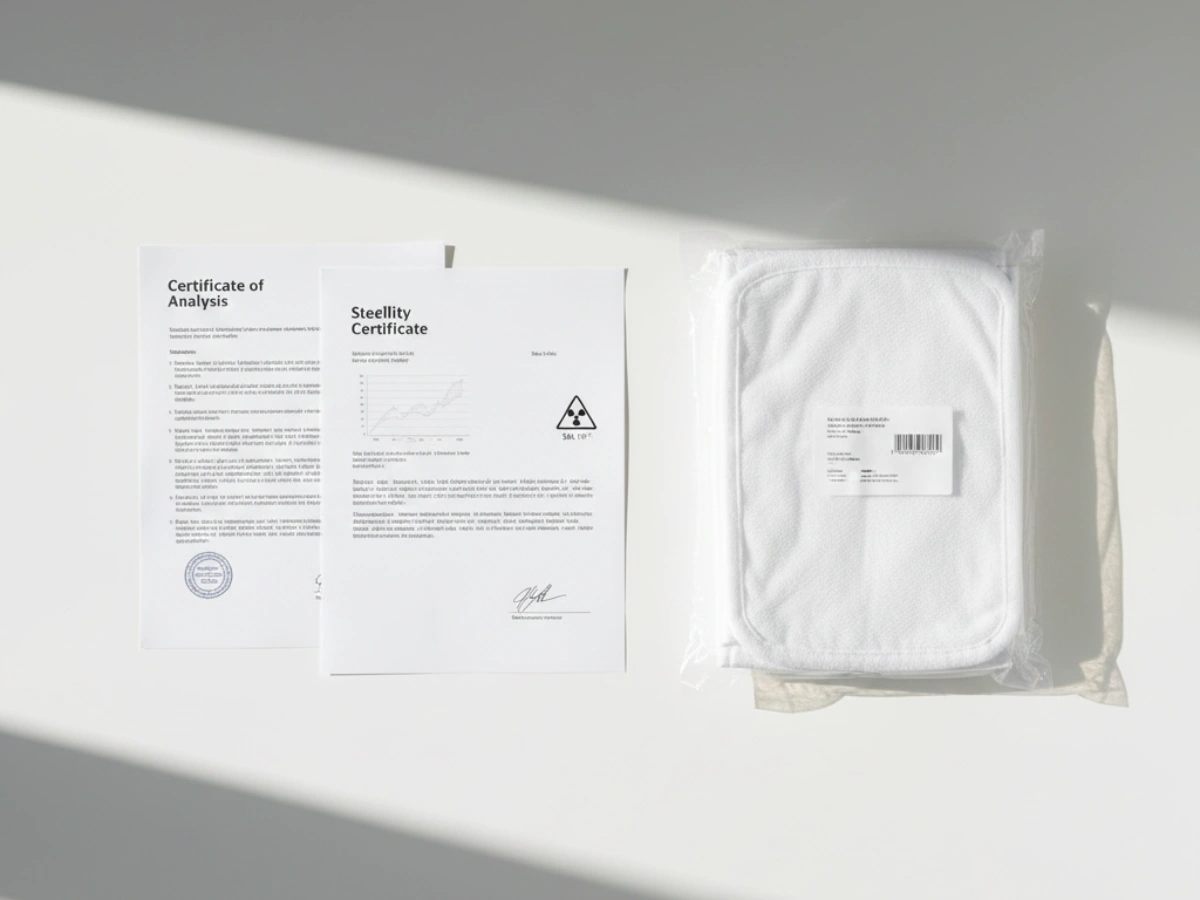
Choosing sterile over non-sterile mops changes the documentation package the facility should expect — and in many cases should require — from its supplier. The sterility specification adds specific document types that are not part of a non-sterile mop procurement. Understanding this documentation difference is important for two reasons: (1) it directly affects supplier qualification scope, and (2) it determines what the facility’s QA team will need to review and archive for each mop batch received.
| Belge Türü | Non-Sterile Mop | Steril Paspas | Why the Difference Matters |
|---|---|---|---|
| Analiz Sertifikası (COA) | Gerekli | Gerekli | Standard for both: confirms product meets stated physical specifications (weight, dimensions, material composition). Same expectation regardless of sterility. |
| Sterilite Sertifikası | Uygulanamaz | Kritik | Per-batch sterility assurance document with batch identifier, sterilization method, sterilization date, SAL. This is the primary document that auditors will request for sterile mop batches entering Grade A/B zones. Absence of this document for a product claimed as sterile is a critical finding. |
| Uygunluk Sertifikası (CoC) | Optional / Often provided | Gerekli | Confirms the product conforms to stated specifications. For sterile products, the CoC should reference the applicable sterility standard and the batch’s sterility certificate identifier. |
| Toplu İzlenebilirlik Kayıtları | İsteğe bağlı | Gerekli | Linking the mop batch to raw material lots, production date, sterilization cycle date, and sterility test batch. Required for sterile products because a sterility failure must be traceable to the affected production batch for recall or investigation purposes. |
| Irradiation Certificate / Sterilization Process Record | Uygulanamaz | Gerekli | Documents the sterilization process parameters: gamma irradiation dose, dose mapping, and cycle validation. This is part of the evidence that the sterilization process was executed correctly for the specific batch. |
| Aseptic Transfer Protocol (facility-side) | Uygulanamaz | Facility-generated | The supplier provides the sterile, double-bagged product. The facility is responsible for the documented, validated aseptic transfer protocol that introduces the sterile mop into the cleanroom. This protocol should be part of the facility’s cleaning SOP, not the supplier’s documentation package. During an audit, the inspector will expect to see both: the supplier’s sterility documentation AND the facility’s transfer protocol. |
| Endotoxin Test Data | Not typically applicable | Conditionally applicable | Required when sterile mops are used in aseptic processing of parenteral products where endotoxin limits are specified. Not required for all sterile mop applications. The facility should determine whether the product-contact pathway in its specific use case triggers endotoxin testing requirements. |
For a structured buyer checklist covering what documentation to request and how to review supplier submissions, refer to the temiz oda paspas doğrulama belgeleri alıcı kontrol listesi. For a detailed explanation of each document type including COA content and sterility certificate verification, see the temiz oda paspası doğrulama belgeleri ve COA rehber.
Practical note for procurement teams: When a facility’s sterility decision transitions from non-sterile to sterile for a specific zone, the supplier documentation requirement expands from approximately 2-3 document types to 5-7 document types per batch. This has a direct impact on incoming QA review workload, batch release turnaround time, and documentation archive requirements. Facilities planning a transition from non-sterile to sterile mop specification should factor this documentation overhead into their QA resource planning.
The following five scenarios represent commonly observed errors in how facilities approach the sterile-vs-non-sterile mop decision. Each includes practical correction guidance.
Sorun: A facility adopts one sterility specification — typically “all mops must be sterile” — and applies it uniformly from Grade A through Grade D without zone-level evaluation. This creates unnecessary cost in support zones where non-sterile mops with appropriate material specifications are functionally equivalent.
Nasıl düzeltilir: Conduct a zone-by-zone sterility review using the decision tree in Section 5. For each zone, document the regulatory requirement, product-contact risk, and the cost-validity of the sterile premium. Where non-sterile is acceptable, implement the specification change with supplier notification, updated cleaning SOP, and operator training. The cost savings from this re-stratification are typically measurable within the first procurement cycle.
Sorun: The purchase order specifies “sterile, gamma-irradiated, double-bagged mops” for Grade A, but the facility’s cleaning SOP does not include a validated staged aseptic transfer protocol. The outer bag is removed in a Grade D material airlock, the inner bag is opened in a Grade C corridor, and the supposedly sterile mop is carried into Grade A without any additional transfer steps. The sterility claim is broken well before the mop reaches its point of use.
Nasıl düzeltilir: A sterile mop specification without a validated transfer protocol is a specification without a supporting system. Implement staged aseptic transfer: outer bag removed at the Grade B/C boundary, inner bag removed inside the receiving zone under aseptic conditions. Document the protocol in the cleaning SOP, train operators, and include transfer protocol verification in the facility’s internal audit program. The supplier’s sterility documentation proves the mop was sterile when it left the manufacturer; the facility’s transfer protocol proves it was still sterile when it was used.
Sorun: A facility treats Grade B as “cleaner than Grade C” but does not apply sterile mops because “sterile is only for Grade A.” This misjudges the regulatory and contamination-control role of Grade B as the protective background for aseptic operations. A non-sterile mop in a Grade B zone during active Grade A aseptic filling creates a microbiology source physically adjacent to the aseptic boundary.
Nasıl düzeltilir: Review the specific Grade B zone’s proximity to Grade A operations. If the Grade B zone is actively serving as background during aseptic filling, apply the same sterile mop specification as Grade A. Reserve non-sterile evaluation for standalone Grade B zones where the three conditions in Section 3 are fully satisfied. This is the single most impactful sterility decision adjustment for many facilities — upgrading Grade B mops from non-sterile to sterile eliminates a contamination-control gap at the boundary of the aseptic core.
Sorun: A facility focuses exclusively on “sterile or non-sterile” as the mop specification decision, treating sterility as the single dimension of mop selection. Important specification variables — material composition (polyester vs microfiber), edge sealing method, mop head weight, packaging configuration, and zone color-coding — are not evaluated because the sterility question consumed the entire specification discussion.
Nasıl düzeltilir: Sterility is one dimension of the mop specification, not the entire specification. A sterile mop with an unsuitable material for the facility’s disinfectant chemistry, or a non-sterile mop without sealed edges generating particle counts above the zone’s expectations, are both specification failures. The sterility decision should be made first (using this framework), then the remaining specification variables should be addressed: material, weight, edge sealing, packaging, and zone segregation features. See Section 8 for related topic resources covering these additional dimensions.
Sorun: The facility’s QA team receives sterile mops with the appropriate supplier documentation (COA, Certificate of Sterility, etc.), but no internal document records WHY the facility chose sterile for Grade A/B and non-sterile for Grade C/D. The decision exists as an unwritten consensus among the facility, engineering, and QA teams, with no formal rationale, risk assessment reference, or decision record. During an audit, the team can demonstrate that the sterile mops are sterile — but cannot demonstrate why the facility decided that sterility was required for the zones using them.
Nasıl düzeltilir: Create a simple Sterility Specification Rationale document for the facility’s cleaning program. For each zone, record: (1) the GMP grade, (2) the sterility decision (sterile or non-sterile), (3) the primary criteria supporting the decision (reference the five criteria in Section 2), (4) the date of the most recent review, and (5) the QA approval. This document does not need to be lengthy — a one-page matrix is typically sufficient. Include it in the cleaning validation documentation package so it is available during internal and regulatory audits. A documented decision is defensible; an undocumented consensus is not.
This guide addresses the sterility dimension of cleanroom mop selection. The following resources address complementary dimensions that intersect with the sterility decision:
A sterile cleanroom mop is required in Grade A / ISO 5 aseptic processing zones where open product, sterile components, or aseptic connections are directly exposed to the environment. In these zones, EU GMP Annex 1 expectations for contamination control extend to all consumables entering the aseptic core, including cleaning tools. Grade B zones that serve as background to active Grade A operations should also default to sterile mops. Outside these scenarios, sterility should be evaluated based on a facility-specific risk assessment that considers cleanroom classification, product-contact proximity, transfer path integrity, and cost-validity.
In practical terms, the difference has three dimensions. (1) Process: Sterile mops have undergone a validated sterilization process (typically gamma irradiation achieving SAL 10-6); non-sterile mops have not. (2) Ambalajlama: Sterile mops are double-bagged in validated sterile-barrier packaging designed for staged aseptic transfer; non-sterile mops are typically single-bagged or bulk-packed for clean storage. (3) Belgeler: Sterile mops include a Certificate of Sterility per batch, batch traceability records, and an irradiation certificate; non-sterile mops typically include a Certificate of Analysis and material certification. The mop head itself — the fabric, construction, weight, edge sealing — may be identical between sterile and non-sterile versions of the same product line. The sterility difference is in the post-production processing, packaging, and documentation, not in the fundamental mop head design.
EU GMP Annex 1 explicitly states that “disinfectants and detergents used in Grade A and Grade B areas should be sterile prior to use.” It does not make an explicit, identically worded statement about cleaning tools such as mops. However, regulatory inspectors interpret the contamination control principle as extending to cleaning tools: a non-sterile mop saturated with sterile disinfectant introduces an uncontrolled microbiology source at the point of cleaning. In practice, most facilities default to sterile mops for Grade B zones that serve as background to Grade A to avoid this regulatory interpretation risk. A non-sterile evaluation for standalone Grade B zones is possible under a formal risk assessment (see Section 3, Condition Framework), but it should be documented and QA-approved.
Yes, and this is the recommended approach for multi-grade facilities. A grade-stratified program — sterile for Grade A and connected Grade B, non-sterile for Grade C and D — is cost-efficient and compliant. The operational requirements for managing mixed sterility specifications are: (1) clearly labeled, physically separated storage for sterile and non-sterile inventories; (2) SOP documentation specifying which zones receive which mop type; (3) operator training that includes the rationale for the sterility difference so operators understand why Grade A mops are sterile and Grade C mops are not; and (4) line clearance verification to confirm the correct mop type is staged at each zone before cleaning begins. The operational complexity of managing two specifications is generally outweighed by the cost savings of not over-specifying Grade C and D zones.
Sterile cleanroom mops carry a cost premium over their non-sterile equivalents. The premium reflects sterilization process cost (gamma irradiation per batch), validated sterile barrier packaging (double-bagging with seal integrity verification), per-batch sterility testing and documentation, and shelf-life management. The exact percentage premium depends on order volume, product configuration, and supplier, but the general relationship is that the sterile premium is most justified in low-volume, high-risk zones (Grade A/B) and least justified in high-volume, low-risk zones (Grade C/D). Facilities should evaluate the sterile premium against the contamination-control benefit in each zone rather than treating it as a fixed cost applied uniformly. For a detailed cost differential framework, see Section 4 of this article.
A sterile mop with compromised packaging should not be used in a zone where sterility is required. The sterility claim is tied to the integrity of the sterile barrier packaging. If the outer bag or inner bag seal is breached, torn, or shows signs of moisture ingress, the sterility of the product cannot be assured and the mop should be discarded or, if the product allows, returned for re-sterilization. This is why facilities should include a visual packaging integrity check as a step in the mop staging or transfer protocol. During an audit, an inspector may ask to see evidence that packaging integrity is verified before sterile mops are introduced into the cleanroom. A documented, photographed packaging integrity check is a straightforward compliance measure.
Using a non-sterile mop with sterile disinfectant in Grade B creates a contamination-control inconsistency. The disinfectant is sterile at the point of use; the mop head delivering it is not. The non-sterile mop head can introduce microorganisms at the point of cleaning, potentially negating the sterility of the disinfectant for the specific zone being cleaned. Regulatory inspectors reviewing the cleaning program may identify this as a contamination-control gap: if the facility has determined that a sterile disinfectant is required for Grade B, the cleaning tool delivering it should meet a comparable contamination-control standard. If the facility has determined through a formal risk assessment that non-sterile mops are acceptable for a particular Grade B zone (under the three-condition framework), then the use of sterile disinfectant with non-sterile mops in that specific zone is internally consistent with the risk assessment’s conclusions. The key is that the mop sterility specification and the disinfectant sterility specification should be evaluated using the same contamination-control logic for the same zone.
The documentation should be proportionate to the regulatory risk but should, at minimum, include: (1) A zone-by-zone sterility specification matrix listing each GMP-classified zone, its assigned sterility requirement (sterile or non-sterile), and the primary criteria supporting the decision. (2) For zones where non-sterile mops are used, a brief rationale referencing the applicable criteria (e.g., “Grade D — non-sterile: product-contact risk is low, airborne particle limits do not necessitate sterility, cost-validity assessment supports non-sterile specification”). (3) The date of the most recent sterility specification review and QA approval. (4) Reference to any supporting risk assessments, environmental monitoring data, or cleaning validation studies that informed the decisions. (5) Inclusion of this document in the facility’s cleaning validation or contamination control strategy documentation package. A one-to-two-page matrix with a brief rationale section is typically sufficient. The purpose is to demonstrate that the sterility decision was made deliberately, with documented criteria, rather than by default or historical inertia.
Whether your facility requires terminally sterilized, double-bagged mops for Grade A/B aseptic core zones or cost-optimized non-sterile options for Grade C/D support areas, MIDPOSI White Cleanroom Mop Series is available in both sterile (gamma-irradiated) and non-sterile configurations across 40g, 55g, and 65g weights. Each sterile batch includes Certificate of Sterility, Certificate of Analysis, and batch traceability records to support your QA documentation package. Non-sterile configurations include Certificate of Analysis and material certification. Contact our technical team to discuss your facility’s zone-specific sterility requirements and request product samples for internal evaluation.
MIDPOSI supplies cleanroom mops in sterile and non-sterile configurations to pharmaceutical, biotech, and medical device manufacturers. Batch-level documentation including Certificate of Analysis (COA) and, for sterile configurations, Certificate of Sterility is available upon request. Contact our team to discuss your facility’s zone-specific sterility requirements and request product samples for internal qualification.