تنظيف الأرضيات الدوائية & التحكم في التلوث
A practical guide to validated cleanroom mopping procedures, including floor cleaning sequence, unidirectional mopping, disinfectant contact time, mop replacement frequency, and sterile vs reusable mop strategy.
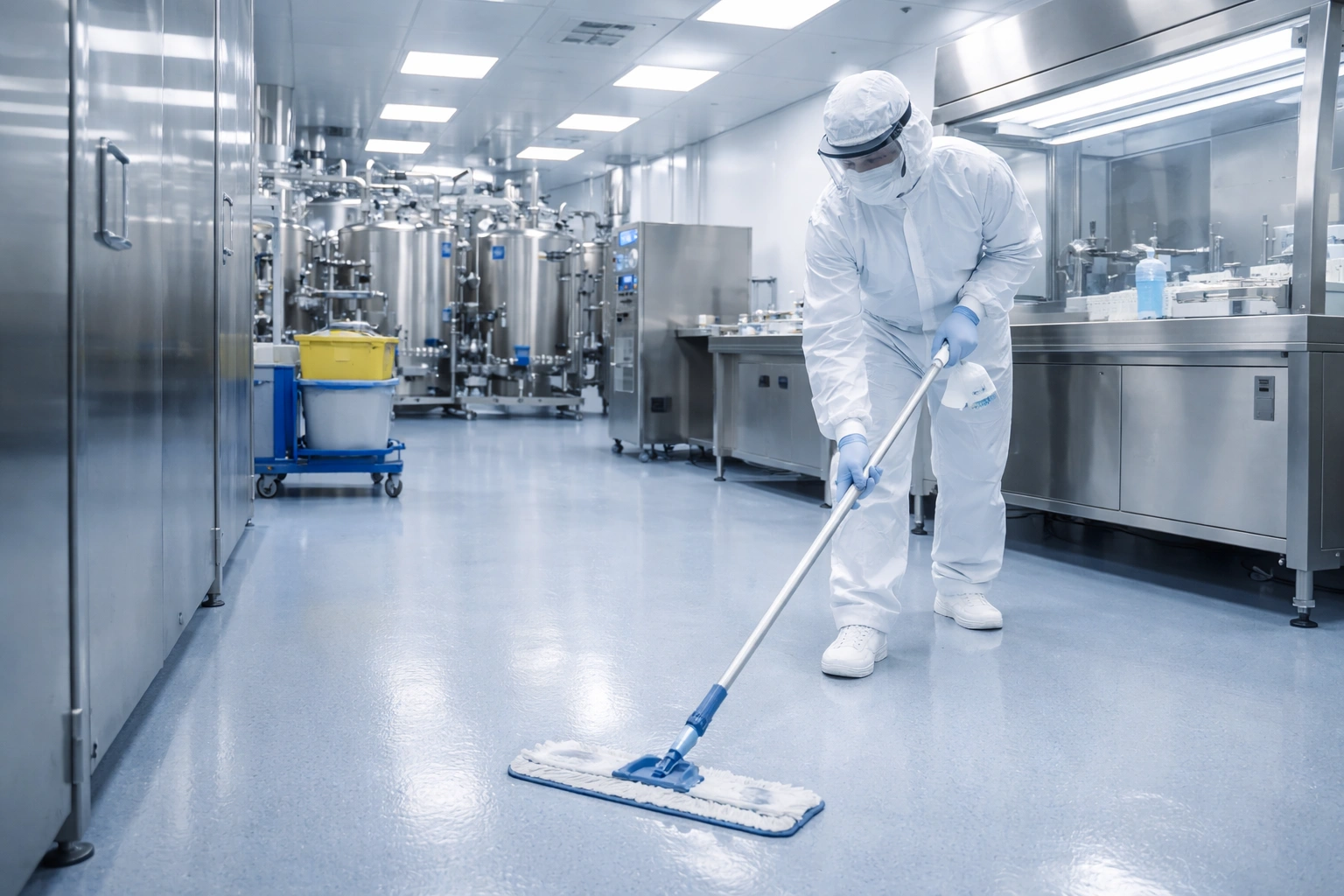
A cleanroom mopping SOP is a validated floor cleaning procedure that defines mop system selection, unidirectional cleaning technique, disinfectant application, mop replacement frequency, and documentation requirements to achieve consistent contamination control in pharmaceutical cleanrooms. In GMP environments, mopping SOPs must support repeatability, traceability, and controlled contamination movement.
In pharmaceutical cleanrooms, the floor is one of the largest exposed surfaces and one of the most common pathways for redistributed particles and residues. Personnel movement, wheeled equipment, airflow disruption, and wet chemistry all increase the risk of floor-related contamination.
That is why floor cleaning is not just a housekeeping task. It is a contamination control activity that directly affects:
If you need the broader system-level framework, see our cleanroom cleaning SOP guide. If you need critical-grade procedure detail, review the إجراءات تنظيف غرف الأبحاث ISO 5.
Before floor cleaning begins, personnel should complete the required gowning, training, and area-entry controls. Only approved mop systems, wipes, disinfectants, and buckets should enter the room.
Qualified operators, gowning compliance, training signoff, deviation awareness.
Sterile or validated mop heads, approved disinfectants, controlled water source, cleanroom buckets.
Cleaning logs, batch traceability where required, disinfectant preparation records, shift signoff.
Mop system choice affects validation burden, contamination risk, operator workload, and long-term cost. In critical pharmaceutical environments, the SOP should clearly define whether disposable sterile mop heads or reusable mop systems are approved.
| ميزة | Sterile Disposable Mop | Reusable Mop |
|---|---|---|
| Initial cost | أعلى | أدنى |
| Validation burden | أدنى | أعلى |
| Cross-contamination risk | Very low | واسطة |
| Workflow consistency | عالي | واسطة |
| Waste generation | أعلى | أدنى |
| Long-term operating logic | Simple | More complex |
For a deeper commercial and technical comparison, see يمكن التخلص منها مقابل ممسحات غرف الأبحاث القابلة لإعادة الاستخدام و pharmaceutical cleanroom mop requirements.
Unidirectional mopping is the core rule in pharmaceutical floor cleaning. The mop should move from the cleanest area toward the less critical area, without dragging contamination back across already-cleaned surfaces.
Start from the cleanest zone or defined starting boundary.
Move the mop forward in one direction only.
Maintain 5–10 cm overlap between passes.
Continue toward the exit or dirtier area without backtracking.
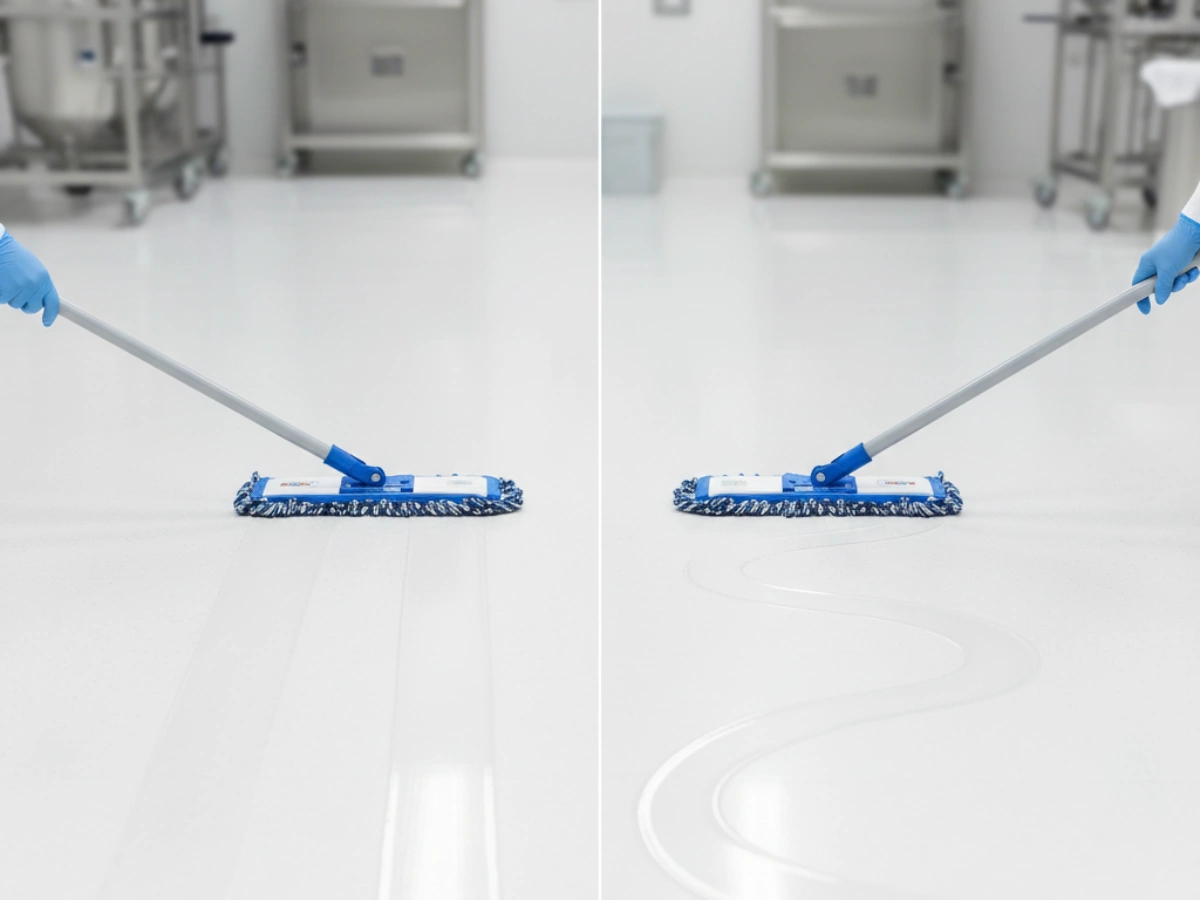
Mops should be sufficiently wetted to achieve uniform floor coverage without creating excessive pooling. The SOP should define the approved saturation range, disinfectant type, application method, and minimum wet contact time.
| Control point | Recommended logic |
|---|---|
| Mop saturation | Enough for consistent coverage, without over-wetting the floor |
| Contact time | Follow validated disinfectant requirement exactly |
| Coverage check | No dry gaps, no excessive puddling |
| تَحَقّق | Visual review, logs, and where needed ATP or environmental follow-up |
Mop replacement should be defined scientifically, not casually. In high-grade environments, contaminated or overloaded mop heads quickly lose effectiveness and may spread residue instead of removing it.
| Cleanroom grade | Typical area coverage | Replacement interval |
|---|---|---|
| ايزو 5 | About 50 m² | Every 2 hours or sooner if overloaded |
| ايزو 7 | About 100 m² | Every 4 hours |
| ايزو 8 | About 200 m² | Every 6 hours |
The final replacement rule should always be confirmed by your facility’s risk assessment, room classification, disinfectant chemistry, and environmental monitoring trends.
Many pharmaceutical sites use a disinfectant rotation strategy rather than relying on one chemistry. A common model is routine alcohol use, scheduled hydrogen peroxide or equivalent broad-spectrum chemistry, and periodic sporicidal intervention.
Use zone-dedicated tools and color coding where appropriate.
Use timers, training, and wet-surface checks to avoid early drying.
Set replacement rules by area, time, and contamination load.
Standardize training and qualify execution, not just theory.
| Cost category | Disposable Mop | Reusable Mop |
|---|---|---|
| Initial investment | $45,000 | $25,000 |
| Validation cost | $5,000 | $25,000 |
| Operating cost | $35,000 / year | $15,000 / year |
| Waste handling | $8,000 / year | $2,000 / year |
| Labor impact | $20,000 / year | $28,000 / year |
| Total cost (3 years) | $143,000 | $125,000 |
Disposable sterile mops are often preferred in high-risk aseptic environments because they reduce validation complexity and cross-contamination risk. Reusable systems may still be valid in the right facility, but they require tighter washing, tracking, integrity control, and qualification management.
Week 1: Draft SOP, assign responsibilities, train operators, choose mop system.
Week 2: Validate cleaning logic, confirm disinfectant use, establish records.
Week 3: Pilot the procedure, review ATP or monitoring data, refine details.
Week 4: Full implementation, retraining, trend review, continuous improvement launch.
Use this simplified decision logic to choose between sterile disposable mop systems and reusable mop systems.
Is the area high-risk aseptic or ISO 5 critical?
Prioritize sterile disposable mop systems for lower contamination risk and easier validation.
Go to Step 2 and evaluate operational and validation factors.
Does your site have strong washing, drying, tracking, and integrity control for reusable mops?
Reusable mop systems may be viable if contamination risk and validation capability are well controlled.
Sterile disposable mop systems are usually safer and operationally simpler.
Is reducing validation burden a priority?
Choose sterile disposable mop systems to simplify qualification, traceability, and change control.
Reusable mop systems may still work if your facility accepts higher process control complexity.
ISO 5 environments often require floor cleaning every shift or more frequently depending on risk. ISO 7 and ISO 8 frequencies are usually lower, but final rules should be based on facility risk assessment.
Verification may include ATP testing, microbial sampling, trend review, and visual confirmation of complete wet coverage.
Reusable mops should be fully dried within the validated drying window and stored in a controlled clean area before reuse.
Selection depends on room classification, contamination risk, validation capacity, operational workflow, and total cost logic.
Related reading: Cleanroom Cleaning SOPو ISO 5 Cleanroom Cleaning Procedureو متطلبات ممسحة غرف الأبحاث الصيدلانية.
Midposi provides pharmaceutical-grade cleanroom mop systems designed for contamination control, including sterile disposable mop heads and validated reusable microfiber systems.