What Is a Cleanroom Mop System and Why Does It Matter?
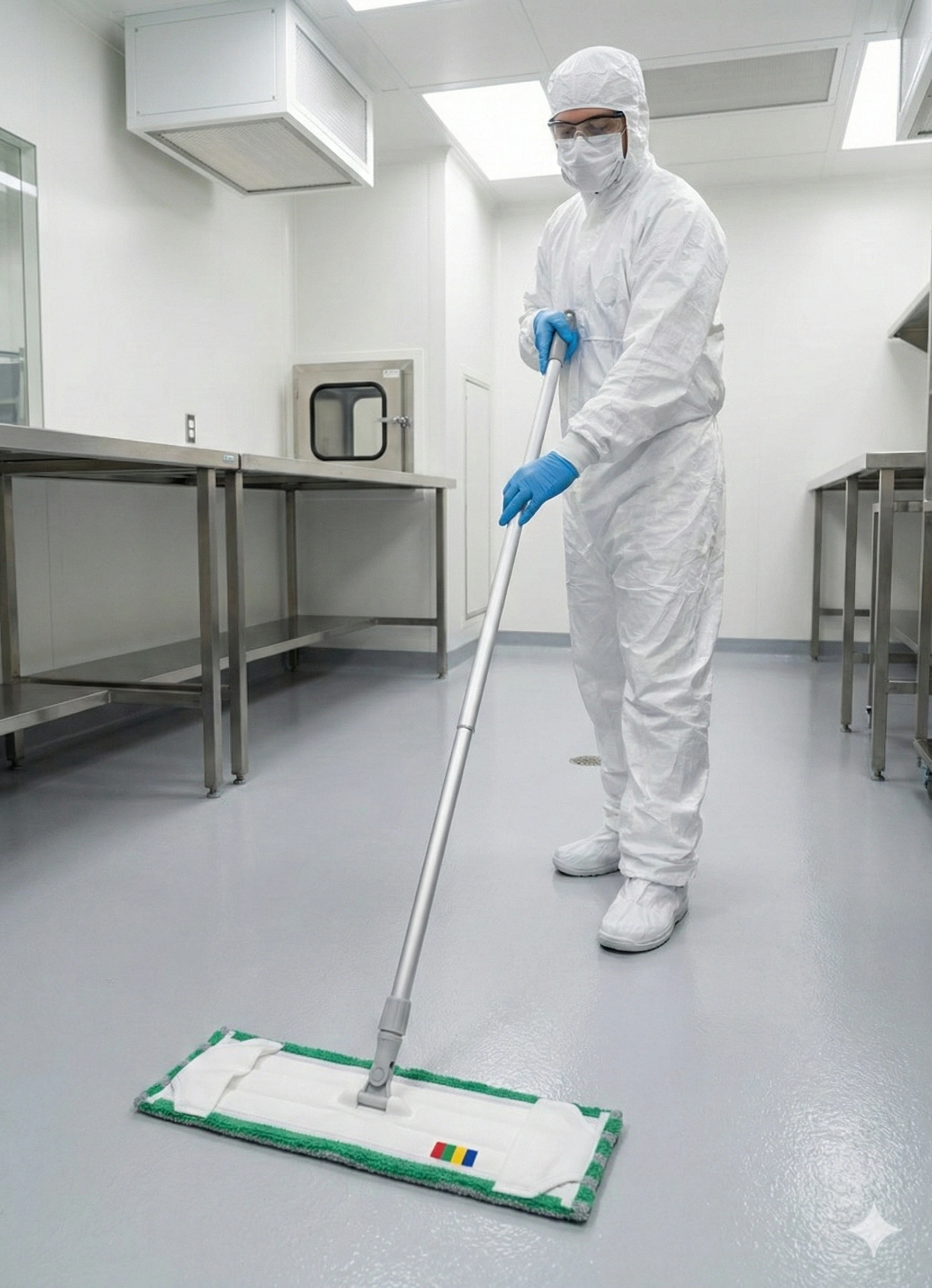
A cleanroom mop is not a product you buy — it is an integrated cleaning system you specify. Understanding what constitutes a cleanroom mop system, and why the system concept is critical for contamination control, is the foundation every buyer should establish before evaluating any cleanroom cleaning equipment.
What Is a Cleanroom Mop System? — A Clear Definition
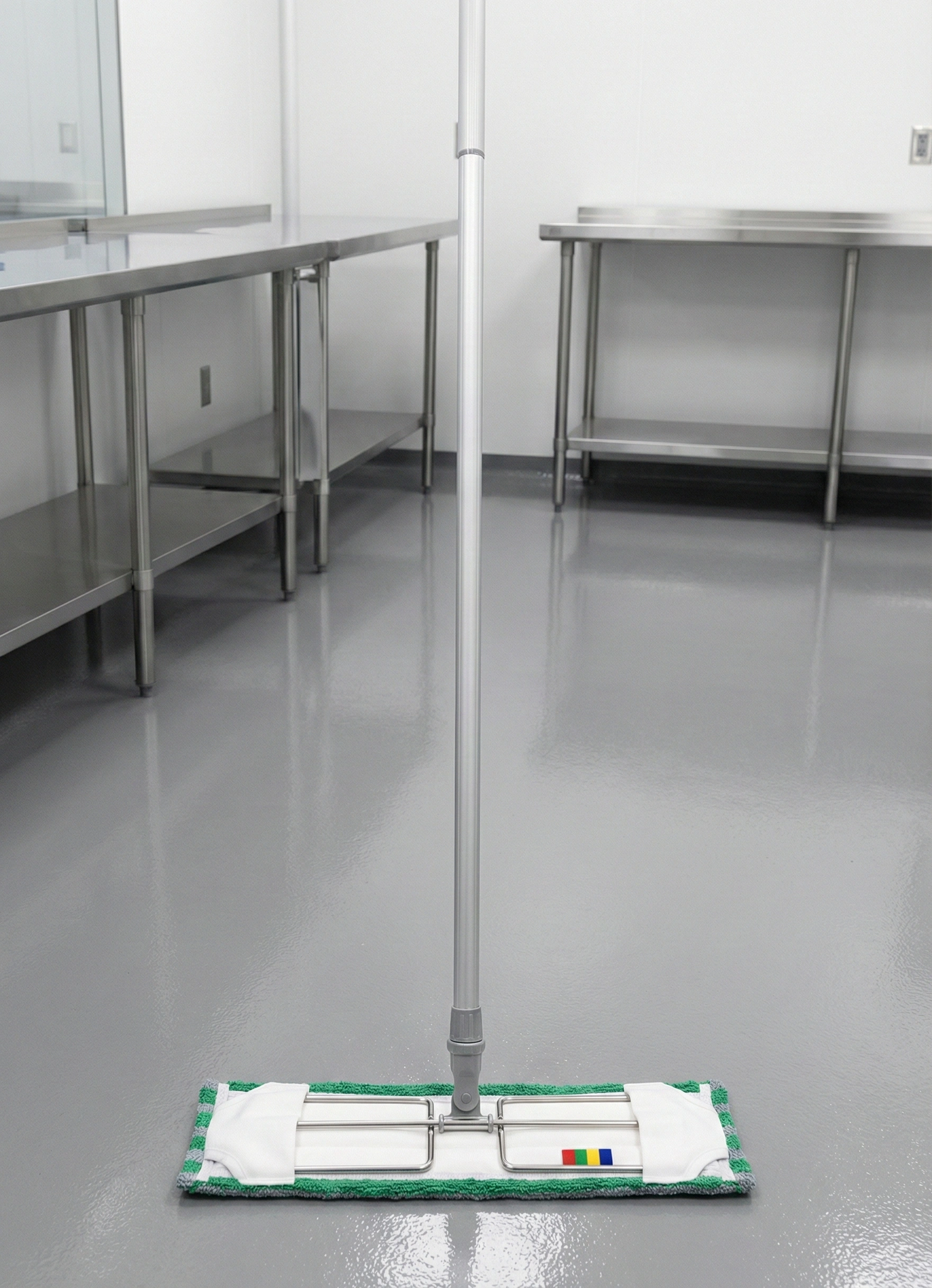
EN renrumsmoppesystem is the integrated assembly of a cleanroom-grade mop head, a compatible frame, a purpose-designed handle, and (for wet cleaning protocols) a bucket/wringer system — where all components are specified to work together within a defined cleanroom classification and cleaning protocol. It is not a single product; it is a matched set of components where each element directly affects the performance of every other element.
Why “System” — Not Just “Mop”
The term “cleanroom mop” is commonly used but incomplete. The mop head alone performs no cleaning without a frame to hold it. The frame achieves nothing without a handle to control it. The handle is irrelevant for wet cleaning protocols if the bucket/wringer system is not dimensionally and materially matched to the mop head. A cleanroom mop system is the combination — and the way these components interact determines whether the cleaning result is consistent, repeatable, and audit-ready.
Who Needs to Understand This Concept
Procurement or facility teams entering controlled-environment operations who need to understand what constitutes a cleanroom mop system before making any purchasing decision.
Teams transitioning from standard manufacturing to controlled environments who must map out equipment requirements.
Professionals evaluating whether current cleaning tools meet the definition of a “validated system” for audit purposes.
Teams who need a clear, authoritative definitional resource to educate end-customers on what they are actually buying.
The fundamental insight: Buying a cleanroom mop is not like buying a commodity cleaning tool. It is specifying an integrated cleaning system that must perform predictably in a controlled environment where particle counts are measured, cleaning results are documented, and regulatory auditors may review the rationale behind every tool choice.
The Four Core Components of a Cleanroom Mop System
A complete cleanroom mop system consists of four interdependent components. Each is analyzed below with its primary function, key selection considerations, and the consequence of a component mismatch.
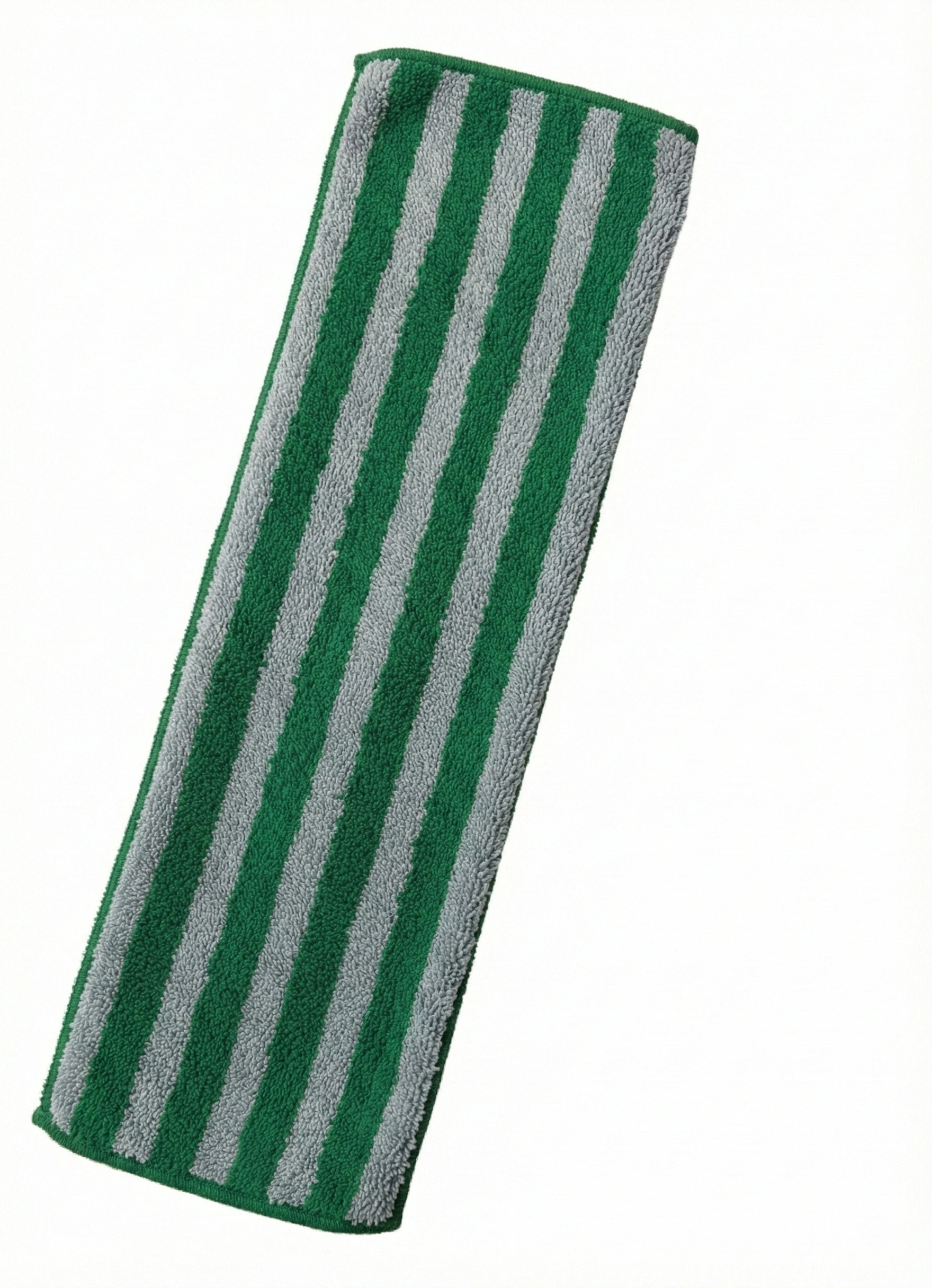
Moppehoved
Role: Primary cleaning contact surface — responsible for particle capture, solution application, and contamination removal.
Material considerations: Polyester knit (continuous filament for low particle shedding, durable) or microfiber (split-fiber for high absorbency, particle capture). Sterile and non-sterile configurations available depending on facility grade.
Weight options: Typically 40g, 55g, or 65g — affecting absorbency, operator handling, and suitability for different floor areas. Weight selection must be evaluated in context of the frame it attaches to and the cleaning protocol it supports.
Edge sealing and construction: The mop head edge finish, quilting pattern, and attachment interface (pocket, hook-and-loop) directly affect cleaning consistency and particle shedding during use.
Mismatch warning: A mop head that does not fit the frame securely — wrong pocket depth, incompatible attachment mechanism — creates cleaning gaps, uneven pressure distribution, and potential detachment during use. The best mop head in the world performs poorly on the wrong frame.
Mopperamme
Role: Structural interface between the mop head and handle — holds the mop head securely and distributes cleaning pressure across the floor surface.
Material considerations: Stainless steel (for GMP environments, chemical compatibility, autoclavable), plastic/polymer (cost-sensitive applications, lighter weight), wire frame (flat mop systems, flexible pressure distribution).
Attachment mechanism: Pocket-type (head slides onto frame arms), hook-and-loop (pressed into place), or clip/mechanical fastening. The attachment mechanism must be specifically designed for the mop head type being used.
Rigidity and weight: Frame rigidity affects pressure transfer from handle to floor. A frame that flexes excessively creates uneven cleaning pressure. Frame weight contributes to total operator handling load — relevant for large-area or multi-shift cleaning operations.
Mismatch warning: A frame with the wrong attachment mechanism for the mop head creates insecure fastening, uneven cleaning pressure, accelerated head wear, or — in the worst case — the mop head detaching mid-operation inside a classified cleanroom.
Mop Handle
Role: Operator interface — controls mopping motion, pressure application, reach, and cleaning consistency across operators and shifts.
Material considerations: Stainless steel (durable, chemical-resistant, autoclavable) or aluminum (lightweight, cost-effective). Material choice should match cleanroom chemical exposure and cleaning frequency.
Telescopic vs fixed length: Telescopic handles allow one handle to serve multiple operators of different heights — reducing SKU count. Fixed-length handles are simpler but may require multiple sizes for different operators.
Grip design: Ergonomic grip with secure connection mechanism to the frame. A handle that is uncomfortable or hard to grip leads to operator fatigue, which directly impacts cleaning consistency in multi-shift cleanroom operations.
Connection mechanism: The handle-to-frame connection must lock securely. A loose connection causes inconsistent mopping pressure and creates a contamination risk point at the joint.
Mismatch warning: A handle that does not lock securely into the frame creates inconsistent cleaning pressure and a potential particle generation point at the loose interface. Operators compensate for a poor connection by adjusting their technique — introducing uncontrolled variables into the cleaning process.
Bucket / Wringer System
Role: Solution management — holds and separates clean and used cleaning solution, controls wringing to manage mop head moisture content, and maintains chemical compatibility with cleanroom disinfectants.
Chamber design: Single-chamber (one solution compartment) or dual-chamber (clean and dirty solution separation). Dual-chamber is preferred in GMP environments where cross-contamination risk must be minimized — the clean solution is never contaminated by the used solution.
Wringer mechanism: The wringer must be dimensionally matched to the mop head size and weight. A wringer designed for a larger mop head will under-squeeze a smaller one; a wringer designed for a smaller head may damage the fibers of a larger one.
Material chemical compatibility: The bucket and wringer materials must be compatible with common cleanroom disinfectants — hydrogen peroxide, isopropyl alcohol, quaternary ammonium compounds, peracetic acid. Material degradation from chemical incompatibility introduces residues and particles into the cleaning process.
Mismatch warning: A bucket with incompatible materials may degrade when exposed to cleanroom disinfectants, releasing chemical residues or particles into the cleaning solution. A wringer not sized for the mop head can over-squeeze (damaging fibers) or under-squeeze (leaving the head too wet for effective cleaning).
Cleanroom Mop System Components at a Glance
| Component | Primary Function | Key Material / Design Considerations | Common Buyer Questions |
|---|---|---|---|
| Moppehoved | Cleaning contact surface — particle capture, solution application, contamination removal | Polyester knit vs microfiber; weight (40g/55g/65g); sterile vs non-sterile; edge sealing; attachment interface | What weight do I need? Sterile or non-sterile? |
| Mopperamme | Structural interface — holds the mop head and connects to handle | Stainless steel vs plastic vs wire frame; pocket vs hook-and-loop attachment; rigidity and weight | Will this frame fit my mop heads? Is stainless steel required? |
| Mop Handle | Operator interface — controls mopping motion, pressure, and reach | Stainless steel vs aluminum; telescopic vs fixed; grip design; frame connection mechanism | Does the handle lock securely? Is it autoclave-compatible? |
| Bucket / Wringer | Solution management — clean/dirty separation, wringing, chemical compatibility | Single vs dual chamber; wringer type; material chemical resistance; mop head size compatibility | Will the wringer damage the mop head? Is the bucket compatible with my disinfectant? |
Why the System Matters — It Is Not Just a Collection of Parts
The four components described above each have individual specifications. But the cleanroom mop system concept exists because the interaction between components determines cleaning outcomes, not the specifications of any single part. Below are five reasons why system-level thinking is essential — and what happens when components are selected in isolation.
1. Compatibility Risk: Each Connection Point Is a Potential Failure Point
There are three critical interfaces in a cleanroom mop system: (1) the head-to-frame interface, (2) the frame-to-handle interface, and (3) the head-to-bucket/wringer interface. If any one of these three connections is unspecified or unverified, the system has a gap. A mop head that does not fit the frame securely creates cleaning gaps. A handle that does not lock properly into the frame causes inconsistent pressure. A bucket not sized for the mop head means the cleaning solution cannot be properly managed. When components are sourced from a single manufacturer, these interfaces are designed, tested, and documented together. When components are mixed from different suppliers, the compatibility is unknown.
2. Cleaning Performance Predictability Depends on System Integration
An integrated mop system provides predictable, repeatable cleaning performance because every component’s behavior is known relative to every other component. A mixed-and-matched set of components introduces unknown variables. A high-specification mop head combined with an incompatible frame may perform worse than a correctly matched mid-range system. No individual component’s specification sheet can predict system-level performance — only system-level validation can confirm it.
3. Regulatory Compliance: Is Your Cleaning System Validated as a System?
In a GMP audit, an auditor may ask: “Is this cleaning system validated as a system?” If components were sourced from multiple suppliers without system-level validation, the answer is “no” — and this raises a red flag. A validated system demonstrates that all components work together as specified under defined cleaning protocols. Individual component certifications (a COA for the head, a material certificate for the frame) do not add up to system-level validation. The documentation must cover how the components perform as a combined unit.
4. Procurement Efficiency Through Single-Source Accountability
Buying a complete system from one supplier simplifies procurement: fewer SKUs to manage, one supplier for reorders, one quality agreement, one documentation package per shipment. When a discrepancy arises — a batch issue, a documentation question, a performance question — there is a single point of accountability. With multi-supplier procurement, investigating a performance issue requires coordinating across suppliers who each produce only one component, making root-cause analysis significantly more complex.
5. Total Cost of Ownership: Hidden Costs of Component Mismatch
Component mismatch leads to accelerated wear: a frame that is slightly too rigid damages mop head fibers, requiring more frequent head replacement. A bucket not chemically compatible with your disinfectant degrades, requiring bucket replacement. A handle connection that loosens over time requires re-tightening or replacement. These costs accumulate beyond the initial purchase price. A validated system with documented compatibility avoids these hidden replacement and rework costs over the facility’s operating lifetime.
5 Signs You Are Buying a System, Not Just Parts
Single-source sourcing is the strongest indicator that the components are designed to work together.
A pocket-depth, hook-and-loop dimension, or clip spacing that matches by design, not by coincidence.
Purpose-built connections minimize looseness, particle generation at the joint, and operator inconsistency.
A correctly matched wringer removes the right amount of solution — neither over-squeezing nor under-squeezing.
System-level documentation confirms that the components function as a combined unit under defined protocols.

GMP and ISO Relevance — Where the System Meets Compliance
The cleanroom mop system concept is not an academic distinction — it has direct implications for GMP and ISO compliance. Different cleanroom grades impose different requirements on the mop system, and understanding these requirements is essential before purchasing.
System Requirements by Cleanroom Grade
| GMP Grade | ISO Class (Approx.) | Sterilitetskrav | Mop Head Material Recommendation | Packaging / Transfer | Documentation Level |
|---|---|---|---|---|---|
| Klasse A | ISO 5 | Sterile (gamma or autoclave) | Polyester knit, continuous filament, low-particle | Double-bagged, validated aseptic transfer | Full: COA, sterility cert, particle data, material cert |
| Klasse B | ISO 5-7 | Steril | Polyester knit or microfiber, low-particle | Double-bagged for transfer into Grade A background | Full: COA, sterility cert, particle data |
| Grad C | ISO 7-8 | Non-sterile acceptable (sterile optional) | Polyester knit or microfiber | Standard cleanroom packaging | Standard: COA, particle data, material cert |
| Klasse D | ISO 8-9 | Ikke-steril | Polyester knit or microfiber | Standard cleanroom packaging | Standard: COA, material cert |
This table provides a reference framework for matching mop system characteristics to cleanroom grades. Specific documentation and sterility requirements vary by application and should be confirmed through your facility’s quality system and risk assessment. Grade selection depends on multiple co-factors including product type, process step, and regulatory jurisdiction.
ISO 14644 and Particle Generation
ISO 14644-1 classifies cleanrooms by maximum allowable airborne particle concentrations. Every tool that enters the cleanroom — including the mop system — can contribute to the particle count. Component material choices directly affect particle compliance: the mop head fabric type and edge finishing determine fiber shedding during use; the frame surface finish affects particle release from metal-on-metal contact; the handle grip material can degrade and release particles over time. An integrated system where all material choices have been evaluated for particle performance under defined cleaning conditions provides more predictable ISO 14644 compliance than individually selected components.
Documentation Expectations in a GMP Environment
A validated cleanroom mop system should be accompanied by documentation that supports the system as a whole: Certificate of Analysis (COA) confirming material and construction specifications, material certifications for all components, particulate test data (per IEST or ISO standards), sterility certificates with sterility assurance level and sterilization method (for sterile systems), packaging integrity validation (for aseptic transfer), and batch traceability records. These documents should cover the system — not only individual components. During a regulatory inspection, the ability to produce system-level documentation for the cleaning tools in use is a stronger position than producing separate documents for each component from different suppliers.
EU GMP Annex 1 and Sterile Manufacturing
EU GMP Annex 1 (effective August 2023) emphasizes contamination control strategy (CCS) as a holistic framework. Mop systems entering Grade A/B zones through aseptic transfer must have validated packaging integrity, documented sterility assurance, and compatibility with facility transfer procedures. The system concept is directly relevant: a pre-sterilized mop head with validated packaging is only one part of the picture. The frame and handle that receive the sterile head inside the cleanroom, and the bucket used for wet cleaning, must also be compatible with the sterile workflow. Annex 1 compliance requires evaluating the cleaning system end-to-end, not just the consumable component.
Audit Readiness
A documented, single-source mop system is easier to defend in an audit than a collection of individually sourced components. When an auditor reviews cleaning tools, the questions are: What is the system? Is it validated? Where is the documentation? With a single-source system, the answers are contained in one documentation package. With multi-source components, the auditor may need to review separate documentation sets from multiple suppliers, and the absence of system-level validation may itself be noted as a finding.
For a deeper exploration of how cleanroom mop systems support GMP facility cleaning protocols, see: cleanroom mop for GMP facility.
How Component Selection Affects Cleaning Performance
Understanding what each component does is the first step. The next step is understanding how component choices translate into cleaning performance outcomes. Below are the key selection dimensions that most directly affect the cleaning result.
Mop Head Weight and Absorbency
Mop head weight — commonly 40g, 55g, or 65g — is not a performance rating. It is a material mass specification that correlates with absorbency and influences handling characteristics. A 40g head may be appropriate for light-duty applications where low moisture is preferred and operator handling over large areas is a consideration. A 55g head provides a balanced absorbency-to-weight profile for general-purpose cleanroom cleaning. A 65g head offers higher absorbency for heavy-duty or high-moisture cleaning protocols. However, weight selection only has meaning in the context of a specific frame, handle, and cleaning protocol — the performance of a 55g head on an incompatible frame may be worse than a 40g head on a well-matched frame. Selection should be verified through in-facility trial under actual cleaning conditions.
Frame Material and Attachment Security
Stainless steel frames are the standard for GMP environments due to chemical compatibility, cleanability, and the ability to be autoclaved. Plastic/polymer frames may be considered for cost-sensitive applications where chemical exposure is limited. Wire frames are typical for flat mop systems, providing flexible pressure distribution across the floor surface. The frame material choice affects not just durability but also the security of the head attachment — a polymer frame may warp slightly under repeated use, loosening the attachment, while a stainless steel frame maintains its dimensional stability. The frame surface finish (electropolished vs standard) also affects particle retention and cleanability. Frame material and finish should be evaluated in the context of your cleanroom grade, cleaning chemicals, and cleaning frequency.
Handle Ergonomics and Cleaning Consistency
Operator fatigue directly affects cleaning consistency. In multi-shift cleanroom operations, the same floor area may be cleaned by different operators using the same protocol — but if the handle is uncomfortable or the connection to the frame is loose, each operator will compensate differently, creating inconsistent cleaning pressure and coverage. Telescopic handles allow one handle to be adjusted for different operators, reducing SKU count and ensuring each operator can set the handle to their optimal working height. The connection mechanism (mechanical lock, thread, quick-release) should be evaluated for reliability over repeated use — a mechanism that loosens over time introduces particle generation and pressure inconsistency.
Bucket / Wringer Design and Chemical Compatibility
A dual-chamber bucket separates clean solution from used solution — a feature that is recommended for GMP environments where cross-contamination risk must be addressed in the cleaning protocol. The wringer mechanism must be specifically matched to the mop head dimensions: a wringer that is too narrow for the head will require the operator to force the head through, potentially damaging fibers; a wringer that is too wide will not remove enough solution, leaving the head over-saturated. The bucket material must be compatible with the specific disinfectants used in your facility — hydrogen peroxide, quaternary ammonium compounds, and peracetic acid each have different material compatibility profiles. Chemical-induced degradation of bucket material introduces particles and chemical residues into the cleaning process, directly undermining the purpose of using a cleanroom-grade mop system.
Compatibility Verification: What to Ask Suppliers
When evaluating a cleanroom mop system, ask the supplier these specific questions: (1) Are the mop head, frame, handle, and bucket designed as a matched system, or are they separately sourced components bundled together? (2) Can you provide system-level documentation — not just individual component specs? (3) Can you demonstrate that a specific mop head weight and frame combination has been tested together under cleaning-relevant conditions? (4) What is the documented chemical compatibility of the bucket/wringer materials with our specific disinfectants? (5) If we change one component (e.g., switch from 55g to 65g head), do we need to change the frame, wringer, or protocol? A supplier who can answer these questions with system-level data is providing a validated system. A supplier who cannot is providing individual parts.
Common Buyer Misconceptions About Cleanroom Mop Systems
Buyers encountering the cleanroom mop system concept for the first time often carry assumptions from general procurement or janitorial cleaning experience that do not hold true in a controlled-environment context. Five common misconceptions are addressed below.
“Any mop head works with any frame.”
The assumption: Mop heads and frames are interchangeable — just buy the cheapest head and attach it to whatever frame you already have.
The reality: Frame attachment mechanisms — pocket depth, hook-and-loop dimensions, clip spacing — are not universal. A mop head designed for a specific frame pocket depth may not fit securely on a different frame. A loose attachment causes uneven cleaning pressure, potential head detachment during use, and accelerated wear on both the head and the frame. The attachment is an engineered interface, not a generic connection.
What this means: Evaluate the head and frame as a matched pair. If you are evaluating heads from one supplier and frames from another, the compatibility is unverified until tested.
“The bucket does not matter — just use whatever is available.”
The assumption: Any bucket and wringer can hold and dispense cleaning solution. The bucket is just a container.
The reality: A bucket not designed for cleanroom mops may have materials incompatible with cleanroom disinfectants, leading to chemical degradation and residue release into the solution. It may lack clean/dirty solution separation, meaning the used (potentially contaminated) solution mixes with the clean solution. The wringer mechanism may not be dimensionally matched to the mop head, causing fiber damage or incomplete moisture removal. The bucket is not a generic container — it is part of the contamination control chain.
What this means: The bucket/wringer should be evaluated as carefully as the mop head. A validated system includes all four components — cutting corners on the bucket undermines the entire cleaning process.
“One mop system works for all cleanroom grades.”
The assumption: A “cleanroom mop system” is a universal product category — buy one type, use it everywhere.
The reality: Grade A sterile filling zones require pre-sterilized, double-bagged mop systems with validated packaging integrity for aseptic transfer. Grade D support areas may use non-sterile systems with standard cleanroom packaging. Using a Grade D-configured system in a Grade B zone is a compliance failure — the sterility, packaging, and documentation levels are not matched to the zone’s requirements. Different cleanroom grades impose different requirements on the same four-component system.
What this means: Start by identifying your cleanroom grade, then specify the system configuration (sterility, packaging, documentation) that matches that grade. A supplier should be able to provide the same mop head model in both sterile and non-sterile configurations, supporting consistent cleaning protocols across different facility zones.
“Price per mop head is the main decision factor.”
The assumption: The mop head is the consumable — focus on getting the lowest price per unit and treat the other components as secondary.
The reality: The mop head is one component of a system. A low-cost head that does not fit the frame securely will wear faster, require more frequent replacement, and produce inconsistent cleaning results. A frame that is slightly incompatible with the head will damage each head faster, increasing total replacement volume. The total cost of the system includes component interaction costs — cheaper heads replaced more frequently, due to poor frame fit, can cost more than properly matched heads with longer service life.
What this means: Evaluate total system cost, not unit cost. A system where all four components are designed to work together may have a higher per-head price but a lower total cost of ownership over the replacement cycle.
“If each component has its own certification, the system is validated.”
The assumption: Collect COAs, material certs, and sterility certs for each component separately, and the system is validated.
The reality: Individual component certifications document that each part meets its own specification. They do not document that the parts work together as a combined unit under defined cleaning conditions. System-level validation confirms that the head on the frame, connected to the handle, using the bucket — as a complete assembly — performs to a defined standard. This validation is a separate activity from individual component testing and is a supplier-level commitment, not something the buyer can assemble by collecting individual certificates.
What this means: Ask for system-level validation documentation, not only component-level documentation. A supplier who can provide both is demonstrating a higher level of quality assurance maturity than a supplier who can only provide component certificates.
Ofte stillede spørgsmål
What is a cleanroom mop system?
A cleanroom mop system is the integrated assembly of a cleanroom-grade mop head, a compatible frame, a purpose-designed handle, and a bucket/wringer system — all engineered to work together within a defined cleanroom classification and cleaning protocol. It is not a single product; it is a matched set of components where each element directly affects the performance of every other element.
Why is a cleanroom mop considered a “system” rather than just a mop?
Because the mop head alone cannot perform cleaning without the frame, handle, and solution management system. Each component affects the performance of the others. A mismatch — wrong head on wrong frame, wrong bucket for the mop — compromises cleaning consistency, particle control, and regulatory compliance. The term “system” reflects that these four components are functionally interdependent, not independently selectable.
What are the four main components of a cleanroom mop system?
The four core components are: (1) the mop head (cleaning contact surface — captures particles and applies solution), (2) the mop frame (structural interface that holds the head and connects to the handle), (3) the mop handle (operator interface controlling motion, pressure, and reach), and (4) the bucket/wringer system (solution management — holding, separating, and wringing cleaning solution for wet protocols).
Can I mix components from different manufacturers?
It is not recommended. Mixing components from different manufacturers introduces unknown compatibility variables — frame attachment mechanisms, handle connections, and bucket dimensions may not match across suppliers. This can cause cleaning gaps, premature wear, and audit complications because there is no system-level validation covering the combined assembly. If mixing components is necessary due to supply constraints, compatibility should be verified through in-facility testing before operational use.
Does the mop bucket and wringer really matter for cleanroom compliance?
Yes. A bucket not designed for cleanroom use may have materials incompatible with cleanroom disinfectants (leading to chemical degradation or residue release into the solution), lack clean/dirty solution separation (creating cross-contamination risk), or use wringer mechanisms that damage mop head fibers (increasing particle shedding). The bucket is part of the contamination control chain — it should be evaluated as carefully as the mop head itself.
How do I know which cleanroom mop system is right for my facility grade?
Start by identifying your cleanroom grade (GMP A/B/C/D or ISO 5-9). Grade A/B requires sterile, validated mop systems with documented packaging integrity for aseptic transfer. Grade C/D may use non-sterile systems but still requires documented particle performance and material certifications. Then match mop head weight to your cleaning protocol — 40g for light-duty, 55g for general-purpose, 65g for heavy-duty — and ensure the frame, handle, and bucket are specifically matched to the selected head. Consult with a supplier who can provide system-level documentation and answer compatibility questions.
What documentation should come with a complete cleanroom mop system?
A validated cleanroom mop system should include: Certificate of Analysis (COA) confirming material and construction specifications, material certifications for all components, particulate test data (per IEST-recognized or ISO-aligned test standards), sterility certificates with sterility assurance level and sterilization method (for sterile systems), packaging integrity validation (for aseptic transfer), and batch traceability records. These documents should cover the system as a whole rather than only individual components.
What should I look for when evaluating a cleanroom mop system supplier?
Three key indicators: (1) The supplier provides batch-level documentation — COA, material certifications, and particle test data — as standard practice, not only when requested. (2) The supplier offers a complete system with mop heads, frames, handles, and bucket/wringer solutions that are demonstrably designed to work together. (3) The supplier can answer technical questions about material specifications, component compatibility, and suitability for your specific cleanroom classification and cleaning protocol. A supplier who meets all three criteria is positioned to provide a validated system rather than just components.
Where to Go Next: From Definition to Decision
Now that you understand what a cleanroom mop system is and why the system concept matters, the following resources help you move from category understanding to specific evaluation and selection:
- Oversigt over renrumsmoppesystem: A comprehensive guide covering system components, material options, application-fit assessment, and GMP/ISO cleaning requirements. Read the Cleanroom Mop System Overview
- How to choose a cleanroom mop system: A practical selection framework covering facility grade, cleaning zone, material choice, and supplier evaluation. Read the Mop System Selection Guide
- Renrumsmoppesystem køberevalueringsramme: A structured approach to evaluating and comparing cleanroom mop systems across suppliers, with criteria for documentation, component compatibility, and application fit. Læs Buyer Evaluation Framework
- Cleanroom mop vs regular mop: A side-by-side comparison establishing why regular mops cannot be used in controlled environments and what distinguishes cleanroom-grade cleaning tools. cleanroom mop vs regular mop differences
Ready to Evaluate a Complete Cleanroom Mop System for Your Facility?
MIDPOSI provides integrated cleanroom mop systems — mop heads (40g/55g/65g, sterile and non-sterile), stainless steel frames, ergonomic handles, and bucket/wringer solutions — engineered as a complete system for GMP and ISO cleanroom compliance, with full documentation support. Whether you are procuring your first cleanroom cleaning system or upgrading an existing one, our team can help you identify the right system configuration for your facility grade and cleaning protocol.
All MIDPOSI cleanroom mop systems include batch-level COA documentation. Sterile products include Certificate of Sterility. Technical consultation available for facility-specific system configuration.