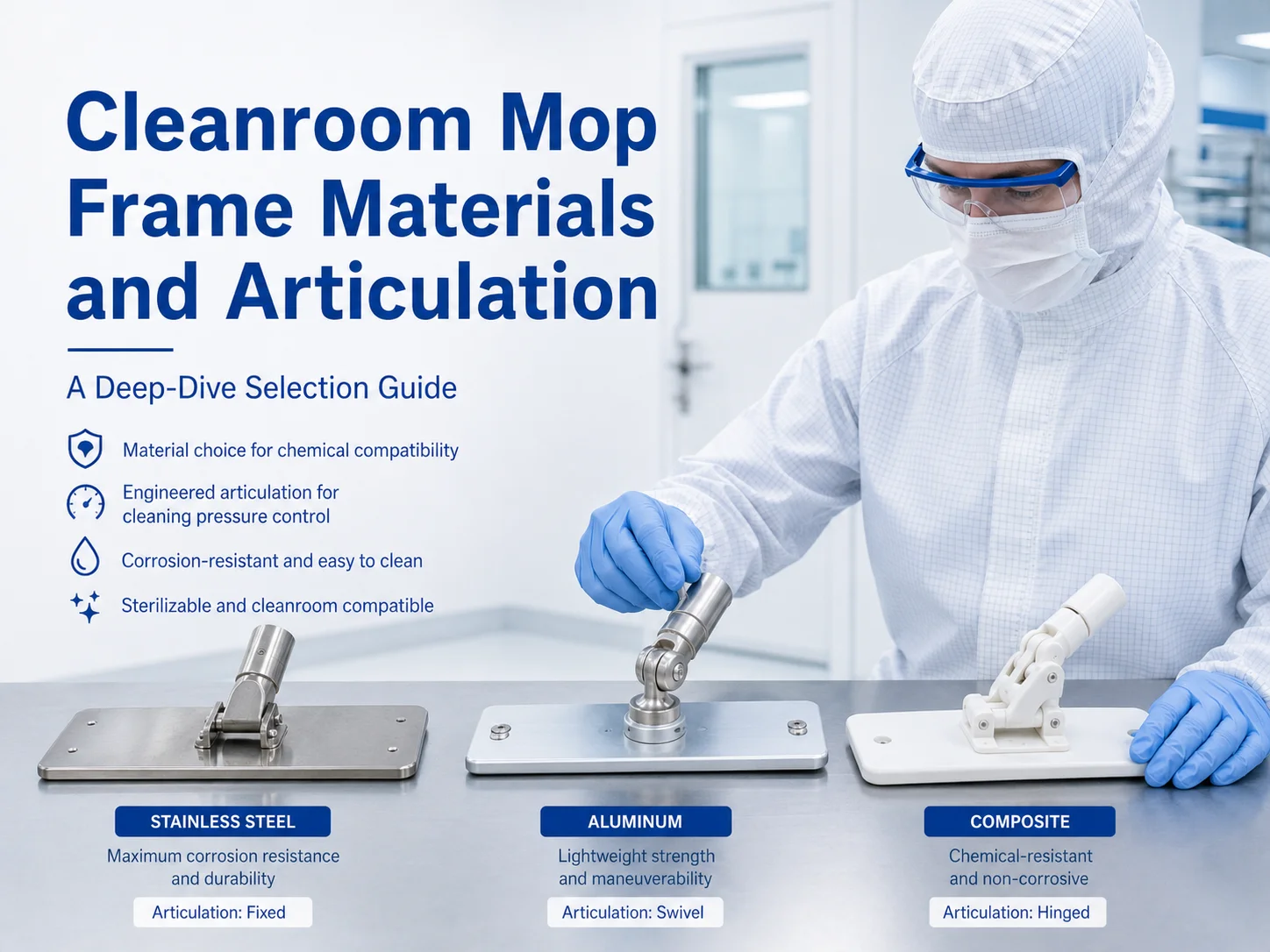
Der Mopprahmen bestimmt drei Betriebsvariablen, die keine andere Komponente hat: Gesamtgewicht des Systems (SS fügt 30–50 % mehr Gewicht hinzu als Aluminium oder Polymer), chemische Beständigkeit (SS verträgt aggressive Desinfektionsmittel; Aluminium birgt die Gefahr galvanischer Korrosion) und Gelenkbereich (Schwenkwinkel, Verriegelungsfähigkeit und ob der Rahmen seine Position an Wänden und Decken halten kann). Ein Rahmen, der ohne Auswertung dieser drei Dimensionen ausgewählt wird, führt nicht validierte Variablen in das Reinigungsprotokoll ein.
| Material | Gewicht | Chemische Beständigkeit | Corrosion Risk | Am besten für |
|---|---|---|---|---|
| SS 304 | Am schwersten | Excellent — tolerates oxidizing disinfectants | Minimal | Grade A/B pharma, aggressive disinfectant rotation |
| SS 316 | Am schwersten | Superior — molybdenum addition resists chloride pitting | Minimal | Grade A/B with chlorine-based disinfectants |
| Eloxiertes Aluminium | 40-50% lighter than SS | Good — anodized layer protects. Scratches expose raw Al. | Galvanic if paired with SS handle + oxidizing disinfectant | Grade C/D, multi-shift operations, weight-sensitive applications |
| Polymer/Composite | Am leichtesten | Excellent — inherently corrosion-proof | Keiner | Grade C/D, aggressive chemical environments, no autoclave requirement |
SS 304 is the standard for pharmaceutical GMP cleanrooms. It provides maximum chemical resistance against the full disinfectant rotation — quaternary ammonium, hydrogen peroxide, peracetic acid — and can be autoclaved at 121°C or 134°C without degradation. SS 316 adds molybdenum, which provides additional resistance to chloride pitting — relevant for facilities using chlorine-based disinfectants or operating in coastal/high-humidity environments. The trade-off is weight: an SS frame adds 0.8-1.2 kg to the system, which is noticeable over multi-shift operations. For grade-specific GMP cleaning tool requirements, see Auswahl der GMP-Reinraum-Moppqualität.
Anodized aluminum frames reduce weight by 40-50% compared to SS — making them suitable for multi-shift operations where cumulative operator fatigue is a concern. The anodized surface layer provides chemical resistance, but if the anodizing is scratched, raw aluminum is exposed. Raw aluminum in contact with oxidizing disinfectants (particularly chlorine-based) can experience pitting corrosion. The second risk: galvanic corrosion when an aluminum frame is paired with a stainless steel handle — the dissimilar metals create a galvanic cell when an electrolyte (cleaning solution) bridges the connection. Anodizing mitigates but does not eliminate this risk. Facilities evaluating aluminum frames should verify anodizing quality and assess galvanic compatibility with the handle material.
Polymer frames eliminate corrosion risk entirely — they are inherently resistant to all standard cleanroom disinfectants and cleaning agents. They are the lightest option, reducing operator fatigue significantly. The trade-offs: polymer frames may have reduced rigidity compared to metal, particularly at the extended widths required for larger mop heads. Articulation mechanisms in polymer frames may have fewer locking positions compared to metal ratcheting systems. Polymer frames are typically not autoclavable — limiting their use in facilities that autoclave the entire mop assembly. They are well-suited for Grade C/D zones and facilities using aggressive chemical disinfection where metal corrosion is a recurring maintenance issue.
Articulation determines whether the mop head maintains flat contact with the surface being cleaned — floor, wall, or ceiling. Free swivel is the standard for floor cleaning: the frame pivots to follow the operator’s stroke direction. Locking articulation allows the frame to be set at a fixed angle — typically 30-45 degrees for wall cleaning — and hold that position without operator effort. Ratcheting articulation provides indexed angle positions, useful when the same frame is used for both floor and wall cleaning and must switch between free movement and fixed angle. For the system-level importance of frame-head-handle integration, see Warum das vollständige Reinraum-Moppsystem wichtig ist.
The frame’s handle receiver must match the handle’s attachment type. A threaded frame receiver (M22 or 3/4-inch ACME) will not accept a quick-connect handle — and vice versa. More critically: the frame and handle materials should be evaluated for galvanic compatibility when different metals are used. An aluminum frame with a stainless steel handle creates a galvanic pair. Anodizing on the aluminum provides electrical isolation at the contact surface — but if the anodizing is worn through at the connection point, galvanic corrosion can begin. See Auswahl der Reinraum-Moppgriffe for handle material and attachment guidance.
SS ist der Standard – aber im Mehrschichtbetrieb der Klasse C/D kann der Gewichtsnachteil die Reinigungskonsistenz stärker beeinträchtigen, als der Vorteil der chemischen Beständigkeit rechtfertigt.
Dies ist die häufigste Paarung unterschiedlicher Metalle in Reinraum-Moppsystemen. Eloxieren bietet Schutz – bis es am Stecker zerkratzt wird. Überprüfen Sie die galvanische Verträglichkeit oder verwenden Sie aufeinander abgestimmte Materialien.
Ein frei drehbarer Rahmen kann keinen festen Winkel an der Wand halten – der Bediener muss den Winkel manuell halten, was die Konsistenz verringert. Verwenden Sie für Wandarbeiten ein arretierbares oder ratschenartiges Gelenk.
An auditor reviewing cleaning tools will ask about cleanability. A frame with no documented surface finish (Ra value for SS) cannot be validated as cleanable.
Most polymer frames are not autoclavable. If the facility’s SOP requires autoclaving the entire mop assembly, verify the frame is rated for the autoclave temperature before procurement.
SS 304 is the standard for Grade A/B pharmaceutical cleanrooms — maximum chemical resistance and autoclavable. Aluminum may be evaluated for Grade C/D where weight reduction benefits multi-shift operations. Polymer is suitable for aggressive chemical environments where metal corrosion is a recurring concern. The “best” material depends on cleanroom grade, disinfectant rotation, and shift patterns — not a universal ranking.
Anodized aluminum can be used with standard oxidizing disinfectants if the anodized surface is intact. However, scratched anodizing exposes raw aluminum — which is susceptible to pitting from chlorine-based disinfectants. Facilities using aluminum frames should inspect the anodized surface at regular intervals and replace frames showing surface damage.
SS frames are approximately 30-50% heavier than comparable polymer or aluminum frames. An SS frame that weighs 1.0 kg may have an aluminum equivalent at 0.5-0.6 kg and a polymer equivalent at 0.4-0.5 kg. The weight difference becomes operationally significant over multi-shift use.
Yes. Free-swivel articulation allows the mop head to follow floor contours but cannot hold a fixed angle for wall cleaning. Locking articulation holds a consistent wall angle — improving cleaning pressure uniformity on vertical surfaces. The articulation type should match the surfaces being cleaned.
Matching materials eliminates galvanic corrosion risk entirely. If different materials must be used, verify galvanic compatibility — particularly for aluminum + SS pairs where anodizing provides the isolation barrier. Anodizing that is worn through at the connector creates a corrosion pathway.
Frame replacement is condition-based rather than calendar-based. Inspection triggers: visible corrosion (aluminum), surface finish degradation (SS — loss of smoothness, pitting), articulation mechanism sloppiness (loose swivel, failed lock), and connector thread wear. A documented frame inspection schedule should be integrated into the cleaning tool maintenance program.
Swivel is sufficient for floor-only cleaning programs. If walls or ceilings are cleaned, locking or ratcheting articulation is recommended — it holds a consistent angle on vertical surfaces without requiring the operator to maintain the angle manually, improving cleaning uniformity.
Specify your cleanroom grades, disinfectant rotation, and cleaning surfaces. MIDPOSI can help match frame material and articulation type to your operational requirements.
White Cleanroom Mop Series — SS 304 frames with swivel articulation — compatible with full handle and mop head range — material documentation for GMP audit support

Verwandt: Dieser Artikel ist Teil der MIDPOSI Reinraum-Moppsystem-Leitfaden – eine vollständige Ressource, die Komponenten, Auswahlkriterien, GMP-Arbeitsabläufe und Dokumentationsunterstützung für die Beschaffung von Reinraum-Mopps abdeckt.