Der Befestigungsmechanismus, der einen Reinraum-Moppkopf mit seinem Rahmen verbindet, ist die unsichtbare Komponente, die sich direkt auf die Wechselgeschwindigkeit, die Verbindungssicherheit, die Partikelerzeugung und das Kreuzkontaminationsrisiko auswirkt. Dies ist die Schnittstelle, an der Textil auf Struktur trifft – und wo die Folgen einer nicht übereinstimmenden Oberfläche wie Ablösung während des Gebrauchs, inkonsistente Bodenbedeckung oder Partikel, die durch mechanische Reibung freigesetzt werden, auftreten. Dieser Leitfaden vergleicht die drei primären Befestigungssysteme, sodass Beschaffungs-, Einrichtungs- und Qualitätssicherungsteams die Befestigung als bewusstes Auswahlkriterium und nicht als nachträglichen Einfall bewerten können.
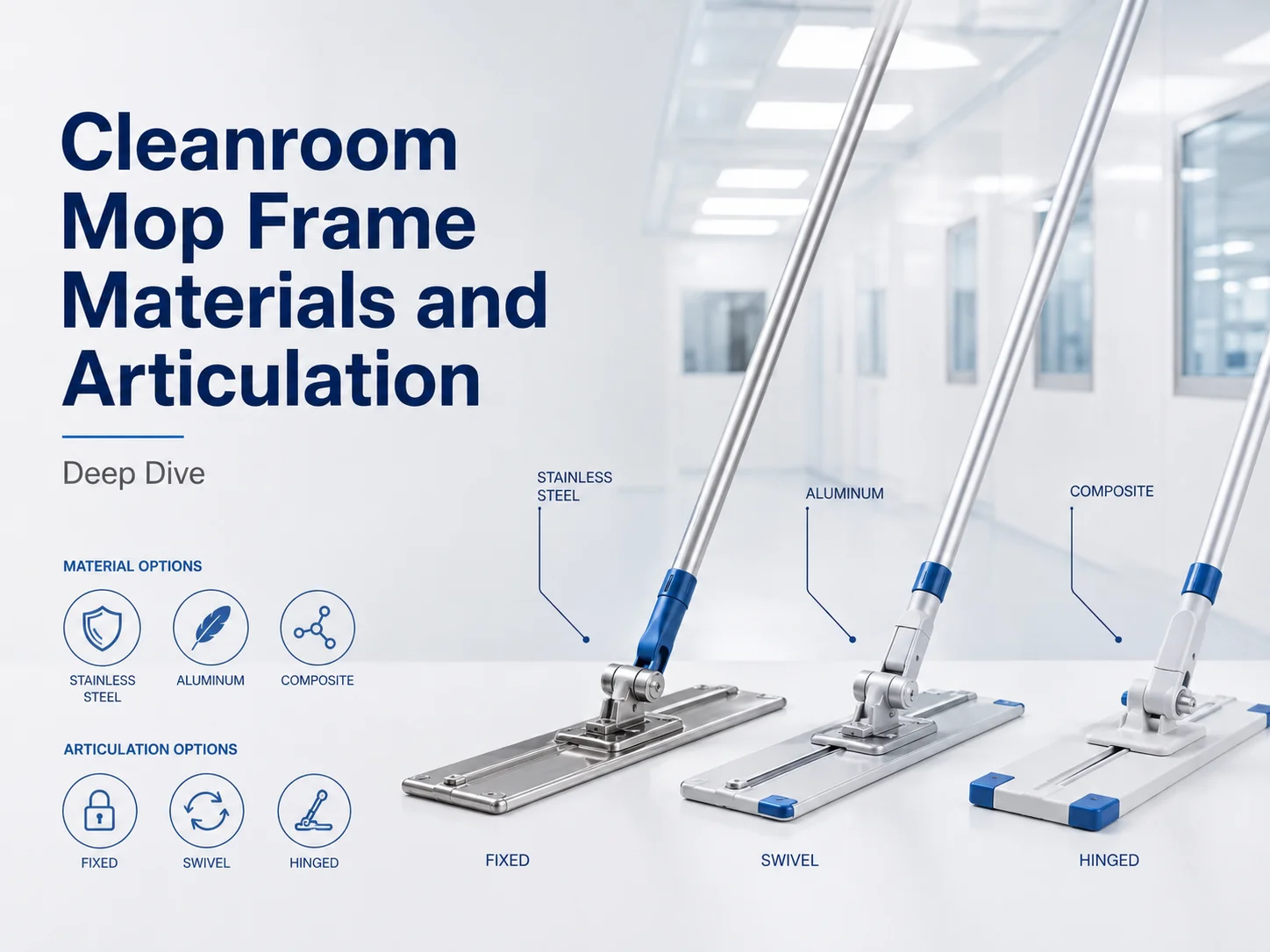
Ein Reinraum-Moppkopf-Befestigungsmechanismus ist die physische Schnittstelle, die die textile Reinigungsoberfläche während des Gebrauchs am starren Rahmen befestigt. Wenn diese Verbindung zuverlässig ist, kann sich der Bediener auf das Reinigungsprotokoll konzentrieren. Wenn es unzuverlässig ist – wenn der Kopf sich bewegt, verrutscht oder sich löst – ist das Ergebnis keine Unannehmlichkeit; Es handelt sich um ein Kontaminationsereignis, das eine Dokumentation, erneute Reinigung und in regulierten Umgebungen eine Abweichungsuntersuchung erfordert. Die Auswahl des Anhangs ist daher keine Bequemlichkeitsentscheidung. Es handelt sich um eine Entscheidung zur Kontaminationskontrolle.
In der Praxis bestimmt der Befestigungsmechanismus drei Betriebsvariablen:
Der Aufsatz muss den Druck-Zug-Kräften, Richtungsänderungen und gelegentlichem Hängenbleiben standhalten, die beim routinemäßigen Wischen auftreten. Ein Kopf, der sich während eines Reinigungszyklus löst, führt zu unkontrolliertem Kontakt zwischen dem Rahmen und dem Boden – einem direkten Kontaminationsvektor – und erfordert, dass der Bediener den Reinigungsvorgang anhält, wieder anbringt und möglicherweise neu startet.
In Mehrzonen-GMP-Einrichtungen, in denen Moppköpfe zwischen Qualitätsbereichen gewechselt werden, bestimmt der Befestigungsmechanismus direkt, wie lange jeder Wechsel dauert und wie viel menschlicher Kontakt mit der verschmutzten Kopfoberfläche erforderlich ist. Ein 5-Sekunden-Wechsel gegenüber einem 30-Sekunden-Wechsel mag trivial erscheinen, aber bei 20 Zonenübergängen pro Schicht wirkt sich der kumulative Unterschied sowohl auf die Betriebseffizienz als auch auf das Kontaminationsrisiko aus.
Jeder Befestigungsmechanismus erzeugt beim Verbinden und Trennen ein gewisses Maß an Partikelfreisetzung. Durch mechanische Reibung zwischen zwei Oberflächen – sei es ein Stoff, der über einen Rahmen gleitet (Tasche), Haken, die in Schlaufen eingreifen (Klettverschluss) oder einrastende Metallklammern (Clip) – entstehen Partikel, die in den Reinraum gelangen. Art und Menge dieser Partikel unterscheiden sich je nach Mechanismus, und höherwertige Reinräume haben eine engere Toleranz für diese Quelle.
| Anhang-Fehlermodus | Typische Grundursache | Operative Konsequenz | Höchstwahrscheinlich in |
|---|---|---|---|
| Der Kopf rutscht beim Wischen ab | Tasche zu flach oder gedehnt; Klettverschluss abgenutzt; Clip sitzt nicht richtig | Ungleichmäßige Bodenbedeckung; Der Bediener hält an, um die Einstellung vorzunehmen. Möglicher Rahmen-Boden-Kontakt | Tasche, Klettverschluss |
| Der Kopf lässt sich vollständig abnehmen | Untergroße Tasche für die Rahmenbreite; Clip nicht eingerastet; Klettscherversagen bei Richtungswechsel | Vollständiges Kontaminationsereignis; Rahmen berührt Boden; Reinigungszyklus neu gestartet; Abweichungsbericht erforderlich | Tasche (falsche Größe), Clip (Benutzerfehler) |
| Übermäßige Freisetzung von Fasern/Partikeln aus dem Befestigungsbereich | Klettverschluss; Rahmenabrieb Innentasche; Metall-auf-Metall-Clip-Reibung ohne Schmierung | Die Partikelanzahl überschreitet die Zonengrenzen. Das Reinigungswerkzeug selbst wird zur Kontaminationsquelle | Klettverschluss, Clip (Metallvarianten) |
| Verschlechterung der Befestigungsoberfläche | Wasch-/Autoklavenzyklen überschreiten die Toleranz des Hakenmaterials oder der Taschennaht | Fortschreitender Verlust der Haltekraft; Befestigung unzuverlässig, selbst wenn sie optisch intakt ist | Klettverschluss (Hakenermüdung), Tasche (Nahtermüdung) |
| Markenübergreifende Inkompatibilität | Rahmenbreite stimmt nicht mit Taschenmaßen überein; Clip-Empfänger nicht bei allen Anbietern Standard | Beschaffung an einen einzigen Lieferanten gebunden; Ohne Überprüfung des Anhangs können Komponenten nicht gemischt werden | Tasche, Clip |
Die wichtigste Erkenntnis: Der Befestigungsmechanismus ist kein Zubehörmerkmal. Es handelt sich um eine strukturelle Schnittstelle, die bestimmt, ob das gesamte Moppsystem als ein einziges gesteuertes Werkzeug funktioniert – oder als zwei unabhängige Komponenten, die im Moment der Verwendung zufällig verbunden werden. Ein grundlegendes Verständnis darüber, wie Kopf, Rahmen und Griff als System interagieren, finden Sie im Reinraum-Moppkopfrahmen-Griffintegration Führung. Für den breiteren Systemkontext siehe die Übersicht über Reinraum-Moppsysteme.
Der Taschenaufsatz ist der am weitesten verbreitete Befestigungsmechanismus für Reinraum-Moppköpfe. Es handelt sich um die Standardkonfiguration für die meisten Flachmoppsysteme in GMP-Pharma- und Medizingeräteanlagen und es ist das System, mit dem die meisten Käufer bei der Bewertung zuerst in Berührung kommen Arten und Auswahl von Reinraum-Moppköpfen.
Der Moppkopf ist ein rechteckiges Textilpad mit einer offenen Tasche, die in jede kurze Seite eingenäht ist. Der starre Mopprahmen wird in beide Taschen eingesetzt – zuerst auf der einen Seite, dann auf der anderen – und sorgt so für eine kraftschlüssige Verbindung, die den Kopf flach an der Unterseite des Rahmens hält. Die Haltekraft ergibt sich aus der maßlichen Übereinstimmung zwischen Taschenbreite/-tiefe und Rahmenbreite, kombiniert mit der Spannung des Stoffes, wenn er sich um die Rahmenkante wickelt.
Es gibt keine mechanischen Befestigungselemente. Es gibt keinen Kleber. Die Verbindung wird allein durch die Geometrie der Tasche und die Spannung des Textils unter Belastung aufrechterhalten.
Die Zuverlässigkeit der Taschenbefestigung hängt von dreidimensionalen Variablen ab, die zwischen Kopf und Kopf aufeinander abgestimmt sein müssen Typen von Reinraum-Mopphaltern:
| Dimension | Was es steuert | Folge einer Nichtübereinstimmung |
|---|---|---|
| Taschenbreite | Die Öffnungsweite muss der Rahmenbreite entsprechen. Die Taschenöffnung sollte etwas breiter als die Rahmenbreite sein, damit Platz zum Einführen vorhanden ist, aber nicht so breit, dass sich der Rahmen während des Gebrauchs seitlich verschieben kann. | Zu fest: Der Bediener hat Schwierigkeiten, den Rahmen einzusetzen; Gefahr des Einreißens der Taschennaht beim Anbringen. Zu locker: seitliches Abdriften beim Wischen; ungleichmäßige Druckverteilung. |
| Taschentiefe | Die Einfügungstiefe bestimmt, wie viel vom Bild erfasst wird. Um ein Herausrutschen des Rahmens bei Richtungsänderungen zu verhindern, ist eine Mindesteinstecktiefe erforderlich. | Zu flach: Rahmenende wird herausgezogen, wenn der Bediener die Richtung ändert; Dies ist der häufigste Taschenfehlermodus, insbesondere bei Rahmen mit abgerundeten oder konischen Enden. |
| Stärke der Taschennaht | Die Nähte an der Innentaschennaht müssen wiederholten Ein- und Ausziehzyklen sowie der beim Wischen durch den Rahmen übertragenen Zugkraft standhalten. | Nahtfehler: Taschenrisse während des Gebrauchs; Kopf lässt sich nicht mehr am Rahmen befestigen. Häufig nach wiederholtem Autoklavieren von Köpfen, die nicht für diese Sterilisationsmethode geeignet sind. |
Die Klettverschlussbefestigung – auch Klettverschlussbefestigung genannt – nutzt ein Feld aus kleinen Haken auf der Rahmenoberfläche, die in ein Feld aus Schlaufen auf der Rückseite des Moppkopfes eingreifen. Der Kopf wird gegen den Rahmen gedrückt, die Haken greifen in die Schlaufen ein und arretieren den Kopf. Das Entfernen erfolgt durch Abziehen des Kopfes vom Rahmen, wodurch sich die Haken von den Schlaufen lösen.
Dieser Mechanismus kommt häufig in Einrichtungen vor, in denen schnelle Wischkopfwechsel zwischen Zonen eine hohe Betriebspriorität haben und in denen die durch den Aufsatz erzeugte Partikelbelastung innerhalb der relevanten Reinraumgrenzen bewertet und akzeptiert wurde.
Der Rahmen trägt einen Streifen (oder mehrere Streifen) aus Hakenmaterial – typischerweise Nylon- oder Polyesterhaken –, der mit der Rahmenoberfläche verklebt oder mechanisch befestigt ist. Der Wischkopf trägt auf seiner Rückseite einen entsprechenden Streifen (oder Vollbezugspad) aus Schlingenmaterial. Wenn der Kopf gegen den Rahmen gedrückt wird, verteilen Hunderte einzelner Klettverschlüsse die Haltekraft über die gesamte Befestigungsfläche. Der Haltemechanismus unterscheidet sich von der Taschenbefestigung: Die Kraft wird auf viele kleine Verbindungspunkte verteilt und nicht auf zwei Taschennähte konzentriert.
Die zum Entfernen des Kopfes erforderliche Schälkraft – typischerweise eine absichtliche, abgewinkelte Bewegung – ist deutlich höher als die Scherkraft, der der Aufsatz beim Wischen standhalten kann. Dies ist die gewünschte Eigenschaft: sicher während des Gebrauchs, abnehmbar durch absichtliche Aktion.
Bei jedem Klettverschluss-Ein- und Auskuppelzyklus entstehen Partikel. Die Haken kratzen beim Befestigen über die Schlaufenoberfläche und die Schlaufen dehnen und verformen sich, wenn sie sich beim Lösen lösen. Dieser mechanische Abrieb erzeugt:
Die Partikelfrage bei der Klettbefestigung ist nicht, ob Partikel erzeugt werden – das ist immer der Fall –, sondern ob die Menge und Art für die angestrebte Reinraumqualität akzeptabel sind. In Umgebungen der Klasse A/B (ISO 5) kann die Partikelbelastung durch wiederholte Klettverschluss-Befestigungszyklen akzeptable Grenzwerte überschreiten und muss anhand tatsächlicher Überwachungsdaten und nicht anhand von Lieferantenangaben bewertet werden.
Die Lebensdauer eines Klettverschluss-Befestigungssystems wird durch Materialermüdung in einer Weise begrenzt, die bei Taschensystemen nicht der Fall ist:
| Degradationsfaktor | Wirkung | Betriebssignal |
|---|---|---|
| Hakenermüdung | Haken verformen sich nach wiederholtem Einrasten dauerhaft; Sie „federn“ nicht mehr zurück, um Schlaufen effektiv zu fangen | Der Kopf lässt sich mit deutlich geringerem Widerstand abziehen; Der Kopf bewegt sich beim Wischen, obwohl dies vorher nicht der Fall war |
| Schleifenkomprimierung | Die Schlingenfasern werden mit der Zeit flacher und matt; weniger verfügbare Schlaufen zum Einhaken der Haken | Auch bei einem neuen Rahmen lässt die Haltekraft nach; Wiederverwendbare Köpfe verlieren nach 50–100+ Zyklen an Halt (materialabhängig) |
| Kontamination des Hakenfeldes | Zwischen den Haken sammeln sich Schmutz, Desinfektionsmittelrückstände oder Fasern an, wodurch die effektive Anzahl der Eingriffspunkte verringert wird | Die Bindung fühlt sich inkonsistent an; einige Bereiche greifen, während andere rutschen; erfordert eine manuelle Reinigung der Hakenleiste |
| Auswirkungen der Sterilisation | Die Temperaturen im Autoklaven können das Hakenmaterial erweichen oder verziehen. Gammastrahlung kann Polymerhaken verspröden | Versagen der Befestigung nach der Sterilisation; Die Haltekraft nimmt nach dem Verarbeitungszyklus ab |
Clip or mechanical attachment systems use a positive-lock mechanism — typically spring-loaded metal or polymer clips, latches, or clamps — to physically secure the mop head to the frame. Unlike pocket systems (friction) or Velcro systems (distributed hook engagement), clip systems create a rigid mechanical connection at specific attachment points.
Dieser Mechanismus ist bei Standard-Moppanwendungen in Reinräumen weniger verbreitet als Taschen- und Klettverschlüsse, eignet sich jedoch für bestimmte Anwendungsfälle, bei denen die Folgen einer Ablösung alle anderen Überlegungen überwiegen – und bei denen die Einrichtung bereit ist, höhere Komponentenkosten und komplexere Austauschverfahren in Kauf zu nehmen.
Der Rahmen verfügt über Clip-Aufnahmen – feste Ankerpunkte an definierten Positionen – in die die entsprechenden Befestigungspunkte des Kopfes einrasten. Der Bediener positioniert den Kopf am Rahmen, richtet die Befestigungspunkte an den Empfängern aus und rastet jeden Clip einzeln ein. Ein richtig eingerasteter Clip erzeugt eine akustische oder fühlbare Bestätigung (ein Klicken oder Einrasten), dass die Verbindung verriegelt ist. Das Lösen erfordert eine bewusste Entriegelungsaktion – Drücken einer Lasche, Drücken einer Entriegelung oder Verschieben eines Riegels –, die ein versehentliches Lösen während des Gebrauchs verhindert.
Clip systems have the highest frame dependency of the three mechanisms. Pocket attachment requires only that the frame width matches pocket width. Velcro attachment requires only that the frame has a hook strip in the correct position. Clip attachment requires a frame specifically designed with clip receivers — and those receivers must match the head’s clip type, position, and engagement geometry. This is not a standard across suppliers. A head with Clip Type A will not attach to a frame with Receiver Type B, even if both are described as “clip attachment.”
This dependency has a procurement implication: clip-attachment heads and frames are typically sourced as a matched set from a single supplier. For more context on frame specifications across different attachment types, see the Typen von Reinraum-Mopphaltern Seite.
| Clip System Variable | Procurement Consideration |
|---|---|
| Clip material | Stainless steel clips: durable, autoclavable, heavier. Polymer clips: lighter, no corrosion risk, but may degrade under repeated autoclaving or gamma irradiation. |
| Number of attachment points | 2-point (one per end): simpler, faster change-out, but head can pivot if one clip releases. 4-point (two per end): more secure, better pressure distribution, but change-out takes longer. |
| Lock confirmation | Audible click: operator hears engagement, reducing the risk of false attachment. Visual indicator (exposed red mark when unlocked): provides post-attachment verification. Neither: operator must physically tug-test each clip. |
| Release mechanism | Thumb-release: faster but requires finger contact near the possibly contaminated head surface. Tool-release: clean but slower; requires a separate release tool or handle-mounted release lever. |
The following matrix evaluates the three attachment mechanisms across the five dimensions that matter most for cleanroom procurement and operations. Each dimension is rated on a three-tier scale based on the mechanism’s inherent characteristics — not on any specific supplier’s implementation.
| Dimension | Pocket-Style | Velcro / Hook-and-Loop | Clip / Mechanical |
|---|---|---|---|
| Connection Security | Relies on dimensional fit and fabric tension. Secure when head and frame are correctly matched; degrades when pocket stretches or frame width is marginally compatible. |
Distributed grip across many points. Degrades gradually as hooks and loops fatigue. Holding force in wet conditions may differ from dry. |
Positive mechanical lock. Connection secure until deliberately released. Sudden failure possible if clip mechanism breaks, but no gradual degradation during use. |
| Wechselgeschwindigkeit | 15–25 seconds. Requires two hands, frame manipulation, and visual check. Head must be aligned and both pockets seated. |
3–8 seconds. Press to attach, peel to remove. Single-handed possible on handle-mounted frames. No alignment precision required. |
20–40 seconds. Each clip engaged individually. Alignment critical. Removal requires deliberate release action per clip. |
| Partikelerzeugung | Minimal particle release during attachment. Fabric-to-frame friction is the primary source; well-controlled with proper frame finish and clean pocket interior. |
Inherent particle generation from hook-loop engagement. Increases with cycle count as hook and loop materials degrade. Primary limitation for high-grade cleanrooms. |
Metal clips: low particle risk at attachment points but metal-on-metal friction possible. Polymer clips: lower friction but material wear particles over time. |
| Cross-Brand Compatibility | Widest available compatibility but pocket dimensions vary by supplier. Head from Supplier A may not fit frame from Supplier B if pocket width/depth differ beyond tolerance. |
Hook strip position, width, and material type differ across frames. Loop material density differs across heads. Cross-brand mixing is possible with verification but not guaranteed. |
Effectively zero cross-brand compatibility. Clip geometry is proprietary. Heads and frames must be sourced as a matched set from the same supplier. |
| Total Cost of Use | Simplest construction = lowest per-unit head cost. No mechanical parts on frame to service. Highest head availability across suppliers. |
Hook-and-loop construction adds cost to both head and frame. Scheduled frame replacement needed when hook field degrades — an additional operational cost. |
Highest per-unit cost. Clip mechanism adds manufacturing complexity. Frame cost higher due to clip receiver integration. Supplier lock-in limits price competition. |
Reading the matrix: No attachment mechanism scores highest across all five dimensions. This is the nature of the trade-off: the mechanism that provides the fastest change-out (Velcro) generates the most particles. The mechanism that provides the most secure connection (Clip) has the slowest change-out and highest cost. The mechanism with the broadest compatibility and lowest cost (Pocket) provides moderate connection security and moderate change-out speed. The correct choice is never “which is best overall” — it is “which trade-off profile matches the cleaning zone grade, operational workflow, and risk tolerance of this specific facility.”
For a broader view of how component choices interact — including how attachment mechanism fits into the overall system selection logic — see the full system integration guide.
The attachment mechanism that works for a Grade D pharmaceutical packaging area is not necessarily the right choice for a Grade B aseptic filling suite. The selection must be driven by the intersection of cleanroom grade requirements, operator workflow, mop head usage model (disposable vs reusable), and audit expectations. The following table maps common facility profiles to their most suitable attachment mechanism.
| Facility Profile | Grade / ISO | Primary Priority | Recommended Mechanism | Begründung |
|---|---|---|---|---|
| Pharmaceutical aseptic filling | Klasse A/B (ISO 5) | Minimize particle generation; connection security must be absolute | Pocket (preferred) or Clip (if validated) | Lowest particle release during attachment. Pocket system with correct dimensional match provides sufficient security for standard mopping forces in aseptic areas. Clip only if operational conditions require mechanical lock beyond what pocket provides. |
| Pharmaceutical secondary packaging / warehouse | Grade C/D (ISO 7–8) | Operational throughput; faster change-out between batches | Velcro or Pocket | Particle tolerance accommodates Velcro. If change-out speed between production batches is the bottleneck, Velcro provides measurable time savings. If speed is not the primary constraint, Pocket offers lower cost. |
| Biotech R&D / pilot plant | Grade B/C (ISO 5–7) | Flexibility; different mop heads for different process steps | Tasche | Broadest head selection across suppliers. Operators can switch between head types (disposable, reusable, different materials) using the same frame. No attachment-specific head modifications required. |
| Medical device cleanroom assembly | ISO 7–8 | Reliable attachment with moderate cost; standardized operator training | Tasche | Lowest complexity to train, lowest procurement risk. Medical device facilities with structured cleaning programs benefit from attachment consistency — every operator uses the same mechanism, reducing training variance. |
| Multi-shift GMP production (24/7) | Grade C/D (ISO 7–8) | Minimum change-out time per zone transition; operator efficiency across shifts | Klettverschluss | Across three shifts, the 15–20 second saving per head change with Velcro versus Pocket accumulates to measurable operational time. Combined with disposable mop heads, this maximizes throughput without compromising cleaning consistency. |
| Sterile API manufacturing | Klasse A/B (ISO 5) | Connection security above all else; detachment = batch contamination risk | Clip (validated) or Pocket (tight-tolerance) | Where the consequence of a single detachment event can trigger batch investigation, the positive-lock nature of a clip mechanism becomes worth the higher cost and slower change-out. Pocket with tight-tolerance head-to-frame matching is the alternative if clip system cost or complexity is not justified. |
| Cleanroom distributor / multi-client facility | Varies by client | Compatibility across multiple end-user requirements | Pocket (primary) + Velcro (option) | Distributors serving diverse clients should offer pocket as the baseline — highest cross-supplier compatibility — with Velcro as an option for clients with documented throughput requirements. |
The mop head usage model interacts with attachment mechanism selection in ways that are not always obvious. Disposable heads are used once and discarded — so pocket stretch, Velcro loop fatigue, and clip wear are not cumulative problems. Reusable heads, especially those subjected to repeated laundering or autoclaving, accumulate material degradation at the attachment interface over time. This means the attachment mechanism that works reliably with disposables may show progressive performance loss with reusables.
For a structured comparison of disposable and reusable strategies, see the Entscheidungshilfe für Einweg- oder wiederverwendbare Reinraummopps. For handle options that support different attachment types in different zone configurations, see the Auswahl der Reinraum-Moppgriffe Seite.
The attachment mechanism not only determines how a head is secured to a frame — it also determines how the operator changes the head during cleaning operations. In GMP facilities where head-change procedures must be documented in SOPs and operator actions must be consistent and verifiable, the attachment mechanism has a procedural dimension that procurement should consider before standardizing on one type.
Typical duration: 15–25 seconds
Operator contact: Hands contact used head edges
Verification: Visual (seating check)
Risk point: Partial seating — frame end not fully inserted into pocket, creating risk of detachment during directional change. Most common when operator is under time pressure.
Typical duration: 3–8 seconds
Operator contact: Hands contact used head edges
Verification: Tactile (press resistance)
Risk point: Partial engagement — head attached at some points but not all; missed areas create uneven holding force. Head appears attached but can peel during use. More common when operator does not press across full attachment surface.
Typical duration: 20–40 seconds
Operator contact: Hands contact clip mechanisms
Verification: Audible/visual + manual check
Risk point: False lock — clip appears engaged but has not fully seated. Operator proceeds with cleaning; clip releases under load. Most dangerous on 4-clip systems where one unseated clip is harder to detect visually.
Attachment mechanism standardization has a direct effect on operator training burden and SOP consistency:
For GMP-compliant cleaning programs, the head change-out procedure is part of the documented cleaning protocol. Attachment mechanisms that rely on operator judgment (pocket seating depth, Velcro press pressure) are harder to proceduralize precisely than mechanisms with positive confirmation (clip lock). This is not an argument against pocket or Velcro — it is a documentation consideration that QA should weigh when selecting an attachment system for GMP environments where procedural precision is a compliance expectation.
For the facility-level GMP cleaning framework that determines which attachment mechanism is appropriate at each grade, see the Leitfaden zur Auswahl der GMP-Reinraummoppqualität.
The attachment mechanism is rarely the headline item in a GMP audit. But when an auditor asks about cleaning tool control, the follow-up questions can reach the attachment system faster than most facilities expect. The attachment is one of the few physical interfaces in a cleaning tool that the operator interacts with directly during cleaning — and any variability in that interaction translates to variability in cleaning consistency, which is an audit-relevant concern.
A cleaning SOP that says “attach mop head to frame” without specifying the attachment mechanism, the correct procedure, and the post-attachment verification step is incomplete. The SOP should name the attachment type and describe the correct procedure — including the verification that the head is properly secured before mopping begins.
Reusable heads with Velcro attachment lose loop integrity over laundering cycles. Pocket seams stretch over repeated frame insertions. Clip springs fatigue. If the attachment mechanism degrades at a different rate than the head’s visible cleaning surface, operators may continue using heads that appear fine but have compromised attachment security. The replacement schedule should account for attachment-specific wear, not just visual head condition.
Frame-side attachment surfaces accumulate residue over time. Pocket interiors can trap particles shed from the frame. Velcro hook fields trap fibers and debris between hooks. Clip mechanisms have recesses that are difficult to clean and inspect. Each attachment type introduces specific cleaning and inspection requirements for the frame — and those requirements should be part of the frame maintenance procedure.
When an operator changes a mop head at the boundary between Grade B and Grade C, the change itself is a transient event that can introduce contamination if the protocol does not account for the attachment mechanism’s specific handling requirements. A pocket change-out that requires manipulating the frame near the used head surface differs in contamination risk from a Velcro peel-off that keeps the operator’s hands further from the soiled surface.
In GMP environments, suppliers should be able to provide attachment-specific performance information: the number of rated attachment cycles, material compatibility with specified disinfectants and sterilization methods, and particle release data under controlled conditions. General statements like “secure attachment” are insufficient for QA evaluation — request attachment-specific documentation as part of the supplier qualification process.
For a broader framework on how GMP cleaning expectations map to specific cleanroom grades and tool selections, see the Leitfaden zur Auswahl der GMP-Reinraummoppqualität. For the foundational system overview, see the Übersicht über Reinraum-Moppsysteme.
Pocket-style attachment generates the fewest particles during normal operation. The attachment does not involve repeated mechanical abrasion of two surfaces — once the frame is seated in the pocket, the textile-to-metal contact is static during mopping. Velcro/hook-and-loop attachment generates more particles because each engagement cycle involves hook-to-loop abrasion, and the hooks continue to shed material over repeated cycles. Clip mechanisms fall between the two, with particle generation dependent on clip material (polymer clips produce fewer particles than metal-on-metal clip mechanisms) and the presence of any lubricant or coating at the contact point.
You can, but you must verify dimensional compatibility first — and not assume it. The two critical measurements are pocket opening width (must clear the frame width with a slight tolerance) and pocket depth (must capture enough of the frame end to prevent slip-out). Even if both products are described as “standard flat mop,” pocket dimensions are not standardized across the industry. Request the head’s pocket dimensions from the head supplier and compare against the frame width from the frame supplier. If either supplier cannot provide this information, assume incompatibility until verified by physical test.
There is no universal replacement interval — it depends on the hook material quality, the number of attachment cycles per shift, the disinfectant chemistry the frame is exposed to, and whether the frame is autoclaved. The practical indicator is a reduction in peel resistance. When an operator notices that head removal requires noticeably less force than when the frame was new, the hook field is degrading. QA-driven programs should establish a cycle-count threshold based on the supplier’s rated life, then validate through periodic peel-force testing. Visual inspection of hook tips is unreliable — hooks can appear intact while having lost their spring-back characteristic.
It depends on the facility’s particle monitoring data and risk assessment. Velcro attachment generates particles as a function of the attachment mechanism itself — this is an inherent characteristic, not a quality defect. Whether that particle load is acceptable in an ISO 5 environment depends on the frequency of head changes (more changes = more particles), the proximity of the attachment action to critical surfaces, and the facility’s particle count limits. Many ISO 5 facilities choose pocket attachment specifically to avoid introducing this variable. If Velcro is under consideration for Grade A/B, request particle generation data from the supplier and validate through in-situ monitoring before adoption.
Insufficient pocket depth for the frame end is the most common cause. When the frame is not fully inserted into the pocket — either because the pocket is too shallow or because the operator did not seat it completely — the frame end can slip out when the operator reverses the mopping direction. This is a dimensional compatibility problem first and an operator procedure problem second. It is best addressed at procurement: verify pocket depth against frame end length before standardizing on a head-frame combination, and set a minimum insertion depth specification that is checked during operator training.
Yes, typically. Clip-attachment heads carry a higher manufacturing cost because they integrate mechanical attachment components — clips, receivers, or reinforced attachment points — into a textile product. The frame cost is also higher because the frame must include matching clip receivers. The total system cost premium for clip attachment versus pocket attachment can be meaningful, particularly in high-volume disposable applications. However, the decision should be evaluated on total operational cost, not unit cost alone: if clip attachment prevents even one contamination-related batch investigation per year, the premium may be justified.
Some can, but this must be confirmed per product specification — it is not a universal capability. Autoclave temperatures can soften or deform the polymer hooks on the frame side and can affect the loop fiber structure on the head side. Gamma irradiation can embrittle polymer hooks, reducing their spring-back characteristic. If a reusable Velcro-attachment system is intended for autoclave or gamma sterilization, request the supplier’s sterilization compatibility documentation specifically for the attachment components — not just for the cleaning fabric.
Many multi-grade facilities standardize on pocket attachment across all zones for operational consistency — one SOP, one training program, one attachment mechanism that works from Grade D to Grade A/B. This simplifies procurement, training, and audit preparation. However, if a specific zone (typically Grade A/B) has attachment security requirements that exceed what pocket provides with the available head-frame combination, a clip mechanism may be introduced for that zone only. The key principle is: standardize unless a specific zone’s requirements demand a different mechanism, and document the rationale for the exception.
The attachment mechanism is one component in a five-part system — head, frame, handle, bucket, and attachment — that must be evaluated as a whole. Before committing to one attachment type, confirm that the heads, frames, and handles in your evaluation pipeline are compatible across all three interface points.
Designed for structured cleanroom cleaning programs across GMP and ISO-controlled facilities. Discuss your attachment requirements, zone grades, and component compatibility questions with MIDPOSI’s technical team.
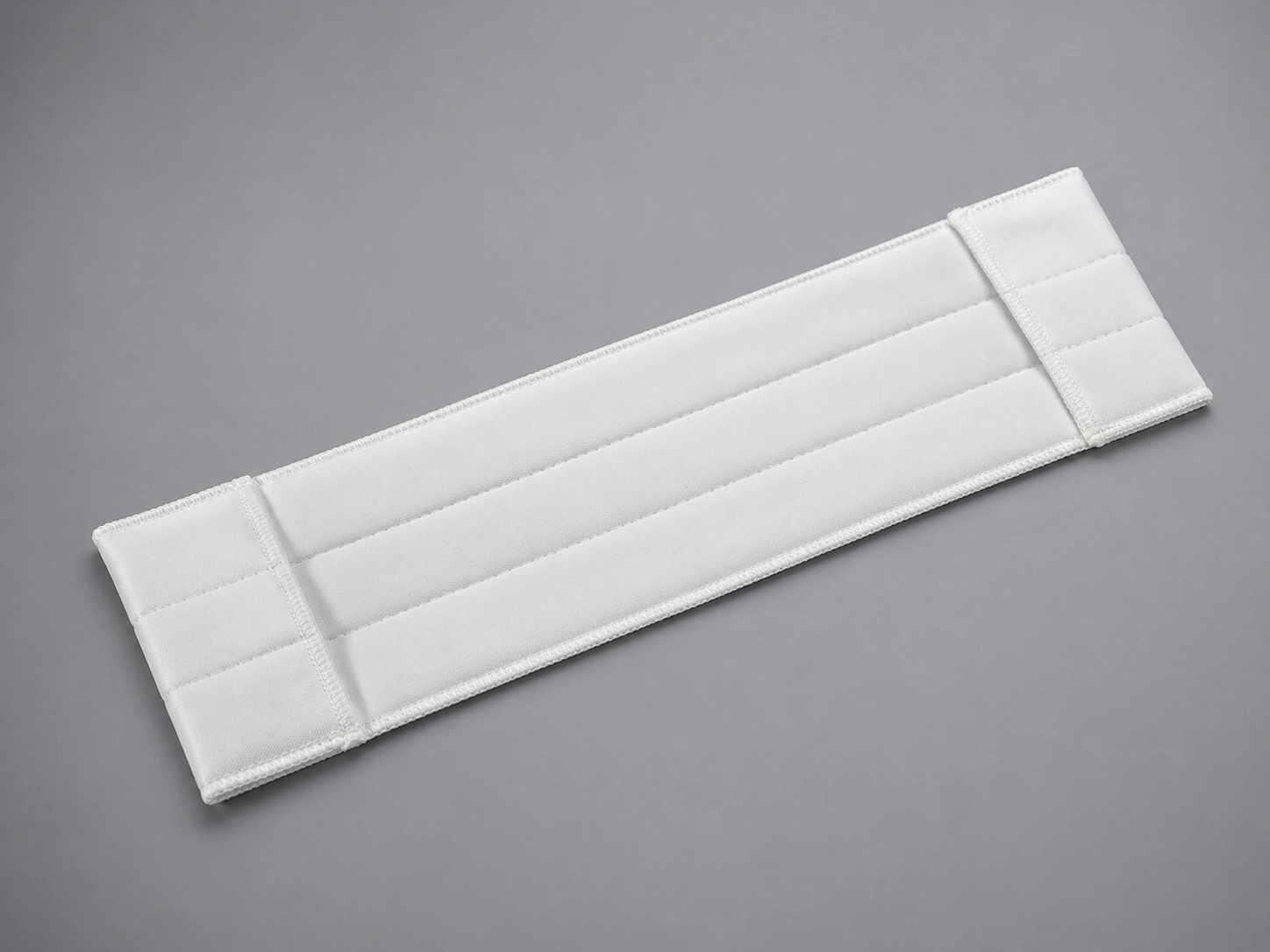
The three most common attachment types are pocket (the frame slides into a sewn pocket on the mop cover), Velcro (hook-and-loop fastening), and clip (mechanical clips secure the cover to the frame). Each type has different compatibility, ease-of-use, and pressure distribution characteristics that should be evaluated against the facility’s cleaning protocol.
No single attachment type is best for all GMP cleanrooms. Pocket attachments provide even pressure distribution and secure fit. Velcro attachments offer quick change between zones. Clip attachments may be preferred where frequent mop cover changes are required. The choice should be based on the facility’s cleaning SOP, operator workflow, and zone requirements.
Yes. Many facilities use different attachment types for different cleanroom zones or cleaning tasks. However, frames must be compatible with the selected attachment type. Mixing attachment types should be documented in the cleaning SOP and operators should be trained on each type used.
Attachment type can affect pressure distribution, mop cover security during use, and operator change time. Pocket attachments typically provide the most even pressure distribution. Velcro may allow faster changes but should be evaluated for particle generation from the hook-and-loop mechanism over repeated use.
MIDPOSI offers cleanroom mop covers with different attachment options for evaluation. Providing your current frame type and attachment preference helps MIDPOSI recommend compatible mop cover options for your facility’s review.