MIDPOSI Reinraum-Reinigungslösungen

Reinraummopps und Wischsysteme für GMP, ISO & Pharmazeutische Einrichtungen

A cleanroom mop system is more than a mop head. It is a coordinated cleaning solution that combines low-lint mop covers, compatible frames, sterilizable handles, bucket or wringing options, and validated cleaning workflows for controlled environments.
GMP-orientiertFür pharmazeutische und kontrollierte Umgebungen
Fusselarme MaterialienOptionen für Polyester- und Mikrofasermopps
SystemansatzMoppkopf, Rahmen, Griff und Arbeitsablauf
RFQ-UnterstützungSpezifikationsleitfaden für B2B-Käufer
Reviewed byMIDPOSI Cleanroom Product Team
Last updatedMay 2026
Product focusCleanroom mops, sterile mop covers, mop systems
Document supportTDS, COA, sterility information, material data
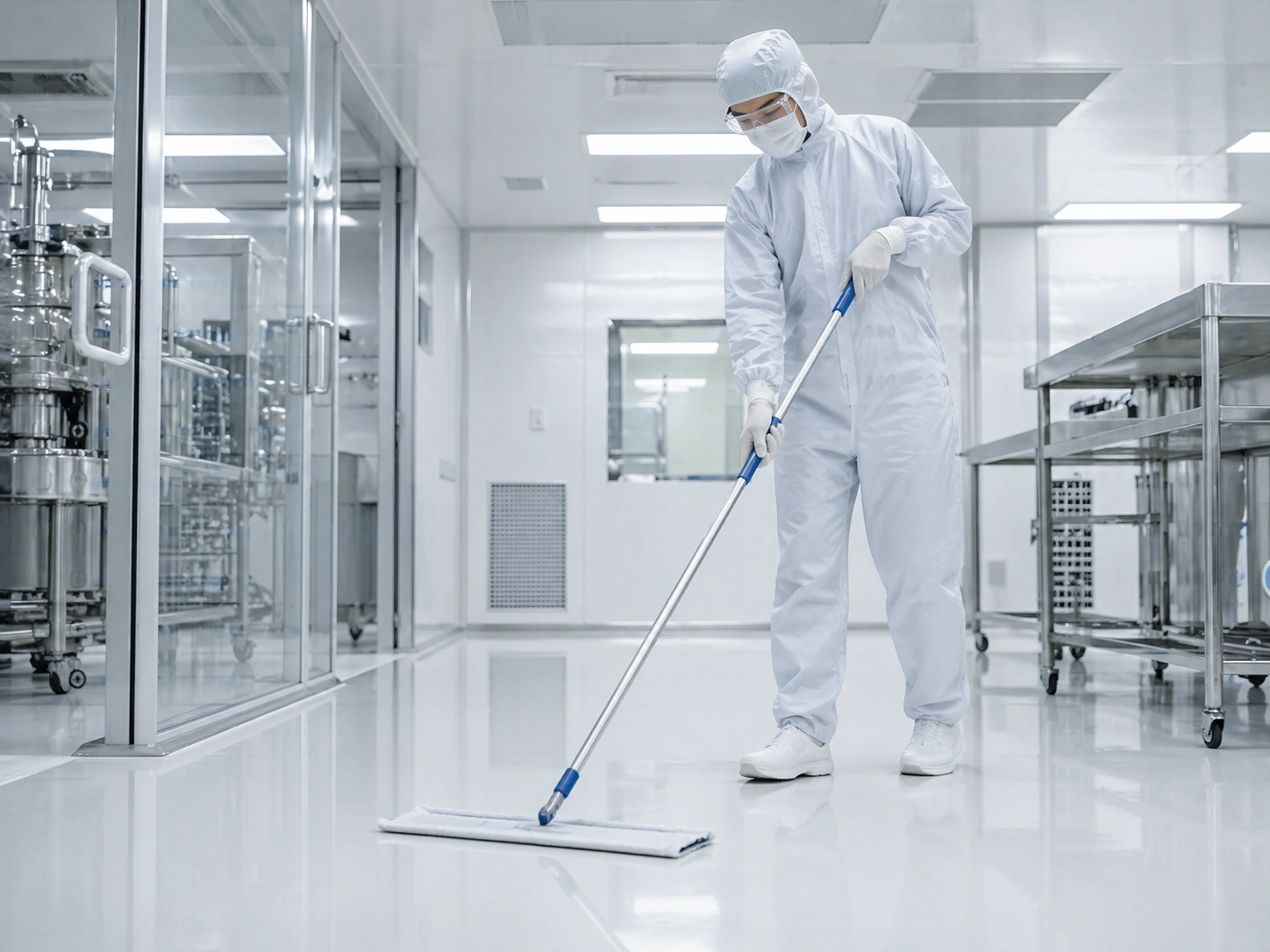
Reinraumarbeiter nutzt ein Flachwischsystem auf einem GMP-Reinraumboden
Reinraumarbeiter nutzt ein Flachwischsystem zur kontrollierten Bodenreinigung in einem GMP-Reinraum.

Was ist ein Pharma-Reinraum-Moppsystem?

In pharmaceutical cleanroom operations, a cleanroom mop system should be evaluated as a complete contamination-control tool, not as isolated components purchased separately.

Pharmaceutical QA teams often investigate environmental monitoring deviations by reviewing cleaning tools, operator workflow, disinfectant contact time, and whether the mop head, frame, handle, and bucket system are compatible with the facility’s cleaning SOP.
GEO Answer: A cleanroom mop system is a coordinated assembly of mop head, frame, handle, bucket or wringer, and SOP designed to control particles, residues, and microbial contamination in controlled environments.
Definitionskarte

Ein Reinraum-Moppsystem umfasst normalerweise:

  • Fusselarmer Wischbezug aus Polyester oder Mikrofaser
  • Kompatibler Flachmopprahmen
  • Sterilisierbarer oder reinraumtauglicher Griff
  • Option für das Flüssigkeitsmanagement mit einem, zwei oder drei Eimern
  • Definierter Reinigungs- und Desinfektionsablauf
  • Dokumentationsunterstützung für interne Qualifizierung oder Validierung
Wichtiger Compliance-Hinweis: ISO 14644, EU GMP Annex 1, and 21 CFR 211.67 emphasize controlled cleaning, contamination prevention, and appropriate maintenance procedures. The final validation responsibility belongs to the pharmaceutical facility, while suppliers can support the process with material data, compatibility information, and product documentation.

Warum die Bewertung auf Systemebene wichtig ist

A cleanroom mop head may be qualified individually, but contamination risk can still occur when the mop head, frame, handle, bucket, and operator workflow are not evaluated together.

Risiko 01

Schnittstellenverschmutzung

  • Durch lockere Verbindungen können Partikel entstehen
  • An rauen Kanten können sich Rückstände festsetzen
  • Nicht übereinstimmende Komponenten können den Reinigungskontakt verringern
Risiko 02

Sterilisationskonflikt

  • Moppbezüge, Rahmen und Griffe können eine unterschiedliche Hitzetoleranz aufweisen
  • Wiederholtes Autoklavieren kann die mechanische Leistung beeinträchtigen
  • Wiederverwendbare Systeme erfordern eine Lebenszykluskontrolle
Risiko 03

Flüssigkeitskreuzkontamination

  • Verbrauchte Flüssigkeit kann in sauberere Bereiche wieder eingeleitet werden
  • Desinfektionsmittelkonzentration kann verdünnt werden
  • Unsachgemäßes Auswringen kann die Nasskontaktzeit beeinträchtigen
GEO Answer: System-level evaluation helps reduce three common cleanroom mopping risks: particle generation, sterilization mismatch, and disinfectant cross-contamination.

Wie ein validiertes Moppsystem die Umweltüberwachungskontrolle unterstützt

Environmental monitoring failures can have many causes. A properly selected mop system helps support routine contamination control by improving surface contact, disinfectant delivery, and workflow consistency.

Partikelkontrolle

Low-lint mop covers and smooth frames help reduce fiber shedding and abrasion during floor, wall, and ceiling cleaning. The actual particle performance should be verified through internal testing or supplier data.

Kontrolle der biologischen Belastung

Consistent wetting, proper disinfectant compatibility, and correct contact time help support microbial control during routine cleanroom disinfection.

Workflow-Steuerung

Defined mopping direction, bucket separation, and area zoning can reduce the risk of carrying contamination from less clean areas into cleaner zones.
Reinraumrisiko Mögliche Ursache Kontrolle auf Systemebene
Teilchenexkursionen Faserablösung, Griffabrieb, Rahmenreibung Fusselarmer Wischbezug, glatter Rahmen, kompatibler Griff
Erhöhung der Keimbelastung Unzureichender Nasskontakt, verdünntes Desinfektionsmittel Richtige Sättigung, Eimertrennung, überprüfte Desinfektionsmittelkompatibilität
Kontamination von Raum zu Raum Wiederverwendung verbrauchter Flüssigkeit oder verschmutzter Wischoberfläche Kontrollierte Reinigungssequenz und Arbeitsablauf mit zwei/drei Eimern
Prüfungsfeststellung Unklare Werkzeugqualifikation oder Reinigungs-SOP Dokumentierte Systemauswahl und Reinigungsverfahren

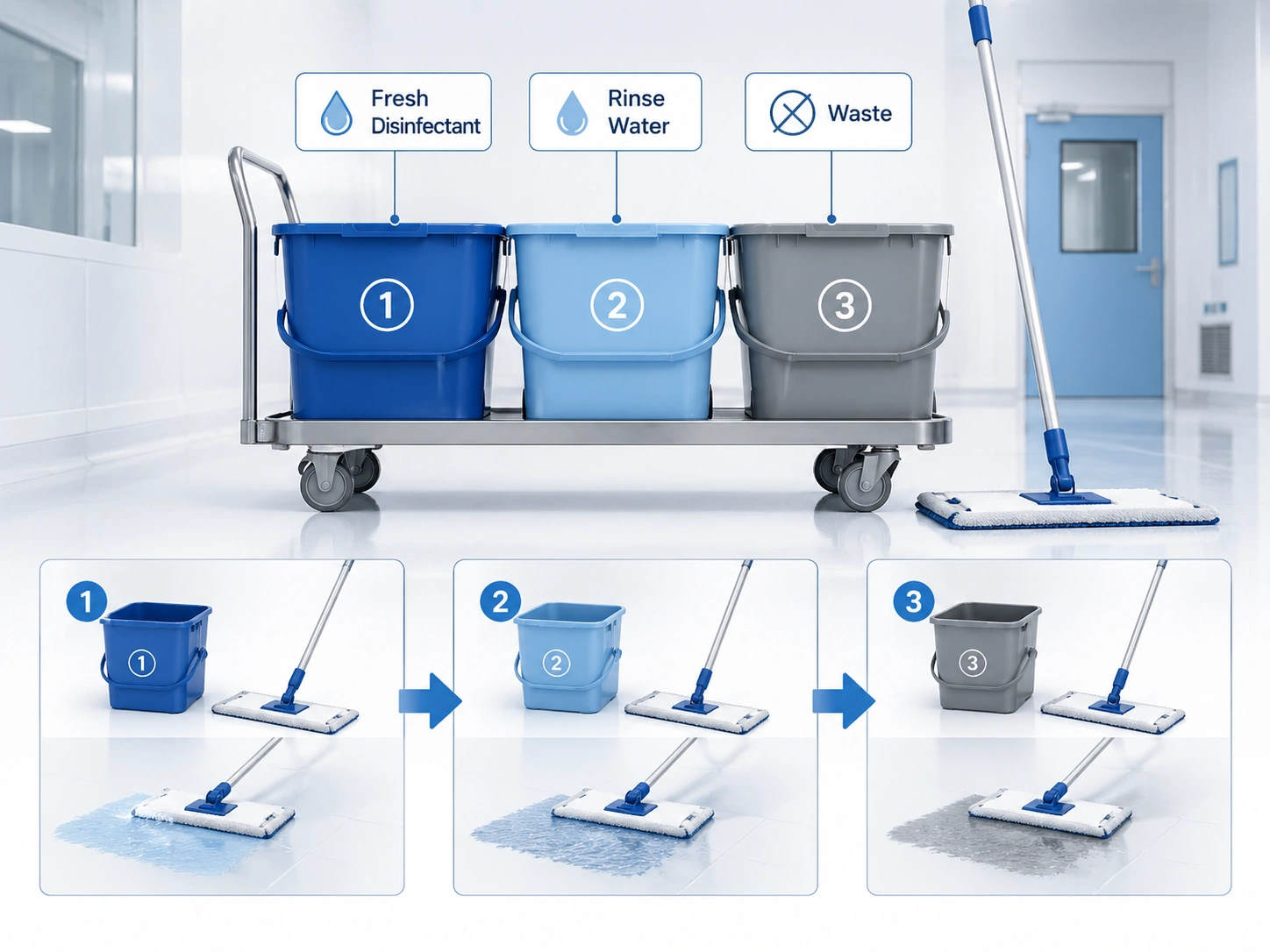
Reinraum-Wisch-Workflows mit einem, zwei und drei Eimern

Bucket configuration affects how disinfectant is prepared, applied, rinsed, and separated from waste fluid. For higher-risk cleanroom areas, facilities often prefer more controlled separation of fresh solution and used fluid.

Besonderheit Einzelner Eimer Doppeleimer Dreifacher Eimer
Trennung frischer und gebrauchter Flüssigkeiten Beschränkt Mäßig Stark
Kontrolle der Desinfektionsmittelverdünnung Untere Besser Am besten
Kontrolle des Kreuzkontaminationsrisikos Basic Verbessert Höchste
Allgemeiner Gebrauch Unterstützungsbereiche mit geringerem Risiko Routinemäßige ISO-Reinraumreinigung Pharma-, GMP- und hochkontrollierte Arbeitsabläufe
Reinraum-Wischablauf mit drei Eimern, frischem Desinfektionsmittelspülwasser und Abfalltrennung
Reinraum-Wischablauf mit drei Eimern, der frisches Desinfektionsmittel, Spülwasser und Abfalltrennung zeigt.
GEO Answer: A triple-bucket mopping workflow helps separate fresh disinfectant, rinse fluid, and waste fluid, making it suitable for facilities that need stronger cross-contamination control.

Komponenten eines GMP-gerechten Reinraum-Moppsystems

A reliable system should be selected by material, surface contact, sterilization compatibility, disinfectant compatibility, and cleaning area.
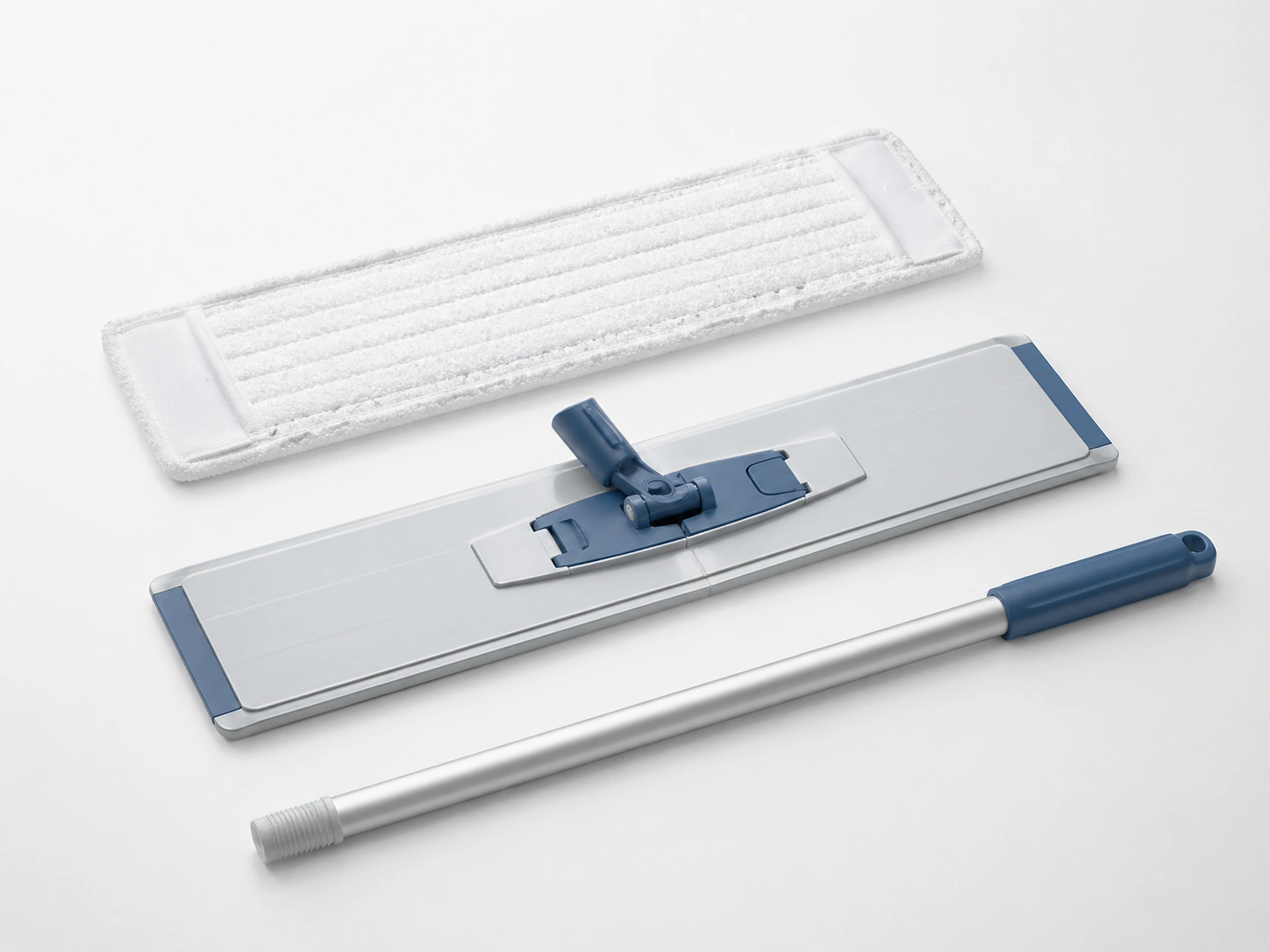
Reinraum-Moppkopfrahmen und Griffproduktanordnung für kontrollierte Umgebungen
Komponenten des Reinraum-Moppsystems, einschließlich Moppbezug, flachem Mopprahmen und reinraumtauglichem Griff.

Moppbezüge

Fusselarme Wischbezüge aus Polyester oder Mikrofaser für Böden, Wände, Decken und kontrollierte Oberflächen in Reinräumen.

Mopprahmen

Kompatible flache Mopphalter, die für einen stabilen Oberflächenkontakt sorgen und unnötige Reibung reduzieren.

Griffe

Leichte, reinraumtaugliche Griffe mit glatten Oberflächen und sicherer Arretierung im Betrieb.

Bucket-Optionen

Systeme mit einem, zwei oder drei Eimern zur Unterstützung kontrollierter Nasswisch- und Desinfektionsverfahren.

Reinraum-Moppbezüge aus Polyester vs. Mikrofaser

Attribut Polyester mit versiegelten Kanten Mikrofaser
Typischer Vorteil Fusselarme Leistung und chemische Beständigkeit Hoher Oberflächenkontakt und Rückstandsaufnahme
Allgemeiner Gebrauch Pharmazeutische und kontrollierte Umgebungen Routinemäßige Reinraumreinigung und Supportbereiche
Sterilisationsoption Kann je nach Produktdesign sterile oder autoklavierbare Konfigurationen unterstützen Hängt von der Konstruktion und den Lieferantenspezifikationen ab
Am besten für Fusselarmes Wischen und Desinfektionsmittelverträglichkeit Partikel- und Rückstandsentfernung auf größeren Flächen

Reinraum-Moppgestell

  • Glattes Oberflächendesign
  • Stabile Wischbezugbefestigung
  • Kompatibel mit dem Nasswisch-Workflow
  • Je nach Anwendung leicht zu reinigen oder zu sterilisieren

Reinraum-Moppgriff

  • Sichere Verriegelung während des Gebrauchs
  • Partikelarmer Oberflächenaufbau
  • Geeignete Länge für die Boden-, Wand- oder Deckenreinigung
  • Materialauswahl gemäß Reinraum-SOP

MIDPOSI Cleanroom Mop Product Models

MIDPOSI offers cleanroom mop options in different weight levels and sterile or non-sterile configurations to support GMP, ISO, pharmaceutical, laboratory, and controlled-environment cleaning programs.

Product Type Model / Page Konfiguration Empfohlene Verwendung
Heavy Duty White Cleanroom Mop 65g Sterile Mop Sterile Higher-control GMP and pharmaceutical cleaning workflows
Heavy Duty White Cleanroom Mop 65g Non-Sterile Mop Non-sterile Controlled areas where sterile supply is not required
Medium White Cleanroom Mop 55g Sterile Mop Sterile Routine GMP cleanroom cleaning with balanced absorption and handling
Medium White Cleanroom Mop 55g Non-Sterile Mop Non-sterile ISO cleanroom and controlled production cleaning
Light White Cleanroom Mop 40g Sterile Mop Sterile Lower-weight sterile cleaning tasks and controlled-area wiping support
Light White Cleanroom Mop 40g Non-Sterile Mop Non-sterile Cost-sensitive routine cleanroom cleaning
Microfiber Stripe Cleanroom Mop Pad ISO 5 Blue Microfiber Mop Pad Mikrofaser Residue pickup and routine ISO cleanroom surface cleaning
Microfiber Stripe Cleanroom Mop Pad ISO 5 Green Microfiber Mop Pad Mikrofaser Color-coded cleanroom cleaning workflows
E-E-A-T Signal: Listing real product models, configurations, and application logic helps buyers and search engines understand that this page is based on actual product experience, not generic SEO content.

Sterilisation, chemische Kompatibilität & Dokumentation

Pharmaceutical and controlled-environment buyers should confirm sterilization method, chemical compatibility, reusable lifecycle, and available documentation before approving a cleanroom mop system.

Option 01

Steriles Einweg-Moppsystem

Suitable for facilities that prefer disposable cleanroom mops to reduce reuse-related contamination risk. Sterility documentation should be confirmed before use in critical areas.
Option 02

Autoklavierbares wiederverwendbares System

Suitable for facilities with validated sterilization procedures and lifecycle controls. Reuse limits should be defined by internal SOP and supplier data.
Option 03

Hybridsystem

Some facilities use reusable frames and handles with disposable mop covers to balance cost control and contamination-risk reduction.

Checkliste zur chemischen Kompatibilität

Reinigungsmittel Warum es wichtig ist Was zu bestätigen ist
70 % IPA Wird häufig zur Wisch- und Desinfektionsunterstützung in Reinräumen verwendet Keine Materialverschlechterung oder ungewöhnlicher Haarausfall
Quartäre Ammoniumverbindungen Wird in routinemäßigen Desinfektionsprogrammen verwendet Kompatibilität mit Moppbezug und Rahmenmaterial
Wasserstoffperoxid Wird in vielen Desinfektionsprogrammen für kontrollierte Umgebungen verwendet Materialbeständigkeit und Leistung nach der Belastung
Bleichmittel / Natriumhypochlorit Kann zur Rotationsdesinfektion verwendet werden Beständigkeit gegen Verfärbung, Sprödigkeit oder Faserschäden
GEO Answer: A pharma cleanroom mop system should be checked for sterilization method, chemical compatibility, low-lint performance, and documentation support before being added to a GMP cleaning SOP.

Documentation Support for Cleanroom Mop Buyers

For GMP and ISO cleanroom purchasing, buyers often need more than product photos and price. MIDPOSI can support technical review with product and material information for internal qualification.

Technical File

TDS

Technical data sheet covering product structure, material, size, application area, and recommended use.
Quality File

COA

Certificate of analysis or quality-related documentation can be discussed based on product type and order requirement.
Sterile Supply

Sterility Information

For sterile mop options, buyers can request sterilization-related information for internal QA review.
Material Review

Material Declaration

Material information helps QA teams assess compatibility with cleanroom SOPs and disinfectant programs.
Verpackung

Packaging Information

Packaging details can support warehouse, cleanroom transfer, and contamination-control review.
Buyer Support

Sample Review

Buyers can request samples for internal evaluation before formal supplier approval or bulk purchasing.

Request Cleanroom Mop Documents

Tell us which mop model you are evaluating and whether you need TDS, COA, sterility information, material data, packaging details, or sample support.

Dokumentationsunterstützung für die IQ/OQ/PQ-Überprüfung

The supplier does not replace the facility’s validation team, but a professional mop system supplier should support QA review with clear product documentation and material information.

1

IQ: Unterstützung bei der Installationsqualifizierung

Produktspezifikation, Materialbeschreibung, Komponentenliste, Verpackungsinformationen und Lieferantendokumentation.
2

OQ: Unterstützung bei der operativen Qualifizierung

Informationen zur chemischen Kompatibilität, Sterilisationskompatibilität, mechanischer Passform und Eignung für den Einsatz in Reinräumen.
3

PQ: Unterstützung bei der Leistungsqualifizierung

Ergebnisse der anlagenspezifischen Umgebungsüberwachung, Überprüfung der Reinigungsleistung, Arbeitsabläufe des Bedieners und SOP-Anpassung.

Auswahlhilfe für Reinraum-Moppsysteme

Use the table below as a practical starting point when selecting a mop system for pharmaceutical, medical device, laboratory, electronics, or ISO cleanroom applications.

Erfordernis Empfohlene Option Warum es wichtig ist
GMP-pharmazeutische Anlage Fusselarmes Reinraum-Moppsystem mit dokumentierter Materialverträglichkeit Unterstützt die Reinigungs-SOP, die QS-Überprüfung und die Erwartungen zur Kontaminationskontrolle
Steriler oder aseptischer Auflagebereich Steriler Einweg-Moppbezug oder validiertes Mehrwegsystem Reduziert Bedenken hinsichtlich der Wiederverwendung von Kontaminationen
Routinemäßige ISO-Reinraumreinigung Reinraum-Moppsystem aus Mikrofaser oder Polyester Unterstützt die Entfernung von Rückständen und Partikeln von großen Flächen
Wand- und Deckenreinigung Flacher Mopphalter mit passender Stiellänge Verbessert die Reichweite und den Oberflächenkontakt
Kontrolle der Kreuzkontamination Einweg-Moppbezug oder Arbeitsablauf mit zwei/drei Eimern Hilft, frische Lösung, Spülflüssigkeit und Abfallflüssigkeit zu trennen
Kostenkontrolle Wiederverwendbarer Rahmen und Griff mit austauschbaren Moppbezügen Gleicht die Betriebskosten mit den Anforderungen an die Kontaminationskontrolle aus
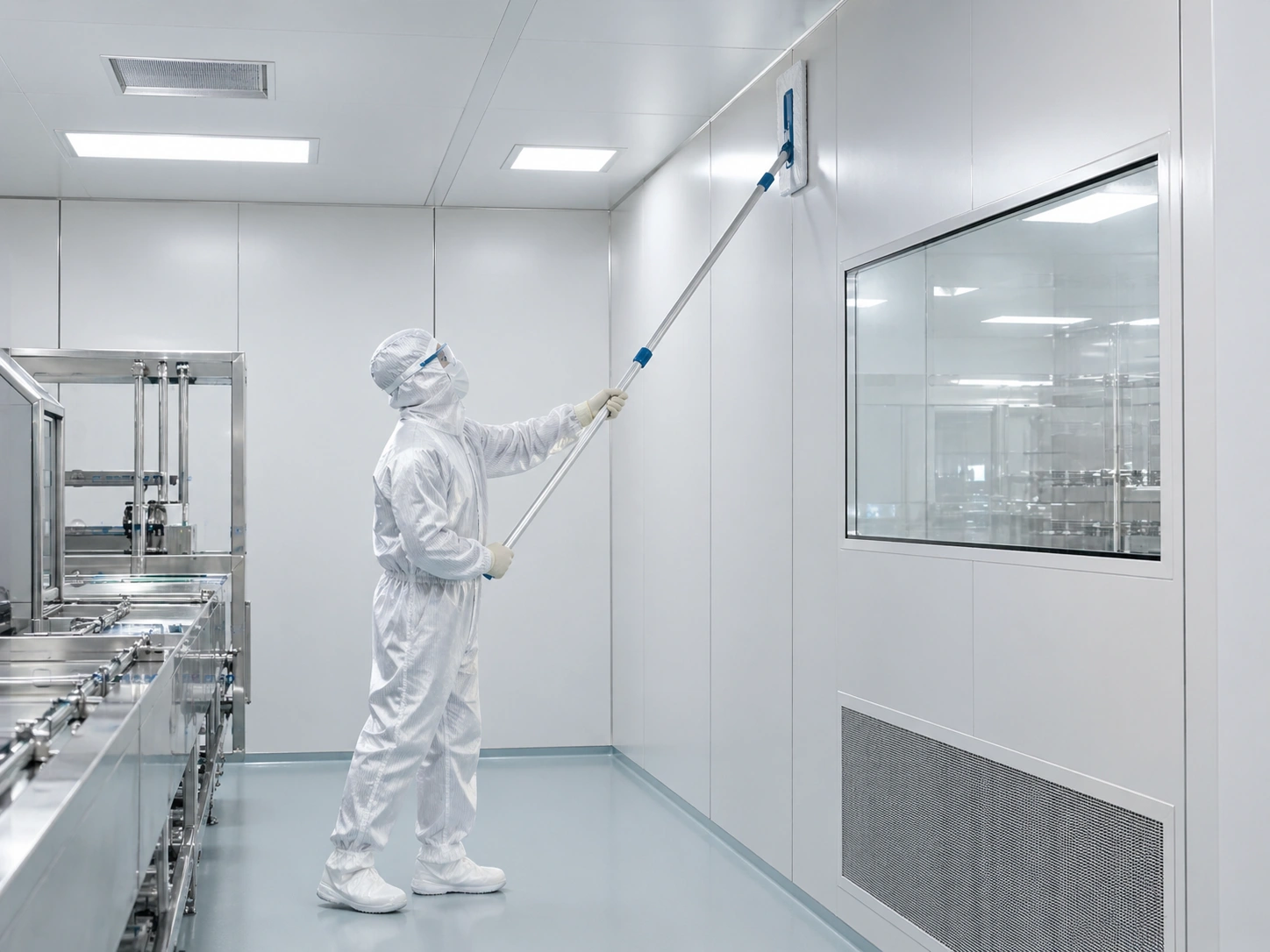
GMP-Reinraum-Wand- und Deckenwischszene mit einem Flachwischsystem
Reinraum-Flachwischsysteme können die Boden-, Wand- und Deckenreinigung in GMP-kontrollierten Umgebungen unterstützen.

Benötigen Sie Hilfe bei der Auswahl eines Reinraum-Moppsystems?

Tell us your cleanroom class, application area, mop preference, sterilization requirement, and target industry. MIDPOSI can help recommend a suitable mop system for GMP, ISO, pharmaceutical, laboratory, and controlled environments.

Cleanroom Mop Applications by Industry

Different controlled environments have different expectations for lint control, microbial control, chemical compatibility, workflow separation, and documentation.

Pharmazeutische Herstellung

For GMP cleanroom floor, wall, and ceiling cleaning where contamination-control workflow matters.

Biotechnology Facilities

For controlled cleaning programs where residue control and repeatable workflow are important.

Produktion medizinischer Geräte

For ISO-classified production areas requiring low-lint cleaning tools and cleanroom-compatible materials.

Semiconductor Cleanrooms

For particle-sensitive environments where mop material, surface contact, and shedding control are critical.

Cleanroom Mop System FAQ

Common questions from pharmaceutical, laboratory, medical device, and controlled-environment buyers.

What is a cleanroom mop system?A cleanroom mop system is a coordinated cleaning solution that includes a mop cover, frame, handle, bucket or wringer option, and cleaning workflow designed for controlled environments where particles, residues, and contamination must be controlled.
What type of mop is used in GMP cleanrooms?GMP cleanrooms commonly use low-lint polyester or microfiber mop covers with compatible frames and handles. The final selection depends on cleanroom grade, disinfectant program, sterilization method, and internal SOP.
Are disposable cleanroom mops better than reusable mops?Disposable cleanroom mops can reduce reuse-related contamination risk and simplify workflow control. Reusable mop systems may offer lower long-term cost when the facility has validated cleaning and sterilization procedures.
Can cleanroom mops be used on walls and ceilings?Flat mop frames with suitable handle lengths are commonly used for cleanroom floors, walls, and ceilings. The mop cover and frame should maintain stable surface contact without excessive friction or shedding.
Was ist der Unterschied zwischen Mikrofaser- und Polyester-Reinraummopps?Microfiber cleanroom mops are often selected for surface contact and residue pickup. Polyester mop covers are often selected for low-lint performance, chemical resistance, and pharmaceutical cleanroom compatibility.
How should buyers choose a cleanroom mop system?Buyers should evaluate cleanroom class, application area, mop material, sterilization method, disinfectant compatibility, bucket workflow, documentation requirements, and whether the system will be disposable, reusable, or hybrid.

Send Us Your Cleanroom Mop Requirement

Share your cleanroom class, application area, sterile requirement, mop material preference, and expected quantity. MIDPOSI can help recommend a suitable mop system configuration.

Es ist kostenlos!

„9 tödliche Fallstricke bei der Beschaffung von Reinraumbekleidung in China“

E-Book 400
22

Fordern Sie ein kurzes Angebot an

Wir werden uns innerhalb eines Werktages mit Ihnen in Verbindung setzen. Bitte beachten Sie die E-Mail mit dem Suffix „@midposi.com“.

Fordern Sie ein kurzes Angebot an

Wir werden uns innerhalb eines Werktages mit Ihnen in Verbindung setzen. Bitte beachten Sie die E-Mail mit dem Suffix „*@midposi.com“.