再利用可能なクリーンルームモップの在庫を管理する施設管理者、清掃検証専門家、QA リーダー向けの実用的なフレームワーク。洗浄プロトコル、オートクレーブパラメータの最適化、化学的適合性、構造化された検査規律、保管のベストプラクティス、モップヘッドが耐用年数に達したことを示す兆候について説明します。
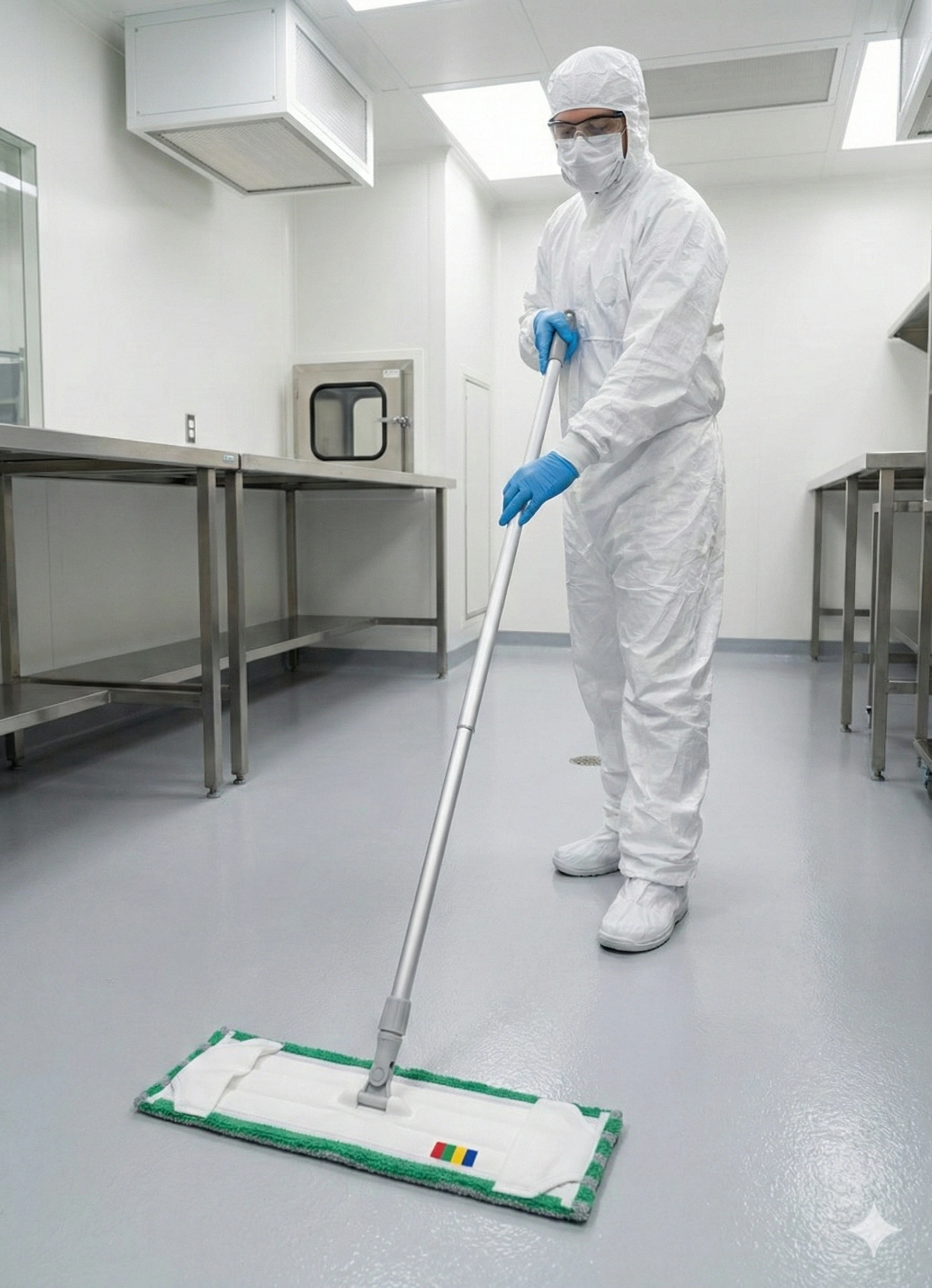
クリーンルームモップの寿命は単一の数字ではありません。これは、洗浄プロトコル、オートクレーブへの曝露、化学的適合性、および検査規律という 4 つの相互作用要因の結果です。再利用可能なクリーンルームモップは、正しく洗浄され、検証されたパラメータ内でオートクレーブ処理され、互換性のある洗浄化学物質にさらされ、使用のたびに検査されているため、管理されていないメンテナンスにさらされているモップよりも大幅に長く使用し続けることができます。具体的なサイクル数は、材料の種類、施設プロトコル、使用強度によって異なりますが、次の概要は実用的な開始フレームワークを示しています。
| 要素 | 寿命への影響 | グッドプラクティス | 警告標識 |
|---|---|---|---|
| 洗浄プロトコル | 過度の温度、強力な洗剤、機械的ストレスにより、繊維の疲労、ステッチの弱体化、寸法の歪みが促進されます。 | 非イオン性洗剤を使用し、メーカー推奨の温度で洗濯してください。柔軟剤は避けてください。穏やかな抽出サイクルまたは低抽出サイクルを使用する | モップ生地は洗濯後にザラザラしたり硬くなったりします。寸法収縮率が3を超える–元の仕様から 5% |
| オートクレーブへの曝露 | 121℃で繰り返し蒸気滅菌°Cまたは134°C は、ポリエステル繊維、エッジシール、キルティングステッチの完全性に累積的な熱応力を引き起こします。 | モップ材のオートクレーブサイクルを検証します。メーカーが指定した最大サイクルに制限します。オートクレーブでの過度の乾燥を避ける | キルティングラインが分離し始めます。エッジシールに層間剥離が見られます。複数回のサイクル後にモップが薄くなったり、構造が弱くなったりするように感じる |
| 化学的適合性 | 酸化消毒剤 (過酸化水素、過酢酸、次亜塩素酸ナトリウム) は、十分にすすがなかった場合、繰り返し暴露されるとポリエステルやポリアミド繊維を劣化させる可能性があります。 | 化学物質と接触した後は十分に洗い流してください。モップ供給業者のデータとの化学的適合性を検証する。明示的に承認されていない限り、塩素系消毒剤を避ける | 生地の変色。接触点での引張強度の損失。洗濯後も化学臭が残る |
| 検査規律 | モップを交換するたびに検査する施設は、劣化の兆候を早期に検出し、汚染のリスクが生じる前にモップを廃棄することができます。 | 各モップのサイクル数を文書化します。目視検査チェックリストを実装する。検査責任を指定された役割に割り当てる | モップヘッドが検査なしで既知のサイクル限界を超えて使用されている。モップバッチごとの文書化された検査記録がない |
免責事項: 上記は一般的な業界慣行を要約したものであり、普遍的な規制要件ではありません。実際のモップの寿命は施設によって異なり、4 つの要素すべてに加えて、清掃頻度、表面状態、オペレーターの技術の相互作用によって決まります。施設は独自のライフサイクル検証を実施し、モップの廃棄基準を清掃 SOP に文書化する必要があります。
モップの使用期間を理解するには、モップを理解することから始まります。 クリーンルームモップシステムの概要 そして、調達時の材料の選択がメンテナンスの上限をどのように定義するか。の GMPクリーンルームモップグレード選択ガイド 使用するグレードゾーンによってどのメンテナンスプロトコルが適用されるかが決まるため、グレード D のモップはグレード A/B モップと同じ基準に維持されていないため、これも関連します。
洗浄は、再利用可能なクリーンルーム モップのライフサイクルの中で最も頻繁に行われるメンテナンス イベントです。洗浄サイクルごとに、モップヘッドは機械的撹拌、熱ストレス、化学物質への曝露にさらされます。洗浄パラメーターの最適化は、施設がモップの耐用年数を延ばすために実行できる最も効果的なアクションです。
適切な洗濯温度は、一般的な洗濯慣例ではなく、モップの素材によって決まります。ポリエステルニットモップは通常40℃で洗濯します。–60°C. 70℃を超える温度°C は、特に熱応力が集中するエッジやキルティングの縫い目で、ポリエステルの繊維疲労を促進します。マイクロファイバー (ポリエステル/ポリアミドブレンド) モップには追加の注意が必要です。ポリアミド成分は純粋なポリエステルよりも熱に敏感であり、洗濯温度は 60 ℃を超えます。°C は、マイクロファイバーに洗浄効果を与える分割繊維構造の進行性の損失を引き起こす可能性があります。
材料の違いは構造的なものです。詳細な マイクロファイバーとポリエステルのクリーンルームモップの比較 は調達への影響について説明していますが、メンテナンスの観点から重要なのは、ポリエステルはマイクロファイバーよりも広い温度範囲に耐えることができ、両方の素材を使用する施設では 2 つの異なる洗浄プロトコルが必要であるということです。
| 洗剤の種類 | おすすめ | 理論的根拠 |
|---|---|---|
| 非イオン性洗剤 | 好ましい | イオン残留物を残さずに効果的に汚れを除去します。クリーンルームファブリックとの相互作用を最小限に抑えます。 GMP洗濯プロトコルで広く使用されています |
| 中性pH (6–8) | 許容できる | 繊維劣化のリスクが低い。洗浄効果が施設の検証要件を満たしていることを確認する |
| アルカリ性洗剤(pH >9) | 慎重に使用してください | サイクルを繰り返すとポリエステルの加水分解が促進される可能性があります。ステッチの完全性が弱まる可能性があります。徹底的なすすぎを伴う時々の強力な洗浄サイクルに制限する |
| 柔軟剤 | 使用しないでください | モップ生地に残留物が残り、消毒効果を妨げる可能性があります。残留物はクリーンルームに粒子を放出する可能性があります。クリーンルームの清掃ツールのメンテナンスとは互換性がありません |
| 塩素系漂白剤 | 明示的に検証されない限り使用しないでください | ポリエステル繊維の酸化劣化。モップの寿命が大幅に短くなります。クリーンルームの消毒剤と予期せぬ相互作用を起こす化学残留物を生成する可能性があります |
洗濯機の機械的動作 (ドラム速度、抽出 G 力、サイクル時間) は、累積的な繊維疲労の原因となります。推奨事項:
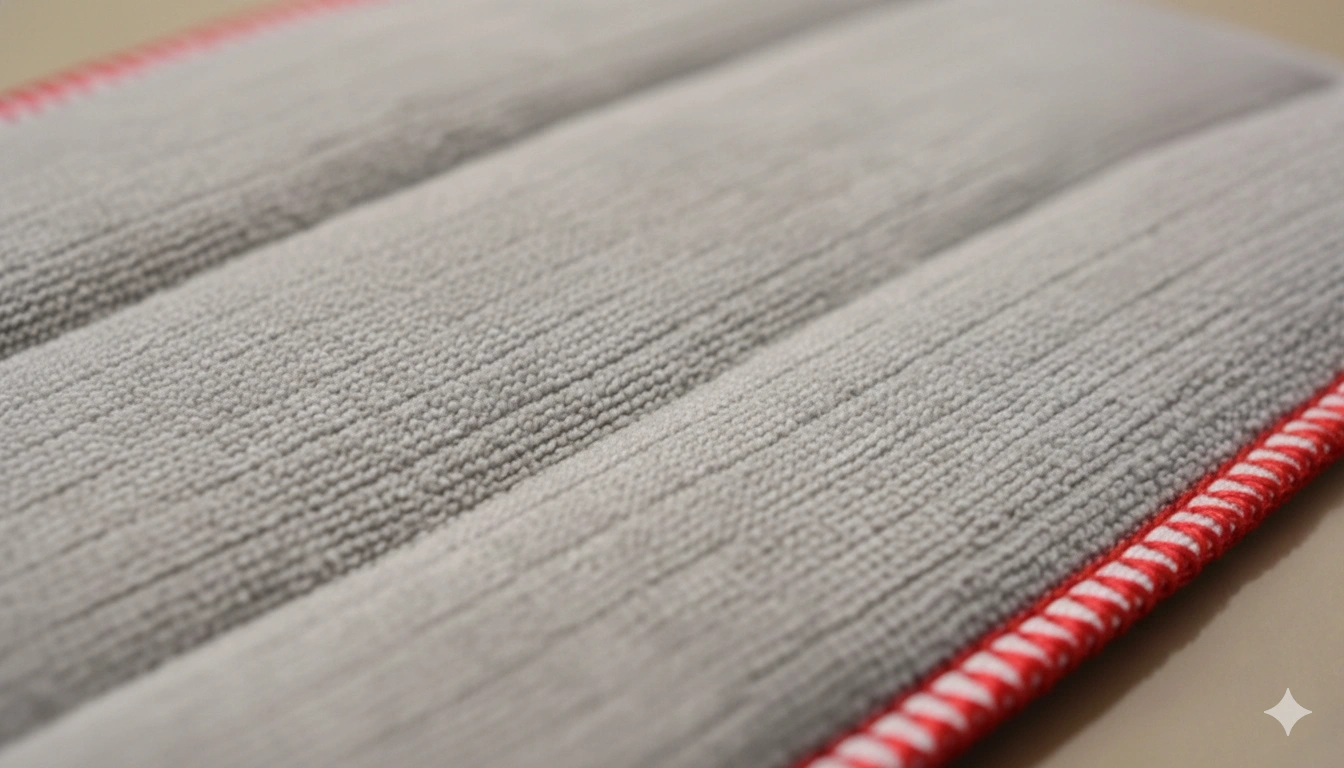
低温(60度以下)でのタンブル乾燥°C) は標準的な洗浄後の乾燥方法です。高温乾燥(70℃以上)°C) は、洗濯後に 2 番目の熱ストレス イベントを追加し、ポリエステル繊維の累積的な劣化を加速する可能性があります。制御された粒子制御環境での空気乾燥は、熱への曝露を最小限に抑えたい施設の代替手段ですが、乾燥環境はモップが入るクリーンルームと同じ清浄度基準を満たしている必要があります。
使用ごとに滅菌が必要な再利用可能なクリーンルーム モップを使用する施設にとって、オートクレーブへの曝露はモップのライフサイクルの中で最も激しいストレス イベントです。オートクレーブのパラメータがモップの材質とどのように相互作用するかを理解することは、モップが劣化する時期を予測し、劣化が汚染リスクになる前に廃棄の閾値を設定するために不可欠です。
蒸気滅菌では、モップ材を高温、湿気、圧力の組み合わせにさらします (通常 121)°C、15 psi (重力サイクル) または 134°30 psi で C (真空前サイクル)。ポリエステル、再利用可能な素材の主流 オートクレーブ可能なクリーンルームモップ ヘッド、ガラス転移温度は約 70–80°℃、融点約250–260°これは、オートクレーブの温度はポリエステルを融解させませんが、ポリマーを熱限界に十分近づけて、各サイクルで累積的な微細構造変化が発生することを意味します。
劣化メカニズムは進行性であり、測定可能です。
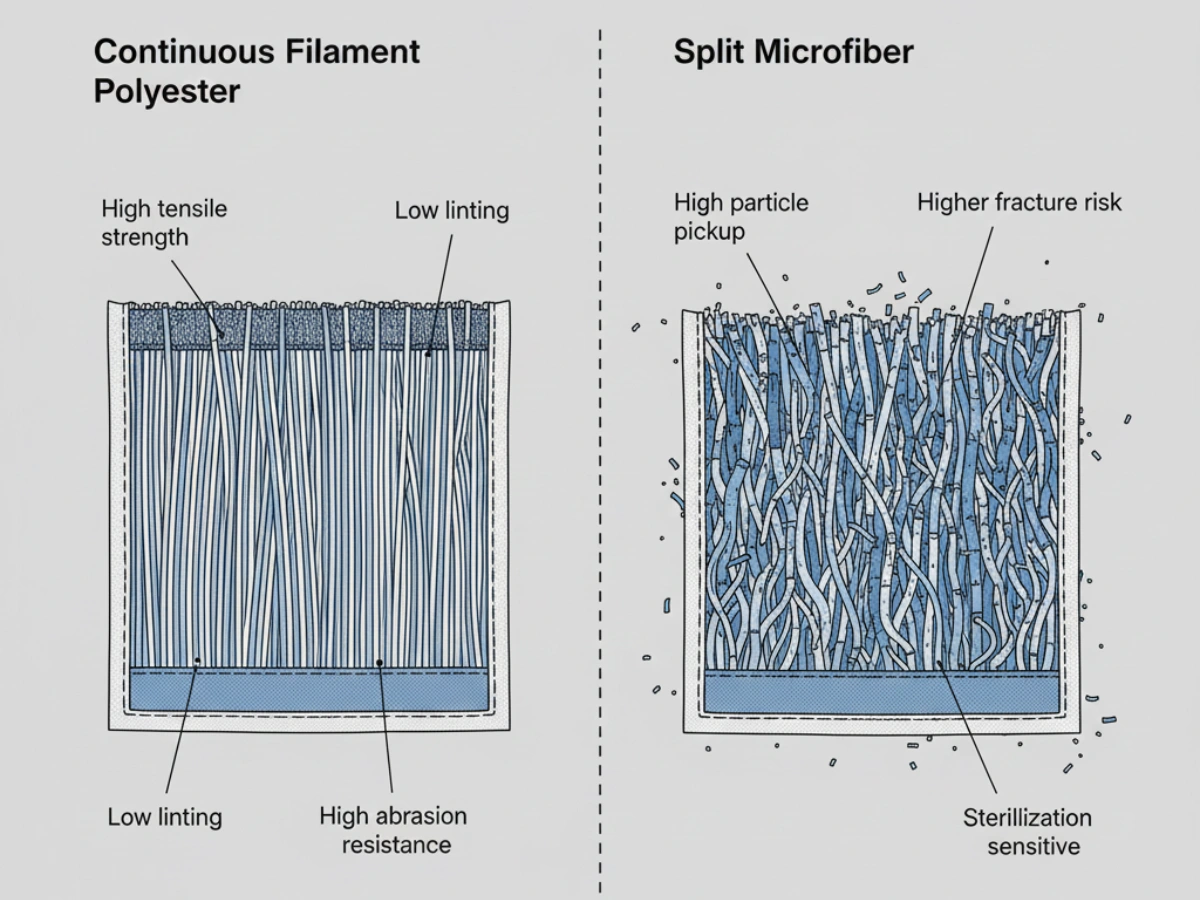
これらは業界で観察されている基準範囲であり、メーカーが保証する制限ではありません。実際の劣化の始まりは、オートクレーブのモデル、サイクルパラメータ、モップの構造品質、およびサイクル間でモップが洗浄や化学薬品にさらされるかどうかによって異なります。施設は一般的な数値を採用するのではなく、独自のサイクル制限を検証する必要があります。
| 材質の種類 | 劣化が始まる可能性のあるサイクル範囲 | 最初に監視すべき兆候 | 退職に関する実際的なガイダンス |
|---|---|---|---|
| 連続フィラメントポリエステルニット (シールエッジ) | サイクル20–40 | エッジシールの剛性が変化します。キルティングステッチのわずかな伸び。軽度の寸法変化 (<3%) | Monitor from cycle 20; retire when any two of the following occur: (a) quilting separation visible, (b) edge seal delamination, (c) dimensional change >5% |
| Polyester knit (non-continuous filament) | Cycle 15–30 | Surface fuzzing from fiber ends; increased particle release in rinse water; quilting line stress visible | Monitor from cycle 15; retire when particle release data exceeds facility acceptance criteria or when visual inspection identifies quilting compromise |
| Microfiber (polyester/polyamide blend) | Cycle 10–20 | Loss of split-fiber texture (mop feels less “grippy”); polyamide component degradation; fiber matting visible under microscope | サイクル 10 から監視します。表面残留物試験で測定した洗浄効果が検証済みの許容基準を下回った場合は終了します。マイクロファイバーは通常、オートクレーブでの寿命がポリエステルより短い |
特定のモップ材に合わせてオートクレーブパラメータを最適化する施設では、多くの場合、上記の一般的な基準範囲を超えて耐用年数を延ばすことができます。主要な最適化ポイント:
The cleaning chemicals and disinfectants that a cleanroom mop is exposed to during use interact with the mop fabric in ways that accumulate over the mop’s service life. This is distinct from autoclave stress or washing stress — it is a chemical degradation pathway that operates every time the mop contacts a disinfectant solution during cleaning, not just during the maintenance cycle.
| Disinfectant Class | Typical Active Agents | Risk to Polyester | Risk to Microfiber (PA Component) | Mitigation |
|---|---|---|---|---|
| Oxidizing agents | Hydrogen peroxide (H2○2), peracetic acid (PAA) | Moderate: repeated exposure without adequate rinsing can cause progressive surface oxidation and loss of fiber tensile strength | 高: ポリアミドはポリエステルよりも酸化劣化を受けやすい。分割繊維構造は劣化を早める可能性があります | 使用後は徹底的にすすぎます。特定の過酸化物濃度と接触時間に関するサプライヤーの化学適合性データを確認する |
| 第四級アンモニウム化合物(Quats) | 塩化ベンザルコニウム、塩化ジデシルジメチルアンモニウム | 低: 一般的にポリエステルと互換性があります。主なリスクは繊維の劣化ではなく残留物の蓄積です | 低~中程度: 第四級残留物がマイクロファイバー表面に結合し、その後の洗浄効果が低下する可能性があります。 | 蓄積された第四級残留物を除去するための定期的な「ストリッピング」洗浄 (中性 pH 洗剤、材料制限内の高温) |
| アルコール系消毒剤 | 70% IPA、70% エタノール | Low: polyester is chemically resistant to alcohols at typical cleanroom concentrations and contact times | Low to Moderate: alcohol can extract processing oils from polyamide over repeated exposure, altering fiber surface properties | Ensure complete evaporation between use cycles; avoid prolonged soaking in alcohol solutions |
| Chlorine-based disinfectants | Sodium hypochlorite (NaOCl) | High: chlorine is an aggressive oxidizer that attacks polyester polymer chains; even dilute solutions cause cumulative degradation | Very High: polyamide is highly susceptible to chlorine degradation; chlorine exposure should be avoided except where specifically validated | Avoid unless specifically validated by the mop supplier for the specific chlorine concentration and contact time; thorough post-use neutralization and rinsing mandatory |
| Phenolic disinfectants | Ortho-phenylphenol, ortho-benzyl-para-chlorophenol | Moderate: phenolics can leave a persistent residue that is difficult to remove; residue may interact with subsequent disinfectants | Moderate: residue binding to microfiber surface; may require dedicated post-phenolic washing protocol | Dedicated washing protocol for mops used with phenolics; verify that subsequent disinfectant rotations are compatible with any phenolic residue that may remain |
化学残留物の蓄積は、最も一般的で最も予防可能な化学分解経路です。ある洗浄サイクルから次の洗浄サイクルまで消毒剤の残留物を運ぶモップは、劣化が加速される可能性があります。これは、一度の曝露によるものではなく、布地内の化学的に活性な残留物の累積的な蓄積に起因するものです。
効果的なすすぎ手順には次のものがあります。
Structured visual inspection is the frontline defense against using degraded mops in controlled environments. The inspection should be performed at every mop change-out and documented on a standardized checklist. The following framework identifies the key inspection points, what to look for, and the decision criteria for retiring a mop head.

| 検査ポイント | What to Look For | Acceptable Condition | Retirement Trigger |
|---|---|---|---|
| 1. Edge Integrity | Fraying, loose fibers, delamination of sealed edges, cut edge exposure | Edge seal intact along entire perimeter; no visible loose fibers at edges; cut edges (if present) are clean and not unraveling | Edge seal delamination >5 mm at any point; visible loose fibers at edges that cannot be trimmed without compromising edge structure; unraveling cut edges |
| 2. Quilting Stitch Integrity | Broken quilting stitches, stitch elongation, separation of fabric layers at quilting lines | All quilting stitches intact; no visible gaps between fabric layers along quilting lines; quilting pattern still holds layers together uniformly | Two or more broken quilting stitches; visible layer separation along quilting lines; quilting thread visibly thinner or weaker than original specification |
| 3. Pocket / Attachment Point | Tears at pocket opening, stretched pocket that no longer grips the mop frame securely, stitching failure at pocket seam | Pocket opening intact; mop head fits securely on frame without slipping during use; pocket seam stitching is complete and shows no elongation | Tear at any point along pocket opening; pocket has stretched such that frame insertion requires force or the mop head slips during normal mopping; broken stitches at pocket seam |
| 4. Fabric Surface Condition | Discoloration, fabric thinning, surface roughness change, fiber matting (microfiber), loss of fabric uniformity | Uniform surface appearance consistent with original condition; no thinned areas; microfiber retains visible split-fiber texture; no localized discoloration patches | Visible thinning at any location (hold mop up to light: if light passes through areas that were originally opaque, the fabric is compromised); matted microfiber surface that has lost texture; discoloration that signals chemical degradation rather than staining |
| 5. Dimensional Conformity | Shrinkage or distortion from original dimensions; asymmetry; corners that no longer align with original shape | Dimensions within 5% of original specification; shape is symmetric and consistent with original pattern; corners are square to within visual tolerance | Dimensional change >5% from original specification; asymmetric distortion that affects frame fit or cleaning coverage; corners that are visibly distorted |
| 6. Particle Release (Supplemental) | If available: particle count data from rinse water after standardized agitation; or visual particle release test (shake mop over a dark surface under controlled lighting) | Particle counts within facility-defined acceptance criteria; no visual particle shower when shaken | Particle counts exceed facility acceptance criteria; visible particle release on shake test |
Effective mop maintenance programs document inspection results. Without documentation, there is no trending data, no basis for adjusting retirement criteria, and no audit trail to demonstrate that mop lifecycle management is under control. Each mop batch should have:
This documentation serves the same purpose as other GMP documentation: it demonstrates that the facility manages its cleaning tools with the same discipline applied to other process consumables. The クリーンルームモップの検証文書とCOA page covers the documentation package that should be requested at procurement; the inspection documentation described here is the in-use complement that extends traceability through the mop’s operational life.
A facility that retires mops at the first sign of minor wear will have higher mop replacement costs. A facility that extends mop use well past visible degradation will have higher contamination risk. The optimal balance is achieved by:
How a cleanroom mop is stored between uses has a direct impact on both maintenance interval and contamination risk. A properly maintained mop stored in a non-controlled environment or stored wet can negate the benefits of the washing and autoclave protocols that preceded storage.
The single most important storage rule: mops must be completely dry before storage. A damp mop stored in a closed container or plastic bag creates conditions for microbial growth. Even if the mop was just autoclaved, residual moisture inside a sealed bag can support microbial proliferation over time. If a mop cannot be dried immediately after washing or autoclaving, store it in a breathable container in a controlled environment — not in a sealed plastic bag in an uncontrolled storage area.
The storage environment should match the cleanroom grade of the mop’s target zone. A mop that will be used in Grade B should be stored in at least a Grade C environment — not in an unclassified warehouse or janitorial closet. This is a logical extension of the staged transfer principle: a mop should not be stored in a lower-classification environment than the zone it enters, because storage is part of the pre-use material condition that the cleaning protocol assumes.
Mop heads should be hung, not stacked. Stacking compresses the mop fabric, creates contact points between mops that can transfer contamination, and prevents air circulation that supports drying. Individual hanging — on dedicated hooks, with spacing between mop heads — ensures each mop remains separate from others and dries completely. Hanging also makes visual inspection easier because the full mop surface is visible at a glance.
| コンテナの種類 | 適切な使用 | 制限事項 |
|---|---|---|
| 通気性のある布製バッグ(クリーンルームグレード) | General storage; allows air circulation while providing particulate barrier | Not a sterility barrier; must be stored in controlled environment |
| 密封されたビニール袋 | Transport between laundry and cleanroom; short-term storage of sterilized mops (validated sterility shelf life applies) | Do not store damp mops in sealed bags; moisture accumulation risk; validated shelf life must not be exceeded |
| ステンレスフックラック(オープン) | Dedicated cleanroom storage areas; best for drying and inspection visibility | Only appropriate inside the cleanroom or in a controlled staging area; provides no particulate barrier |
| Closed plastic bin | Bulk storage of pre-washed mops awaiting distribution | Confirm bin material does not shed particles; bins should be dedicated to cleanroom mop storage only, not shared with other facility items |
Even a properly stored mop has a finite shelf life in storage. Sterilized mops have a validated sterility shelf life that must not be exceeded. Non-sterile mops, while not subject to sterility expiration, should follow a first-in-first-out (FIFO) rotation to ensure that mops do not sit in storage for extended periods where they may accumulate environmental contamination. A 30-day maximum storage duration is a common starting point for non-sterile mops; facilities can extend or shorten this based on environmental monitoring data from storage areas.
Many mop maintenance problems are not caused by a single catastrophic error but by repeated small deviations from protocol that accumulate over the mop’s service life. The following are the most common patterns observed in GMP facilities, along with practical corrections.
Facilities that run polyester and microfiber mops through the same washer cycle — typically the polyester cycle, which uses higher temperatures — expose microfiber mops to temperatures that degrade the polyamide component. The microfiber mop loses its split-fiber structure and cleaning efficacy, but the facility does not detect this because the mop still looks acceptable.
修正: Establish separate wash protocols by material type. If only one washer is available, run the lower-temperature (microfiber) protocol as default and use shorter cycle times for polyester to compensate. Validate that each material type’s wash protocol achieves the required cleanliness standard.
Some facilities set a fixed autoclave cycle number (e.g., “retire at 30 cycles”) and replace all mops at that threshold. This approach ignores the fact that autoclave degradation is not uniform: mops used with harsh chemicals or washed at higher temperatures will degrade faster than mops used under gentler conditions, even at the same cycle count. Cycle-count-based retirement risks both early retirement of mops that still have remaining service life and delayed retirement of mops that have already degraded.
修正: Use cycle count as a trigger for intensified inspection, not as the retirement criterion itself. At a defined cycle count (e.g., 20 cycles), increase inspection frequency from every-use to every-cycle documentation with particle release verification. Retire based on inspection findings, not cycle count alone.
Mops that are stored before they are fully dry — whether in sealed bags, bins, or closets — provide conditions for microbial growth. The cleaning protocol then introduces a microbe-carrying mop into the cleanroom, undermining the environmental monitoring program. This problem is often invisible until an environmental monitoring excursion triggers an investigation that traces back to mop storage conditions.
修正: Implement a drying verification step before storage. This can be as simple as a visual check (no visible moisture), a touch check (fabric feels dry, not cool/damp), or a more formal moisture content verification if the facility requires it. Document the drying verification as part of the mop maintenance log.
Inspection that happens informally — an operator glances at a mop head before mounting it on the frame — is not inspection. Without documentation, there is no way to trend degradation patterns, demonstrate inspection discipline during an audit, or link a contamination event to a mop that should have been retired.
修正: Create a one-page mop inspection checklist and make it part of the cleaning SOP. A simple paper log or digital form with: batch ID, date, inspector, each inspection point (pass/fail), and action taken (continue use / escalate / retire). Even a checklist that takes 30 seconds to complete is infinitely more auditable than no checklist at all.
Fabric softeners and laundry additives designed for consumer or hospitality textiles leave a residue coating on fabric fibers. On cleanroom mops, this residue can interfere with disinfectant contact, release particles when the mop is agitated during use, and attract and hold contaminants that a clean mop surface would not retain.
修正: Restrict mop washing to approved detergents only. The detergent specification should be part of the cleaning validation protocol. If a facility also operates a general laundry for garments or non-cleanroom textiles, the cleanroom mop washing must be physically segregated — separate machine or dedicated validated cycle — to prevent cross-contamination with fabric softener residues.
Packing the washer or autoclave to maximum capacity to save time or utility cost results in: uneven washing (some mops receive less detergent contact or less effective mechanical action), uneven sterilization (some mops receive less steam penetration), and physical compression of mop heads against each other and against chamber walls — which accelerates quilting wear and fabric abrasion.
修正: Define and document maximum load configurations for both washer and autoclave. A practical rule: mops should occupy no more than 70–80% of chamber volume and should be arranged so that no mop head is compressed against another mop head or against the chamber wall. This is equipment-specific and should be validated for each washer and autoclave model in the facility.
There is no universal cycle count. Continuous filament polyester mops may begin to show degradation signs between 20 and 40 autoclave cycles; microfiber mops typically begin to show degradation between 10 and 20 cycles. However, these are general reference ranges, not guaranteed limits. The actual number depends on washing parameters, autoclave cycle selection, chemical exposure, and inspection discipline. Facilities should validate their own retirement criteria based on visual inspection findings and, where available, particle release data — not on a fixed cycle count alone.
Polyester mop heads: 40–60°C is the optimal range; temperatures above 70°C should be avoided for routine washing. Microfiber mop heads: 40–50°C is the optimal range; temperatures above 60°C risk degrading the polyamide component. The specific temperature should be selected within these ranges based on the detergent used and the facility’s validated cleaning protocol. If a facility uses both polyester and microfiber mops, they should not share the same wash cycle.
No. Fabric softeners leave a residue coating on mop fibers that can interfere with disinfectant efficacy, release particles during mopping, and attract and hold contaminants. Fabric softeners are incompatible with cleanroom mop maintenance regardless of mop material type. Only non-ionic detergents with neutral pH (or detergents specifically approved by the mop supplier) should be used for cleanroom mop washing.
The earliest visual signs depend on the mop material and construction. For polyester knit mops with sealed edges: edge-seal rigidity changes (the edge feels less stiff or shows slight separation), minor quilting stitch elongation, and dimensional change below 3% from original. For microfiber mops: loss of the visible split-fiber texture (the surface appears smoother or more matted), polyamide component discoloration, and fabric surface that feels less “grippy” to the touch. Any of these signs should trigger intensified inspection frequency.
Not necessarily. The washing protocol (temperature, detergent, cycle parameters) can be the same across grades, because effective cleaning is required regardless of where the mop will be used. However, inspection frequency and retirement criteria should be stricter for Grade A/B mops than for Grade C/D mops. Grade A/B mops should be inspected at every use with documented results, and retirement triggers should be more conservative — retire at the first sign of quilting compromise or edge seal degradation. Grade C/D mops may follow a less frequent inspection schedule with slightly less conservative retirement criteria, reflecting the lower contamination risk in support zones.
Mops must be completely dry before storage. They should be hung individually (not stacked) in an environment that matches or exceeds the cleanroom classification of the target zone. For sterilized mops, storage must respect the validated sterility shelf life. For non-sterile mops, a first-in-first-out rotation with a maximum storage duration (commonly 30 days, adjusted based on facility environmental monitoring data) prevents extended storage accumulation of environmental contamination. Sealed plastic bags should only be used when the mop is fully dry and for transport or validated sterile storage — never for damp mops.
Yes. The disinfectant class used in the facility interacts with the mop material in ways that can accelerate or slow degradation. Oxidizing disinfectants (hydrogen peroxide, peracetic acid) cause moderate cumulative degradation of polyester and higher degradation of microfiber’s polyamide component. Chlorine-based disinfectants cause the most aggressive degradation and should be avoided unless specifically validated by the mop supplier. Quaternary ammonium compounds and alcohol-based disinfectants generally have the lowest impact on mop materials. Facilities using aggressive oxidizers should expect shorter mop service life and should schedule more frequent inspections accordingly.
At minimum: (1) a mop batch identifier linked to the procurement batch for traceability; (2) a cycle count log recording each wash cycle and autoclave cycle; (3) inspection records per inspection event with date, inspector identity, and pass/fail result for each inspection point; (4) retirement records with retirement date, reason for retirement, and disposal method. This documentation demonstrates lifecycle management discipline during audits, enables trending analysis to optimize retirement criteria, and provides traceability if a contamination event investigation must trace back to cleaning tools.
MIDPOSI provides cleanroom mop systems designed for validated, repeatable cleaning performance across GMP classifications. Explore the White Mop Series for mop heads engineered with continuous filament polyester knit, sealed edges, and construction designed to withstand validated washing and autoclave protocols. For questions about material specifications, chemical compatibility data, or maintenance protocol guidance, contact the MIDPOSI team.
Cleanroom mop systems engineered for GMP cleaning programs — with material specifications, construction quality, and documentation packages designed to support validated maintenance protocols.