施設内の各クリーンルーム ゾーンで滅菌モップを指定する必要がある時期、および非滅菌オプションが機能的に適切かつコスト的に適切な時期を決定するための構造化された意思決定フレームワーク。 GMP グレードの要件、附属書 1 のリスク評価、製品と接触の近接性、搬送経路の考慮事項、防御可能な調達仕様を伝えるコストと妥当性のトレードオフをカバーします。
この記事の違い: これは意思決定の枠組みです — いつ 無菌か非無菌かを選択します。これは滅菌モップの一般的な定義ではなく、無菌移送プロトコルを深く掘り下げたものでもありません。これらのトピックについては、セクション 8 にリンクされている関連記事を参照してください。

モップの滅菌か非滅菌かの決定は、施設全体での単一の答えではありません。ゾーン階層化されています。次のマトリックスは、一般的なクリーンルーム シナリオ全体で無菌性の推奨事項がどのように変化するかを迅速に参照できる概要を示しています。各行は一般的な評価の開始点を表しており、普遍的な規制上の義務ではありません。施設固有のリスク評価、製品と接触の近接性、および洗浄検証データが最終仕様に反映される必要があります。
| クリーンルームの状況 | おすすめ | 主な理論的根拠 |
|---|---|---|
| グレード A / ISO 5 無菌充填ゾーン | 無菌 | 製品との接触リスクが最も高くなります。無菌コアに入るすべての消耗品の無菌性は、EU GMP Annex 1 に基づく基本的な期待値です。非無菌導入は、このゾーンでは準拠していないとみなされます。 |
| グレード B からグレード A へ | 無菌 (デフォルト) | グレード B はグレード A の保護背景として機能します。清掃用具の無菌性は環境制御をサポートします。非滅菌は、QA 承認を伴う正式な文書化されたリスク評価に基づいてのみ、スタンドアロン グレード B として評価できます。 |
| グレード C / ISO 7 ソリューションの準備 | 非滅菌 | 通常、非滅菌の粒子制御モップは許容されます。純粋なグレード C ゾーンの滅菌仕様では、相応の汚染管理効果が得られずにコストが増加します。代わりに、材料の品質とゾーン分離に焦点を当てます。 |
| グレード D / ISO 8 材料ステージング | 非滅菌 | グレード D の滅菌モップは通常、コスト効率の悪いオーバースペックです。浮遊粒子制限は無菌ゾーンよりも大幅に高くなります。適切な材質仕様と色分けされたゾーン分離を備えた非滅菌モップが標準的に推奨されます。 |
| 共同清掃チームを備えたマルチグレード施設 | 混合(ゾーン層別) | すべてのゾーンに単一の無菌仕様を適用するのは、コスト効率が高くなく、運用上も最適ではありません。グレード階層化アプローチ (グレード A/B は無菌、グレード C/D は非無菌) が推奨されます。一般に、2 つの仕様を管理する運用の複雑さよりも、無菌性を実際のゾーン要件に一致させるコストとコンプライアンスの利点の方が優先されます。 |
免責事項: これらは、一般的な業界慣行および EU GMP Annex 1 / ISO 14644 フレームワーク原則に基づく一般的な評価ガイドラインであり、規制上の義務ではありません。特定の施設のリスク評価、洗浄検証プロトコル、製品との接触の近接性、および適用される地域の規制要件によって、最終的なモップの無菌仕様が決定される必要があります。
クリーンルームモップの無菌か非無菌かの決定は、単一の要因に基づいているわけではありません。通常、相互接続された 5 つの基準によって、施設が特定のゾーンに滅菌モップを指定する必要があるかどうかが決まります。各基準の重みとそれらの相互作用を理解することは、防御可能な調達仕様の基礎となります。あ クリーンルームモップシステムの概要 コンポーネントを定義します。このセクションでは、ゾーンごとにどの無菌仕様が適用されるかを定義します。
それが決定するもの: ベースラインの不妊期待値。グレード A / ISO 5 ゾーンには、ゾーンに入るすべての消耗品が最終的に滅菌され、検証された無菌移送によって導入されるという明確な規制上の期待があります。グレード C / ISO 7 ゾーンとグレード D / ISO 8 ゾーンでは、清掃ツールに対して同じ期待はありません。ただし、分類だけが唯一の決定要因ではありません。グレード A の業務に物理的に接続されているグレード B ゾーンでは、たとえ両方が同じ GMP 分類を持っているとしても、独立したグレード B の研究ラボとは異なる分析が必要です。
それが決定するもの: 無菌性を任意の品質選択ではなくコンプライアンス要件とする規制の背景。 EU GMP 付属書 1 では、「グレード A およびグレード B のエリアで使用される消毒剤と洗剤は、使用前に滅菌する必要がある」と規定されています。この文書では主に液体について取り上げていますが、汚染管理の原則はこれらのゾーンに入る清掃用具にも適用されます。滅菌消毒剤が染み込んだ非滅菌モップヘッドは汚染管理のギャップを生み出します。無菌製造施設の洗浄プログラムを検討している規制当局は、各ゾーンの境界で無菌性の決定が行われた理由の根拠を理解することを期待しています。正式に文書化されていない決定自体が監査の結果となる可能性があります。
それが決定するもの: 許容される滅菌閾値は、洗浄された表面が製品にどれだけ近いかに基づいて決まります。グレード A の無菌充填室で洗浄された床は、たとえ両方が床であったとしても、グレード D の資材倉庫で洗浄された床よりも開封済みの製品に近いものです。近接原理は、モップの清掃面が製品接触面に近づくほど、滅菌基準が高くなければならないということです。この基準は、床がグレード A の充填ラインに物理的に隣接しているものの、エアフロー バリアによって分離されているグレード B の前室など、境界線にあるケースに特に関連します。このような場合、リスク評価では、グレード B 側の非滅菌モップが許容できない汚染経路を生み出すかどうかを考慮する必要があります。
それが決定するもの: 包装から使用時点まで無菌チェーンを維持できるかどうか。滅菌モップの仕様は、それをクリーンルームに運ぶ搬送経路と同じくらい有効です。施設が最終滅菌済みの二重袋入りモップを指定しているが、検証された段階的無菌移送プロトコル (ゾーン境界での外袋の除去、無菌条件下での受け取りゾーン内での内袋の除去) を備えていない場合、無菌仕様は導入時点で損なわれます。この基準は逆にも機能します。つまり、グレード C ゾーンを経由してグレード C 保管エリアへの移送経路に、無菌性を維持または検証できる段階が含まれていない場合、そのゾーンに無菌モップを指定すると、達成可能な無菌性のメリットが得られずにコストが発生します。
それが決定するもの: 無菌仕様の増分コストが、特定のゾーンにおける測定可能な汚染制御の利点によって正当化されるかどうか。滅菌モップは、追加の滅菌プロセス、検証済みのパッケージング、バッチごとの滅菌テスト、および各滅菌バッチに付属する文書パッケージにより、非滅菌同等品よりもコストが高くなります。ゾーンの規制枠組みが無菌性を要求しておらず、製品との接触リスクが低い場合、無菌プレミアムは最小限の汚染管理利益を生み出します。これについてはセクション 4 で詳しく説明します。
このセクションでは、上記の 5 つの基準をゾーン固有の無菌推奨事項に変換します。無菌性の期待はクリーンルームの分類と最も強く相関しているため、このフレームワークは 4 つの GMP クリーンルーム グレードを中心に構成されています。無菌性のみを超えて、グレードごとの材料、重量、包装をカバーする完全な仕様マトリックスについては、 GMPクリーンルームモップグレード選択ガイド。導入中に無菌性を維持する具体的な無菌移送プロトコルについては、 滅菌クリーンルームモップ無菌移送および梱包ガイド.
決断: 無菌。グレード A の無菌処理ゾーンに対する信頼できる非無菌の議論はありません。
理論的根拠: グレード A は、開封済みの製品、滅菌コンポーネント、および無菌接続が環境に直接さらされるゾーンです。 EU GMP Annex 1 では、グレード A を「高リスク作業のローカルゾーン」と定義しています。このゾーンに入るすべての消耗品 (清掃用具を含む) は、最終的に滅菌され、検証された無菌移送プロセスを通じて導入されることが期待されます。グレード A に該当する非滅菌モップヘッドは、たとえ滅菌消毒剤が染み込んでいたとしても、管理されていない汚染源となり、規制検査中に防御することが困難です。
無菌仕様には以下を含める必要があります。
このゾーンの MIDPOSI オプション: 無菌クリーンルームモップのオプション ホワイト モップ 40g、55g、65g はガンマ線照射滅菌構成で、段階的無菌移送用の二重袋包装になっています。
決断: 無菌がデフォルトの推奨事項です。非滅菌は特定の条件下で評価される場合があります。
理論的根拠: グレード B は、グレード A の無菌操作のバックグラウンド環境として機能します。静止粒子制限ミラーグレード A (≤3,520個/m³ で ≥0.5 µm)。付属書 1 では、消毒剤と同様にグレード B の滅菌洗浄ツールの使用を明示的に義務付けていませんが、汚染管理原則は自然に拡張されます。無菌コアを保護するバックグラウンド自体が汚染源であってはなりません。グレード B で使用される非滅菌モップは、無菌境界のすぐ近くに微生物負荷を生じさせます。
例外フレームワーク — 非滅菌モップは、次の 3 つの条件をすべて満たす場合にのみグレード B として評価できます。
実際には、多くの施設ではデフォルトですべてのグレード B ゾーンに滅菌モップを使用しています。これは、滅菌プレミアムのコストが、規制監査中に滅菌以外の例外を文書化して弁護するコストよりも低いためです。リスク評価、モニタリングデータ、および QA 承認がすでに整備されている場合、スタンドアロンのグレード B ゾーンの非無菌仕様は、準拠性とコスト効率の両方を高めることができます。 3 つの条件のいずれかが不確かな場合は、引き続き無菌が推奨されます。
決断: 標準的には非滅菌が推奨されます。施設が統一の無菌プログラムを採用している場合には、無菌を使用することができます。
理論的根拠: グレード C ゾーン (溶液の準備、コンポーネントの洗浄、機器の組み立てエリア) には、洗浄ツールの無菌要件はありません。静止時のグレード C の浮遊粒子制限は 352,000 粒子/m です。³ で ≥0.5 µm (グレード A の 100 倍)、運用限界は 3,520,000 粒子/m³. At these thresholds, the contamination-control value of a sterile mop is marginal relative to its cost premium. The more important specification focus for Grade C is: (1) particle-controlled material (polyester or microfiber with appropriate edge sealing), (2) zone segregation to prevent cross-zone contamination, and (3) compatibility with the facility’s disinfectant formulary. A well-designed non-sterile mop program for Grade C delivers the contamination-control outcomes that matter at this classification level.
Sterile exception: Some facilities choose to extend their sterile mop specification from Grade A/B into Grade C for operational simplicity — one mop specification across all classified zones, one supplier, one validation package. This is a valid operational choice, not a regulatory requirement. The decision should be made with full awareness of the cost differential and with documentation that the Grade C zone does not require sterile mops from a regulatory standpoint.
決断: Non-sterile. Specifying sterile mops for Grade D is typically a cost-inefficient over-specification.
理論的根拠: Grade D zones handle the least critical stages of sterile product manufacturing: material staging, equipment cleaning, packaging. Airborne particle limits at rest for Grade D are 3,520,000 particles/m³ で ≥0.5 µm — 1,000x higher than Grade A. The contamination-control return on a sterile mop in this environment is negligible. A non-sterile mop with appropriate material quality, edge sealing, and zone-visibility features (color-coding, zone labeling) is fully adequate.
Common pitfalls specific to Grade D: The most frequent error in Grade D zones is not under-specification but over-specification — purchasing sterile mops for Grade D “because Grade A uses sterile mops” without asking whether the Grade D zone’s regulatory framework, product-contact risk, or environmental monitoring data justify the expense. A second common error is inadequate zone segregation between Grade D and higher-grade zones, where a mop used in Grade D is inadvertently taken into Grade C. This is a usage protocol and training issue, not a sterility specification issue. The mop itself does not need to be sterile; the facility’s system for preventing cross-zone movement needs to be robust.

The sterile-vs-non-sterile decision has an economic dimension that is separate from — but complementary to — the regulatory dimension. Sterile cleanroom mops carry a cost premium over their non-sterile equivalents. This premium reflects the cost of the sterilization process (typically gamma irradiation), validated sterile packaging, per-batch sterility testing, and the documentation package that accompanies each sterile production batch. For a broader discussion of sterile vs non-sterile mop characteristics, see the 無菌と非無菌のクリーンルームモップ overview page.
While exact pricing depends on order volume, product configuration, and supplier, the relative cost relationship can be described in terms of a percentage framework:
| Cost Layer | 非滅菌モップ | 滅菌モップ | Incremental Driver |
|---|---|---|---|
| Base product | Standard unit cost | Equivalent base product cost | Identical base material and construction; sterility does not change the mop head itself |
| Sterilization process | 適用できない | +Gamma irradiation per batch (fixed cost per cycle) | Gamma irradiation facility cost; the per-unit cost decreases with higher batch volume but never reaches zero |
| 包装 | Single-bag or bulk pack; standard clean packaging | Double-bagged; validated sterile barrier packaging | Additional bag layer, validated seal integrity, and packaging material qualification add material and process cost |
| Quality testing | Standard COA per production batch | COA + Certificate of Sterility per sterile batch + sterility testing | Sterility testing per batch (biological indicators, dose verification) adds a recurring quality control cost |
| ドキュメンテーション | COA, material certification | COA + Sterility Certificate + batch traceability records + irradiation certificate | Additional documentation preparation, review, and archiving; largely a fixed per-batch cost |
| Logistics and storage | Standard warehousing; no shelf-life constraint tied to sterility | Sterile storage conditions; sterility expiry date monitoring; FIFO inventory management | Shelf-life management adds operational complexity; expired sterile product must be re-sterilized or discarded |
The sterile premium is clearly justified when the zone requires sterile cleaning tools as a regulatory or product-safety necessity — Grade A aseptic filling, and Grade B zones serving as background to Grade A operations. In these zones, the cost of a contamination event (batch rejection, regulatory finding, product recall, or patient-safety investigation) dwarfs the incremental cost of a sterile mop specification. This is a straightforward cost-of-failure calculation: the sterile premium is a fraction of the cost of defending a single environmental monitoring excursion that could be attributed to non-sterile cleaning tools.
The sterile premium is difficult to justify when the zone’s regulatory framework, product-contact risk, and environmental monitoring data do not support a sterility requirement. In Grade C and D zones specifically:
A grade-stratified sterility program — sterile for Grade A and connected Grade B, non-sterile for Grade C and D — typically represents the cost-optimal compliance position. The operational complexity of managing two sterility specifications (sterile inventory for the aseptic core, non-sterile inventory for support zones) is generally outweighed by the cost efficiency of not over-specifying the support zones. Facilities that choose a uniform sterile program should document that this is an operational choice and not a regulatory requirement — this documentation can be useful during procurement reviews and internal cost optimization audits.
The following decision tree translates the five criteria and zone-by-zone analysis into a structured, stepwise decision flow. Start at the top and follow the path that matches your facility’s zone profile.
Terminally sterilized (gamma, SAL 10-6), double-bagged, staged aseptic transfer, full documentation package including Certificate of Sterility per batch.
Same sterile specification as Grade A. Non-sterile exception only with formal QA-approved risk assessment, validated monitoring data, and documented zone independence.
Documented risk assessment, validated environmental monitoring, QA approval on file. Non-sterile with appropriate material specification may be used. Retain the risk assessment documentation for regulatory audits.
Particle-controlled, appropriately packaged non-sterile mops. Focus on material quality, edge sealing, zone segregation (color-coding), and disinfectant compatibility. Sterile option available if the facility chooses a uniform sterile program for operational simplicity — this is an operational choice, not a regulatory requirement.
For non-classified areas, standard non-sterile cleaning tools with appropriate industrial specifications are typically adequate. Facility-specific cleaning protocols should define the requirement.
IMPORTANT: This decision tree is a general guidance framework. It does not replace a formal facility-specific risk assessment, cleaning validation protocol, or regulatory review. Each facility should verify its specific sterility decisions against current applicable regulations and the facility’s environmental monitoring history. When in doubt between two paths, default to the more conservative sterility specification — the cost of over-specifying is financial; the cost of under-specifying can be regulatory and operational.
Choosing sterile over non-sterile mops changes the documentation package the facility should expect — and in many cases should require — from its supplier. The sterility specification adds specific document types that are not part of a non-sterile mop procurement. Understanding this documentation difference is important for two reasons: (1) it directly affects supplier qualification scope, and (2) it determines what the facility’s QA team will need to review and archive for each mop batch received.
| 文書の種類 | 非滅菌モップ | 滅菌モップ | Why the Difference Matters |
|---|---|---|---|
| 分析証明書 (COA) | 必須 | 必須 | Standard for both: confirms product meets stated physical specifications (weight, dimensions, material composition). Same expectation regardless of sterility. |
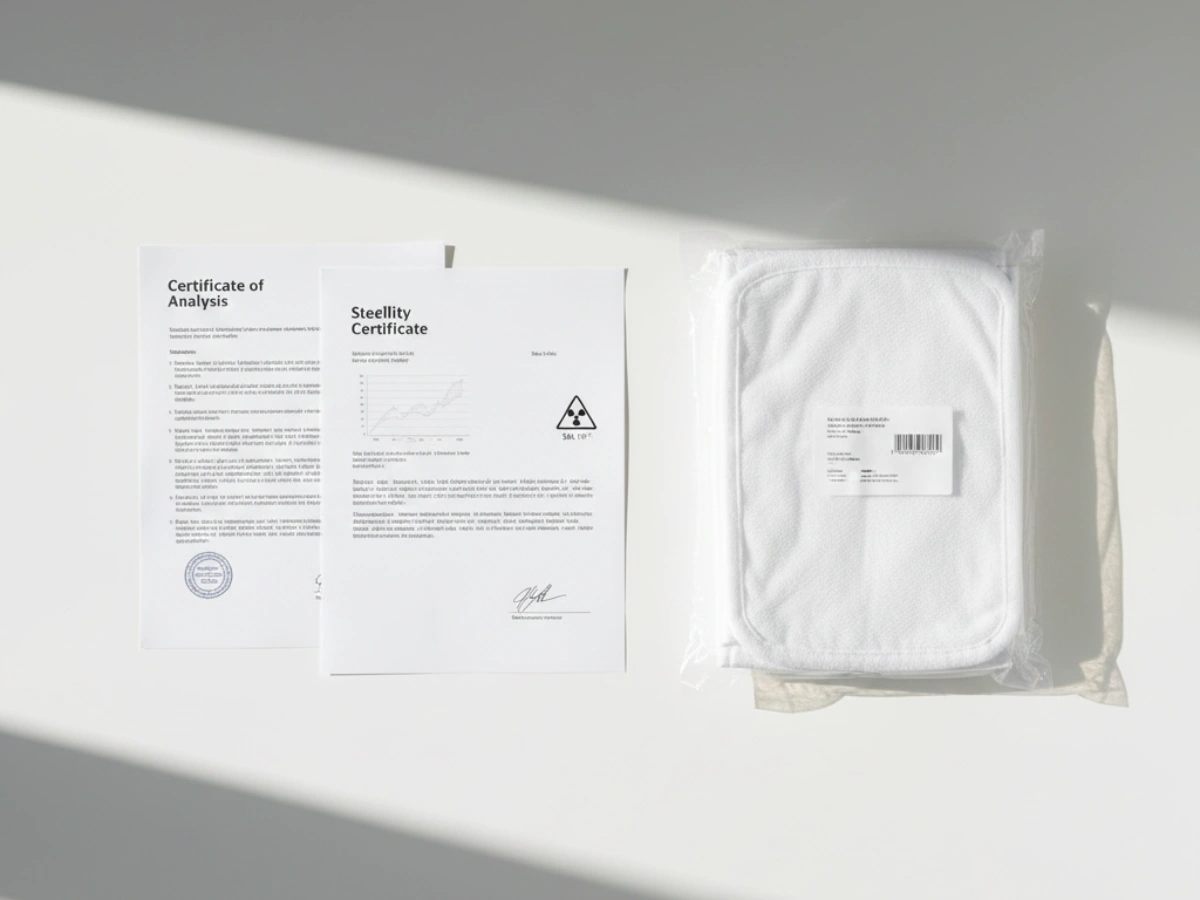
| 無菌証明書 | 適用できない | 致命的 | Per-batch sterility assurance document with batch identifier, sterilization method, sterilization date, SAL. This is the primary document that auditors will request for sterile mop batches entering Grade A/B zones. Absence of this document for a product claimed as sterile is a critical finding. |
| 適合証明書 (CoC) | Optional / Often provided | 必須 | Confirms the product conforms to stated specifications. For sterile products, the CoC should reference the applicable sterility standard and the batch’s sterility certificate identifier. |
| バッチトレーサビリティ記録 | オプション | 必須 | Linking the mop batch to raw material lots, production date, sterilization cycle date, and sterility test batch. Required for sterile products because a sterility failure must be traceable to the affected production batch for recall or investigation purposes. |
| Irradiation Certificate / Sterilization Process Record | 適用できない | 必須 | Documents the sterilization process parameters: gamma irradiation dose, dose mapping, and cycle validation. This is part of the evidence that the sterilization process was executed correctly for the specific batch. |
| Aseptic Transfer Protocol (facility-side) | 適用できない | Facility-generated | The supplier provides the sterile, double-bagged product. The facility is responsible for the documented, validated aseptic transfer protocol that introduces the sterile mop into the cleanroom. This protocol should be part of the facility’s cleaning SOP, not the supplier’s documentation package. During an audit, the inspector will expect to see both: the supplier’s sterility documentation AND the facility’s transfer protocol. |
| Endotoxin Test Data | Not typically applicable | Conditionally applicable | Required when sterile mops are used in aseptic processing of parenteral products where endotoxin limits are specified. Not required for all sterile mop applications. The facility should determine whether the product-contact pathway in its specific use case triggers endotoxin testing requirements. |
For a structured buyer checklist covering what documentation to request and how to review supplier submissions, refer to the クリーンルームモップ検証文書購入者チェックリスト. For a detailed explanation of each document type including COA content and sterility certificate verification, see the クリーンルームモップの検証文書とCOA ガイド。
Practical note for procurement teams: When a facility’s sterility decision transitions from non-sterile to sterile for a specific zone, the supplier documentation requirement expands from approximately 2-3 document types to 5-7 document types per batch. This has a direct impact on incoming QA review workload, batch release turnaround time, and documentation archive requirements. Facilities planning a transition from non-sterile to sterile mop specification should factor this documentation overhead into their QA resource planning.
The following five scenarios represent commonly observed errors in how facilities approach the sterile-vs-non-sterile mop decision. Each includes practical correction guidance.
問題: A facility adopts one sterility specification — typically “all mops must be sterile” — and applies it uniformly from Grade A through Grade D without zone-level evaluation. This creates unnecessary cost in support zones where non-sterile mops with appropriate material specifications are functionally equivalent.
修正方法: Conduct a zone-by-zone sterility review using the decision tree in Section 5. For each zone, document the regulatory requirement, product-contact risk, and the cost-validity of the sterile premium. Where non-sterile is acceptable, implement the specification change with supplier notification, updated cleaning SOP, and operator training. The cost savings from this re-stratification are typically measurable within the first procurement cycle.
問題: The purchase order specifies “sterile, gamma-irradiated, double-bagged mops” for Grade A, but the facility’s cleaning SOP does not include a validated staged aseptic transfer protocol. The outer bag is removed in a Grade D material airlock, the inner bag is opened in a Grade C corridor, and the supposedly sterile mop is carried into Grade A without any additional transfer steps. The sterility claim is broken well before the mop reaches its point of use.
修正方法: A sterile mop specification without a validated transfer protocol is a specification without a supporting system. Implement staged aseptic transfer: outer bag removed at the Grade B/C boundary, inner bag removed inside the receiving zone under aseptic conditions. Document the protocol in the cleaning SOP, train operators, and include transfer protocol verification in the facility’s internal audit program. The supplier’s sterility documentation proves the mop was sterile when it left the manufacturer; the facility’s transfer protocol proves it was still sterile when it was used.
問題: A facility treats Grade B as “cleaner than Grade C” but does not apply sterile mops because “sterile is only for Grade A.” This misjudges the regulatory and contamination-control role of Grade B as the protective background for aseptic operations. A non-sterile mop in a Grade B zone during active Grade A aseptic filling creates a microbiology source physically adjacent to the aseptic boundary.
修正方法: Review the specific Grade B zone’s proximity to Grade A operations. If the Grade B zone is actively serving as background during aseptic filling, apply the same sterile mop specification as Grade A. Reserve non-sterile evaluation for standalone Grade B zones where the three conditions in Section 3 are fully satisfied. This is the single most impactful sterility decision adjustment for many facilities — upgrading Grade B mops from non-sterile to sterile eliminates a contamination-control gap at the boundary of the aseptic core.
問題: A facility focuses exclusively on “sterile or non-sterile” as the mop specification decision, treating sterility as the single dimension of mop selection. Important specification variables — material composition (polyester vs microfiber), edge sealing method, mop head weight, packaging configuration, and zone color-coding — are not evaluated because the sterility question consumed the entire specification discussion.
修正方法: Sterility is one dimension of the mop specification, not the entire specification. A sterile mop with an unsuitable material for the facility’s disinfectant chemistry, or a non-sterile mop without sealed edges generating particle counts above the zone’s expectations, are both specification failures. The sterility decision should be made first (using this framework), then the remaining specification variables should be addressed: material, weight, edge sealing, packaging, and zone segregation features. See Section 8 for related topic resources covering these additional dimensions.
問題: The facility’s QA team receives sterile mops with the appropriate supplier documentation (COA, Certificate of Sterility, etc.), but no internal document records WHY the facility chose sterile for Grade A/B and non-sterile for Grade C/D. The decision exists as an unwritten consensus among the facility, engineering, and QA teams, with no formal rationale, risk assessment reference, or decision record. During an audit, the team can demonstrate that the sterile mops are sterile — but cannot demonstrate why the facility decided that sterility was required for the zones using them.
修正方法: Create a simple Sterility Specification Rationale document for the facility’s cleaning program. For each zone, record: (1) the GMP grade, (2) the sterility decision (sterile or non-sterile), (3) the primary criteria supporting the decision (reference the five criteria in Section 2), (4) the date of the most recent review, and (5) the QA approval. This document does not need to be lengthy — a one-page matrix is typically sufficient. Include it in the cleaning validation documentation package so it is available during internal and regulatory audits. A documented decision is defensible; an undocumented consensus is not.
This guide addresses the sterility dimension of cleanroom mop selection. The following resources address complementary dimensions that intersect with the sterility decision:
A sterile cleanroom mop is required in Grade A / ISO 5 aseptic processing zones where open product, sterile components, or aseptic connections are directly exposed to the environment. In these zones, EU GMP Annex 1 expectations for contamination control extend to all consumables entering the aseptic core, including cleaning tools. Grade B zones that serve as background to active Grade A operations should also default to sterile mops. Outside these scenarios, sterility should be evaluated based on a facility-specific risk assessment that considers cleanroom classification, product-contact proximity, transfer path integrity, and cost-validity.
In practical terms, the difference has three dimensions. (1) Process: Sterile mops have undergone a validated sterilization process (typically gamma irradiation achieving SAL 10-6); non-sterile mops have not. (2) 包装: Sterile mops are double-bagged in validated sterile-barrier packaging designed for staged aseptic transfer; non-sterile mops are typically single-bagged or bulk-packed for clean storage. (3) ドキュメント: Sterile mops include a Certificate of Sterility per batch, batch traceability records, and an irradiation certificate; non-sterile mops typically include a Certificate of Analysis and material certification. The mop head itself — the fabric, construction, weight, edge sealing — may be identical between sterile and non-sterile versions of the same product line. The sterility difference is in the post-production processing, packaging, and documentation, not in the fundamental mop head design.
EU GMP Annex 1 explicitly states that “disinfectants and detergents used in Grade A and Grade B areas should be sterile prior to use.” It does not make an explicit, identically worded statement about cleaning tools such as mops. However, regulatory inspectors interpret the contamination control principle as extending to cleaning tools: a non-sterile mop saturated with sterile disinfectant introduces an uncontrolled microbiology source at the point of cleaning. In practice, most facilities default to sterile mops for Grade B zones that serve as background to Grade A to avoid this regulatory interpretation risk. A non-sterile evaluation for standalone Grade B zones is possible under a formal risk assessment (see Section 3, Condition Framework), but it should be documented and QA-approved.
Yes, and this is the recommended approach for multi-grade facilities. A grade-stratified program — sterile for Grade A and connected Grade B, non-sterile for Grade C and D — is cost-efficient and compliant. The operational requirements for managing mixed sterility specifications are: (1) clearly labeled, physically separated storage for sterile and non-sterile inventories; (2) SOP documentation specifying which zones receive which mop type; (3) operator training that includes the rationale for the sterility difference so operators understand why Grade A mops are sterile and Grade C mops are not; and (4) line clearance verification to confirm the correct mop type is staged at each zone before cleaning begins. The operational complexity of managing two specifications is generally outweighed by the cost savings of not over-specifying Grade C and D zones.
Sterile cleanroom mops carry a cost premium over their non-sterile equivalents. The premium reflects sterilization process cost (gamma irradiation per batch), validated sterile barrier packaging (double-bagging with seal integrity verification), per-batch sterility testing and documentation, and shelf-life management. The exact percentage premium depends on order volume, product configuration, and supplier, but the general relationship is that the sterile premium is most justified in low-volume, high-risk zones (Grade A/B) and least justified in high-volume, low-risk zones (Grade C/D). Facilities should evaluate the sterile premium against the contamination-control benefit in each zone rather than treating it as a fixed cost applied uniformly. For a detailed cost differential framework, see Section 4 of this article.
A sterile mop with compromised packaging should not be used in a zone where sterility is required. The sterility claim is tied to the integrity of the sterile barrier packaging. If the outer bag or inner bag seal is breached, torn, or shows signs of moisture ingress, the sterility of the product cannot be assured and the mop should be discarded or, if the product allows, returned for re-sterilization. This is why facilities should include a visual packaging integrity check as a step in the mop staging or transfer protocol. During an audit, an inspector may ask to see evidence that packaging integrity is verified before sterile mops are introduced into the cleanroom. A documented, photographed packaging integrity check is a straightforward compliance measure.
Using a non-sterile mop with sterile disinfectant in Grade B creates a contamination-control inconsistency. The disinfectant is sterile at the point of use; the mop head delivering it is not. The non-sterile mop head can introduce microorganisms at the point of cleaning, potentially negating the sterility of the disinfectant for the specific zone being cleaned. Regulatory inspectors reviewing the cleaning program may identify this as a contamination-control gap: if the facility has determined that a sterile disinfectant is required for Grade B, the cleaning tool delivering it should meet a comparable contamination-control standard. If the facility has determined through a formal risk assessment that non-sterile mops are acceptable for a particular Grade B zone (under the three-condition framework), then the use of sterile disinfectant with non-sterile mops in that specific zone is internally consistent with the risk assessment’s conclusions. The key is that the mop sterility specification and the disinfectant sterility specification should be evaluated using the same contamination-control logic for the same zone.
The documentation should be proportionate to the regulatory risk but should, at minimum, include: (1) A zone-by-zone sterility specification matrix listing each GMP-classified zone, its assigned sterility requirement (sterile or non-sterile), and the primary criteria supporting the decision. (2) For zones where non-sterile mops are used, a brief rationale referencing the applicable criteria (e.g., “Grade D — non-sterile: product-contact risk is low, airborne particle limits do not necessitate sterility, cost-validity assessment supports non-sterile specification”). (3) The date of the most recent sterility specification review and QA approval. (4) Reference to any supporting risk assessments, environmental monitoring data, or cleaning validation studies that informed the decisions. (5) Inclusion of this document in the facility’s cleaning validation or contamination control strategy documentation package. A one-to-two-page matrix with a brief rationale section is typically sufficient. The purpose is to demonstrate that the sterility decision was made deliberately, with documented criteria, rather than by default or historical inertia.
Whether your facility requires terminally sterilized, double-bagged mops for Grade A/B aseptic core zones or cost-optimized non-sterile options for Grade C/D support areas, MIDPOSI White Cleanroom Mop Series is available in both sterile (gamma-irradiated) and non-sterile configurations across 40g, 55g, and 65g weights. Each sterile batch includes Certificate of Sterility, Certificate of Analysis, and batch traceability records to support your QA documentation package. Non-sterile configurations include Certificate of Analysis and material certification. Contact our technical team to discuss your facility’s zone-specific sterility requirements and request product samples for internal evaluation.
MIDPOSI supplies cleanroom mops in sterile and non-sterile configurations to pharmaceutical, biotech, and medical device manufacturers. Batch-level documentation including Certificate of Analysis (COA) and, for sterile configurations, Certificate of Sterility is available upon request. Contact our team to discuss your facility’s zone-specific sterility requirements and request product samples for internal qualification.