Human hair and skin are among the largest sources of particles and microorganisms in any cleanroom. A single uncovered strand of hair at the forehead or a gap at the back of the neck can undo the work of a well-designed coverall. That is why head coverage is one of the first items an auditor checks, and why buyers need to understand the difference between a bouffant cap, a cleanroom cap and a hood before they write a purchase specification. This guide compares the main types of cleanroom hats, caps and hoods, explains which cleanroom grades and ISO classes each one suits, and lists what to check when you buy them.
Быстрый ответ: disposable bouffant caps and simple cleanroom caps cover the hair and suit lower-grade areas such as ISO Class 8 or EU GMP Grade D. Higher grades need a hood that covers the hair, ears and neck and tucks into the garment collar. For Grade A/B aseptic areas, the hood must be sterile and enclose all hair, including facial hair. ESD caps and hoods with conductive fibers are used where static control matters, such as electronics and semiconductor production.
The main types of cleanroom headwear
Disposable bouffant caps
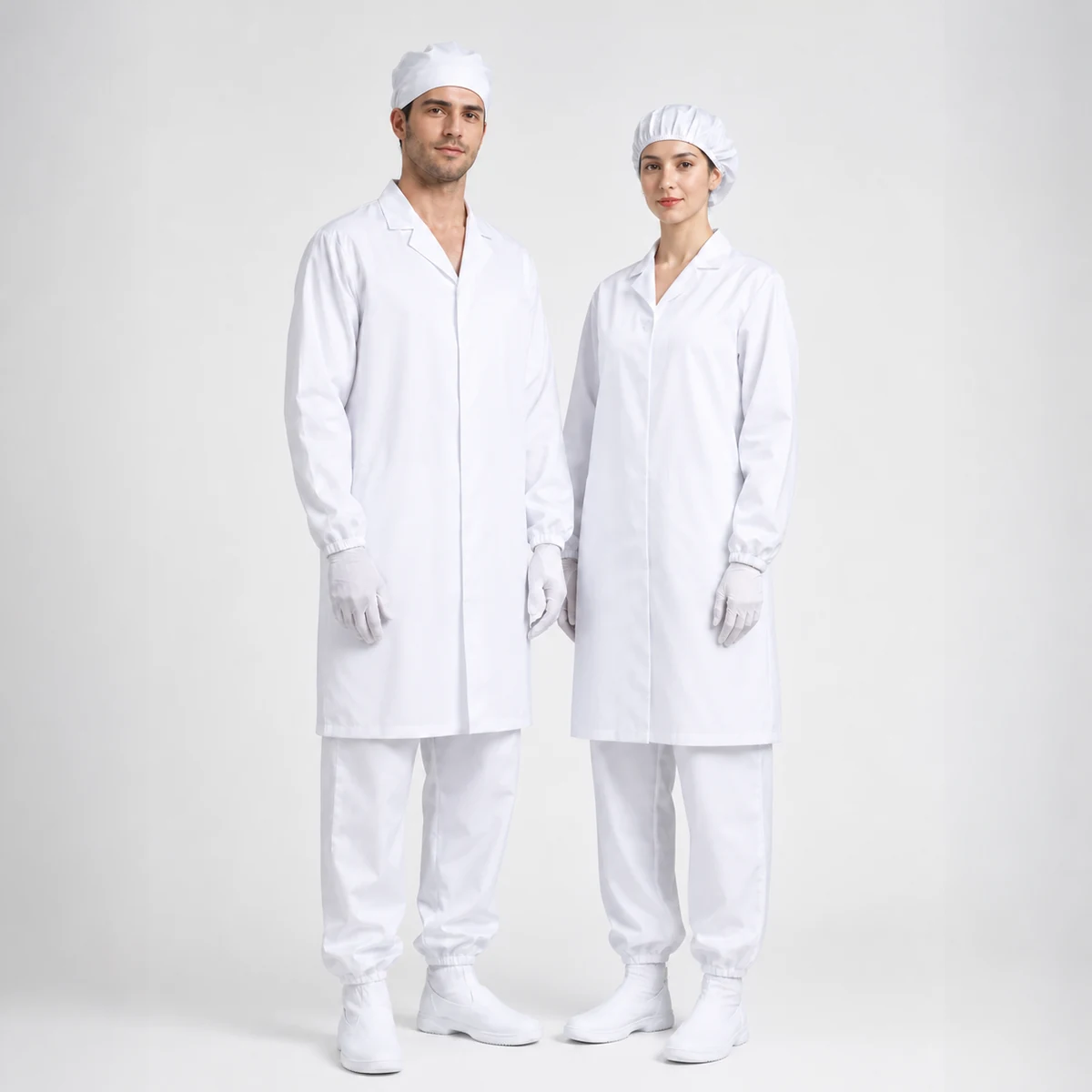
A bouffant cap is a loose, elasticated cap, usually made of nonwoven polypropylene. It is cheap, light and used once. Bouffant caps cover the top of the head and most of the hair, but they leave the ears, neck and sideburns open. They are common in gowning anterooms, ISO 8 areas, Grade D areas, hospitals and food processing, and they are often worn under a hood as a first layer in higher grades.
Beard covers
Annex 1 requires that beards and moustaches are covered in Grade C and D areas, and that sterile headgear encloses all facial hair in Grade B. A disposable beard cover, or a hood with a face mask, closes this gap. A beard cover is cheap, so leaving it out of the gowning kit is rarely worth the audit risk.
Reusable cleanroom caps
Reusable caps are made of the same low-linting woven polyester as cleanroom coveralls. They have an elastic band or snap adjustment at the back, and many include conductive fibers for static control. They are more comfortable than disposable caps and shed less, but they still leave the neck and lower face open. They suit ISO 7 and ISO 8 areas and many electronics assembly rooms where full hoods are not specified.
Cape-style hoods
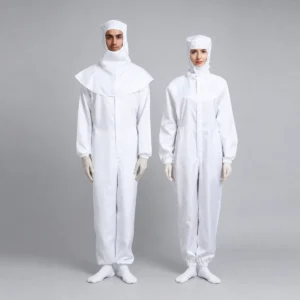
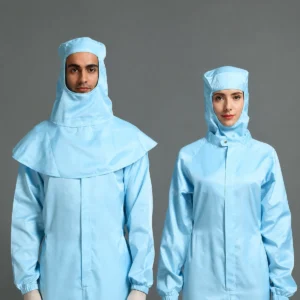
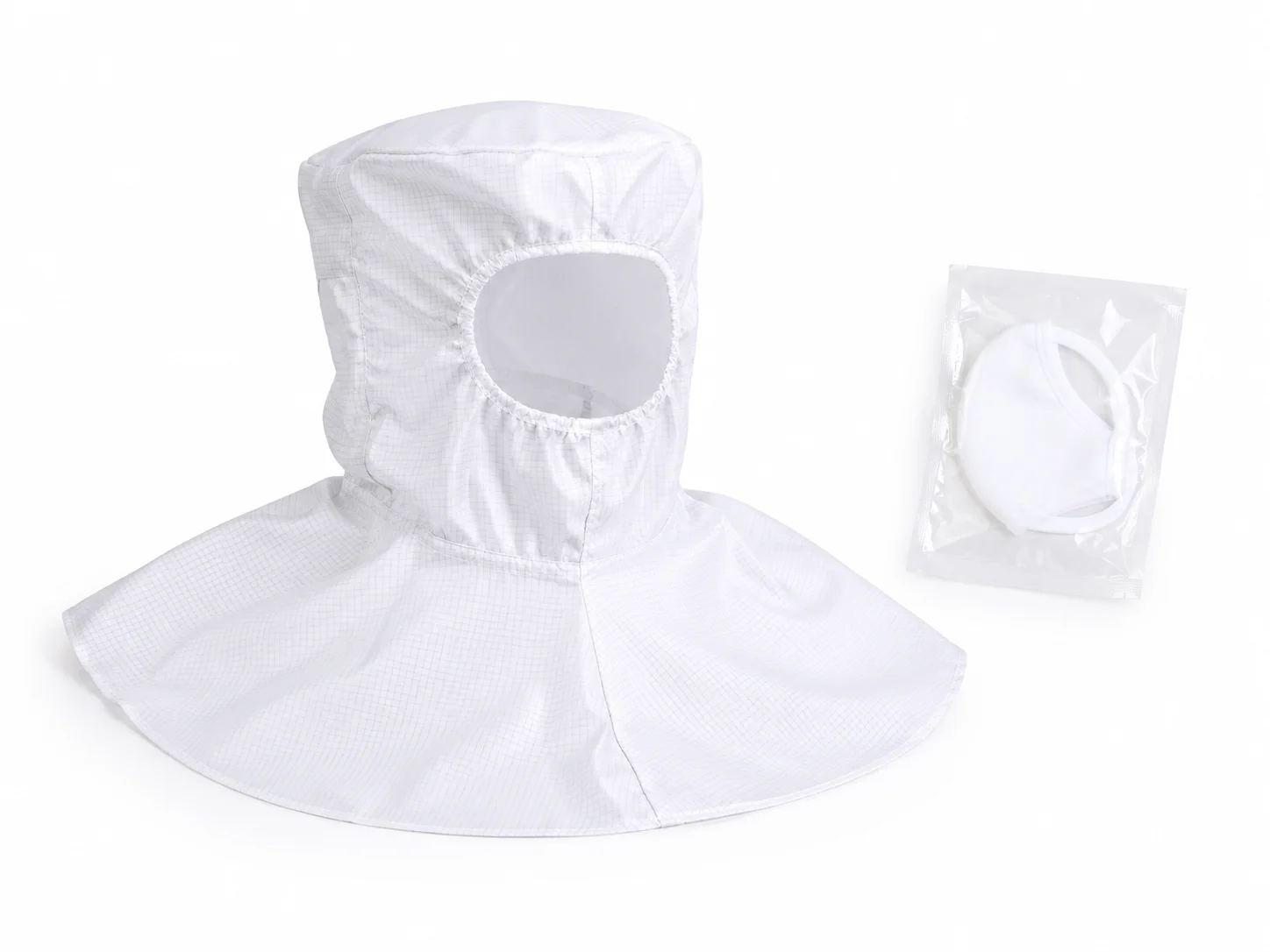
A cape-style hood covers the head, ears and neck, and has a cape that drops over the shoulders. The cape is worn under the coverall collar so that there is no gap between the hood and the suit. Many designs have an elastic band at the back of the head to adjust the fit, and an open face that is closed with a mask. This style is easy and quick to don, which is why it is popular in production cleanrooms. The MIDPOSI ESD cleanroom hat uses this flat hood design.

Fitted hoods
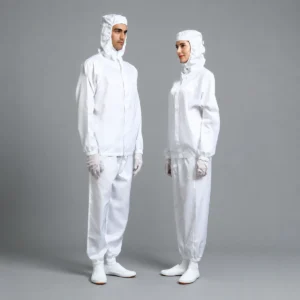
A fitted hood follows the shape of the head and neck more closely, often with snaps or ties at the neck and a face opening that frames the eyes. Fitted hoods give a cleaner interface with goggles and masks and are the usual choice for ISO 5 and Grade A/B areas. See the MIDPOSI MD-09J01 autoclavable cleanroom hood, available with stripe or grid conductive fiber options.
Integrated hoods
Some coveralls have the hood sewn on, which removes the hood-to-collar interface entirely. Integrated hoods reduce gowning steps and the risk of a gap, but the hood and suit must be sized together. Our Руководство по выбору комбинезона для чистых помещений compares hooded, non-hooded and integrated designs.
Which headwear for which cleanroom grade
ISO 14644-1 classifies air cleanliness but does not prescribe garments. Garment selection is left to the user, guided by documents such as ISO 14644-5 and IEST-RP-CC003. In pharmaceutical production, EU GMP Annex 1 is more specific. The table below summarizes common practice:
| Область | Typical headwear | Почему |
|---|---|---|
| ISO 8 / Grade D | Bouffant cap or reusable cap, plus beard cover | Annex 1 requires hair, beards and moustaches to be covered |
| ISO 7 / Grade C | Reusable cap or hood, plus beard cover or mask | Same Annex 1 rule, but lower particle limits favor better neck coverage |
| ISO 5–6 (non-sterile, e.g. semiconductor) | Hood with cape or fitted hood, often ESD, plus mask | Full coverage of hair, ears and neck; static control |
| Grade A/B (aseptic) | Sterile fitted or integrated hood tucked into a sterile coverall, with sterile mask and goggles | Annex 1 requires sterile headgear that encloses all hair, including facial hair |
These are typical choices, not rules. Your contamination control strategy and gowning qualification should decide what is worn in each room. If you are working through a Grade C program, see our guide to Grade C cleanroom requirements and gowning.
ESD caps and hoods for electronics and semiconductors
In electronics, semiconductor and optics production, headwear has a second job: it must not hold a static charge near sensitive devices. ESD caps and hoods use woven conductive fibers, usually in a stripe or grid pattern, so that the fabric can dissipate charge. ESD control programs are typically built around IEC 61340-5-1 or ANSI/ESD S20.20, and garment resistance is tested with methods such as IEC 61340-4-9.
When you buy ESD headwear, ask for ESD test reports on the finished item, not just the fabric. Check how the conductive performance holds up after repeated washing, and make sure the hood is worn with an ESD coverall, so that the garment system as a whole meets your ESD program.
Reusable or disposable headwear?
Disposable bouffant caps and beard covers make sense for visitors, gowning anterooms and low-grade areas where low cost and simple logistics matter most. Reusable caps and hoods shed less, fit better and cost less per use over their life, which is why most ISO 7 and cleaner areas use them. Reusable headwear must go through the same qualified laundering process as your coveralls, with a defined cycle limit. For the wider decision, read Автоклавируемая и одноразовая одежда для чистых помещений.
Fit and donning tips
- Put on head coverage first, before the coverall, so that hair cannot fall onto the suit. A gowning sequence works from the top down.
- Tuck all hair inside, including the hairline at the forehead, sideburns and the nape of the neck.
- Cover the ears fully. Caps that stop above the ears are only acceptable in the lowest grades.
- Tuck the hood cape or skirt inside the coverall collar and close the collar over it.
- Check that the mask and goggles meet the hood without gaps. See our hood and face mask selection guide и how to choose sterile goggles.
- Offer more than one size. A hood that is too large folds and gaps, and one that is too small pulls away from the collar.
The full sequence is covered in our СОП процедура переодевания в чистых помещениях.
Buyer checklist for cleanroom caps and hoods
- Style: cap, cape-style hood, fitted hood or integrated hood, matched to each room grade.
- Fabric: low-linting continuous filament polyester, with or without conductive fibers.
- Seams and edges: covered or bound, with no raw edges that can shed.
- Fit: elastic or snap adjustment, size range and compatibility with your masks and goggles.
- Processing: laundering and sterilization method, and the number of cycles the supplier rates.
- Documentation: particle, filtration and ESD test reports, and quality system certificates.
- Identification: color coding by grade, and labels or marks for tracking cycles.
- Terms: minimum order, sample quantity and lead time, especially if you need private label.
Cleanroom headwear from MIDPOSI
MIDPOSI has made cleanroom garments since 2004 and is ISO 13485 certified, with a CE certificate. Our autoclavable cleanroom hoods and ESD hats can be ordered together with our coveralls and suits. They are suitable for EU GMP Grade A/B, C and D areas and rated for up to 100 autoclave cycles. Particle, filtration and ESD test reports are available on request. Production orders start at 50 pieces per style, samples and trial orders start at 10 pieces, and the lead time is about 25 days. OEM and private label orders follow the same terms.
To match headwear to each room, try the cleanroom garment selector. To plan quantities for a full gowning kit, use the cleanroom quote estimator.
Часто задаваемые вопросы
Is a bouffant cap enough for an ISO 7 cleanroom?
It depends on your gowning specification, but many ISO 7 and Grade C areas use a hood or a reusable cap with a beard cover, because a bouffant cap leaves the ears and neck uncovered. Bouffant caps are more often used in ISO 8 or Grade D areas, or as a base layer under a hood.
What is the difference between a cleanroom cap and a hood?
A cap covers only the top of the head and the hair. A hood also covers the ears and neck, and its cape or skirt tucks into the coverall collar, so that there is no gap between the head cover and the suit.
Can cleanroom hoods be autoclaved?
Reusable woven polyester hoods made for cleanroom use can be laundered and steam sterilized. MIDPOSI garments are rated for up to 100 autoclave cycles, and your validated limit should be set during garment qualification.
Do semiconductor fabs need ESD caps?
Most semiconductor and electronics cleanrooms specify ESD headwear as part of an ESD garment system, so that the hood does not hold a charge near sensitive devices. Check your site’s ESD control program for the exact requirement.
Get samples or a quote
Tell us your room grades, the headwear styles you use today and the quantities you need, and we will recommend matching hoods and caps. Samples start at 10 pieces. Send an inquiry through our contact form или message us on WhatsApp.