Cleanroom Mop Head Attachment Systems—Pocket, Velcro, and Clip Mechanisms Compared
A practical comparison of the three attachment mechanisms that connect cleanroom mop heads to frames. Covers change-over speed, connection security, particle contamination risk, cross-supplier compatibility, and GMP suitability—for procurement teams, facility managers, and cleaning supervisors specifying complete mop systems.
Быстрый ответ—Three Attachment Mechanisms, Five Decision Dimensions
Three attachment mechanisms connect cleanroom mop heads to mop frames. The right choice depends on five dimensions: connection security (will the head stay on during mopping?), change-over speed (how fast can operators swap heads between zones?), particle risk (does the mechanism itself generate contamination?), compatibility (does it work with existing frames?), and hardware complexity (are there additional components to clean and validate?).
| Механизм | Security | Change-over Speed | Particle Risk | Лучшее для |
|---|---|---|---|---|
| Pocket-Type | Умеренный–High (when dimensionally matched). Pocket can stretch over repeated use, reducing security. | Moderate. Sliding frame into pocket takes 5–10 seconds per head. Familiar to trained operators. | Lowest. No added material at the attachment point — the fabric is the attachment. No adhesive, no hook material, no clip hardware touching the mop. | Most GMP and ISO cleanroom facilities. Standard choice for ISO 5–8 / GMP Grade A–D. Compatible with most stainless steel wire frames. |
| Velcro / Hook-and-Loop | Moderate. Initial grip is strong; degrades as hook side wears or loop side accumulates residue over repeated use. | Fastest. Peel-off and press-on in 3–5 seconds. Advantageous in high-throughput multi-zone cleaning programs. | Умеренный–High. Hook side sheds microfibers over time. Loop side accumulates disinfectant and particulate residue. Additional particle source at the attachment interface. | ИСО 7–8 / GMP Grade C–D where speed is prioritized and particle budget accommodates the attachment contribution. Not recommended for ISO 5 / Grade A–B without documented particle data. |
| Mechanical Clip | Highest. Mechanical lock resists pull-force disconnection under aggressive mopping. The most secure of the three mechanisms. | Slowest. Clipping and unclipping requires more operator attention. 8–15 seconds per head. More sensitive to operator technique. | Низкий–Moderate. The mechanism itself does not generate particles, but the clip hardware introduces an additional surface to clean and validate. Clip spring mechanisms can wear and introduce metallic or plastic debris if poorly maintained. | Heavy-duty or high-abrasion cleaning where pull-force resistance is critical. Facilities with validated SOPs for hardware cleaning and inspection. |
In practice: Pocket-type is the industry standard for a reason — it introduces no additional contamination source at the head-to-frame interface and is compatible with the widest range of mop frames. However, pocket dimensional match is critical: a loose pocket slips; a tight pocket slows change-over. Attachment choice should be made within the context of the complete mop system, not treated as an isolated component decision. See our article on why the full cleanroom mop system matters for integration considerations.
Pocket-Type—The Industry Standard
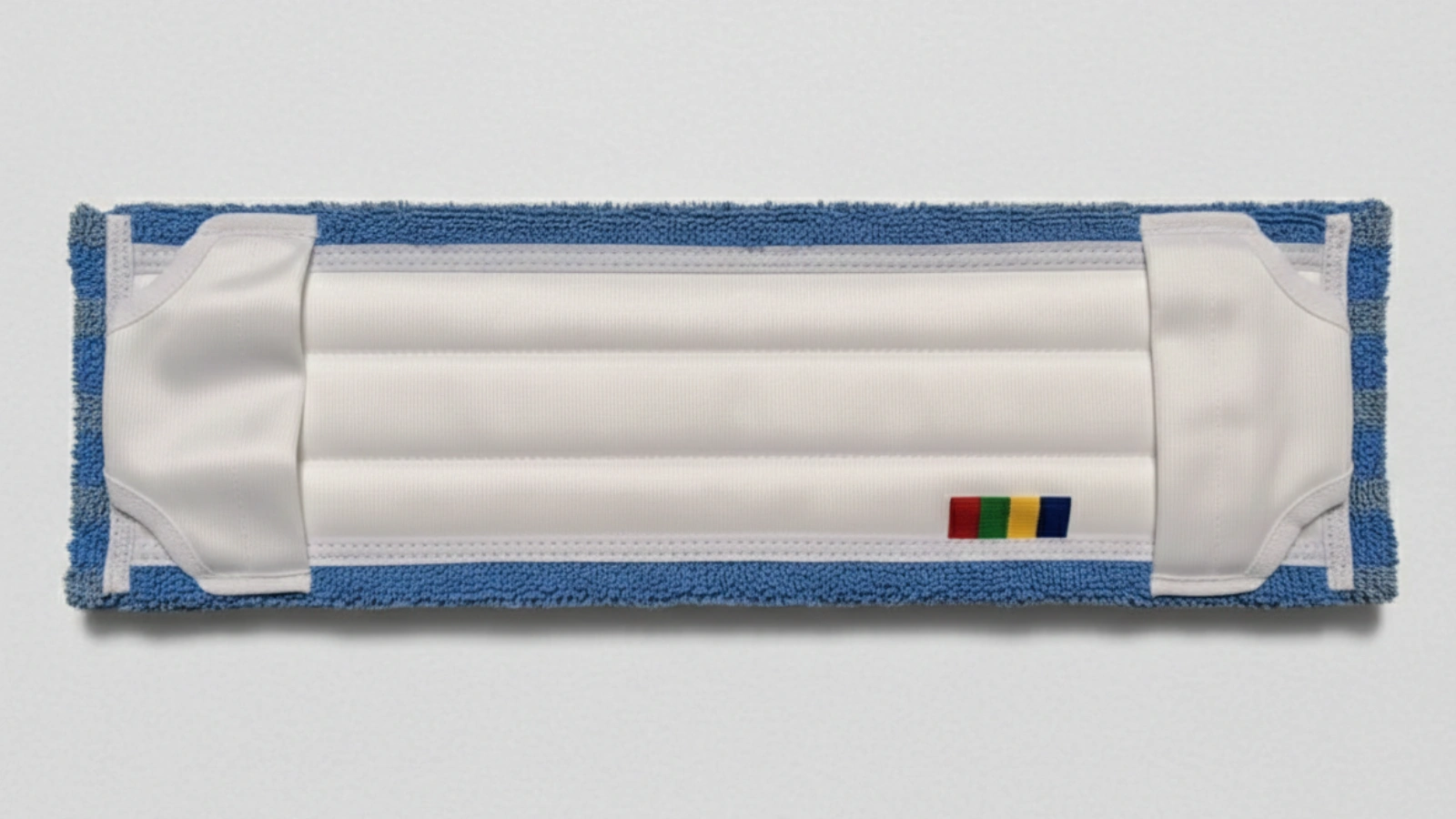
Pocket-type attachment is the most widely used mechanism in cleanroom mop systems. The mop head has one or two fabric pockets sewn into its back side. The mop frame — typically a flat stainless steel wire frame — slides into the pocket(s), and the fabric tension holds the head in place during mopping. The attachment is purely mechanical-frictional: no adhesive, no hook material, no clip hardware touches the mop head at the attachment point.
Why Pocket-Type Is the Default Choice for Most Cleanroom Facilities
There are three reasons pocket-type dominates the cleanroom mop market:
No Added Particle Source
The attachment mechanism is the mop fabric itself. There is no hook material shedding fibers, no adhesive degrading, and no metal clip contacting the cleaning surface. In particle-sensitive environments, this is a structurally simpler contamination-control profile — fewer components at the critical head-to-frame interface means fewer potential particle sources to manage and document.
Broad Frame Compatibility
Pocket-type mop heads are compatible with the most common cleanroom mop frame design: the flat stainless steel wire frame. This means a pocket-type head can fit frames from multiple suppliers, as long as the frame width matches the pocket width. This is relevant for multi-supplier procurement strategies or facilities transitioning between mop head suppliers while keeping existing frames.
Operator Familiarity
Cleaning operators in GMP and ISO facilities are widely trained on pocket-type attachment. The motion — slide frame into pocket, verify fit, begin mopping — is instinctive after minimal training. This reduces the risk of improper attachment (frame partially inserted, loose head) due to operator unfamiliarity with a non-standard mechanism.
The Dimensional Dependency: Pocket Must Match Frame Width
The primary limitation of pocket-type attachment is its dimensional dependency. The pocket opening on the mop head must match the width of the mop frame. When specifying or procuring pocket-type heads in isolation from the frame, verify:
- Frame width (typically 40 cm for standard cleanroom flat mops, though narrower frames exist for specialized applications)
- Frame thickness (wire gauge, which affects how tightly the pocket grips)
- Pocket depth (how far the frame inserts into the pocket; shallow pockets increase slip risk)
- Pocket fabric compliance (fabric stretch; some stretch is needed for insertion, but excessive stretch leads to loose fit over repeated use)
Dimensional information should be explicit on supplier specification sheets. If a supplier cannot provide frame width compatibility, pocket dimensions, or recommended frame gauge for their pocket-type mop heads, this is a procurement risk signal. For more on frame compatibility considerations, see our guide to cleanroom mop frame types.
Failure Mode: Pocket Stretching
The primary failure mode for pocket-type attachment is pocket fabric stretching over repeated insertion-removal cycles, wet-dry cycling, and autoclave exposure. As the pocket stretches, the fabric’s grip on the frame loosens. A loose pocket can cause:
- Head rotation during mopping: The mop head twists on the frame, reducing effective cleaning contact and potentially exposing the frame edge to the cleaning surface.
- Partial disconnection: The head slips partially off the frame during aggressive mopping, requiring the operator to stop and re-seat the head — a workflow interruption and a potential protocol deviation.
- Contact inconsistency: Loose fit reduces the pressure transfer from frame to head, affecting liquid application uniformity and cleaning consistency across the mop surface.
Pocket stretching is not a design flaw in the pocket concept — it is a service-life variable. Procurement should include a plan for monitoring pocket fit (visual inspection at each head change, frame-fit test at each laundering cycle) and a defined replacement trigger (e.g., “replace when pocket insertion force drops below a specified threshold or when visual sag is observed”).
Velcro / Hook-and-Loop—Speed vs Particle Shedding Risk
Velcro-type (hook-and-loop) attachment systems use a strip of hook material on the mop frame and a corresponding loop material patch on the mop head. The hook side mechanically engages the loop side when pressed together, creating a secure but peelable connection. Change-over is fast: the operator peels the used head off, presses a fresh head on, and continues cleaning — typically 3–5 seconds per head change.
The Speed Advantage: When It Matters
In facilities with high-frequency head changes — multi-zone cleaning programs where operators move through Grade C, D, and unclassified areas, changing heads at each zone boundary — the 2–5 second time saving per head change (compared to pocket-type) can accumulate to meaningful labor savings over a shift. Facilities running 20–30 head changes per shift can save 1–2 minutes of active change-over time with Velcro vs pocket-type, which may be relevant in high-throughput production environments where cleaning windows are tightly scheduled.
However, this speed advantage should be weighed against the particle-generation risk introduced by the Velcro mechanism. In critical zones (ISO 5 / GMP Grade A-B), that 5-second speed saving is irrelevant if it comes with a particle contribution that the facility must then manage through additional monitoring and documentation.
The Particle Risk: Hook-Side Shedding and Loop-Side Residue
Velcro attachment introduces a particle-generation mechanism that pocket-type systems avoid:
Hook-Side Fiber Shedding
The hook side (typically nylon or polyester molded hooks on the frame strip) undergoes repeated engagement/disengagement cycles. Over time, individual hooks can break, bend, or detach — releasing microplastic or microfiber fragments at the attachment interface. Because the hooks are on the frame side (not the disposable head side), hook wear accumulates across many head changes and is not refreshed when a new head is installed. The frame-side hook strip must be inspected and replaced as a separate maintenance item.
Loop-Side Residue Accumulation
The loop side (fabric loops on the mop head) can accumulate disinfectant residue, particulate matter, and cleaning-solution solids over time in reusable programs. This accumulated residue can transfer back to the hook side on the frame, creating a cross-contamination pathway between mop heads. For disposable (single-use) heads, the loop-side residue issue is limited to a single use, but the hook-side shedding issue remains.
For these reasons, Velcro attachment is generally not recommended for ISO 5 / GMP Grade A-B environments unless the supplier provides particle shedding data for the specific Velcro material under the facility’s use conditions (including disinfectant exposure, autoclave cycles if applicable, and expected engagement/disengagement count). Without this data, the particle contribution from the attachment mechanism is an unknown variable in the facility’s contamination control profile. For guidance on what particle testing to request, see our cleanroom mop testing standards guide.
When Velcro May Be the Right Choice
Velcro can be an appropriate choice when:
- The facility operates at ISO 7–8 / GMP Grade C–D, where particle budgets are higher and the attachment contribution is proportionally less significant.
- Change-over speed is a documented operational priority (e.g., time-critical between-batch cleaning in a multi-product facility).
- The supplier provides particle shedding data for the specific Velcro material, and the facility has validated that the contribution is within acceptable limits.
- Heads are single-use disposable (loop-side accumulation is not a concern across multiple uses).
Mechanical Clip—Most Secure, Slowest Change-over
Mechanical clip systems use a physical clamping mechanism — typically spring-loaded metal or plastic clips on the frame — that grips the mop head fabric or a reinforced attachment point on the head. The clip provides a positive mechanical lock: once engaged, the head cannot detach unless the clip is deliberately released. This makes mechanical clip systems the most pull-force-resistant of the three attachment types.
Where Maximum Security Matters
Mechanical clip attachment addresses a specific operational concern: pull-force disconnection during aggressive mopping. In cleaning workflows that involve:
- High-friction floor surfaces (textured epoxy, anti-slip coatings)
- Large-area mopping with long push-pull strokes
- Cleaning under equipment or in confined spaces where the mop head can catch on protrusions
- Wall and ceiling mopping where gravity works against the attachment
…the risk of head disconnection is higher than in standard flat-floor mopping. In these scenarios, a mechanical clip can prevent a head disconnection event — which in a cleanroom context is not just a workflow inconvenience but a potential contamination event requiring documentation and corrective action.
The Hardware Complexity Trade-Off
The security advantage of mechanical clip systems comes with a specific cost: additional hardware to clean, sterilize, and validate. The clip mechanism introduces:
- Additional surfaces: Clip jaws, spring mechanisms, hinge points, and clip mounting hardware are all surfaces that must be cleaned and, in sterile environments, sterilized. Each surface is a potential harborage point for disinfectant residue, particulate matter, or microbial contamination.
- Wear components: Spring mechanisms have a finite cycle life. A clip that loses spring tension over time may provide less clamping force than when new, potentially compromising attachment security without a visible indication of failure.
- Совместимость материалов: The clip material (typically stainless steel or engineered polymer) must be compatible with the facility’s disinfectant chemistry and sterilization method. An incompatible clip material can corrode, embrittle, or degrade under repeated chemical or thermal exposure — introducing particle or contamination risks from the clip itself.
- Validation burden: In GMP-regulated environments, any component that contacts the cleaning tool train (which contacts the cleaned surface) may be within the scope of cleaning validation. A mechanical clip mechanism adds validation documentation for clip cleaning procedures, clip inspection schedules, and clip replacement criteria.
Change-over Speed and Operator Technique Sensitivity
Mechanical clip systems are typically the slowest for head changes because clipping and unclipping requires more deliberate operator action than sliding (pocket) or peeling (Velcro). The operator must:
- Release the clip (often a squeeze mechanism)
- Remove the used head
- Position the new head
- Engage the clip and verify lock
This sequence is more sensitive to operator technique than pocket-type or Velcro. An incompletely engaged clip may appear secure but release under mopping force; an over-engaged clip in a polymer mechanism may damage the clip over repeated use. Operator training and periodic competency verification are more important for clip systems than for the other two attachment types.
Decision Framework—Which Attachment System for Your Facility?
The attachment choice is not a single-answer question — it depends on the facility’s classification, cleaning workflow, and operational priorities. Below are four common facility scenarios mapped to recommended attachment types with rationale.
ИСО 5–7 / GMP Grade A–C Pharmaceutical Facility
Rationale: Particle control is the overriding priority. Pocket-type introduces no additional particle source at the attachment interface. The change-over speed difference (3–5 seconds vs pocket-type) is negligible in Grade A–C environments where cleaning is procedural and deliberate, not time-pressured. Frame compatibility is broad, which supports multi-supplier qualification strategies. The main risk (pocket stretching over repeated autoclave cycles) is managed through inspection and replacement protocols.
ИСО 7–8 / GMP Grade C–D Multi-Zone Facility with High Head-Change Frequency
Rationale: In Grade C–D, particle budgets are higher, and change-over speed may be a meaningful operational variable. Pocket-type remains a strong choice with zero added particle risk. Velcro can be evaluated if: (a) the supplier provides particle shedding data for the specific Velcro material, (b) the facility validates that the Velcro particle contribution is within budget, and (c) heads are disposable to eliminate loop-side residue accumulation. If any of these conditions is not met, pocket-type is the lower-risk choice.
Heavy-Duty / High-Friction Floor Cleaning (Textured Surfaces, Large Areas)
Rationale: Pull-force resistance becomes a priority on high-friction surfaces. Pocket-type with a well-matched frame width and frame gauge may provide sufficient security for most applications. Mechanical clip should be considered if: (a) the facility has documented head disconnection incidents with pocket-type, (b) cleaning involves wall/ceiling surfaces where gravity works against attachment, or (c) aggressive mopping technique is required by the surface type and cannot be modified. The clip adds a hardware cleaning and validation burden that must be accounted for in SOPs.
Multi-Supplier Procurement Strategy (Multiple Mop Head Suppliers, Single Frame Fleet)
Rationale: For facilities that maintain a single fleet of mop frames but source mop heads from multiple suppliers (a common procurement strategy for supply-chain resilience), pocket-type offers the widest cross-supplier compatibility — provided the frame width and pocket dimensions are matched. Velcro hook-strip patterns and clip attachment points are less standardized across suppliers. A facility running Velcro frames from Supplier A cannot easily switch to Velcro heads from Supplier B unless the hook-loop pattern is compatible. Mechanical clip attachment points are even more proprietary. Pocket-type, when specified with explicit dimensional tolerances, is the most supplier-agnostic attachment method. For a broader procurement framework, see our cleanroom mop system overview.
Frequently Asked Questions About Mop Head Attachment Systems
What is the most common cleanroom mop head attachment type?
Pocket-type is the industry standard for cleanroom mop attachment. The mop head has fabric pockets on its back side, and the flat mop frame (typically stainless steel wire) slides into the pockets. Pocket-type introduces no additional particle source at the attachment interface and is compatible with the widest range of mop frames. It is used in facilities from ISO 8 to ISO 4 / GMP Grade D to Grade A.
Does Velcro attachment generate particles in cleanroom environments?
Velcro/hook-and-loop attachment can generate particles through two mechanisms: hook-side fiber shedding (individual hooks break or detach over repeated engagement cycles, releasing microfiber fragments) and loop-side residue accumulation (the loop material accumulates disinfectant residue and particulate matter over time). Because the hook strip is on the frame (not replaced with each head change), hook wear accumulates across many cycles. For ISO 5 / GMP Grade A-B environments, Velcro is generally not recommended without documented particle shedding data for the specific material under the facility’s use conditions.
Can I use mop heads from one supplier with frames from another supplier?
Pocket-type offers the best cross-supplier compatibility, provided the frame width matches the pocket width and the frame gauge is compatible with the pocket’s grip. Velcro and mechanical clip systems are less standardized — the hook-loop pattern, clip attachment point location, and clip mechanism design vary between suppliers, making cross-supplier compatibility less reliable. When procuring from multiple suppliers, specify pocket dimensions and frame width explicitly, and request fit-test samples before committing to volume orders.
How do I know when a pocket-type mop head needs to be replaced (stretching)?
Pocket stretching should be monitored through a defined inspection protocol. Practical indicators include: visual sag or looseness when the frame is inserted, head rotation or shifting during mopping, frame insertion force noticeably lower than a new head, or head disconnection during use (which is a definitive replacement trigger). For GMP-documented environments, establish a quantitative or semi-quantitative fit test (e.g., “frame insertion should require X grams of push force” or “head should not shift more than Y mm when pulled laterally with Z Newtons of force”) and replace heads that fall below the threshold.
Which attachment system is fastest for operator head changes?
Velcro/hook-and-loop is the fastest: peel off used head, press on new head — typically 3-5 seconds per change. Pocket-type is moderately fast (5-10 seconds) and benefits from operator familiarity. Mechanical clip is the slowest (8-15 seconds) because clipping and unclipping requires deliberate action and verification. The time difference is most significant in high-frequency head-change programs (20+ changes per shift), but in most cleanroom environments, the 2-5 second difference should be weighed against the contamination-control trade-offs of each mechanism.
Are mechanical clip systems worth the additional hardware complexity?
Mechanical clip systems are worth the complexity when pull-force disconnection is a documented operational risk — for example, on high-friction textured flooring, during wall/ceiling cleaning against gravity, or in facilities where head disconnection incidents have been recorded with pocket-type or Velcro. The clip adds hardware surfaces to clean and validate, wear components to monitor, and operator training requirements. In standard flat-floor cleanroom mopping, pocket-type with a well-matched frame typically provides sufficient security without the clip’s added complexity. The decision should be driven by documented operational requirements, not by a generalized preference for “more security.”
Specifying a Cleanroom Mop System? Start with Components Designed to Work Together
MIDPOSI White Cleanroom Mop Series uses pocket-type attachment — the industry-standard mechanism with no added particle source at the head-to-frame interface. Pocket dimensions are matched to standard flat mop frame widths, supporting cross-supplier compatibility and reliable fit retention over repeated autoclave cycles. Available in 40g, 55g, and 65g weights, sterile and non-sterile, with documented dimensional specifications for qualified procurement evaluation.
MIDPOSI cleanroom mop heads are designed with pocket-type attachment compatible with standard flat mop frames. Dimensional specifications and frame compatibility documentation can be provided for procurement evaluation. Sample provision and fit-testing support are available for qualified buyers.