Швабра для чистых помещений не является самостоятельным продуктом. Это сборка из трех взаимозависимых компонентов — головки, рамы и ручки — где допуски на размеры, совместимость материалов и механизмы крепления должны быть спроектированы как согласованный комплект. Когда какой-либо компонент поступает из независимого источника без проверки, последствия представляют собой не просто неудобства: это случаи загрязнения, отклонения от СОП и результаты аудита, которые полностью можно предотвратить с помощью закупок на системном уровне.

Система швабры для чистых помещений имеет значение, потому что три компонента — головка, рама и ручка — структурно взаимозависимы.. Насадка швабры крепится к раме. Рамка соединяется с ручкой. Оператор толкает ручку, которая передает усилие через раму на насадку швабры к полу. Несоответствие размеров или материалов в любой из этих двух точек соприкосновения меняет результат очистки: неравномерное давление на пол, неполное покрытие, отсоединение компонентов или образование частиц из-за контакта с несовместимыми материалами. Системный подход гарантирует совместную работу всех трех компонентов так, как задумано. Автономный подход перекладывает бремя проверки на покупателя и на оператора, который обнаруживает несоответствие во время использования.
| Пара компонентов | Что происходит, если не совпадают | Операционное воздействие |
|---|---|---|
| Голова → Рамка | Карман слишком мелкий → голова соскальзывает во время мытья полов. Рама слишком узкая → неполный контакт с полом, неравномерное давление. Рамка слишком широкая → карман растягивается, рвутся швы. | Событие загрязнения (головка отсоединяется во время очистки). Непоследовательность очистки (пропущенные участки). Преждевременная замена головы (порвались карманы). |
| Рамка → Ручка | Несоответствие резьбы → ручка не прикрепляется. Быстрое соединение с неправильным приемником → неполная фиксация, ручка отсоединяется под действием тягового усилия. Несовместимость материалов (ручка из нержавеющей стали + алюминиевая рама) → гальваническая коррозия с некоторыми дезинфицирующими средствами. | Риск безопасности оператора (отсоединение ручки). Инструмент непригоден для использования до тех пор, пока не будет найден правильный разъем. Образование частиц на корродированных контактных поверхностях. |
| Ручка → Оператор → Рамка → Голова | Рукоятка слишком короткая → оператор сгибается, что снижает плавность хода. Угол рукоятки не соответствует шарнирному сочленению рамы → давление при чистке неравномерно. Комбинированный эффект: усталость оператора → качество очистки ухудшается с течением смены. | Устранение несогласованности валидации (разные операторы дают разные результаты с помощью одного и того же инструмента). Вывод аудита: «Эффективность процедуры очистки не продемонстрирована в реальных условиях эксплуатации». |
Вывод: Совместимость компонентов — это не удобство, а показатель контроля загрязнения. Для более широкого сравнения подходов к закупкам на уровне системы и на уровне компонентов см. Сравнение системы швабры для чистых помещений и плоской швабры. Общий обзор того, что представляет собой система швабры, см. Обзор системы швабры для чистых помещений.
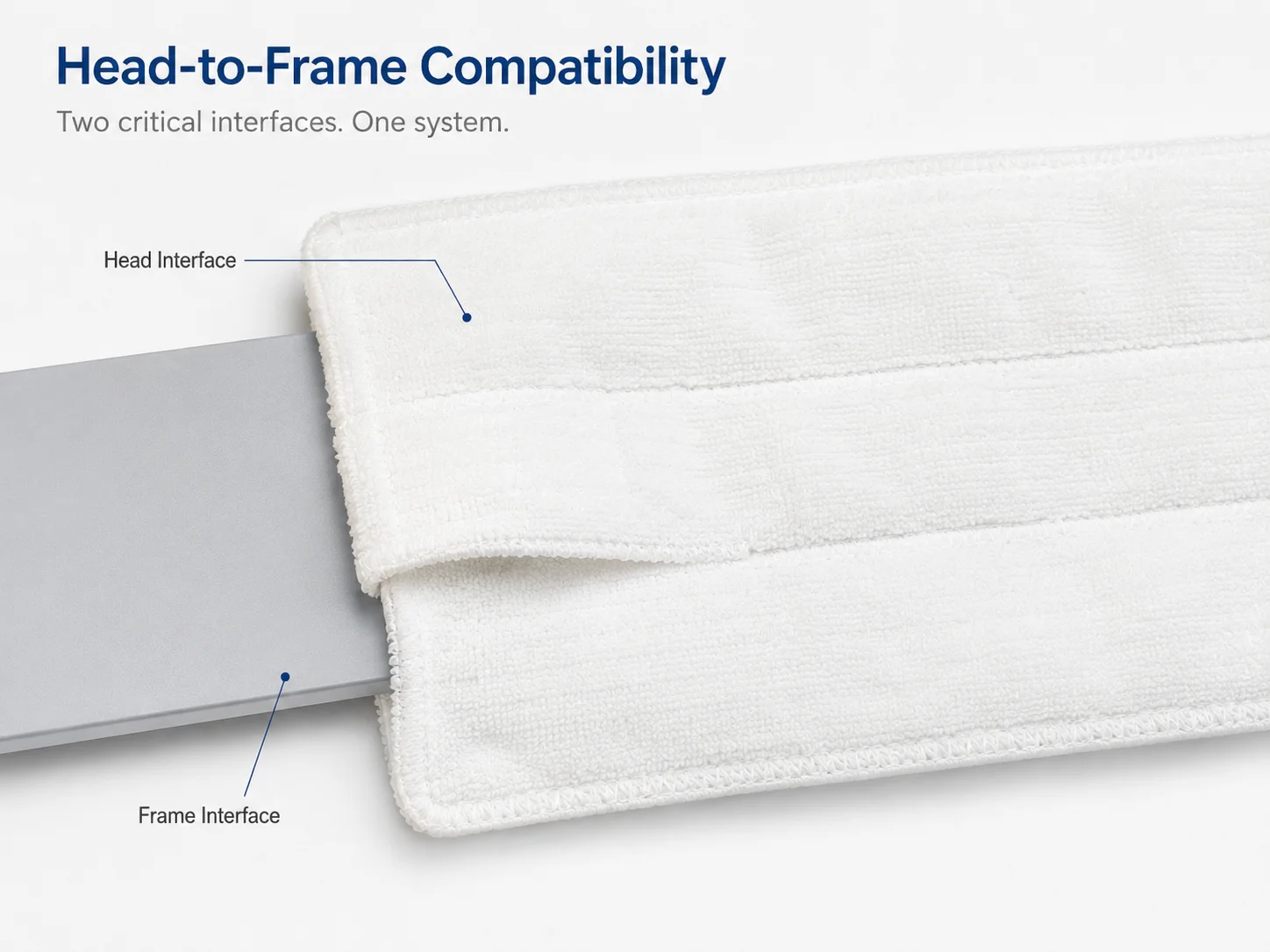
Понимание того, почему важна вся система, требует понимания того, что происходит в каждой точке интерфейса — физической границе, где два компонента встречаются и должны работать как один. Следующая разбивка отображает три компонента и два важнейших интерфейса между ними.
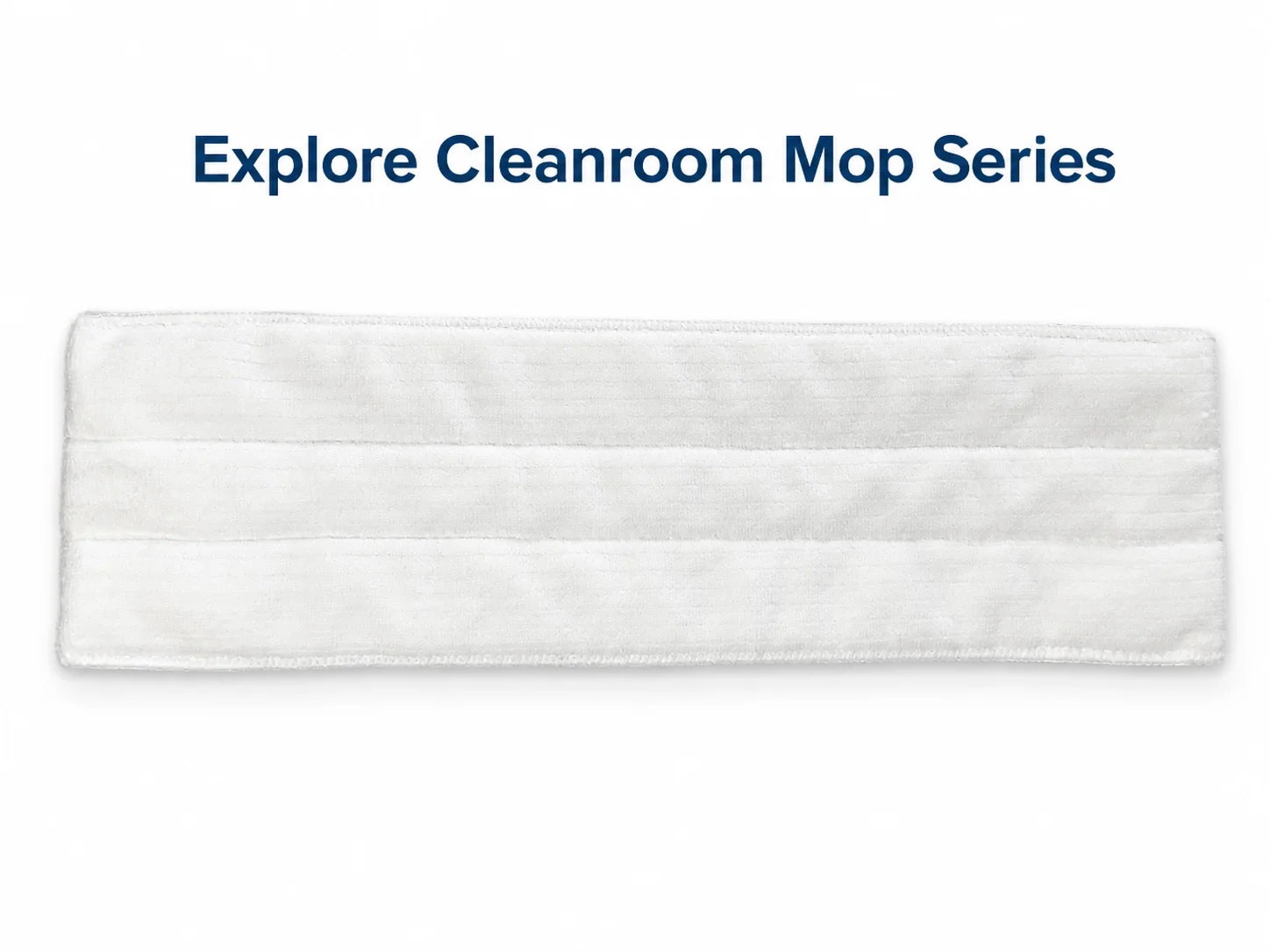
Поверхность для чистки текстиля. Размеры кармана (ширина и глубина), прочность материала кармана и вес ткани определяют, какую ширину рамы он может принять, какую силу карман может выдержать во время движения «тяни-толкай», а также то, как вес головы взаимодействует с жесткостью рамы, создавая постоянное давление при контакте с полом.
Ключевой интерфейс: Открытие кармана ↔ Ширина рамы. Карман должен быть достаточно широким, чтобы вместить оправу без приложения усилий, достаточно глубоким, чтобы надежно удерживать оправу при изменении направления, и достаточно прочным по шву, чтобы противостоять разрыву при многократном использовании.
Информацию о материале головки, весе и вариантах стерильности см. Типы и выбор насадок швабры для чистых помещений страница. Для выбора в зависимости от веса см. Руководство по весу насадки швабры для чистых помещений.
Жесткая конструкция, удерживающая насадку швабры на полу. Ширина рамы, материал (нержавеющая сталь, алюминий, композит), вес и тип разъема ручки определяют, какие насадки и ручки совместимы, а также то, как очищающая сила распределяется по поверхности насадки швабры.
Ключевые интерфейсы: Ширина рамы ↔ Подголовник (Интерфейс A). Приемник ручки ↔ Разъем ручки (Интерфейс B). Центральным компонентом является рама — она должна совпадать с головой с одной стороны и ручкой с другой. Рама от Поставщика А с головкой от Поставщика Б и ручкой от Поставщика С имеет две потенциальные точки несоответствия.
Информацию о материале рамы, ширине и вариантах крепления см. Типы рамок швабр для чистых помещений страница.
Интерфейс оператора. Длина ручки, материал, вес, конструкция рукоятки и тип разъема определяют комфорт оператора, постоянство давления мытья полов и скорость переключения. Рукоятка не является стандартной палкой — ее характеристики зависят от разъема рамы и биомеханики оператора.
Ключевой интерфейс: Разъем ручки ↔ Приемник кадров (Интерфейс B). Резьбовые соединители должны соответствовать шагу и диаметру резьбы. Системы быстрого подключения должны иметь одинаковую конструкцию запорного механизма. Ручка, которая надежно фиксируется на верстаке, но отсоединяется под действием силы тяги при мытье полов, является ошибкой совместимости, а не дефектом продукта.
Материал ручки, длину и варианты разъемов см. выбор ручки швабры для чистых помещений страница.

Из двух точек взаимодействия в системе швабры именно здесь возникает большинство проблем из-за несоответствия компонентов. Причина структурная: голова представляет собой текстильное изделие, диапазон допусков которого определяется конструкцией ткани и швами, а каркас представляет собой жесткое изделие с жесткими размерными допусками. Когда эти два поля допуска не совпадают, в результате либо головка скользит во время использования, либо рама не полностью заходит в головку.
Карман для насадки швабры представляет собой тканевый рукав, в который вставляется рамка. Два размера кармана определяют совместимость рамы:
| Измерение | Что он контролирует | Последствия несоответствия |
|---|---|---|
| Ширина кармана (открытие из стороны в сторону) | Можно ли вообще вставить раму и какое боковое смещение когда-то совершила головка | Слишком узкий: невозможно вставить рамку. Слишком широкая: при смене направления головка смещается вбок, что приводит к неравномерному контакту с полом и ускоренному износу швов карманов. |
| Глубина кармана (насколько рамка проникает в голову) | Насколько надежно голова захватывает раму во время толчков и тяг | Слишком мелкая: головка соскальзывает с рамы во время хода тяги — наиболее распространенный отказ компонента, зарегистрированный на предприятиях GMP. Слишком глубокая: лишняя ткань скапливается по краям рамы, уменьшая эффективную площадь чистящей поверхности. |
The frame width must correspond to the mop head width. A 40 cm frame paired with a mop head designed for a 45 cm frame leaves 5 cm of unsupported fabric at each end — fabric that does not receive consistent cleaning pressure, creates drag, and may fold under the frame during use. Conversely, a frame that is wider than the head cannot be fully inserted, leaving the frame edges exposed and potentially contacting the floor directly.
The material pairing between frame and head affects friction, wear, and particle generation:
Реальный сценарий: Предприятие заказало насадки для швабр весом 65 г и продолжило использовать существующие рамки диаметром 40 см. Головки весом 65 г были разработаны для рам 45 см. Уменьшенная рама не полностью зацепляла карман для головы — постоянное давление оказывалось только на центральную часть головы. В течение двух недель операторы сообщили, что головы соскальзывают во время гребков. В учреждении объяснили неудачу «плохим качеством головки». Фактической причиной было несоответствие размеров, которое было бы обнаружено, если бы голова и рама были указаны как согласованная система.
Хотя совместимость головы и рамы является наиболее заметной точкой отказа, совместимость ручки и рамы больше всего упускается из виду. Разъем ручки небольшой, часто стандартизирован в рамках семейства продуктов и скрыт от глаз после присоединения, но выход из строя этого интерфейса означает, что оператор полностью теряет контроль над инструментом.
| Тип разъема | Как это работает | Преимущество | Режим отказа |
|---|---|---|---|
| Резьбовой (винтовой) | Обработать нити в рамочном приемнике. Шаг резьбы и диаметр должны совпадать. | Самое безопасное соединение. Устойчив к отключению при тяговом усилии. | Перекрестная резьба, если ручка не выровнена перед затягиванием. Износ резьбы при многократной сборке/разборке. Несовместимые стандарты резьбы между поставщиками. |
| Быстроразъемное соединение (с пружинным замком) | Handle pushes into receiver; spring-loaded pin or collar locks it in place. Release requires pressing a button or pulling a collar. | Fastest change-over. No threading required. | Incomplete lock if pin does not fully engage — handle appears connected but releases under pull force. Spring fatigue over time. Mechanism-specific — quick-connect Brand A does not work with Brand B. |
| Зажим / Крючок | Handle attaches via a clip or hook mechanism on the frame. | Simplest mechanism. Fewest moving parts. | Lowest pull-force resistance. Clip deformation over repeated use. Accidental release if mop catches on an obstacle. |
When the handle and frame are made from different metals — for example, a stainless steel handle connected to an aluminum frame — the contact point creates a galvanic pair. In the presence of an electrolyte (most cleanroom disinfectants qualify), galvanic corrosion can occur at the interface. The visible result is discoloration or pitting at the connection point. The functional result is a gradual weakening of the connector mechanism. This is a material science issue, not a product defect — but it can only be prevented if the handle and frame are specified as a matched set with verified material compatibility.
Handle length interacts with frame design to determine the operator’s body position during mopping. A handle that is too short forces the operator to bend forward, reducing stroke consistency. A handle that is too long changes the force vector — more horizontal push, less downward pressure. The ideal handle length depends on operator height, floor area, and the frame’s articulation angle. A system-specified handle is selected for the frame it pairs with and the cleaning task it performs. A standalone handle is selected for availability and price — and the ergonomic consequences are discovered during use.
The operational consequences of component mismatch are visible: slipping heads, disconnected handles, inconsistent cleaning. The documentation consequences are less visible but equally significant — especially during a GMP audit.
When an auditor reviews cleaning tool documentation, they are asking: “Is there documented evidence that the cleaning tools used in this facility are fit for purpose and used as validated?” The answer differs fundamentally depending on whether the facility uses an integrated system or independently sourced components.
The difference in audit preparation time between these two scenarios is measurable — and it compounds when the auditor asks follow-up questions about compatibility verification methodology, dimensional tolerance acceptance criteria, and material interaction testing. For structured guidance on the documentation that buyers should request from mop suppliers, see the Контрольный список документов для проверки швабры для чистых помещений. For a supplier-level audit framework, see the Контрольный список аудита поставщика швабр для чистых помещений.
The most commonly overlooked components in a cleanroom mop system specification are the bucket and wringer. While procurement teams carefully specify mop heads, frames, and handles, the bucket and wringer are frequently treated as generic janitorial accessories — purchased from a separate catalog, without specification, without compatibility verification, and without documentation.
This is a specification error with operational consequences. The bucket holds the cleaning solution that contacts every cleaned surface. The wringer determines the moisture level of the mop head — and moisture level directly affects cleaning efficacy, residue removal, and drying time. A bucket and wringer that are not specified to cleanroom standards introduce three contamination vectors into an otherwise validated cleaning protocol.
A cleanroom-grade bucket is not a container — it is a solution management system. Three design elements distinguish it from a janitorial bucket:
The wringer opening must be dimensionally matched to the mop frame width. An unmatched wringer applies uneven pressure — the center of the mop head is compressed more than the edges — producing inconsistent moisture levels across the cleaning surface. This inconsistency is not visible during mopping but results in variable cleaning efficacy and residue removal. For GMP environments where cleaning consistency must be demonstrated, an unvalidated moisture variable introduced by a generic wringer is an audit vulnerability.
A cleanroom-grade wringer provides calibrated pressure matched to the mop frame dimensions, producing consistent moisture removal across the full mop head width. This consistency supports the cleaning validation argument that the mop head condition is repeatable from stroke to stroke and from operator to operator.
A standard janitorial bucket used in a cleanroom introduces four failure modes:
A complete cleanroom mop system consists of five components — mop head, frame, handle, bucket, and wringer — working as a single validated workflow. The mop head attaches to the frame. The frame connects to the handle. The wringer removes solution from the head at a calibrated pressure matched to the frame width. The bucket holds the solution in a cleanroom-compatible container with documented material and cleanability. When all five components are specified as an integrated system, compatibility is ensured by design. When any component is sourced independently, that component introduces an unvalidated variable — and in a GMP environment, unvalidated variables are audit findings.
For a detailed bucket and wringer selection guide covering material grades, wringer types, single/dual/triple-bucket logic, and capacity planning, see the cleanroom mop bucket and wringer selection guide.
If your facility sources mop heads, frames, and handles from the same supplier as a matched system, the following checklist is the supplier’s responsibility, not yours. If you source components independently — or are evaluating whether to — this checklist is what you must verify before any component enters production cleaning.
Request supplier specifications for pocket width and depth. Measure frame width. Confirm that the frame inserts fully without forcing and that the head does not slip when pulled in the opposite direction of insertion. Document the verification result.
Identify the connector standard: threaded (record thread pitch and diameter), quick-connect (record brand and model), or clip (record dimensions). Confirm mechanical fit under both static and dynamic load — connect, then apply pull force equivalent to mopping resistance. Document the result.
If frame and handle are different metals, assess galvanic corrosion risk with the disinfectants used in your facility. If either component is composite or plastic, verify chemical resistance to your cleaning agents. Document the compatibility assessment.
Confirm that the head, frame, and handle can all withstand the sterilization method used in your facility (autoclave at specified temperature and cycle, gamma irradiation at specified dose, or EtO). A head that tolerates autoclave paired with a composite frame that warps at autoclave temperature is a system failure.
Each component supplier should provide: Certificate of Analysis or Certificate of Conformance, material composition statement, and sterilization compatibility documentation. If three suppliers provide documentation in three different formats, consolidate into a single audit-ready file before the cleaning tools enter service.
Verify the assembled system under your actual cleaning protocol: your cleaning agent, your operator technique, your floor surface. A component combination that passes bench verification may still fail under production conditions — and the production floor is not the place to discover this.
Document the specific component part numbers, supplier names, and the verification date in the cleaning SOP. If any component changes, the SOP must be revised and the new combination must be re-verified. This is the documentation link that auditors will check.
A simple table listing each approved head + frame + handle combination with verification date, verification method, and reviewer. This register is the first document an auditor will ask for if they identify that cleaning tools are sourced from multiple suppliers. See the Руководство по выбору швабры для чистых помещений GMP for how this register fits into the broader grade-based tool specification framework.
If you are executing this checklist for three components from three suppliers, you are doing the system integration work yourself — which means YOU own the compatibility risk. The system approach eliminates this checklist by design: the supplier guarantees compatibility, and the buyer verifies the supplier’s system-level documentation rather than performing component-level compatibility testing.
The following five mistakes represent patterns observed when facilities manage mop components independently rather than as an integrated system. Each is preventable through system-level procurement — and each has been documented in real facility operations.
«Обе стандартные плоские насадки для швабры — они должны подойти». Размеры карманов, конфигурация ремешков и толщина материала различаются у разных производителей. Насадка швабры, которая, кажется, помещается на скамейке, может соскользнуть во время первого движения по производственному полу. В чистом помещении это связано с загрязнением, а не с проблемой удобства.
Исправление: Перед закупкой сверьте размеры кармана с размерами рамы. Если головка и рама от разных поставщиков, перед развертыванием всем операторам проведите испытание на физическую посадку в производственных условиях.
A facility switches from 55g to 65g mop heads. The head is thicker, the pocket is slightly different, and the frame — selected for 55g heads — does not engage fully. The operator notices the head feels loose but continues using it. This is how a procurement decision (let’s try heavier heads) becomes an operational problem (loose head on the frame).
Исправление: When changing any component specification (head weight, material, or supplier), re-verify compatibility with all other components in the assembly before production deployment.
“A handle is a handle.” Facilities routinely replace broken handles with whatever is available in inventory — different length, different connector type, different material. The result: an operator using a handle that does not match the frame connector, either forcing a connection that damages the receiver or using an improvised attachment that fails under load.
Исправление: Specify handle type, length, and connector as part of the mop system specification — not as a separately managed consumable. When a handle must be replaced, verify the replacement matches the original specification exactly.
The cleaning SOP lists: “Mop Head: Supplier A, Part #X. Frame: Supplier B, Part #Y. Handle: Supplier C, Part #Z.” There is no mention of whether these three components have been verified to work together. An auditor asks: “How do you know Part #X fits Part #Y?” The answer should be documented — not verbal.
Исправление: If using multi-supplier components, include a compatibility verification record in the SOP appendix. Reference the component compatibility register (Checklist item 08) and the verification date. If using an integrated system, reference the system specification document and note that compatibility is supplier-guaranteed.
A stainless steel handle connected to an aluminum frame, used with an oxidizing disinfectant. Over six months, galvanic corrosion develops at the connection point. The handle becomes loose. The facility attributes the failure to “handle quality” and replaces the handle — with another stainless steel handle — repeating the cycle without addressing the root cause.
Исправление: Assess material compatibility at both interface points during system specification. If using mixed metals, verify galvanic corrosion risk with the specific disinfectants used in the facility. Where possible, specify frame and handle in the same material to eliminate the galvanic variable entirely.
Component integration is one dimension of cleanroom mop system evaluation. The following related content on the MIDPOSI site addresses other dimensions of the system selection decision that interact with the component-level choices discussed in this guide.
The most common failure is head slippage during the pull stroke — the head detaches from the frame mid-cleaning. In a cleanroom, this is a contamination event. Less dramatic but equally problematic: an undersized frame that does not fully engage the pocket creates uneven floor pressure, leading to inconsistent cleaning coverage. The cleaning SOP assumes uniform contact; the mismatched tool delivers patchy results that may not be detected until environmental monitoring identifies an excursion.
Technically yes — if you verify dimensional compatibility, material compatibility, and sterilization compatibility before deployment. This verification is your responsibility, not the supplier’s. You must measure head pocket dimensions against frame width, test the attachment under production conditions, assess material interaction (galvanic corrosion, fabric abrasion), and document the verification results. If you perform this verification for every component combination in your cleaning program, a multi-supplier approach is operationally valid. If you do not perform this verification, you are accepting unresolved compatibility risk.
Handle connector type affects three operational variables: (1) change-over speed — quick-connect is fastest, threaded is slowest; (2) connection security — threaded is most secure under pull force, clip is least secure; (3) cross-supplier compatibility — threaded connectors from different suppliers may have different thread standards, quick-connect mechanisms are typically brand-specific. Facilities that value fast head change-over may prefer quick-connect. Facilities where handle disconnection would cause a contamination event in a critical zone may prefer threaded. The choice should match the operational risk profile of the cleaning zone.
At minimum: head pocket width and depth (from the head supplier), frame width and connector type (from the frame supplier), handle connector type and thread specification (from the handle supplier), and handle length. These four measurements determine physical compatibility. Additionally, verify: frame material and handle material (for galvanic corrosion assessment), sterilization compatibility across all components, and the maximum load rating of the connector mechanism if specified by the supplier.
Cleaning validation assumes that the tool used during validation is the same tool used during production cleaning. If a component changes — a different head weight, a different frame width, a different handle length — the validated cleaning conditions may no longer apply. The cleaning pressure, coverage pattern, and operator technique can all shift with component changes. A facility that validates with System X and then replaces the head with a different model without re-validating has introduced an unvalidated variable into a validated process. This is the documentation risk that the system approach eliminates: the system specification is the validated configuration, and any component change triggers a re-validation assessment.
A supplier offering an integrated mop system should provide: (1) a system specification document listing all components and confirming they are designed and tested as a matched set; (2) dimensional specifications for each component sufficient to verify fit; (3) material specifications for each component sufficient to assess chemical compatibility with common cleanroom disinfectants; (4) sterilization compatibility statements for each component; and (5) a Certificate of Analysis or Certificate of Conformance for the consumable components (mop heads). A supplier that cannot provide these documents for the system as a whole — only for individual components — is treating the components as standalone products, not as an integrated system.
Mixing components from different suppliers is acceptable when: (1) a documented compatibility verification has been performed and passed for the specific combination; (2) the verification covers dimensional fit, material interaction, and sterilization compatibility; (3) the verification is documented in the cleaning SOP or a companion compatibility register; and (4) a change control process is in place to trigger re-verification if any component in the combination changes. Without these four conditions, multi-supplier component mixing introduces undocumented variables into a process that requires documented control. For Grade A/B zones, the documentation burden of multi-supplier verification often outweighs the procurement flexibility benefit.
A system approach means you are locked into system-level compatibility — not necessarily into one supplier. If you switch to a different supplier’s system, the entire assembly (head, frame, handle) transitions together, maintaining compatibility. The constraint is that you cannot switch individual components independently without re-verification. This is not supplier lock-in — it is the logical consequence of component interdependence. A head designed for Frame A will only perform predictably with Frame A unless verified otherwise. The system approach acknowledges this reality and builds procurement processes around it. The standalone approach ignores it — and absorbs the consequences during operations.
Specify your cleanroom grades, cleaning surfaces, and workflow requirements. MIDPOSI provides matched head-frame-handle-bucket system recommendations with dimensional compatibility documentation for GMP audit readiness.
Доступность документации может зависеть от конфигурации продукта. Стандартная техническая документация предоставляется по каждому запросу.