

Cleanroom mopping is not a simple housekeeping task in pharmaceutical manufacturing. A mopping SOP is part of the facility’s contamination control system, and it must show how operators clean classified areas, verify disinfectant contact time, control tool contamination, document execution and respond to environmental monitoring failures.
A 2025 FDA warning letter to Excelvision Fareva cited failure to establish an adequate system for cleaning and disinfecting rooms and equipment to produce aseptic conditions. This type of finding is rarely about the mop alone. More often, the SOP fails to connect cleaning execution with Contamination Control Strategy, validation checkpoints, tool sterilization and post-cleaning verification.
This guide gives a practical structure for writing a cleanroom mopping SOP that supports ISO 14644, EU GMP Annex 1 and FDA CGMP expectations. It is written for QA, validation, production and cleanroom operations teams working in ISO 5–8 pharmaceutical, biotech and medical device environments.
A strong SOP should define where the procedure applies, which tools and disinfectants are approved, how operators prepare the room, how mopping is performed, how contact time is verified, how mops are disposed or reprocessed, and what records prove the cleaning was completed correctly.
Cleaning procedures in pharmaceutical cleanrooms operate under a different burden than ordinary janitorial cleaning. In an office, “clean enough” may be judged visually. In a GMP cleanroom, the SOP must provide objective evidence that cleaning helps maintain the classified state required for production.
EU GMP Annex 1 places cleaning and disinfection inside the broader Contamination Control Strategy. It expects cleaning and disinfection programs to be validated, monitored and justified by risk. ISO 14644-5:2025 also treats cleaning, personnel movement, material transfer, maintenance and monitoring as controlled operational activities, not informal routines.
When FDA issues observations for inadequate cleaning validation or when auditors question disinfection programs, the root cause is often procedural. The SOP may not define the ISO grade logic, may omit contact time, may fail to identify approved sterile tools, or may provide no verification step after cleaning.
Practical point: a cleanroom mop does not make a cleaning program compliant by itself. Compliance depends on the full system: SOP, approved tools, disinfectant validation, operator training, documentation and environmental monitoring feedback.
For tool selection, MIDPOSI has separate guidance on صاف ڪمرو فليٽ موپ سسٽم, صاف ڪمرو ايمپ هينڊلز, cleanroom mop frames ۽ microfiber cleanroom mops.
A pharmaceutical cleanroom mopping SOP should be written as a control framework. It should guide operators through preparation, execution, verification and documentation. The structure below is easier to audit than a long narrative procedure.
| SOP Section | What It Should Define | ڇو اهو معاملو آهي |
|---|---|---|
| Scope and Area Classification | Rooms, ISO class, GMP grade, surfaces covered, occupancy state and exclusions. | Area classification drives mop type, disinfectant requirement and verification level. |
| Responsibilities | Who performs cleaning, who reviews records, who approves deviations and who maintains tools. | Clear responsibility prevents gaps between production, QA and cleaning teams. |
| Definitions and References | Terms such as sterile, low-lint, contact time, sporicidal, reprocessing and hold time. | Operators and auditors need consistent interpretation of critical terms. |
| Approved Tools and Materials | Mop heads, mop frames, handles, buckets, disinfectants, concentrations and lot requirements. | The SOP must state exactly what can be used in each area grade. |
| Pre-Mopping Preparation | Gowning, tool inspection, sterile package check, disinfectant preparation and material transfer. | Many contamination risks enter before mopping starts. |
| Step-by-Step Procedure | Room sequence, mopping direction, overlap, contact time, disposal and reprocessing path. | Operators need clear executable steps, not vague cleaning instructions. |
| Verification and Documentation | Cleaning logs, disinfectant lot, mop lot, contact time, EM tie-in and deviation triggers. | This creates the audit trail needed for GMP defense. |

The operational core of the SOP is the workflow operators actually follow. The sequence should be short enough to execute but detailed enough to prove control.
Confirm the room status, complete gowning, inspect mop packaging and verify disinfectant lot, concentration and expiry. For Grade A/B areas, confirm that cleaning tools and disinfectants meet the required sterile or sterilized status.
Operators should reject any mop with damaged packaging, visible fiber damage, missing sterility indicator, expired lot or unclear traceability.
Check room readiness before cleaning. Confirm pressure differential, airflow status where applicable, material flow path and absence of unnecessary equipment in the mopping route.
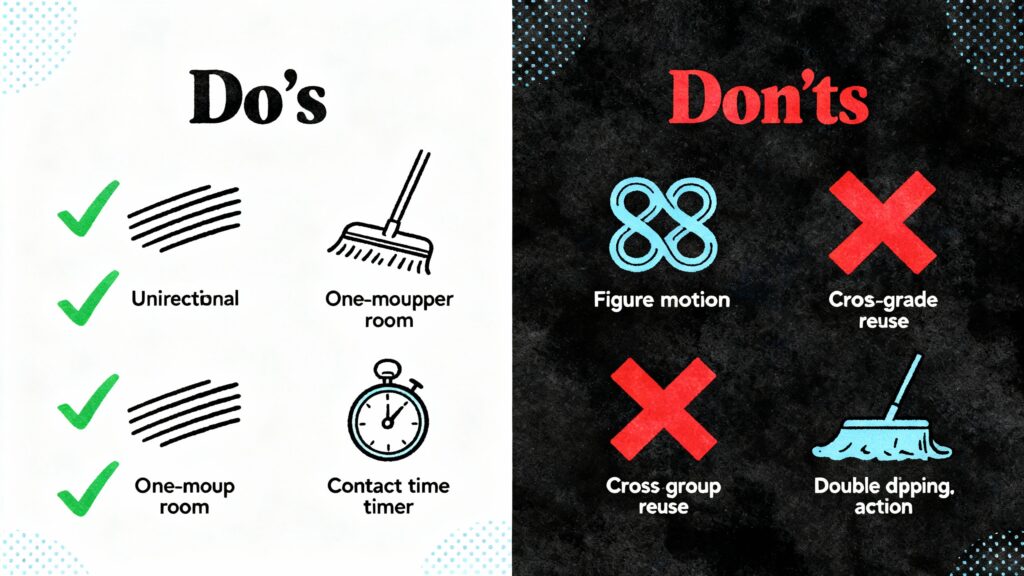
Mopping should proceed from the cleanest or furthest point toward the exit so that operators do not walk across freshly cleaned surfaces.
Use unidirectional, overlapping strokes. Avoid back-and-forth scrubbing unless the SOP specifically defines it for a residue-removal step. Each stroke should slightly overlap the previous stroke to avoid gaps.
For classified areas, the SOP should state whether one mop is used per room, per area, per surface or per defined square meter coverage.
The surface must remain visibly wet for the validated or manufacturer-defined contact time. If the surface dries too early, the SOP should require re-application and restart of the contact-time timer.
Operators should record the disinfectant lot, required contact time and whether wet contact was achieved.
Disposable mops should be discarded after use according to the site waste procedure. Reusable mops should be transferred to a defined soiled-tool container and sent for validated laundering, sterilization or controlled reprocessing.
The SOP should define maximum use cycles, rejection criteria, reprocessing records and grade segregation for reusable mop systems.

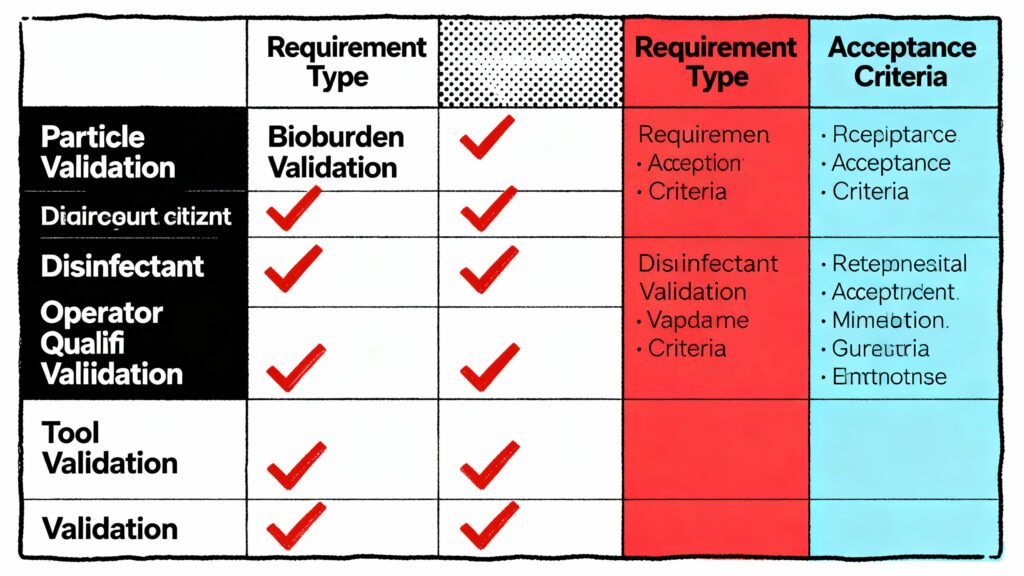
An unvalidated cleaning SOP is difficult to defend. A GMP-ready procedure should connect the written steps with measurable evidence: particle recovery, bioburden results, disinfectant effectiveness, operator qualification and tool validation.
| Validation Area | What to Verify | Example Evidence |
|---|---|---|
| ذرو ڪنٽرول | Mopping does not prevent the room from returning to the required ISO state. | Particle monitoring before, during and after representative cleaning. |
| Bioburden ڪنٽرول | Cleaning and disinfection reduce viable contamination to defined limits. | Contact plates, swabs, EM trend data and investigation records. |
| Disinfectant Effectiveness | Disinfectant is effective on actual surfaces, with defined contact time. | Contact time study, surface compatibility and recovered flora review. |
| Operator Qualification | Operators can perform the procedure consistently. | Training record, observed qualification checklist and periodic reassessment. |
| Tool Validation | Mops, frames, handles and buckets are qualified for the intended use. | CoA, particle data, sterility record, autoclave cycle data and supplier documentation. |
Disposable and reusable mop systems require different validation effort. Disposable sterile mops reduce reprocessing validation, but they require supplier qualification, sterility documentation and lot traceability. Reusable mops can reduce long-term cost, but they require validated laundering, sterilization, cycle-count control and rejection criteria.
For more detail, see MIDPOSI’s guide on گاما شعاع وارو بمقابله آٽو ڪليبل صاف روم موپس ۽ double-bagged sterile cleanroom mops.
The approved tools section of the SOP should reference products that match the room classification, cleaning method, disinfectant rotation and validation model. This is where many procedures become too vague. Operators should not have to guess which mop, handle, frame or disinfectant is allowed in a specific room.
MIDPOSI supplies cleanroom mop systems for pharmaceutical, biotechnology, medical device and controlled manufacturing environments. Our portfolio includes صاف ڪمرو فليٽ موپ سسٽم, microfiber cleanroom mops, mop frames, mop handles and application-specific mop options for pharmaceutical and biotech facilities.
For pharmaceutical cleaning programs, MIDPOSI can support SOP development by providing product recommendations, technical documentation, mop system configuration and supplier qualification materials. Buyers can also review pharmaceutical cleanroom mop solutions, GMP Annex 1 mop guidance ۽ pharmaceutical cleanroom mop cleaning SOP guidance.
Annex 1 expects more than one disinfectant with different modes of action and periodic use of a sporicidal agent. The SOP should define the rotation schedule, sporicidal frequency and how effectiveness is reviewed through environmental monitoring trends.
The required contact time depends on the product label and facility validation. Because IPA evaporates quickly, the SOP should define how operators verify wet contact and what to do if the surface dries before the required contact time is achieved.
No. Disposable mops still require supplier qualification, lot traceability and sterility or material documentation where applicable, but they avoid laundering and reprocessing validation. Reusable mops require additional controls for washing, sterilization, cycle count and retirement.
Not without validated reprocessing. A mop used in a lower-grade area should not be moved into a higher-grade area because it can carry particles and bioburden. SOPs should define one-mop-per-room, one-mop-per-grade or color-coded segregation rules.
Depending on the application, buyers may request certificates of conformance, material information, lot traceability, sterilization records, particle data, chemical compatibility information and supplier qualification documentation.
Send MIDPOSI your ISO class, GMP grade, disinfectant protocol, mop preference and sterilization model. Our team can help you match mop heads, frames, handles and documentation to your cleanroom mopping SOP.


 Optimized by Seraphinite Accelerator